Food Chemistry: Alkaline Gluten Crosslinking & Sesame Phase Inversion
From Covalent Disulfide Networks and Flavonoid Chromophores to Non-Newtonian Paste Rheology
A rigorous food-physics and cereal-chemistry investigation into Wuhan Reganmian: how sodium carbonate catalyzes sulfhydryl-disulfide interchange and ionizes endogenous wheat flavonoids into bright yellow hues, alongside the colloidal phase-inversion rheology of stone-ground sesame paste.
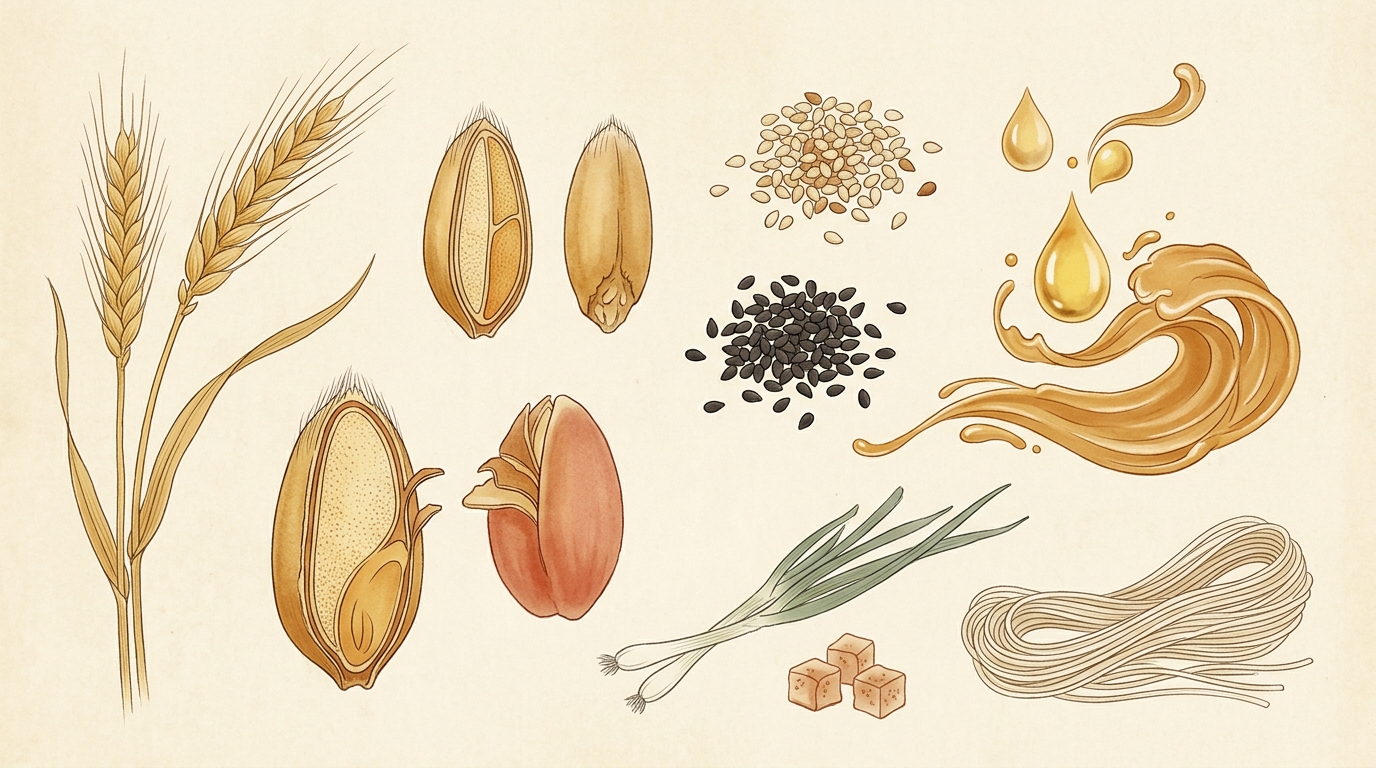
A Sidewalk Laboratory of Polymer & Colloid Physics
At 5:30 AM along a steam-veiled Hankou alley, a Wuhan breakfast master plunges a conical bamboo basket of golden pre-oiled noodles into rolling boiling water. Six seconds later, three sharp flicks of the wrist banish excess water; ladles of spiced soy broth, garlic infusion, and glossy amber sesame paste land in rapid succession. Within ten brisk cross-lifting tosses of a diner’s chopsticks, every 1.8-millimeter strand wears a velvety, unbroken coat of nutty sauce—no broth pooling at the bottom, no clumping into starchy knots.
What looks like effortless street choreography is, beneath the microscope, a masterclass in cereal polymer chemistry and soft-matter rheology. Every hallmark sensory trait prized by Wuhan locals—the snappy resilience of twice-cooked alkaline strands, their luminous canary tint free of egg or dye, and the clingy silkiness of stone-ground sesame paste—rests upon precise molecular transformations.
“Without alkali, flour has no spine; without oil-thinning, sesame paste cannot robe the strand.” — Traditional Hankou Noodle Workshop Maxim
The Chemistry of Jianshui: Disulfide Crosslinking & Flavonoid Chromophores
Unlike northern Chinese white salted noodles (which rely solely on sodium chloride at a mildly acidic dough pH of 5.8–6.2), authentic Wuhan Reganmian belongs to the great Asian family of yellow alkaline noodles (jianshuimian). Dissolving 0.6%–1.0% food-grade sodium carbonate ($\text{Na}_2\text{CO}_3$, occasionally blended with potassium carbonate $\text{K}_2\text{CO}_3$) into the hydration water drives dough pH up to 9.5–10.5. That high-pH environment orchestrates three simultaneous physicochemical shifts:
1. Thiol Ionization and Covalent Disulfide Interchange
Wheat dough derives its viscoelasticity from two storage proteins: monomeric gliadins (viscous flow) and polymeric glutenins (elastic snap). At neutral pH, most free cysteine sulfhydryl groups ($-\text{SH}$, $\text{p}K_a \approx 8.3$) remain protonated and relatively sluggish. Once sodium carbonate pushes pH past 9.5, sulfhydryl groups deprotonate into highly nucleophilic thiolate anions ($-\text{S}^-$), dramatically accelerating thiol–disulfide ($\text{-SH/S-S}$) interchange and oxidative crosslinking across glutenin macropolymers:
$$\text{Gluten-S}^- + \text{Gluten-S-S-Gluten} \longrightarrow \text{Gluten-S-S-Gluten} + \text{Gluten-S}^-$$
Concurrently, alkali promotes oxidative coupling of ferulic acid side chains on wheat arabinoxylans, reinforcing the protein matrix with polysaccharide bridges. This tightly crosslinked three-dimensional cage traps swelling starch granules, giving Reganmian the tensile strength to survive two separate thermal shocks—first parboiling to 80% doneness (danmian) and hours later flash-blanching in boiling water—without turning mushy.
2. Apigenin-C-Diglycosides and the Canary-Yellow Shift
First-time visitors often assume Reganmian owes its golden hue to duck eggs or synthetic tartrazine. In reality, cereal chemists (notably E. P. Fuerst and Craig Morris) traced the pigment to endogenous apigenin-C-diglycosides (such as schaftoside and isoschaftoside) naturally present in wheat endosperm and bran fractions. Below pH 7, these flavonoid molecules absorb exclusively in the ultraviolet band (~330 nm) and appear colorless. Above pH 9, deprotonation of phenolic hydroxyl groups reorganizes the conjugated $\pi$-electron system, triggering a pronounced bathochromic shift into the visible blue-violet spectrum (~390–410 nm). Reflecting complementary wavelengths, the dough blushes a warm, translucent canary gold. (This also explains the home-kitchen baking-soda hack: sodium bicarbonate sits near pH 8.3 at room temperature, turning noodles deeply yellow only in boiling water as thermal decomposition yields sodium carbonate: $2\text{NaHCO}_3 \xrightarrow{\Delta} \text{Na}_2\text{CO}_3 + \text{H}_2\text{O} + \text{CO}_2\uparrow$.)
3. Elevated Starch Gelatinization Onset
Carbonate and sodium ions strongly compete for free water and stabilize crystalline regions within wheat starch granules, elevating the gelatinization onset temperature ($T_o$) by 2–4°C. Surface starch gelatinizes cleanly without sloughing amylose into the cooking cauldron, preserving strand definition and clean bite.
Sesame Paste Rheology: Capillary Seizing, Phase Inversion & Oil-Thinning
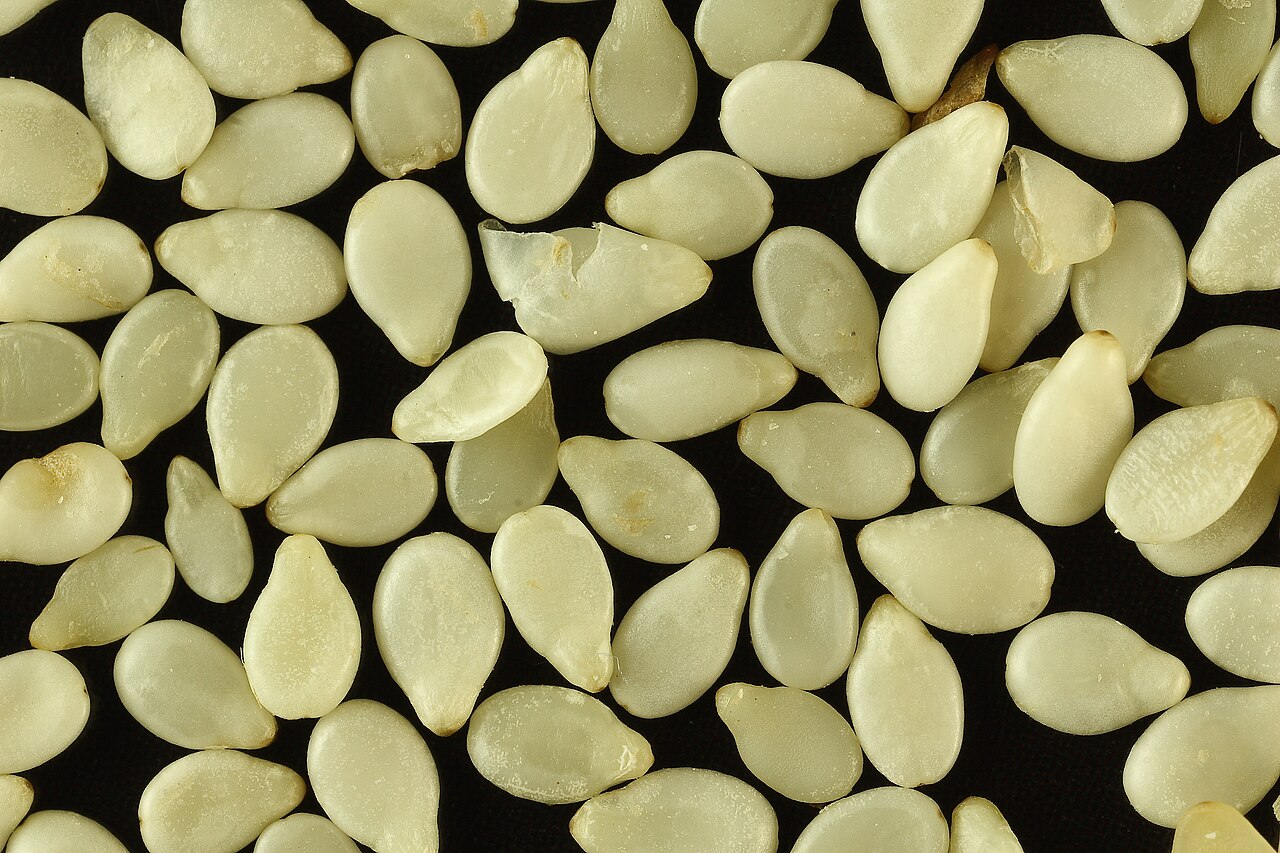
Pure stone-milled white sesame paste (zhimajiang) is a dense colloidal suspension: roughly 52%–55% liquid sesame oil forming a continuous hydrophobic phase packed with finely fractured protein bodies, cell-wall polysaccharides, and hull microparticles (15–35 $\mu\text{m}$). Rheologically, raw paste behaves as a Herschel-Bulkley non-Newtonian fluid—it exhibits a distinct yield stress at rest (holding peaks like stiff clay) followed by pronounced shear-thinning once agitated.
Across Chinese noodle traditions, chefs tame this ultra-viscous paste via two starkly contrasting colloidal pathways:
| Physicochemical Parameter | Undiluted Pure Paste | Water-Thinned (Shuipai — Beijing Chilled Style) | Oil-Thinned (Youpai — Classic Wuhan Reganmian) |
|---|---|---|---|
| Colloidal Architecture | Concentrated solid-in-oil suspension (W/O tendency) | Undergoes W/O $\to$ O/W phase inversion; water becomes continuous | Continuous lipid phase preserved throughout dilution |
| Viscosity Curve During Prep | High yield stress; impossible to toss evenly | Spikes violently into a stiff clump first, then drops past inversion | Smooth monotonic viscosity reduction; zero clumping |
| Color & Optical Luster | Deep roasted amber; oil separates on standing | Lightens to pale matte beige via emulsion light scattering | Rich, glossy mahogany-gold translucence |
| Interface with Oiled Strands | Tears fragile strands under high chopstick drag | Aqueous exterior resists oil-coated noodles; weeps water if held | Seamless lipophilic wetting; coats every strand instantly |
| Aroma Release Kinetics | Coats palate heavily; risks dry throat sensation | Bright, immediate front-palate hit with lighter finish | Sustained release of fat-soluble pyrazines and sesamol |
Why Adding a Splash of Water Makes Sesame Paste Seize
Every home cook who has spooned cold water into pure tahini or Chinese sesame paste knows the panic of watching fluid paste suddenly lock into crumbly concrete. When water comprises 10%–25% of the mixture, polar droplets cannot dissolve into the continuous sesame oil; instead, they wet hydrophilic protein particles and form high-tension capillary liquid bridges (the pendular-to-capillary state). Capillary attraction pulls dispersed solids into a rigid percolating network, multiplying apparent viscosity up to tenfold. Only when total water surpasses 45%–55% under relentless unidirectional whisking do endogenous sesame globulins and phospholipids stabilize dispersed oil droplets, flipping the matrix across its phase-inversion point into a pourable oil-in-water (O/W) emulsion.
Wuhan’s In-Situ Micro-Emulsion in the Bowl
Classic Wuhan masters bypass pre-bowl water-thinning altogether, instead thinning stone-ground paste with small-mill toasted sesame oil (xiaomo xiangyou) or neutral vegetable oil at roughly a 3:1 to 2.5:1 paste-to-oil ratio (youxie, “oil-loosening”). Because danmian noodles already wear a 3–5% protective sesame-oil film, oil-thinned paste achieves zero-barrier lipophilic wetting the instant it touches hot strands.
Where, then, does the aqueous balance come from? From the 15–20 mL of spiced soy braising broth (lushui), light soy sauce, rice vinegar, and crushed garlic water resting at the bottom of the paper bowl. As the diner executes ten rapid cross-tosses over steaming 80°C noodles, heat lowers lipid viscosity while mechanical chopstick shear emulsifies those savory aqueous droplets directly into the oil-paste film and trace surface amylopectin—forging a glossy, unified emulsion right before the first bite.
- Fuerst, E. P., et al. (2006). Polyphenol oxidase and flavonoid pigments in yellow alkaline noodles. Cereal Chemistry, 83(1), 10-16.
- Hou, G. G. (Ed.). (2010). Asian Noodles: Science, Technology, and Processing. John Wiley & Sons.
- Journal of Food Engineering: Rheological behavior and phase inversion kinetics of roasted sesame paste dispersions.
❓ Frequently Asked Questions
Does authentic Wuhan Reganmian get its bright yellow color from eggs or food coloring?
Neither. Wheat flour naturally contains colorless flavonoid glycosides—specifically apigenin-C-diglycosides—that remain invisible at neutral pH. When sodium carbonate raises dough pH above 9.5, phenolic hydroxyl groups deprotonate, triggering a bathochromic shift in light absorption that reflects a vivid canary-yellow hue naturally.
Why does pure sesame paste suddenly seize into a stiff lump when you first add water?
Pure stone-ground sesame paste is a concentrated suspension of hydrophilic protein and cell-wall particles dispersed in a continuous oil phase. Adding a small splash of water (10%–25% by weight) forms high-tension capillary water bridges between solid particles, locking them into a rigid 3D network. Only adding more water under vigorous shear pushes the system past its phase-inversion point into a fluid oil-in-water emulsion.
Why do traditional Wuhan shops thin sesame paste with sesame oil instead of water?
Parboiled Reganmian strands are pre-coated in a thin film of oil during the Danmian cooling process. Thinning sesame paste directly with aromatic sesame oil preserves a continuous lipid phase, preventing capillary seizing and allowing instantaneous lipophilic wetting against the oiled noodles without watery runoff.
✦ Cross-Referenced Chapters
Secrets of Alkaline Noodles (Jianshuimian)
High-gluten flour specifications, sodium carbonate ratios, 1.8mm round strand geometry, and signature springy chew.
Soul of the Bowl: Stone-Ground Sesame Paste Craft
Low-temperature roasting, stone-mill grinding, and the great culinary debate between 100% pure sesame vs. 80/20 sesame-peanut blends.
Small-Mill Sesame Oil, Blending Fats & Chili Oil
Why oil-thinned sesame paste coats every strand superiorly to water-thinned paste, plus aromatic Wuhan chili oil infusion.
The Core Art of "Danmian": Parboiling & Oil-Tossing
Step-by-step mastery of 80%-cooked boiling, fan-cooling, and sesame-oil tossing that keeps alkaline noodles springy for hours.
Global Brothless Noodles: Reganmian Meets Cacio e Pepe & Abura Soba
Cross-cultural culinary physics connecting Wuhan sesame emulsion with Roman Cacio e Pepe, Indonesian Mie Goreng, and Tokyo Abura Soba.
Atlas of Asian Alkaline Noodles: Jianshui, Kansui & Penghui
Tracing alkaline salt chemistry across Wuhan Reganmian, Cantonese bamboo-pressed wonton noodles, Lanzhou pulled noodles, and Japanese Ramen.