The Core Art of 'Danmian': Parboiling & Oil-Tossing
Why 80% Gelatinization, Rapid Evaporative Cooling, and a 3.5% Sesame Oil Film Make Wuhan Reganmian Possible
An authoritative culinary-science breakdown of Danmian—the foundational pre-cooking craft behind Wuhan Hot Dry Noodles. Learn how parboiling alkaline strands to an exact 'pinhead white core,' draining without cold rinsing, fan-cooling, and tossing with roasted sesame oil keep noodles springy and clump-free for hours.
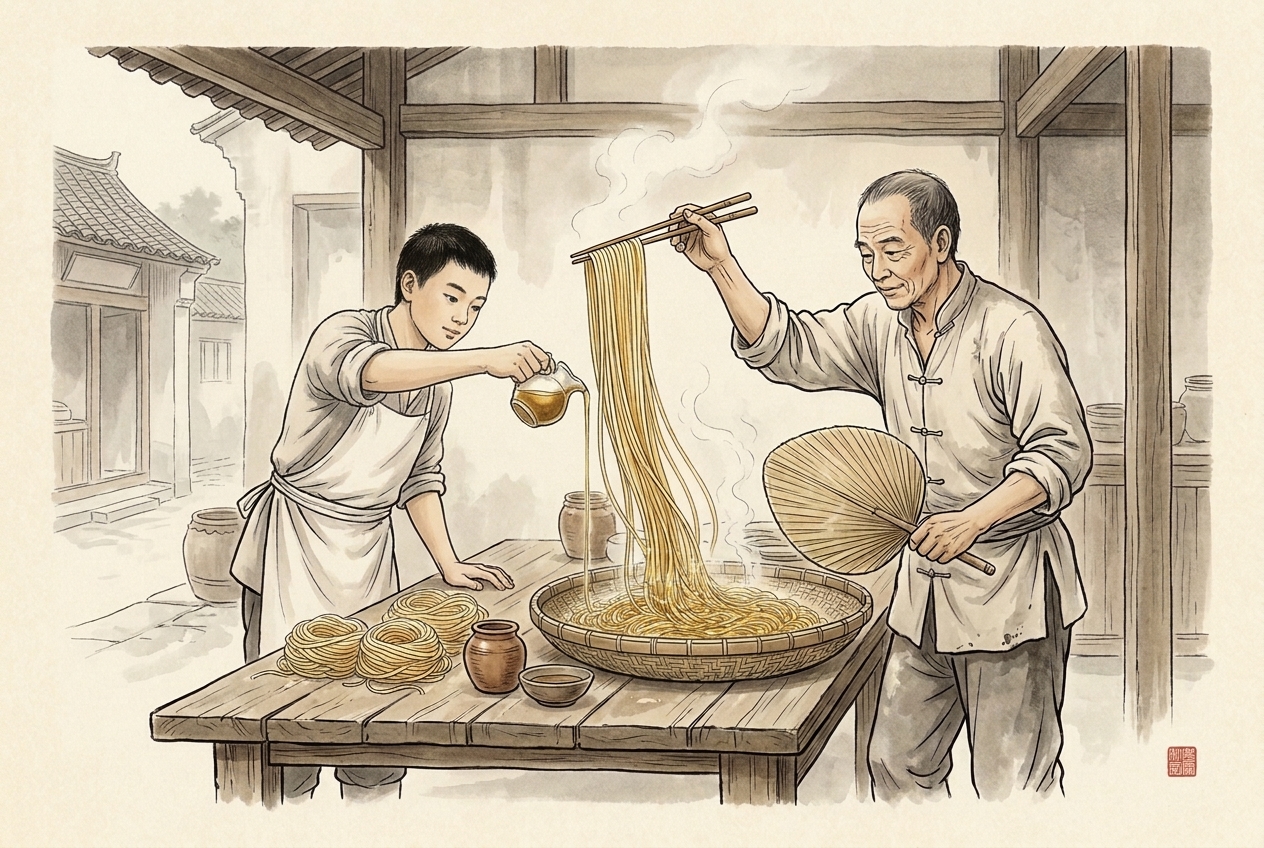
🍜 Standardized Culinary Formula Card
Ingredients
- Fresh Wuhan high-gluten alkaline noodles (1.6–1.8mm round cut): 500g
- Water for wide-pot boiling: 4,500ml
- Small-mill toasted sesame oil (or 3:1 blend of cooked neutral oil and sesame oil): 18g
- Fine sea salt (optional, to stabilize boiling water ionic strength): 5g
Key Steps
- Establish a Vigorous Rolling Boil: Bring 4,500ml of water to a roaring boil (98°C–100°C) in a wide, deep stockpot so the temperature never dips below 92°C upon noodle entry.
- Shake & Fan Into the Vortex: Gently shake excess dusting starch off 500g of fresh alkaline noodles, scatter them evenly into the boiling vortex, and immediately swirl clockwise with long bamboo chopsticks to prevent sticking.
- Pull at the Pinhead Core ('Bai Xin'): Boil over high heat for 55 to 75 seconds until the strands float and turn bright canary gold. Nip one strand in half—when a tiny opaque white dot the size of a pinhead remains at the very center (75%–80% cooked), cut the heat immediately.
- Snap-Drain Without Rinsing: Scoop all noodles out in one swift motion using a wide bamboo strainer and give three sharp upward wrist snaps to eject free water. Never rinse under cold water.
- Flash-Vent Steam Before Oiling: Spread the hot noodles onto a wide bamboo tray or stainless-steel table in front of a high-speed electric fan. Lift the strands 30cm high and shake briskly with long chopsticks for 25–30 seconds until the thickest cloud of steam dissipates and the surface turns slightly tacky.
- Thread Oil & Toss to Room Temperature: Drizzle 18g of toasted sesame oil in two thin streams while continuously lifting and shaking before the fan for another 2 minutes, until every strand is sealed in a microscopic oil film, cool to the touch (<32°C), and completely loose.
The Two-Stage Architecture That Defines Wuhan Hot Dry Noodles
Nearly every great noodle dish in the world—from Tokyo ramen and Lanzhou hand-pulled beef noodles to Roman cacio e pepe—cooks raw dough in a single continuous boil right before serving. Wuhan Reganmian (Hot Dry Noodles) defies that universal rule. Its entire culinary identity rests on splitting thermal processing into two distinct stages separated by hours: Stage One is Danmian (掸面), done before dawn or the afternoon prior, in which fresh alkaline noodles are parboiled to 80% doneness, air-cooled, and sealed in sesame oil; Stage Two is Tangmian (烫面), a 6-to-8-second plunge in boiling water at the moment a commuter orders.
Skip Danmian and boil raw alkaline noodles straight to 100% doneness, and you will never achieve authentic Reganmian. Fully boiled noodles exude surface amylose starch, trap excess water, and collapse into a gummy, pasty knot the instant thick stone-ground sesame paste hits the bowl. Master Danmian, however, and every golden 1.8-millimeter strand acquires what Wuhan locals call jingu (筋骨)—architectural spine, resilient snap, and a satin-dry surface engineered to grip rich sauce without turning soggy.
“Wide water, fierce flame, leave a pinhead of white; bamboo tray facing the wind, shake threads of gold; three coins of sesame oil lock the spine—come morning, every strand wakes alive.” — Traditional Hankou noodle-shop apprenticeship verse
Historically, this ingenious craft emerged along Hankou’s sweltering Yangtze wharves in the late 1920s and 1930s. Before commercial refrigeration, raw wet noodles soured within hours during Wuhan’s 39°C summer heat. Street peddlers discovered that parboiling alkaline strands, fanning off surface moisture, and coating them in fragrant sesame oil retarded microbial spoilage until the next morning’s guozao breakfast rush—inadvertently inventing China’s most celebrated brothless noodle texture.
Cereal Chemistry of the “Pinhead White Core” (Bai Xin)
Why must the initial boil stop strictly at 75% to 80% gelatinization? Looking inside a strand of Wuhan jianshuimian (made from high-protein wheat flour ≥11.5% protein and 0.6%–1.0% sodium carbonate) reveals a delicate interplay between cross-linked gluten proteins and starch granules:
- Dual-Zone Moisture & Starch Gradient: When plunged into a generous 8:1 bath of rolling 100°C water, sodium carbonate enhances disulfide bonding in the gluten matrix while tinting natural wheat flavones a luminous yellow. At 55 to 75 seconds, the outer 80% of the strand’s radius has undergone starch gelatinization and protein coagulation, turning supple and elastic. Yet free water has not fully penetrated the innermost 0.2–0.3mm core. Snapping a strand between your thumbnails reveals a tiny, opaque, chalk-white pinpoint at dead center—known in Wuhan kitchens as bai xin (白芯, the pinhead white core).
- Preventing Amylose Leaching: Continuing to boil until that white core vanishes forces outer starch granules to rupture, leaching sticky amylose onto the noodle’s exterior. Once cooled, leached amylose rapidly retrogrades into an adhesive glue, welding strands into solid bricks.
- Thermal Headroom for the Morning Plunge: Leaving a 20% ungelatinized core creates a built-in thermal buffer. Hours later, when a vendor dips a portion into boiling water for just six seconds, heat conducts rapidly to the center, finishing gelatinization right on cue while the oil-sealed exterior stays taut and bouncy.
| Initial Parboil Level | Cross-Section Appearance | Post-Cooling Strand Behavior | Final Texture After 6s Re-Blanch | Craft Verdict |
|---|---|---|---|---|
| Under-parboiled (<65%) | Thick white core (>1/3 diameter); dull pale yellow | Brittle, stiff, refuses to absorb oil film evenly | Floury, raw-tasting center; requires over-blanching that strips oil | Underdone |
| Target Danmian (75%–80%) | Tiny pinhead bai xin at center; translucent golden ring | Supple, dry-glossy, completely loose for 8–12 hours | Core vanishes cleanly; snappy, elastic al dente bite | Gold Standard |
| Fully Cooked (95%–100%) | Uniformly translucent, zero white core; swollen girth | Sticky surface, tears during tossing, clumps into mats | Mushy, limp, turns sesame paste into heavy wallpaper paste | Overcooked |
The Six Commandments of Authentic Danmian Execution
Codified in Wuhan’s municipal standard Specification for Production Management of Wuhan Reganmian (DB 4201/T 699-2024) and preserved by provincial intangible-heritage masters, authentic Danmian hinges on six non-negotiable steps:
1. Wide Water, Violent Boil
Thermal recovery is paramount. Use at least 4.5 liters of water per 500 grams of fresh noodles over maximum burner output. When noodles hit the pot, water temperature must rebound to a rolling boil within seconds so surface gluten sets instantaneously rather than dissolving into cloudy starch soup.
2. Dust Off & Swirl Gently
Tap raw wet noodles gently between your palms to shed excess cornstarch or dusting flour before fanning them into the pot. During the first 15 seconds, nudge the strands clockwise with long bamboo chopsticks rather than whipping aggressively, letting convection currents separate the bundle intact.
3. Read the Color, Nip the Core
As alkaline flavonoids bloom in boiling water, the noodles shift from pale ivory to vivid canary yellow and bob to the surface. For standard 1.8mm fresh alkaline noodles, begin testing at 55 seconds. Nip a strand in two: the moment the white center shrinks to a fine needle-point, pull the entire batch within three seconds.
4. Snap-Drain—Never Cold-Shock
Scoop the noodles out with a wide-mesh bamboo colander and snap your wrists upward three or four times to fling off trapped droplets. Resist every temptation to run cold tap water over them. You need the residual 95°C internal heat to drive off surface moisture by evaporation.
5. Vent Steam First, Oil Second
Dump the steaming noodles onto a wide bamboo winnowing tray or stainless prep table (spread shallower than 5cm) directly in front of a strong electric fan. With long chopsticks in both hands, lift the noodles 30cm high and shake them loose repeatedly for 25 to 30 seconds before touching the oil bottle. Pouring oil onto soaking-wet, 95°C noodles traps steam underneath an oil barrier, causing sliminess. Wait until the billowing white steam subsides and the surface feels faintly tacky (around 60°C–65°C).
6. Micro-Film Sesame Oil Coating
Drizzle 3% to 4% oil by fresh noodle weight (15–20g per 500g noodles) in thin ribbons across the lifted strands while continuing to toss in front of the fan for another two minutes. Once the noodles drop below 32°C, feel cool and satin-dry between your fingers, and cascade individually without clinging, transfer them loosely into a breathable cloth-lined basket.
Seasonal Calibration Across Wuhan’s Extreme Climate
Wuhan is famously one of China’s “Four Furnaces” in July and damply bone-chilling in January. Veteran Danmian artisans adjust their parameters with the barometer:
- High Summer (>32°C ambient): Shorten the parboil by 5 seconds (closer to 75% doneness), run industrial fans at maximum velocity, use the full 4% oil ratio (favoring a 4:1 blend of cooked soybean oil to toasted sesame oil for oxidative stability), and refrigerate covered batches at 4°C–8°C if held longer than four hours.
- Midwinter (<8°C ambient): Boil to a full 80% doneness, switch fans to gentle low speed so cold air does not chap or crack the noodle skin, and raise the proportion of pure small-mill sesame oil to keep strands supple in crisp morning air.
- DB 4201/T 699-2024: Specification for Production Management of Wuhan Reganmian, Wuhan Municipal Market Regulation Administration
- Hubei Provincial Intangible Cultural Heritage Dossier: Cai Lin Ji Reganmian Crafting Technique
- Annals of Wuhan Gastronomy (Wuhan Yinshi Zhi), Wuhan Local Chronicles Compilation Committee
❓ Frequently Asked Questions
What does the Wuhan dialect term 'Danmian' literally mean?
In Wuhan Mandarin, 'Dan' (掸) means to flick, dust, or briskly shake off—like flicking dust with a feather duster. Applied to noodle making, it describes the artisan's signature motion of lifting steaming parboiled alkaline noodles a foot into the air with extra-long bamboo chopsticks and shaking them loose in front of a strong breeze so surface moisture flashes off instantly.
Why should you never rinse parboiled Reganmian under cold tap water like cold soba or Sichuan liangmian?
Shocking alkaline noodles in cold water washes away soluble wheat aromatics and surface alkalinity while leaving a slick film of free water on the exterior. Worse, water-logged outer starch struggles to grip oil-emulsified sesame paste later. Forced-air evaporative cooling dries the exterior to a satin matte finish that drinks in sesame oil and clings tenaciously to sauce.
Should I use 100% toasted sesame oil or neutral vegetable oil for Danmian?
Traditional heritage flagships such as Cai Lin Ji prize 100% small-mill toasted sesame oil for maximum aroma. High-volume neighborhood stalls, however, often blend refined cooked soybean or rapeseed oil with toasted sesame oil at a 3:1 or 4:1 ratio. This keeps the strands glossy, prevents heavy sesame aromatics from oxidizing over several hours, and lowers cost without sacrificing fragrance.
✦ Cross-Referenced Chapters
Secrets of Alkaline Noodles (Jianshuimian)
High-gluten flour specifications, sodium carbonate ratios, 1.8mm round strand geometry, and signature springy chew.
Small-Mill Sesame Oil, Blending Fats & Chili Oil
Why oil-thinned sesame paste coats every strand superiorly to water-thinned paste, plus aromatic Wuhan chili oil infusion.
Street Blanching & The Golden Ten-Second Bowl
Deconstructing the street master’s 6-second boiling dip, triple wrist-shake drain, and rapid sauce ladling.
Commercial Noodle Shop Batch Formula & SOP
Professional 25kg batch noodle parboiling, master spiced broth formulation, and high-volume breakfast rush workflow.
Food Chemistry: Alkaline Gluten Crosslinking & Sesame Phase Inversion
How sodium carbonate strengthens disulfide gluten bonds and tints flavonoids yellow, plus the rheology of sesame paste emulsion.