Street Blanching & The Golden Ten-Second Bowl
Inside the Conical Bamboo Strainer, the 'Three-Toss Two-Tap' Drain, and Dawn Ergonomics at a Wuhan Stall
Deconstructing the hypnotic 10-second theater of a Wuhan morning noodle window: how a 6-second dip in a conical bamboo basket finishes the 20% raw core, why the 'three-toss, two-tap' wrist snap leaves an exact 6-gram hot water film for sauce emulsification, and how semicircle condiment stations power 300 bowls an hour.
Ten Seconds in the Morning Mist: Speed Born on the Yangtze Wharves
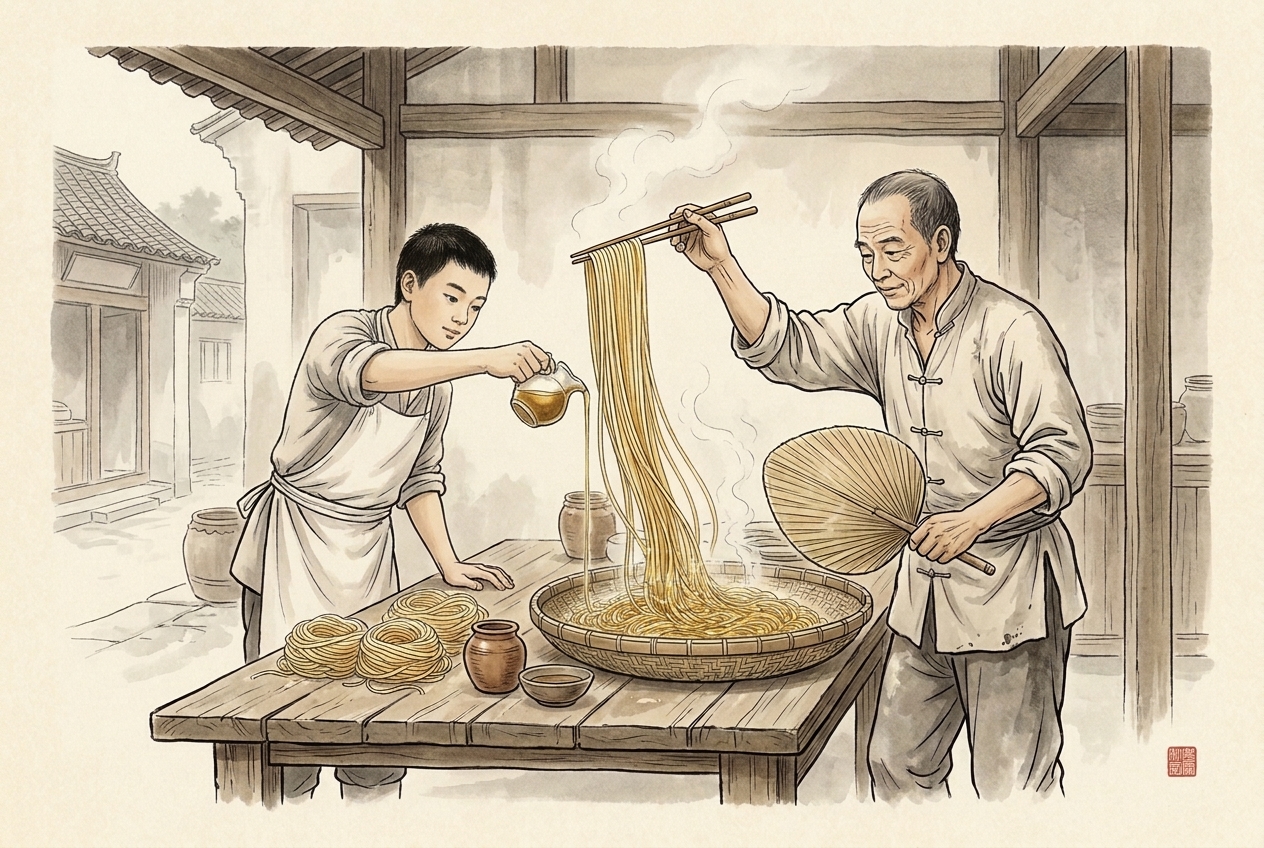
Walk down Hankou’s Dacheng Road or Wuchang’s Liangdao Street at 6:15 on a misty morning and you will witness a logistical marvel. Twenty commuters—office clerks, schoolkids, delivery riders, retired neighbors in pajamas—stand queued before a cloud of billowing white steam. Nobody glances impatiently at their phone, because the queue moves at walking speed. Behind an 80-centimeter cauldron of roaring water, a single noodle master turns out steaming bowls of Reganmian every ten to twelve seconds.
This “Golden Ten-Second Bowl” is not theatrical showmanship; it is industrial ergonomics forged on 1930s Hankou river wharves. Stevedores hauling cargo sacks between Yangtze steamers and railway freight yards had bare minutes between shifts to bolt down a high-calorie meal. Waiting four minutes for raw dough to stretch and boil—as in northern pulled-noodle shops—was unthinkable. By decoupling cooking into slow backstage Danmian parboiling and lightning-fast front-stage Tangmian re-blanching, Wuhan vendors compressed point-of-sale cooking time by 95 percent without sacrificing fresh-off-the-fire heat.
“Cauldron roaring like a tide, bamboo basket darting like a shuttle; six seconds down and golden waves rise; three tosses fling off surface water, one sweep drops ten flavors into the bowl.” — Traditional Wuhan morning-stall street rhyme
Cauldron Physics & The Conical Bamboo Strainer (Zhu Zhaoli)
Everything at a classic Wuhan noodle counter is engineered around heat transfer and economy of motion. At center stage sits a deep, heavy-gauge cauldron fired by a high-BTU burner that maintains an unbroken, violent rolling plume at 98°C–100°C. Many stalls weld an internal divider inside the cauldron: three-quarters clean boiling water for noodles, one-quarter simmering pork-or-beef bone stock for blanching raw sliced beef (shengtang niurou) or ladling side soups.
In the master’s dominant hand rests the iconic conical woven bamboo strainer (jiandi zhu zhaoli):
- Hydrodynamic Cone Geometry: Measuring roughly 16cm across the mouth, 18cm deep, and tapering to a rounded point with a curved 45cm Moso-bamboo handle, the basket cradles a single 2-liang serving (140g parboiled weight, yielding ~200g hot) in an airy bundle. As the cone plunges downward, boiling water jets inward from 360 degrees through diagonal bamboo slits, reaching the center of the noodle mass in under two seconds.
- Cauldron Water Discipline: After blanching two hundred oil-coated alkaline portions, trace sesame oil and sodium carbonate inevitably leach into the pot. Left unchecked, starchy alkaline water turns viscous and imparts a dull, soapy bitterness. Seasoned stallkeepers skim floating oil and refresh a third of the pot with clean boiling water from an auxiliary kettle every 40 minutes to keep the blanching bath crisp.
Frame-by-Frame: Dissecting the Ten-Second Sequence
Slow down a thirty-year Wuhan noodle master’s hands on high-speed video and a seamless four-beat choreography emerges:
| Timestamp | Tactical Phase | Hand Mechanics & Sensory Cues | Culinary Physics Purpose |
|---|---|---|---|
| 0.0 – 1.5 s | Single-Claw Portioning | Left hand plucks an exact 140g mound of loose Danmian (within ±5g by muscle memory), fluffing it into the bamboo cone | Restores air channels between oiled strands for instant water penetration |
| 1.5 – 7.5 s | Vortex Plunge & Swirl | Basket submerges into the boiling plume; chopsticks swirl twice; 5–6s in summer, 8–10s in winter | Gelatinizes the remaining 20% bai xin core; spikes core temp >82°C; blooms sesame oil aroma |
| 7.5 – 9.0 s | “Three-Toss, Two-Tap” Drain | Basket snaps upward flipping the noodle ball 3 times in midair, then taps the pot rim twice (du-du) | Ejects 90% of free water while leaving a precise 6–8g hot moisture film |
| 9.0 – 12.0 s | Crescent Sweep Seasoning | Noodles invert into a grease-proof paper bowl; steel ladle dances across 8–10 condiment pots in one arc | Locks volatile aromatics into 80°C strands; stages bottom broth & top sesame paste |
Seasonal Micro-Timing: Why Winter Takes Four Seconds Longer
Great street cooks never watch a wall clock; they read resistance through the bamboo handle. On a 36°C July morning, parboiled noodles sitting in a shaded basket already start near 30°C—five to six seconds in boiling water turns them supple and piping hot. On a 2°C January morning, chilled oiled strands require eight to ten seconds, often punctuated by lifting the basket into the air for half a second mid-boil before dipping again (“double-dipping to pierce the core”) so the bowl stays steaming hot even while eaten outdoors on a plastic stool.
The 6-Gram Moisture Paradox: Mastering “Three Tosses, Two Taps”
First-time cooks attempting Reganmian almost always err at one extreme: either dumping wet noodles into the bowl so a watery puddle drowns the bottom, or draining them so fanatically dry that the sesame paste seizes like peanut butter on dry toast.
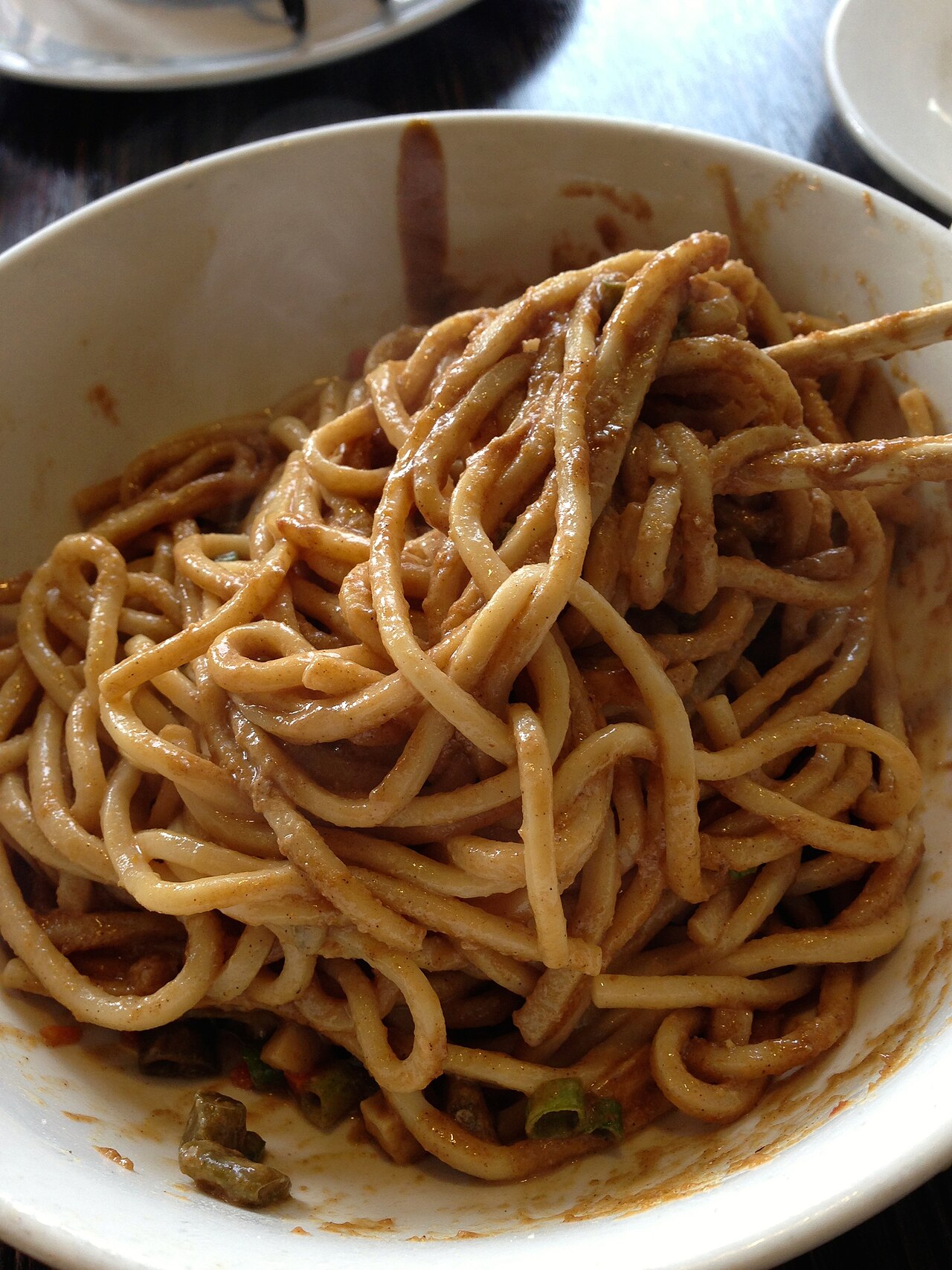
Wuhan’s “dry” (gan) means brothless, never parched. During the master’s three sharp upward wrist tosses (san dian), centrifugal force flips the noodle bundle so trapped pockets of water fly back into the cauldron. Two crisp raps of the bamboo rim against the pot edge (liang dou) shear off hanging drips at the tip of the cone. What lands in the paper bowl is 200 grams of springy noodles coated in an invisible 6-to-8-gram film of 90°C water. Seconds later, when the diner cross-tosses the bowl, those 6 grams of hot water meet a ladle of spiced soy broth and oil-thinned sesame paste, triggering an instant micro-emulsion that wraps every strand in glossy velvet while leaving zero liquid at the bottom.
The Semicircle Cockpit: One-Arc Condiment Choreography
Arranged in a tight semicircular arc within half an arm’s reach of the cauldron sit eight to ten stainless-steel wells and a deep stoneware crock of stone-ground sesame paste. Without taking a single step, the vendor’s ladle executes a practiced sweep:
- Umami Hydration Base: 15ml of amber ten-spice braised soy broth (lushui), a splash of light soy sauce, and raw crushed garlic water (suanshui) hit the hot noodles first, releasing an immediate savory cloud.
- Crystalline & Spice Notes: A flick of fine salt (or spiced sesame salt), white pepper, and a pinch of sugar melt instantly on contact.
- Textural Crunch: Heaping spoonfuls of crisp sun-dried Huangpi pickled radish dices, fermented sour cowpeas (suandoujiao), and bright green chopped scallions scatter across the crown.
- The Velvet Crown: A wide spoon lifts 35 to 40 grams of satin-smooth sesame paste from the stoneware vat and ribbons it in a bold zigzag across the peak—topped, on request, with a ladle of toasted Wuhan chili oil complete with crisp fried chili flakes.
“Two liang, full toppings, medium spicy—watch your fingers!” From raw order to outstretched hand, twelve seconds have elapsed, and Wuhan’s morning pulse beats on without missing a stride.
- Annals of Wuhan Gastronomy (Wuhan Yinshi Zhi), Wuhan Local Chronicles Compilation Committee
- Field Cinematography & Artisan Records: A Bite of China Season 2 & Breakfast in China (Wuhan Episodes)
- DB 4201/T 699-2024: Specification for Production Management of Wuhan Reganmian
❓ Frequently Asked Questions
How can 6 seconds in boiling water possibly cook wheat noodles all the way through?
Because 80% of the cooking already happened hours earlier during Danmian parboiling! The street blanch only needs to drive heat into a pre-gelatinized, oil-coated strand to finish the remaining 20% pinhead white core ('bai xin'), raise internal temperature above 80°C, and re-awaken the fragrance of the toasted sesame oil coat.
Should blanched Reganmian be drained bone-dry or left slightly wet?
Neither sopping wet nor bone-dry—the secret is 'zero pooling water, thin thermal film.' A puddle at the bottom dilutes spiced soy broth and breaks the sesame paste emulsion; yet bone-dry strands cause pure sesame paste to seize into a throat-choking lump. The master's 'three-toss, two-tap' wrist motion leaves roughly 6 to 8 grams of 90°C moisture clinging to the noodles, providing the exact micro-hydration needed to emulsify thick sesame paste into velvet.
Why do traditional Wuhan vendors insist on woven bamboo strainers instead of perforated metal baskets?
Conical Moso-bamboo strainers ('zhu zhaoli') solve three practical physics problems at once: bamboo insulates the vendor's hand against four hours of scalding steam; the tapered cone centers a 2-liang portion while letting boiling water surge diagonally through flexible splints; and bamboo's natural micro-texture flips the noodle mass cleanly during wrist tosses without snagging or tearing strands.
✦ Cross-Referenced Chapters
Utensil & Cart Evolution: Poles, Bamboo Strainers & Paper Bowls
A material history from wooden shoulder-poles and conical bamboo baskets to iconic grease-proof paper bowls.
The Ten-Condiment Flavor Matrix & Layering Order
Exact gram ratios and sequencing of light/dark soy, rice vinegar, white pepper, sugar, and spiced sesame salt.
The Core Art of "Danmian": Parboiling & Oil-Tossing
Step-by-step mastery of 80%-cooked boiling, fan-cooling, and sesame-oil tossing that keeps alkaline noodles springy for hours.
Commercial Noodle Shop Batch Formula & SOP
Professional 25kg batch noodle parboiling, master spiced broth formulation, and high-volume breakfast rush workflow.
The Art of Eating While Walking & Cross-Tossing Etiquette
Mastering the Wuhan commuter’s signature one-handed bowl cradle and rapid cross-lifting chopstick toss without spilling a drop.