Utensil & Cart Evolution: Poles, Bamboo Strainers & Paper Bowls
A Century of Street-Level Industrial Design—From Shoulder-Pole Cabinets to Iconic Greaseproof Paper Bowls
A material-culture history of Wuhan Reganmian's tools and vessels: examining the modular 1930s bamboo shoulder-pole kitchen, the fluid dynamics of conical green-bamboo strainers, and four generations of dining bowls culminating in Wuhan's ergonomic greaseproof paper bowl.
Tools That Shape Taste: Everyday Vernacular Engineering
In culinary history, great techniques are inseparable from the physical implements created to execute them. Just as Cantonese wok hei relies on thin hammered cast iron and Neapolitan pizza requires a domed refractory brick hearth, Wuhan Reganmian owes its ten-second cadence and brothless sheen to a century of ingenious street-level industrial design.
From a springy moso-bamboo shoulder pole swaying down 1930s Changdi Street to the millions of wide-rimmed, grease-proof paper bowls cradled every morning on Wuhan subways and sidewalks, the material culture of Hot Dry Noodles tells a vivid story of urban hygiene, commuter ergonomics, and artisanal physics.
“Ahead swings the copper cauldron white with steam; behind rides the ten-spice cabinet of camphor wood. Three wrist-snaps of green bamboo, one paper bowl striding across the River City.” — Traditional Hankou noodle-maker’s rhyme
Generation Zero: The Modular Shoulder-Pole Kitchen (1920s–1950s)
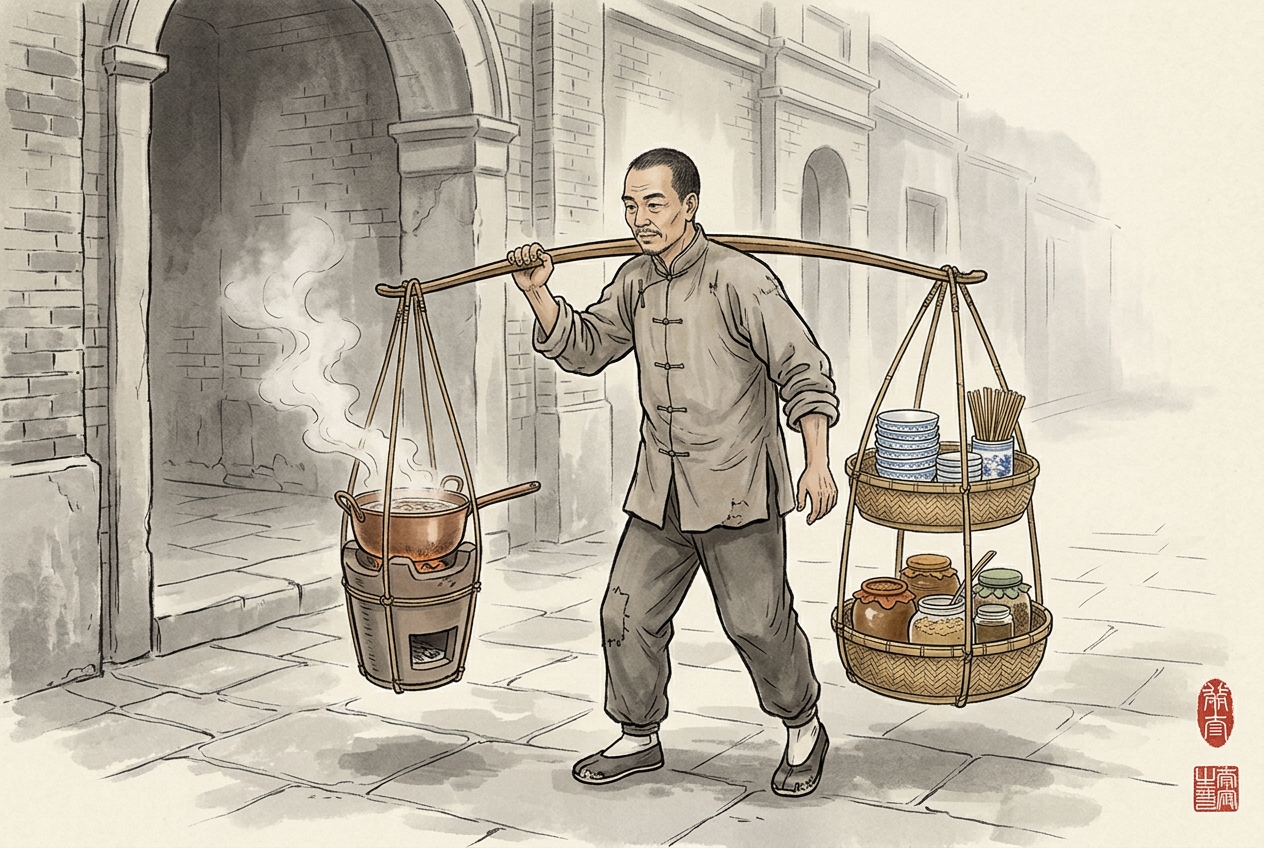
Before permanent storefronts like Cai Lin Ji took root in 1945, Reganmian was cooked and served from a self-contained noodle pole-cart (miandanzi) carried across a peddler’s shoulder:
- The Carrying Beam (Nanzhu Biandan): Hewn from seasoned southern Hubei moso bamboo heat-bent into a gentle arch, flexing rhythmically with the hawker’s stride to absorb shock and prevent boiling water from sloshing.
- The Front Rig (Heat & Cauldron): Suspended by iron chains hung a cylindrical red-clay charcoal stove (later adapted for honeycomb coal briquettes) crowned with a wide-bellied brass or cast-iron cauldron. Rolling water boiled continuously while two bamboo strainers hooked neatly along the rim.
- The Rear Rig (Mortised Condiment Cabinet): Crafted from lightweight fir and aromatic camphor wood using mortise-and-tenon joinery. Its top deck supported a broad bamboo sieve piled with golden, oil-tossed danmian beneath damp cotton gauze; its middle deck featured six circular cutouts cradling glazed stoneware crocks of stone-ground sesame paste, spiced soy lushui, rice vinegar, garlic water, chili oil, and diced pickled radish; bottom drawers stored coarse porcelain bowls, bamboo chopsticks, and copper change. Occupying barely one square meter of alley space, one artisan could feed hundreds before mid-morning.
The Unchanged Soul Tool: Physics of the Conical Bamboo Strainer
Over ninety years, charcoal braziers gave way to high-pressure gas burners and digital induction noodle boilers. Yet in heritage flagships and cult alley stalls alike, masters still reach for the hand-woven conical green-bamboo strainer (zhu zhaoli or mianlouzi).
Woven from the tough outer green skin (qingmie) of three-year-old moso bamboo in an open hexagonal weave, the basket tapers from a wide mouth down to a sharp conical point, lashed to a meter-long curved purple-bamboo handle fitted with a notch hook to rest on the pot’s lip.
Why have perforated stainless-steel baskets never displaced woven bamboo among purists? Three principles of kitchen physics explain its endurance:
- Gentle Thermal Conductivity: Metal mesh sitting in 100°C water superheats on contact, scorching the delicate sesame-oil film on alkaline noodles and causing sticky starch buildup. Bamboo conducts heat poorly, cradling strands gently.
- Micro-Textured Agitation: Slightly fibrous bamboo splints create gentle turbulence as boiling water surges through the weave, separating strands naturally without nicking or shearing bouncy dough.
- Centrifugal Funnel Drainage: Excess cooking water is the mortal enemy of thick sesame paste. When the cook lifts the basket and executes three crisp wrist snaps (san dian liang dou), the wide upper bell catches tossed strands while the pointed bottom tip acts as a gravity nozzle—expelling every drop of free water in under two seconds.
Four Generations of Vessels: How the Bowl Reshaped Street Etiquette
While the bamboo strainer stayed constant behind the counter, the vessel handed to the diner transformed four times alongside modern Chinese urban life:
1. Blue-Rimmed Coarse Porcelain Bowls (1930s–1970s)
Early peddlers and state noodle halls served Reganmian in thick-walled blue-rimmed stoneware bowls (lanbian cucifanwan) or rooster-painted bowls from Jingdezhen and Hubei’s Makou kilns. Heavy ceramic walls retained winter heat beautifully, scrubbed clean between customers in steaming wooden tubs of soda-ash water.
2. Stamped Aluminum Lunchboxes & Enamel Mugs (1960s–1980s)
During the grain-coupon decades, families routinely brought household vessels to state shops at dawn. Children queued clutching dented rectangular aluminum lunch tins, while elders held oversized peony-printed enamelware basins (tangcigang) to carry half a kilogram of steaming noodles home to share around courtyard tables.
3. The “Plastic-Bagged Bowl” Transition (Late 1980s–Early 2000s)
As private sidewalk stalls multiplied and morning commutes accelerated in the 1990s, vendors lacking dishwashing plumbing improvised a controversial shortcut: stretching a whisper-thin polyethylene bag over a reusable bowl (“bowl-in-a-bag” / wantao suliaodai), or handing commuters tied plastic bags to eat from directly. Though lightning-fast, public-health warnings over hot sesame oil leaching plasticizers—followed by China’s landmark 2008 Plastic Restriction Order and Wuhan civic sanitation drives—brought the era to a close.
4. The Ergonomic PE-Coated Paper Bowl (Late 2000s–Present)
Today’s ubiquitous food-grade polyethylene-lined paper bowl is an unsung triumph of vernacular ergonomics. Unlike narrow, vertical instant-ramen cups, a Wuhan Reganmian bowl is deliberately wide-mouthed and squat (~14 cm top diameter by ~7.5 cm tall). That generous flare allows twin bamboo chopsticks to plunge to the bottom and lift strands high in rapid “cross-tossing” strokes without snagging knuckles in sesame sauce. Meanwhile, a recessed double-rolled bottom rim creates an air-pocket heat shield—allowing Wuhanites to cradle a 90°C bowl effortlessly on four fingertips while striding toward the metro.
Centennial Matrix of Reganmian Vessels
| Vessel Era | Peak Decades | Primary Material | Dining Posture & Context | Catalyst for Transition |
|---|---|---|---|---|
| Gen I | 1930s–1970s | Thick blue-rimmed coarse porcelain | Squatting by carts, bamboo beds, or state hall benches | Heavy, breakable, impossible for long-distance commuters |
| Gen II | 1960s–1980s | Stamped aluminum tins & enamel mugs | Customer bring-your-own takeaway for family breakfast | Phased out as grain rationing ended & on-the-go eating rose |
| Gen III | 1988–2007 | Thin polyethylene bag over bowl | Stool-as-table sidewalk rush & bus-stop takeaway | Plasticizer food-safety risks & 2008 national plastic limits |
| Gen IV | 2008–Present | Food-grade PE-lined paper bowl | Palm-cradled ‘eating while walking’ & clean chain dining | Heat-insulated, leakproof, wide-mouth toss geometry & eco-hygiene |
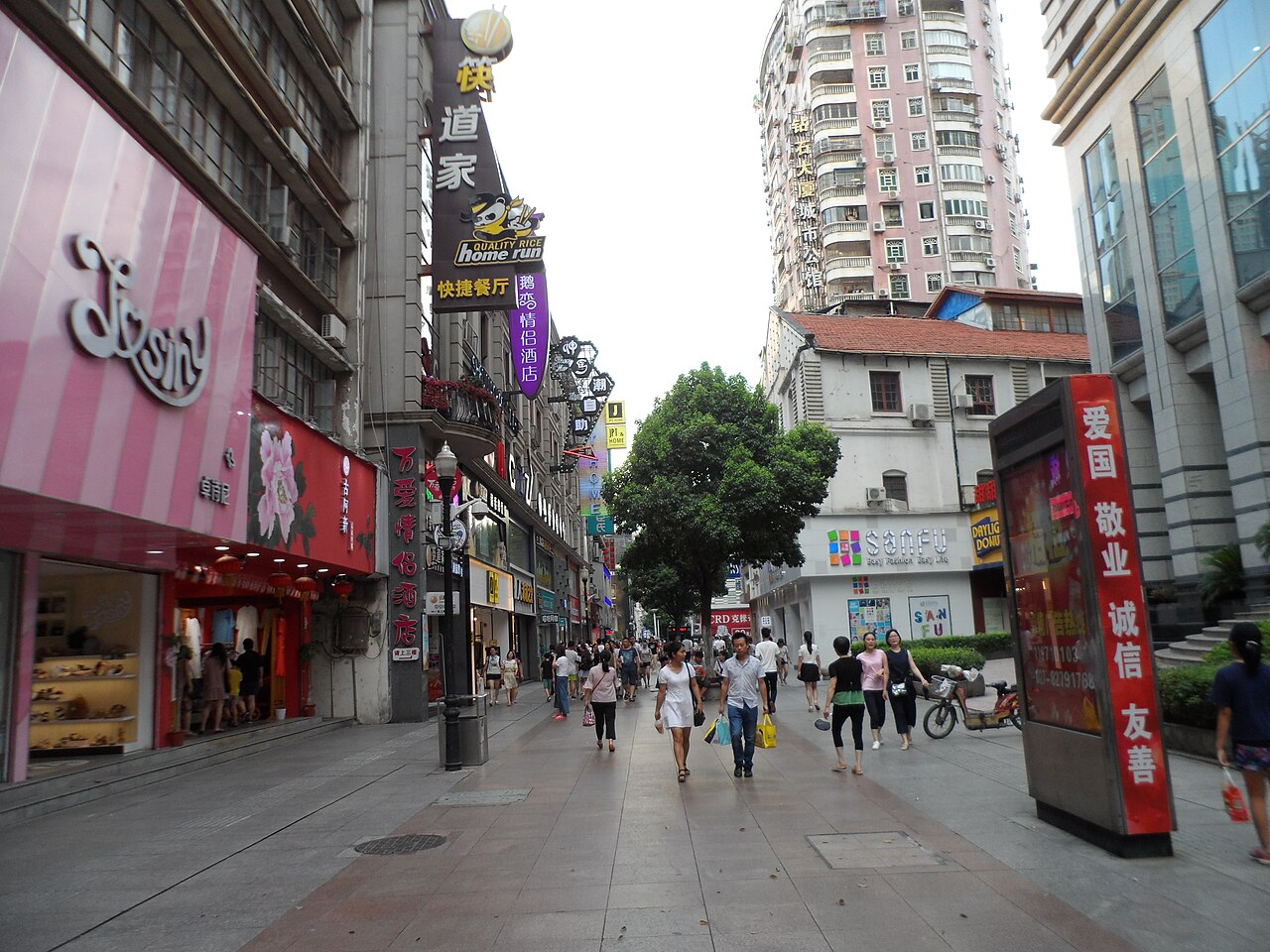
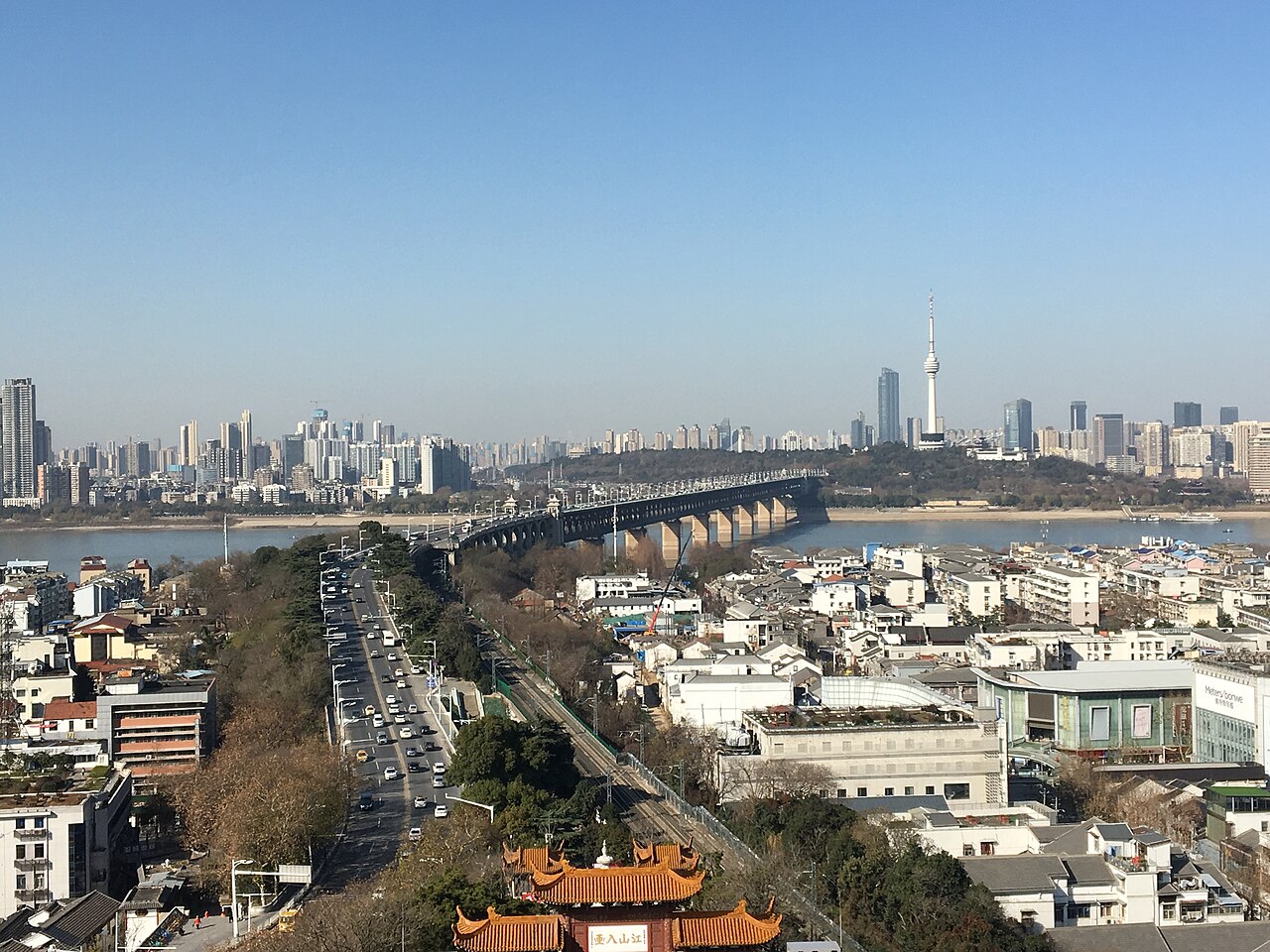
Today, flagship chains print ink-wash silhouettes of Yellow Crane Tower and playful Wuhan dialect idioms across those paper bowls. From split green bamboo to recyclable food-grade paperboard, every material shift has honored the same century-old promise: hot, dry, fragrant, and ready to move at the speed of the city.
- Chronicles of Wuhan Gastronomy: Chapter on Cooking Implements & Vessels (Wuhan Commercial Service College)
- Wuhan Museum & Jiqing Street Folk Museum Artifact Notes on Republican-Era Noodle Poles
- Hubei Packaging Federation: Hygiene & Structural Standards for Food-Contact PE-Coated Paper Bowls
- Photographic Archives of Everyday Life in Wuhan (1950–2015)
❓ Frequently Asked Questions
Why are traditional Wuhan noodle strainers woven in a pointed cone out of green bamboo?
The conical moso-bamboo basket ('mianlouzi') solves three culinary physics problems at once: bamboo's low thermal conductivity protects the oiled noodle skin from scorching against hot metal; microscopic bamboo ribs agitate strands without cutting them; and the funnel-shaped pointed tip channels free water straight down and out during the master's signature 'triple wrist-shake' drain.
Why did Wuhan stalls wrap porcelain bowls in thin plastic bags during the 1990s?
During the post-reform explosion of sidewalk stalls in the late 1980s and 1990s, many street carts lacked running hot water to scrub sticky sesame grease during the frantic morning rush. Sleeving bowls in disposable polyethylene bags eliminated dishwashing and enabled instant takeaway, before food-safety concerns over hot-oil plasticizer migration and China's 2008 plastic restrictions phased the practice out.
Why is a Wuhan Reganmian paper bowl short and wide rather than tall like a cup-noodle tub?
Thick stone-ground sesame paste pools on top of the noodles and requires deep, vigorous 'cross-lifting' chopstick strokes from the very bottom of the vessel to coat every strand evenly. A shallow, wide-mouthed trapezoid (~14 cm top diameter) maximizes tossing room while its recessed hollow base ring insulates the diner's palm while walking.
✦ Cross-Referenced Chapters
Centennial Chronology (1920s–2020s)
A decade-by-decade timeline from Republican-era wharf stalls and state-private partnerships to heritage status and global exports.
Old Hankou Wharf & Bamboo-Bed Street Roots
How dockworker labor intensity and summer bamboo-bed alleys shaped Reganmian’s brothless, calorie-dense, 10-second format.
Street Blanching & The Golden Ten-Second Bowl
Deconstructing the street master’s 6-second boiling dip, triple wrist-shake drain, and rapid sauce ladling.
The Art of Eating While Walking & Cross-Tossing Etiquette
Mastering the Wuhan commuter’s signature one-handed bowl cradle and rapid cross-lifting chopstick toss without spilling a drop.