The Art of Eating While Walking & Cross-Tossing Etiquette
Five-Finger Bowl Cradling, Vertical Cross-Lifting Physics, and Wuhan's Kinetic Sidewalk Ballet
A biomechanical and cultural field guide to Wuhan's signature commuter skill: walking briskly down plane-tree avenues while cross-tossing and slurping steaming Reganmian without spilling a drop—plus the civic evolution sparked by mainland China's first subway food ban in 2012.
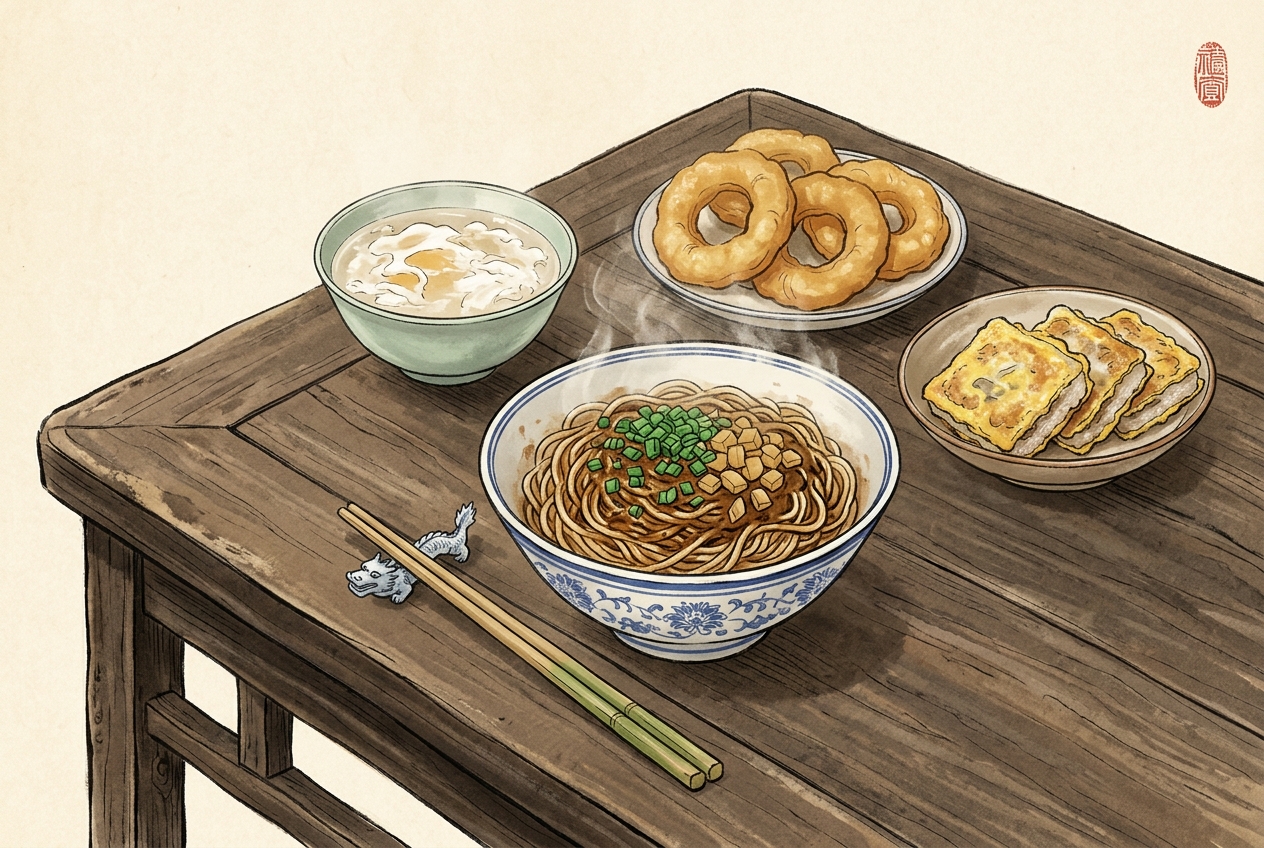
Sidewalk Ballet Beneath the Plane Trees
In New York or Tokyo, morning kinetic energy is fueled by lidded paper coffee cups; in Paris, perhaps the flaky heel of a baguette. Step onto a leafy French-plane-tree boulevard in Wuhan at 7:45 AM, however, and you enter an altogether more daring choreography of motion:
Bank executives in crisp white dress shirts, high-schoolers in tracksuits, hospital nurses coming off night shift, and parents walking toddlers to kindergarten all stride purposefully down the pavement cradling open, steaming bowls of Reganmian in their left hands. In their right hands, bamboo chopsticks rise and plunge in brisk staccato rhythm. At red crosswalk signals, heads dip in unison for three triumphant slurps; when the pedestrian light flashes green, the crowd surges forward without breaking stride—and not a single speck of crimson chili oil mars a collar.
Outsiders often marvel at Wuhan’s “eating while walking” (bianzou bianchi) phenomenon as sheer daredevil impatience. In truth, it is an evolved urban craft shaped by brothless noodle architecture, thermal rheology, specialized paper-bowl engineering, and unspoken sidewalk courtesy.
Hardware & Ergonomics: The “Hubei Provincial Bowl” and Lotus Grip
None of this mobile acrobatics would be possible with soup noodles or flimsy tableware. Since the 1990s, Wuhan’s breakfast ecosystem has standardized around a heavy-gauge, polyethylene-lined kraft paper vessel affectionately dubbed by Chinese netizens the “Hubei Provincial Bowl” (Hubei Shengwan). Three subtle design features make it a commuter’s best friend: extra-stiff grease-proof walls that refuse to buckle under hot oil, a high rolled lip rising two centimeters above typical noodle fill lines to contain vigorous tossing, and a deep eight-millimeter recessed foot-ring underneath.
Handed an 85°C bowl straight from the blanching counter, an experienced local never clutches the scalding sidewalls. Instead, muscle memory engages one of two classic grips:
- The Five-Finger Lotus Cradle (Standard Stride): All five fingertips of the left hand spread wide beneath the recessed bottom foot-ring while the center of the palm arches completely hollow, creating an air-cooled chimney underneath the hot base. Acting like a human gimbal, the wrist absorbs sidewalk bumps and curb drops effortlessly.
- The Tiger-Mouth Rim Lock (Stairs & Overpasses): Thumb and index finger hook firmly around the rigid rolled upper rim while the middle and ring fingers brace the lower taper—locking the bowl at three points when climbing pedestrian bridges.
Physics of the “Cross-Toss”: Why Circular Stirring Fails
Ask any veteran Wuhan noodle master why a tourist’s bowl tastes dry and clumpy while a regular’s gleams like satin, and the answer comes down to fifteen seconds of chopstick physics.
When a bowl of Reganmian slides across the counter, its ingredients sit in deliberate vertical strata: steaming alkaline noodles in the middle, dense oil-thinned sesame paste pooled on top, and watery ten-spice soy braising liquor, raw garlic infusion, and rice vinegar resting at the very bottom. You have a strict fifteen-to-thirty-second window while surface steam is still billowing to marry that aqueous bottom layer into the lipid-rich sesame paste above. Wait three minutes until you find a park bench, and cooling sesame paste seizes into stubborn clay while alkaline starch bonds glue neighboring strands together.
“Novices stir whirlpools—dry paste on top, salty soy below; / Masters lift in crosses from the floor—twenty paces and every strand glows.” — Manchun Road noodle-shop proverb
The cardinal sin of the uninitiated is clockwise circular stirring. Twisting long, 1.8-millimeter alkaline strands around a central axis winds the entire portion into a tight rope knot, trapping thick sesame paste on the surface and slinging chili oil outward by centrifugal force.
Authentic Wuhan Cross-Tossing (Shizi Tiaoban—or its eight-point cousin, Mizi star-tossing) relies exclusively on vertical shear and aeration:
- Beat 1 — Dead-Center Plunge: On your very first step away from the stall, drive slightly parted chopsticks straight down through the center of the noodles until the tips tap the bottom of the paper bowl.
- Beat 2 — High Vertical Lift: Lift a sheaf of bottom-soaked strands seven to nine centimeters into the air above the rim. Rising noodles drag thin spiced soy broth and garlic water straight up through the blanket of sesame paste—triggering instant water-in-oil emulsification while venting excess steam so the noodles stay al dente.
- Beat 3 — Ninety-Degree Quarter Turn: Drop the strands gently, rotate the bowl a quarter turn on your fingertips (north-south, then east-west like writing a
+or*), and lift again, folding crunchy pickled radish dices and scallions evenly throughout the matrix. - Beat 4 — Rim Sweep: Trace one quick pass along the inner paper wall to gather stray ribbons of sesame sauce. Within twenty brisk strides (roughly ten vertical lifts over fifteen seconds), every single strand shines uniform amber from top to bottom, with zero puddles left below.
Sidewalk Civility & The Landmark 2012 Subway Ban
Beneath its freewheeling surface, Wuhan’s mobile breakfast culture honors a remarkably considerate code of street etiquette. Seasoned eaters practice the fifteen-degree forward bow (weiqing huli)—tilting slightly from the hips over the paper bowl during each bite so gravity drops any rogue radish dice harmlessly downward rather than onto a white blouse or a passing neighbor. Outside alley shops furnished with nested plastic stools (“tall stool as table, low stool as chair”), departing diners stack empty paper bowls neatly and tuck used bamboo chopsticks inside before dropping them into curbside bins.
Modern civic life also drew a clear boundary on December 28, 2012—the historic morning Wuhan opened Metro Line 2, its first subway tunnel beneath the Yangtze River. Enacted the very same day, Article 40 of the Wuhan Municipal Rail Transit Management Regulation introduced mainland China’s first statutory ban on eating or drinking aboard subway trains, backed by fines of 50 to 200 RMB. While nostalgic elders still swap tall tales of balancing bowls of Reganmian standing up on lurching 1990s Route 521 buses without spilling a drop, the city embraced a charming new ritual: every weekday at 8:15 AM, clusters of well-dressed commuters stand shoulder to shoulder beside the trash receptacles just outside metro station entrances—cross-tossing, slurping down the last savory strands in forty-five seconds flat, wiping their lips, and striding cleanly into the underground train.
Diagnostic Guide: Local Master vs. First-Time Taster
| Technique Dimension | Authentic Wuhan Commuter | Uninitiated Novice | Resulting Bowl & Wardrobe Outcome |
|---|---|---|---|
| Timing of First Toss | Immediately upon receiving the bowl (within 15 sec) | Carries untouched bowl 5 minutes to a desk or bench | Local gets silky emulsion; novice fights a stiff, clumped noodle brick |
| Chopstick Motion | Vertical ’+’ / ’*’ Cross-Lifts from bottom center | Clockwise whirlpool stirring | Local coats every strand evenly; novice winds a dry knot over salty bottom puddles |
| Left-Hand Bowl Hold | Five-finger lotus cradle under recessed base ring | Full-palm squeeze around hot middle wall | Local stays cool and level; novice burns fingers and warps the paper rim |
| Eating Posture | Subtle 15° forward lean; tidy half-chopstick bites | Upright stance; overloaded swinging forkfuls | Local keeps white shirts spotless; novice wears crimson chili polka dots |
| Transit Etiquette | Finishes bowl beside metro-entrance bin before entry | Attempts to sneak open aromatic bowl past turnstiles | Preserves both century-old street joy and clean public transit cars |
- Wuhan Municipal Rail Transit Management Regulation (Effective December 28, 2012, Article 40 Transit Dining Prohibition)
- Chi Li, 'Wuhan Guozao and the Rhythm of the Street', Selected Essays of Chi Li, Changjiang Literature & Art Press
- Wuhan Folklore Research Society, 'Material Culture and Postural Etiquette of Three-Town Street Dining'
❓ Frequently Asked Questions
Why do so many Wuhan commuters eat Reganmian while walking instead of sitting down?
Beyond century-old wharf hustle, food physics demands immediate action. Freshly blanched alkaline noodles leave the cauldron at 85°C shrouded in steam; if you spend three minutes hunting for a seat or walking to an office desk, pure stone-ground sesame paste cools and seizes into an immovable lump. Tossing on the move captures the 20-second peak emulsification window.
Why does stirring Reganmian clockwise in circles ruin the bowl?
Springy 1.8mm alkaline strands behave like long capellini: circular stirring winds them into a tight, impenetrable rope knot, trapping thick sesame paste on top while leaving thin spiced soy broth stranded at the bottom—and flinging chili oil outward by centrifugal force. Vertical cross-lifting ('shizi tiaoban') pulls bottom liquid upward through top paste for even coating.
Is it still legal to eat Reganmian on Wuhan buses and subways?
No. On December 28, 2012, coinciding with the opening of cross-river Metro Line 2, Wuhan enacted mainland China's very first statutory subway food ban (carrying 50–200 RMB fines). Today, the beloved commuter ritual culminates right outside metro entrances, where riders polish off their final bites beside station trash bins before tapping through the turnstiles.
✦ Cross-Referenced Chapters
Utensil & Cart Evolution: Poles, Bamboo Strainers & Paper Bowls
A material history from wooden shoulder-poles and conical bamboo baskets to iconic grease-proof paper bowls.
Street Blanching & The Golden Ten-Second Bowl
Deconstructing the street master’s 6-second boiling dip, triple wrist-shake drain, and rapid sauce ladling.
Troubleshooting 20 Common Mistakes & Master Proverbs
Fixing clumpy strands, bitter alkali aftertaste, broken oil-separated sesame paste, and overly dry bowls.
Wuhan "Guozao" Panorama: A Month Without Repeating Breakfast
Origins of the term "Guozao" and how Wuhan’s exuberant morning street-food universe revolves around Hot Dry Noodles.
Urban Legends: Balancing Bowls on Wuhan Buses & Mass Records
Remembering the legendary balance of Wuhan bus riders prior to transit food bans, alongside massive communal tasting festivals.
Street Sociology: The Egalitarian Republic of Plastic Stools
Tall stool as table, short stool as seat—an ethnographic look at how sidewalk noodle dining dissolves social hierarchy.