Street Sociology: The Egalitarian Republic of Plastic Stools
Tall Stool as Table, Short Stool as Seat—How Sidewalk Micro-Furniture Dissolves Urban Hierarchy
An architectural and sociological study of Wuhan's signature breakfast seating—a 46-cm tall plastic stool paired with a 24-cm low stool—revealing how minimal street furniture creates a radically egalitarian public sphere beneath the plane trees.
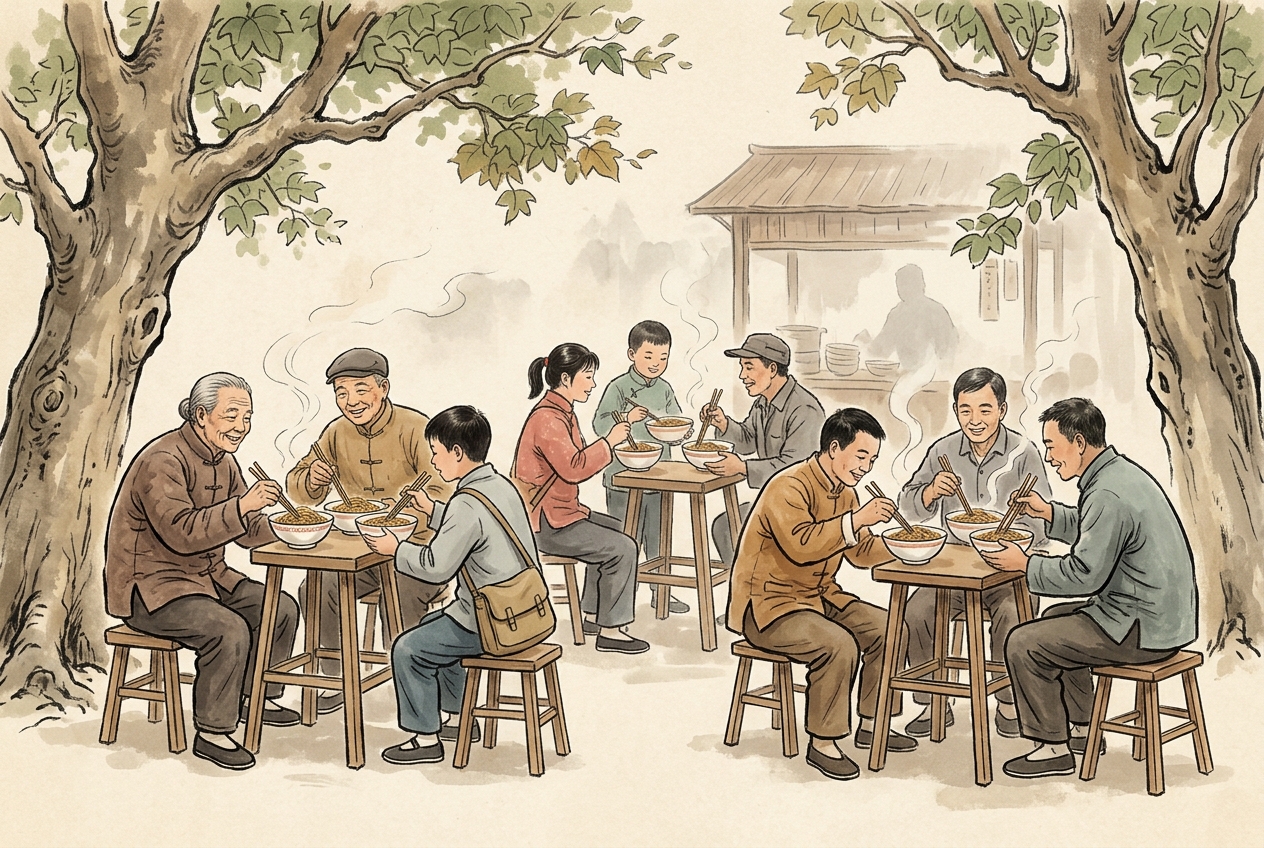
Forty-Six Centimeters Meets Twenty-Four: Vernacular Micro-Urbanism
Walk down Shanhaiguan Road in Hankou or Dacheng Road in Wuchang at seven in the morning, and your eye immediately catches a rhythmic primary-colored geometry lining the sidewalk beneath the plane trees. There isn’t a conventional dining table in sight. Instead, every half-meter stands a 46-centimeter-tall red molded-plastic stool, paired nose-to-nose with a 24-centimeter-low blue stool (or a worn pine bench polished glossy by decades of denim and cotton pajamas).
Locals sum up the arrangement in eight brisk syllables: gaodeng dang zhuo, aideng zuo ren—“tall stool serves as table, short stool seats the diner.”
Viewed through the lens of architectural micro-urbanism, Wuhan’s high-low stool module is a triumph of grassroots spatial engineering. Traditional neighborhood noodle shops occupy sliver-thin ground-floor bays in historic lifen rowhouses—often three meters wide and five meters deep. Once you fit a roaring three-burner cauldron, ten ceramic condiment crocks, and trays of oil-fanned alkaline noodles behind the counter, zero square footage remains indoors for four-top tables.
Full-sized tables placed outdoors block pedestrian flow and force solitary commuters into awkward eye-to-eye table-sharing. Two nested stools solve every constraint at once. Each diner claims a self-contained 0.35-square-meter island—just wide enough on top of the tall stool for a paper bowl of Reganmian, a cup of sweet danjiu egg rice wine, and a communal box of tissues. Friends slide three pairs together into an instant banquette; solo eaters face the street theater undisturbed. Best of all, when the Guozao rush subsides at 10:30 AM, the proprietor sweeps thirty tall stools into one vertical tower and thirty short stools into another, restoring the sidewalk to midday commerce in under three minutes.
Posture as Equalizer: Dissolving Hierarchy at Knee Level
Yet what elevates the Wuhan plastic stool from clever furniture hack to sociological institution is what it does to human posture and urban status.
Most metropolitan dining spaces are engines of subtle stratification: velvet banquettes, reserved booths, and crisp linen tablecloths cue patrons to perform their income bracket. A 24-centimeter low stool, by contrast, enforces radical anatomical democracy. Regardless of whether a diner stands five-foot-two or six-foot-one, sitting that close to the pavement lifts the knees above the hips, rounds the shoulders forward thirty degrees, and tucks the elbows inward. Nobody can swagger, lounge imperiously, or look down their nose while folded like a pocketknife over a steaming paper bowl.
“Inside glass office towers you may be Chairman or Chief Counsel; on a twenty-four-centimeter plastic stool, everyone holds the exact same rank—person trying to toss sesame paste before it clumps.”
Watch a single ten-minute cycle outside a cult neighborhood stall and witness Wuhan’s social contract in action. A black Mercedes eases against the curb, and a woman in a tailored wool trench coat steps out, drops seamlessly onto a scarred blue stool, and begins cross-lifting her chopsticks. Two feet to her left sits a retired grandfather in quilted flannel pajamas dipping crispy mianwo into leftover sesame sauce; to her right rests a sanitation worker in an orange reflective vest, broom leaned against a tree trunk, trading morning banter with a uniformed middle-schooler.
When a gust of river wind threatens to blow away the shared tissue packet atop the tall stool, the woman in the trench coat anchors it neatly beneath the chili-oil jar for the grandfather beside her. Steam blurs class lines; roasted sesame levels every collar. What urban sociologist Ray Oldenburg famously termed the “Third Place”—an informal civic anchor where citizens mingle as equals—requires neither espresso machines nor craft-beer taps in Wuhan. Two injection-molded stools costing fifteen yuan do the job with effortless grace.
Taxonomy of Four Classic Wuhan Street-Dining Stances
Spend a morning observing Wuhan’s Three Towns with an ethnographer’s notebook, and four distinct street-dining postures emerge:
| Street Posture | Furniture & Body Mechanics | Footprint | Typical Crowd & Habitat | Sociological Vibe |
|---|---|---|---|---|
| High-Low Stool Pair (高矮双凳式) | 46-cm tall stool as table + 24-cm low stool as seat; knees bent, torso bowed | ~0.35 m² | All walks of life; Shanhaiguan Rd, Liangdao St, Meigui St | Relaxed egalitarianism; shared tissues, vinegar, and neighborhood gossip |
| Single-Stool Cradle (独凳捧碗式) | Seated on one low wooden stool or curbstone; left palm cradling hot paper bowl | ~0.20 m² | Veteran neighborhood elders & regulars; hidden diaojiao lanes | Unfussy mastery; seamless union of hand, chopsticks, and bowl |
| Curbside Squat (街沿蹲踞式) | Deep flat-footed squat when stools sell out; bowl balanced near knees | ~0.18 m² | Hungry weekend food pilgrims & tradespeople outside famed stalls | Pure culinary devotion—flavor trumps comfort every time |
| Walking Cross-Toss (疾步端走式) | Left thumb-web gripping bowl base; right hand tossing strands at brisk stride | 0 m² (mobile) | Rush-hour subway commuters & 8:00 AM students near transit exits | Dockworker velocity reborn in modern commuter choreography |
Unwritten Etiquette of the Sidewalk Commons
For all its boisterous energy, the republic of plastic stools runs on crisp, self-policing courtesy. During the 7:15 AM peak when hungry regulars hover two deep waiting for a seat, nobody lingers over short videos once their bowl is empty. Six minutes from sit-down to final slurp is par: diners wipe their mouths, drop their crumpled paper bowl straight into the curbside bin, nudge the two stools back into alignment with a toe, and give a quick nod to the next person waiting with steaming bowl in hand.
In recent years, as Wuhan modernized its streetscapes, municipal planners wisely resisted sterilizing old breakfast lanes. Instead of banning outdoor stools outright, heritage food streets introduced tidy setback lines, grease-resistant mats, and sanitation support—proving that civic order and sidewalk yanhuoqi (human warmth and hearth-smoke) need never be enemies. Skyscrapers and suspension bridges proclaim Wuhan’s ambition, but those humble red-and-blue stools safeguard its soul.
- Ray Oldenburg, 'The Great Good Place' (on informal 'Third Places' and civic leveling)
- Wang Di, 'Street Culture in Chengdu: Public Space, Urban Commoners, and Local Politics' (comparative Chinese street-space historiography)
- Wuhan Municipal Urban Management Guidelines on Characteristic Breakfast Street Exterior Seating
❓ Frequently Asked Questions
Why did Wuhan noodle stalls invent the 'tall stool as table, short stool as seat' setup?
Neighborhood breakfast shops in historic Hankou and Wuchang typically occupy tiny ground-floor storefronts barely three meters wide, leaving room inside only for the boiling cauldron and condiment bar. Pairing two lightweight, stackable stools eliminates bulky tables, adapts flexibly to narrow shaded sidewalks, and disappears indoors within minutes once the morning rush ends.
What makes plastic-stool dining a symbol of social equality in Wuhan?
Fine dining rooms sort patrons by dress code, VIP rooms, and check size. On a 24-cm low stool, physical ergonomics treats everyone identically: bank executives, pajama-clad retirees, delivery riders, and schoolchildren all hunch forward at the exact same angle over the exact same five-yuan paper bowl, sharing one tissue box and chili jar.
Can visitors still experience authentic plastic-stool Guozao in modern Wuhan?
Yes. While major arterial boulevards enforce clear-sidewalk transit rules, beloved culinary lanes such as Shanhaiguan Road, Liangdao Street, Dacheng Road, Meigui Street, and hundreds of residential alleys preserve orderly rows of tall-and-short stools as cherished living heritage.
✦ Cross-Referenced Chapters
Utensil & Cart Evolution: Poles, Bamboo Strainers & Paper Bowls
A material history from wooden shoulder-poles and conical bamboo baskets to iconic grease-proof paper bowls.
The Art of Eating While Walking & Cross-Tossing Etiquette
Mastering the Wuhan commuter’s signature one-handed bowl cradle and rapid cross-lifting chopstick toss without spilling a drop.
Cult Neighborhood Stalls Across Hankou, Wuchang & Hanyang
An insider’s dossier on beloved alley shops—Luo Shi Raw-Blanched Beef, Zhao Shifu Oil-Pie & Reganmian, Changzi, and Xiaoqiu.
Urban Legends: Balancing Bowls on Wuhan Buses & Mass Records
Remembering the legendary balance of Wuhan bus riders prior to transit food bans, alongside massive communal tasting festivals.
Mirror of the Wharf: Directness, Warmth & Nine-Province Openness
How brisk blanching, generous sesame richness, and north-south condiment fusion embody Wuhan’s forthright civic character.