Campus Chronicles: Canteen Reganmian Across Wuhan’s 80+ Universities
How Dining-Hall Noodle Windows at WHU, HUST, and CCNU Turn 1.3 Million Students into Lifelong Wuhaners
Chronicling the world's largest collegiate noodle rite of passage: across 83 universities and over 1.3 million enrolled students, legendary canteens like WHU's Meiyuan, HUST's Baijingyuan, and CCNU's Guixiangyuan convert skeptical freshmen into lifelong ambassadors of Reganmian.
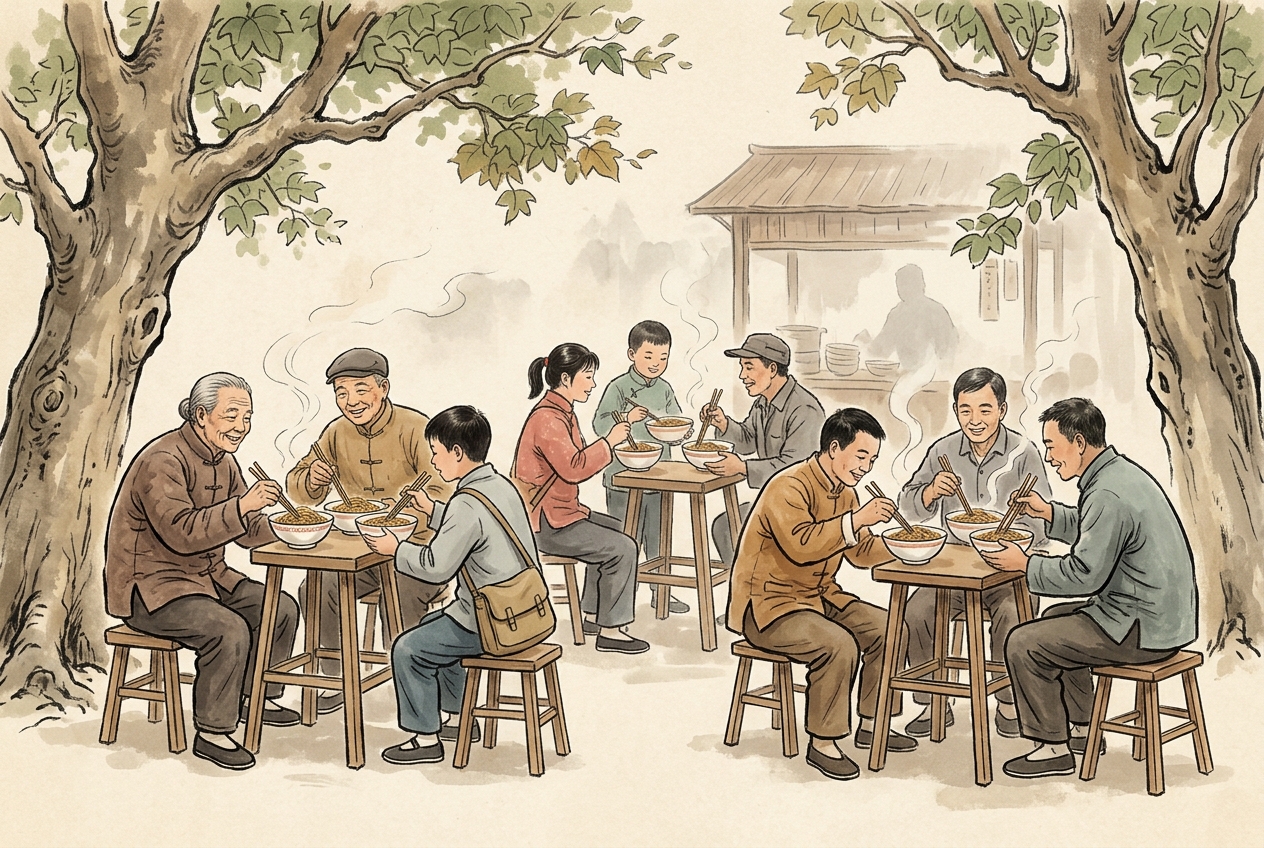
1.3 Million Meal Cards: The World’s Largest Reganmian Conservatory
No other metropolis on Earth concentrates youth quite like Wuhan. Spread across its lake-ringed hills and riverbanks stand 83 universities and colleges, home at any given moment to more than 1.3 million undergraduate and graduate students. Every weekday at 7:25 AM, as campus bells chime warning of 8:00 AM lectures (zaoba), hundreds of thousands of sleepy twenty-year-olds stream into dining halls from Luojia Hill to Yujia Mountain and the vast Nanhu university belt.
Measured in culinary anthropology, Wuhan’s university canteens constitute the most powerful palate-conversion engine in Chinese food history.
Each September, eighteen-year-olds arrive by high-speed train from Cantonese dim-sum towns, Shanxi knife-cut noodle valleys, northeastern dumpling kitchens, and Jiangnan rice-porridge water towns. Their first encounter with Wuhan almost always unfolds in military-training fatigues in front of a steaming canteen window. Over the next thousand mornings—subsidized by university logistics offices at a recession-proof 3.5 to 5.0 RMB a bowl—a dish that once seemed bafflingly thick and brothless quietly becomes the taste of youth itself.
Roll Call of Legends: From Luojia Hill to HUST’s 36-Canteen Empire
Ask any Wuhan university graduate ten years out of school to recite a differential equation, and they may hesitate; ask which dining-hall window ladled the best sesame paste, and their eyes light up instantly.
At Wuhan University (WHU), morning mist curls off the green-tiled eaves of historic dormitories as students bound down stone steps into Meiyuan (Plum Garden) Canteen or Guiyuan Canteen, grabbing a four-yuan bowl topped with two generous scoops of self-serve spicy radish dices before sprinting to humanities lectures. Come late afternoon, Hubin (Lakeside) Canteen beside East Lake’s Lingbo Gate offers arguably China’s most romantic student meal: freshly blanched beef Reganmian eaten with lake breezes rippling across the water.
Eastward beneath the forested canopy of Yujia Mountain lies Huazhong University of Science and Technology (HUST), celebrated nationwide for its sprawling empire of more than thirty campus dining halls. During the morning rush at Yunyuan Canteen, Dongyi (East No. 1), and Xiyi (West No. 1), veteran noodle masters wield two bamboo strainers simultaneously with assembly-line precision, while engineering students in plaid shirts debate whether Baijingyuan’s wood-paneled food court or Baihuiyuan’s pan-fried buns make the superior Reganmian sidekick after an all-night coding sprint.
Across town on osmanthus-scented Guizi Hill, Central China Normal University (CCNU) alumni swear eternal allegiance to Guixiangyuan Canteen and Xuezhi Canteen, where pairing a velvety sesame bowl with a freshly fried, golden shredded-radish cake (luobosibing) fuels generations of future teachers. Farther south around Nanhu Lake, Wuhan University of Technology (WUT) feeds legions of engineering majors hefty 3-liang portions at Zhiyuan and Yueyuan; Zhongnan University of Economics and Law (ZUEL) pairs braised-pork Reganmian with legendary one-yuan side dishes at Huanhuyuan; and Huazhong Agricultural University (HZAU) students wash down rich sesame strands with bottles of campus-fermented yogurt.
| University | Legendary Canteen Windows | Iconic Student Pairing | Subsidized Price | Signature Campus Memory |
|---|---|---|---|---|
| Wuhan University (WHU) | Meiyuan, Hubin, Guiyuan & Info-Faculty Canteens | 2-liang plain bowl + warm soy milk | 3.5–5.0 RMB | Studying vocabulary on stone benches under March cherry blossoms |
| HUST (Huazhong Tech) | Baijingyuan, Dongyi, Xiyi & Yunyuan Canteens | Reganmian + spiced egg + pan-fried jianbao | 3.5–5.5 RMB | Navigating an empire of 30+ canteens without repeating a window all month |
| CCNU (Central China Normal) | Guixiangyuan & Xuezhi Canteens | Rich sesame Reganmian + crispy shredded-radish cake | 3.5–4.5 RMB | Sweet October osmanthus drifting through open canteen windows at 7:00 AM |
| Wuhan Univ. of Tech (WUT) | Nanhu Zhiyuan, Yueyuan & Mafangshan Halls | Hearty 3-liang bowl + chilled mung-bean soup | 4.0–5.0 RMB | Aunties behind the counter famous for steady, non-shaking sesame ladles |
| ZUEL (Economics & Law) | No. 5 Xiangtaoyuan & No. 10 Huanhuyuan | Sliced beef or zhajiang Reganmian + 1-RMB sides | 4.0–8.0 RMB | Willow-lined Xiaonanhu Lake mornings during bar-exam cramming season |
| Huazhong Agricultural (HZAU) | Taoyuan, Huiyuan & Zhuyuan Canteens | Classic all-in bowl + campus-made fresh yogurt | 3.5–4.5 RMB | Cycling across a massive lakeside agricultural campus to beat the 8 AM bell |
The Four-Stage Conversion Arc of an Out-of-Province Freshman
Across campus forums and alumni chats, almost every non-Hubei student laughs at having lived through the exact same Four-Stage Reganmian Conversion Arc:
- Freshman September (Shock): You buy your first bowl, spend two minutes photographing it for your parents’ group chat while the noodles cool into a solid brick, take one dry, throat-coating bite without a drink, and vow in the dorm that night never to touch it again.
- Sophomore Autumn (Initiation): A Wuhan roommate intervenes at the self-serve condiment counter—adding crushed garlic water, black rice vinegar, and heaping sour cowpeas, demonstrating the ten-second bottom-up cross-toss, and handing over a two-yuan cup of hot danjiu egg rice wine. Suddenly the emulsion clicks.
- Junior Year (Pilgrimage): Canteen bowls become daily fuel, and Saturday mornings mean cycling off campus into Liangdao Street or Guangba Road alleys to hunt cult neighborhood masters on plastic stools.
- Post-Graduation Diaspora (Lifelong Homesickness): Years later, working late in a Shanghai skyscraper or Boston lab, you step into a restaurant advertising Wuhan noodles, take one bite, and sigh: “Not chewy enough—nothing like the auntie’s window at Dongyi Canteen.”
“Freshman year we complained that Reganmian choked the throat; graduation morning we realized it wasn’t the sesame paste catching in our throats—it was saying goodbye to being twenty beside East Lake.”
Every spring during alumni homecoming season, thirty-five-year-old executives walk past white-tablecloth banquets straight into their old campus dining hall, politely tap a passing undergraduate on the shoulder to borrow a student ID card, and listen for the familiar beep at the noodle window. Four yuan poorer and twenty years younger, they stir the dark sesame paste upward—citizen-alumni of the River City for life.
- Wuhan Municipal Bureau of Statistics, 'Wuhan Statistical Yearbook' (Higher-Education Institutions & Enrollment Tables)
- People's Daily Special Feature, 'A Bite of Wuhan Universities: Youth Memories Inside Baijingyuan, Meiyuan, and Guixiangyuan'
- Campus Dining Archives of Wuhan University, HUST, Central China Normal University, and ZUEL
❓ Frequently Asked Questions
Why are Wuhan's university canteens considered the single greatest engine spreading Reganmian nationwide?
Wuhan hosts one of the largest university student populations of any city on Earth—over 1.3 million young people drawn from every province in China and dozens of countries. Four to seven years of eating subsidized, freshly blanched canteen Reganmian before morning classes permanently rewires their comfort-food baseline before they graduate into careers worldwide.
Which university dining halls in Wuhan are most famous for their morning Reganmian windows?
Iconic stops include Wuhan University's tree-shaded Meiyuan and lakeside Hubin canteens; Huazhong University of Science and Technology's (HUST) legendary network of 30+ dining halls led by Baijingyuan, Dongyi, Xiyi, and Yunyuan; Central China Normal University's (CCNU) Guixiangyuan; WUT's Zhiyuan; and ZUEL's Xiangtaoyuan and Huanhuyuan.
Why do many out-of-province freshmen dislike Reganmian in their first week, only to become obsessed by sophomore year?
Newcomers often pause to take photos until the noodles cool and clump, then eat them plain without drink pairings. Once Wuhan roommates teach them to add garlic water, vinegar, and sour cowpeas from the self-serve condiment bar, toss vigorously within ten seconds, and sip sweet egg rice wine alongside, skepticism reliably turns into devotion.
✦ Cross-Referenced Chapters
Soulmate Drinks: Egg Rice Wine (Danjiu) & Sweet Fermented Rice Soup
Why velvety poached-egg sweet rice wine and osmanthus Humijiu are the ultimate palate-cleansing companions to rich sesame noodles.
Across China: Authentic Reganmian Outposts in Major Cities
Where to find genuine Wuhan alkaline noodles and stone-ground paste in Beijing, Shanghai, Guangzhou, Shenzhen, and Chengdu.
Livelihood Barometer: Forty Years of Bowl Prices
Tracking the price of a 2-liang bowl from grain-coupon dimes in the 1980s to today’s 5-RMB neighborhood benchmark.
Diaspora Nostalgia: First Bowl Home & Suitcases Packed with Noodles
Why returning Wuhan natives head straight from the train platform to their neighborhood stall—and pack dry noodles across oceans.
Taster Flavor Profiles: Matching Your Palate to Stalls & Packs
Mapping four distinct flavor personas—Pure Sesame Purist, Spicy Beef Seeker, Crunch Enthusiast, and Light-Bowl Modernist.