Livelihood Barometer: Forty Years of Bowl Prices
From 12-Cent Grain-Coupon Bowls in the 1980s to Today's Five-Yuan Neighborhood Benchmark
An economic and social history of China's urban transition told through the price of a standard bowl of Wuhan Reganmian—tracing the abolition of grain coupons in 1993, Wuhan's informal 'Reganmian CPI Index,' surging real purchasing power, and elderly shopkeepers who refuse to raise prices on elderly neighbors.
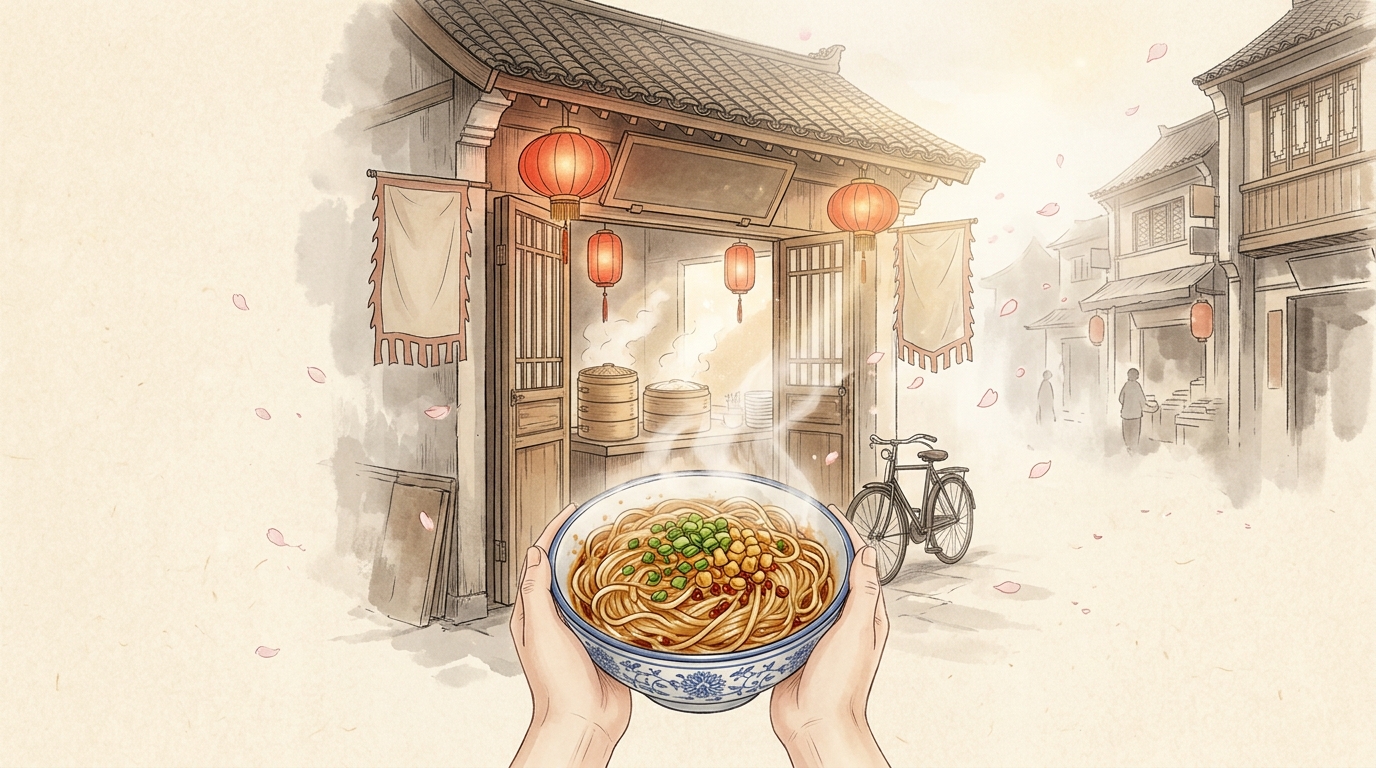
Wuhan’s Own “Big Mac Index”
In 1986, The Economist introduced the Big Mac Index as a lighthearted gauge of purchasing-power parity across nations. Along the middle reaches of the Yangtze River, however, eleven million citizens of Wuhan have long relied on an older, far more visceral economic indicator: the street price of a plain er-liang (standard two-tael) bowl of Reganmian.
Visitors to Wuhan are often amused by a recurring journalistic phenomenon. Whenever the prevailing neighborhood price of plain Hot Dry Noodles nudges upward by twenty or fifty fen (cents)—as happened notably in 2006, 2011, 2015, and 2021—local dailies dispatch investigative reporters at 5:00 AM with scales and calculators. Articles dissect wholesale white-sesame harvests in Xiangyang, wheat flour futures on the Jianghan Plain, honeycomb-coal prices, and storefront rents. During periods of sharp agricultural inflation, municipal price regulators have even issued public advisories urging breakfast vendors not to hike prices in unison.
Wuhanese diners are famously generous hosts at evening banquets, yet fiercely protective of their morning noodle price. The reason is sociological: Reganmian is not a discretionary luxury, but a civic utility shared daily by bank executives, university freshmen, cabbies, and pensioners alike. Across four decades of China’s economic transformation, its price tag has quietly recorded the passage from rationed scarcity to market abundance.
“Two liang of paper grain script, twelve copper fen counted thrice in a calloused palm—forty years of China’s economic miracle sit distilled at the bottom of a sesame-stained bowl.”
Ration Coupons and Bamboo Tallies (1970s–1992)
Forty-five years ago, ordering breakfast in Wuhan required navigating the dual currency of China’s planned economy. Prior to 1993, urban residents received monthly grain ration booklets calibrated to age and physical labor intensity (roughly 14 to 15 kilograms of grain per adult per month). Stepping up to the counter of a state-owned eatery—such as an old Cai Lin Ji branch in Hankou—cash alone could not buy a bowl of noodles.
A standard bowl cost 0.12 to 0.18 RMB, accompanied by a mandatory 2-liang (100-gram dry-flour equivalent) Hubei or Wuhan grain coupon. With typical factory wages hovering around 40 to 50 RMB a month, cash was tight, and grain coupons were guarded even more jealously. Parents routinely ate leftover rice porridge at home so they could tuck two-liang paper coupons into their children’s schoolbags for a fortifying bowl of sesame noodles before morning classes.
At the wooden cashier booth, customers surrendered paper fen notes and ration slips in exchange for a smooth, grease-burnished bamboo tally stick (later colored plastic tokens). Handing the tally to the cook beside the steaming iron cauldron, many locals held out a rectangular aluminum lunchbox rather than eating on site—carrying the fragrant prize home so grandparents and toddlers could each savor a few glossy strands.
Market Unfreezing and the Climb to Five Yuan (1993–2020s)
On January 1, 1993, the Wuhan Municipal Government formally ended nearly forty years of unified grain rationing, abolishing grain coupons overnight. Liberated from flour quotas, thousands of family-run breakfast carts and neighborhood storefronts blossomed across Wuhan’s Three Towns, inaugurating the modern market history of Reganmian:
- Mid-to-Late 1990s (The Fifty-Fen Era): For Wuhanese who came of age in the 1990s, nostalgia tastes of a 0.50 to 0.80 RMB bowl of Reganmian paired with a 0.20 RMB cup of Danjiu (sweet fermented rice wine with poached egg ribbons)—a complete, soul-warming breakfast for a single one-yuan note.
- 2000–2011 (Cent-by-Cent Adjustments & The 3-Yuan Milestone): Entering the new millennium at 1.20 to 1.50 RMB, vendors raised prices in timid 10- or 20-cent increments (1.70 RMB in 2006, 2.00 RMB in 2008) out of fear of losing loyal regulars. Only in 2010–2011, when domestic sesame prices surged and urban wages accelerated, did the citywide benchmark cross 3.00 RMB.
- 2014–Present (QR Codes, Central Kitchens & The 5-Yuan Standard): Over the past decade, upgrades in food safety—food-grade poly-coated paper bowls, chilled alkaline wet noodles delivered daily from automated central factories, and pure stone-milled sesame paste—alongside rising urban rents brought neighborhood plain bowls to 4.00 RMB around 2015 and 5.00 to 6.00 RMB in the 2020s (with major heritage chains pricing plain bowls at 6.00 to 8.00 RMB).
When nominal prices are measured against urban wages, however, the real economic story flips dramatically:
| Era | Typical Plain Bowl Price | Approx. Wuhan Avg. Monthly Wage | Bowls Affordable per Monthly Wage | Payment & Retail Ecosystem |
|---|---|---|---|---|
| 1980–1984 | 0.12–0.18 RMB + 2-liang coupon | ~42–55 RMB | ~300 bowls (capped by grain quota) | Cash + paper grain ration + bamboo tallies at state shops |
| 1993–1997 | 0.50–1.00 RMB | ~350–600 RMB | ~600–700 bowls | Coupons abolished; family sidewalk carts proliferate |
| 2004–2008 | 1.50–2.50 RMB | ~1,500–2,400 RMB | ~950–1,050 bowls | Coins & small bills; permanent community storefronts |
| 2013–2017 | 3.50–4.50 RMB | ~4,500–6,200 RMB | ~1,200–1,400 bowls | WeChat/Alipay QR codes; hygienic central noodle factories |
| 2022–2026 | 5.00–6.00 RMB | ~8,500–10,000+ RMB | ~1,500–1,800 bowls | Multi-tier market: alley stalls, chains & boutique bars |
In real purchasing-power terms, Reganmian today is roughly five to six times more affordable for an average Wuhan worker than it was in the early 1980s—while delivering vastly higher sesame purity, hygienic packaging, and condiment variety.
The Holdouts: Elderly Couples and “Conscience Noodle Stalls”
Even in a five-yuan world, pockets of stubborn neighborhood grace endure. Every year, Wuhan metropolitan reporters uncover a handful of holdout “conscience noodle stalls” (liangxin xiaodian) tucked inside 1980s residential alleys in Hanyang, Qiaokou, Qingshan, or old Wuchang, where handwritten red-paper signs still advertise plain Reganmian for 2.50, 3.00, or 3.50 RMB.
Almost invariably, these stalls are run by retired husbands and wives in their sixties or seventies—affectionately addressed in Wuhanese as Diedie (Grandpa) and Popo (Grandma)—operating out of their own ground-floor apartments. Freed from commercial rent and hired labor costs, they rise at 3:30 AM to boil spiced broth and grind sesame paste, clearing barely forty or fifty cents per bowl.
Asked by journalists why they refuse to match the five-yuan rate down the avenue, their answer is remarkably consistent: “Half our regulars are retired factory hands on fixed pensions and street sweepers coming off the dawn shift. The house is ours; our kids are grown. Making enough for groceries while keeping old neighbors fed is plenty.” Caught between a modernized multi-billion-yuan noodle industry and the quiet moral economy of old alleyways, Wuhan’s forty-year price ledger records not only China’s growing wealth, but its enduring neighborhood heart.
- Wuhan Municipal Chronicles: 'January 1, 1993: Deregulation of Grain & Edible Oil Prices and Abolition of Ration Coupons'
- China Economic Net: 'Wuhan Reganmian Crosses the 3-Yuan Threshold: Anatomy of a Morning Cost Ledger', 2011
- Chutian Metropolis Daily: 'Forty Years of Guozao Receipts and Wuhan's Holdout Low-Price Stalls'
- National Bureau of Statistics (Wuhan Survey Office): Historical Urban Wage and Consumer Price Bulletins
❓ Frequently Asked Questions
Why did buying a bowl of Reganmian require both cash and a grain coupon before 1993?
Under China's planned-economy grain rationing system (1950s–1992), flour was strictly allocated by household registration. State-run eateries had to collect a 2-liang (100-gram flour equivalent) Hubei or Wuhan grain coupon for every standard bowl sold in order to replenish their municipal wheat flour quota.
Why do twenty-cent or fifty-cent price increases in Reganmian make front-page news in Wuhan?
Because millions of bowls are consumed every morning across all income brackets, local newspapers and municipal price bureaus treat plain Reganmian as a hyper-sensitive barometer of wheat, sesame seed, cooking oil, and commercial rent inflation.
How do Wuhan's famous '3-yuan conscience stalls' survive while competitors charge 5 or 6 yuan?
Found mostly in older residential compounds in Hanyang, Qiaokou, and Qingshan, these stalls are typically run by retired couples operating out of their own ground-floor apartments. With zero commercial rent and no hired staff, they accept a razor-thin profit of 0.40–0.50 RMB per bowl to keep breakfast affordable for elderly neighbors and sanitation workers.
✦ Cross-Referenced Chapters
Centennial Chronology (1920s–2020s)
A decade-by-decade timeline from Republican-era wharf stalls and state-private partnerships to heritage status and global exports.
Oral Histories of 3:00 AM Noodle Artisans
Intimate portraits of husband-and-wife stallkeepers and third-generation masters tending boiling cauldrons before dawn.
The Multi-Billion RMB Reganmian Supply Chain Ecosystem
From dedicated wheat mills and automated central wet-noodle factories to tens of thousands of storefronts and live-stream retail.
Small Noodle Shop Unit Economics: Inside a 5-RMB Bowl
Breaking down per-bowl ingredient costs, paper bowl overhead, morning peak throughput, and neighborhood shop profitability.