The Multi-Billion RMB Reganmian Supply Chain Ecosystem
From Jianghan Wheat Belts and Automated Central Kitchens to 30,000 Morning Storefronts
An end-to-end industrial anatomy of Wuhan's 10-to-15-billion-RMB Hot Dry Noodle ecosystem—tracing dedicated high-gluten wheat mills and stone-ground sesame refineries through automated parboiling factories to tens of thousands of street stalls and global e-commerce.
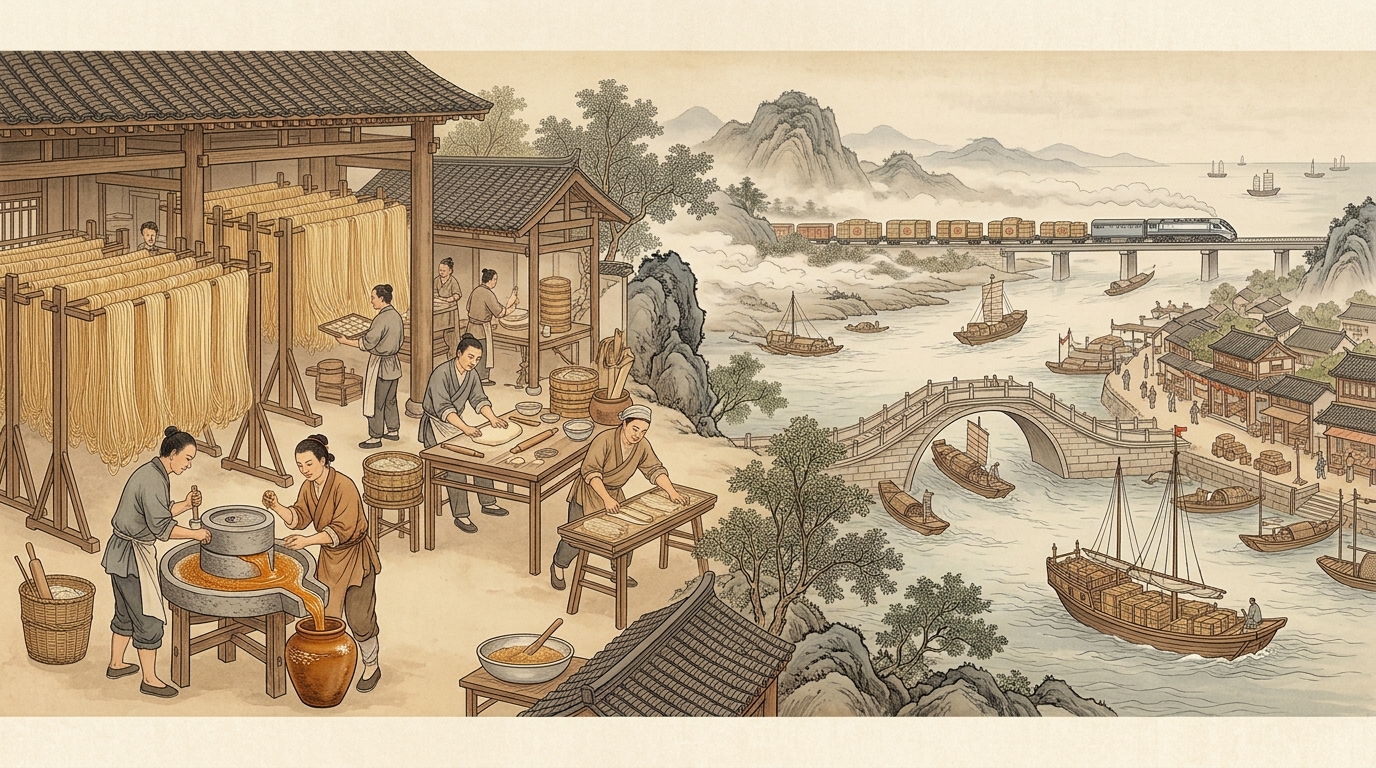
A Five-Yuan Bowl Commanding Billions
At first glance, Wuhan’s signature breakfast—Reganmian (Hot Dry Noodles)—looks like the antithesis of big industry. On any misty morning along Shanhaiguan Road or Liangdao Street, a vendor plunges a conical bamboo basket of yellow noodles into boiling water for six seconds, shakes it thrice, ladles over glossy sesame paste and spiced soy broth, and hands over a steaming paper bowl for five RMB (roughly $0.70 USD). Yet behind that ten-second street choreography hums one of China’s most sophisticated regional food supply chains.
“Before the morning fog lifts off the Yangtze, ten thousand cauldrons are already at a rolling boil—and a thousand tons of golden alkaline strands have completed their pre-dawn sprint across the Three Towns.”
According to culinary trade associations and consumer market analysts, the broader Wuhan Reganmian ecosystem—spanning upstream specialty grain and oilseed farming, midstream central wet-noodle plants and condiment manufacturers, and downstream restaurant chains plus omni-channel packaged retail—generates an estimated 10 billion to 15 billion RMB ($1.4B–$2.1B USD) in annual output. Within Wuhan alone, between 20,000 and 30,000 outlets—ranging from iconic heritage chains to husband-and-wife alley stalls, university canteens, and convenience-store hot counters—serve between five and eight million bowls every single day.
Upstream Terroir: Specialty Strong Wheat, High-Oil Sesame & Crock Pickles
Unlike soft southern Chinese soup noodles that forgive ordinary all-purpose flour, Reganmian’s brothless, heavy-sauce architecture places extreme mechanical stress on every strand. If the gluten matrix is weak, vigorous chopstick tossing in thick sesame paste turns the bowl into mush. Consequently, industrialization began in the fields:
- Dedicated High-Gluten Wheat Milling: Leading grain processors anchored in Wuhan—including Yihai Kerry (Wilmar) Wuhan and COFCO Flour Wuhan—source hard winter wheat from northern Hubei’s upland belt (Xiangyang, Zaoyang) and southern Henan. Custom-blended “Reganmian Specialty Flour” is milled to a wet-gluten benchmark of 32% to 35% with dough stability exceeding eight minutes, ensuring snappy chew even after double cooking.
- Central China’s Sesame Heartland: Hubei is China’s premier white-sesame terroir. Seeds harvested across Xiangyang, Jingmen, and Tianmen boast oil contents of 52% to 56%. Regional oilseed processors roast and stone-mill or colloid-mill tens of thousands of tons of pure sesame paste, small-mill sesame oil (xiaomo xiangyou), and 80/20 sesame-peanut commercial blends annually.
- Fermented Garnish Clusters: The indispensable crunchy counterpoints—sun-wilted spiced radish dices (luobuding) from Huangpi District and crock-fermented sour long beans (suandoujiao) from Xinzhou and Xiaogan—have evolved from backyard earthenware jars into standardized HACCP-certified pickling facilities, alongside local beverage makers like Jinhuiquan supplying aseptic osmanthus sour-plum brew for breakfast combos.
Midstream Manufacturing: Dongxihu Central Factories & Six Standardized Formats
For decades, Reganmian was trapped within Wuhan’s city limits by a stubborn biological clock: danmian—fresh alkaline noodles parboiled to 80% doneness and tossed in oil—spoiled within twelve to twenty-four hours at ambient temperatures. Breaking that bottleneck required re-engineering the midstream factory floor, centered heavily in Wuhan’s Dongxihu Food Industrial Park (Linkong Economic Zone) and Hannan’s smart food manufacturing corridor.
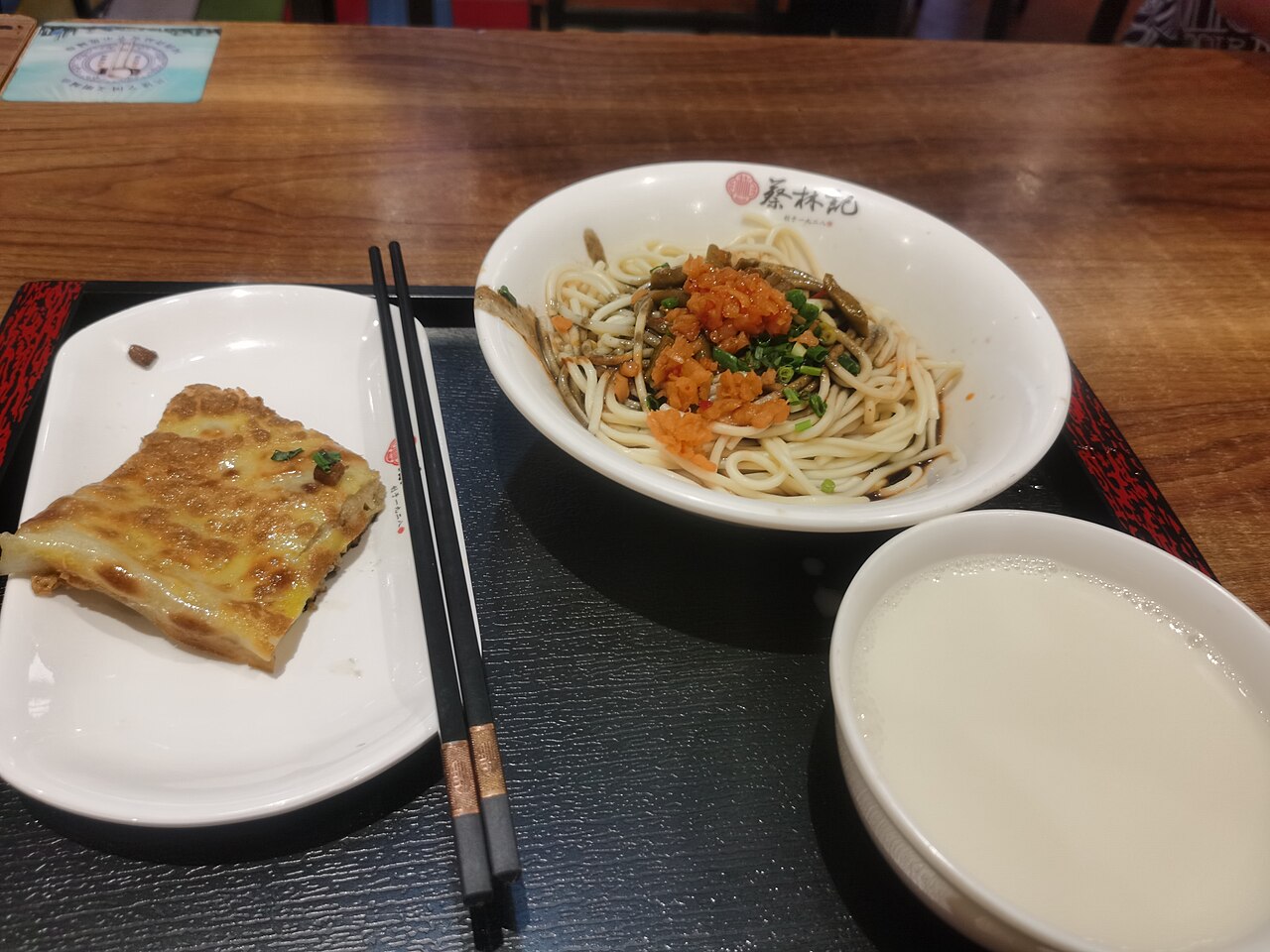
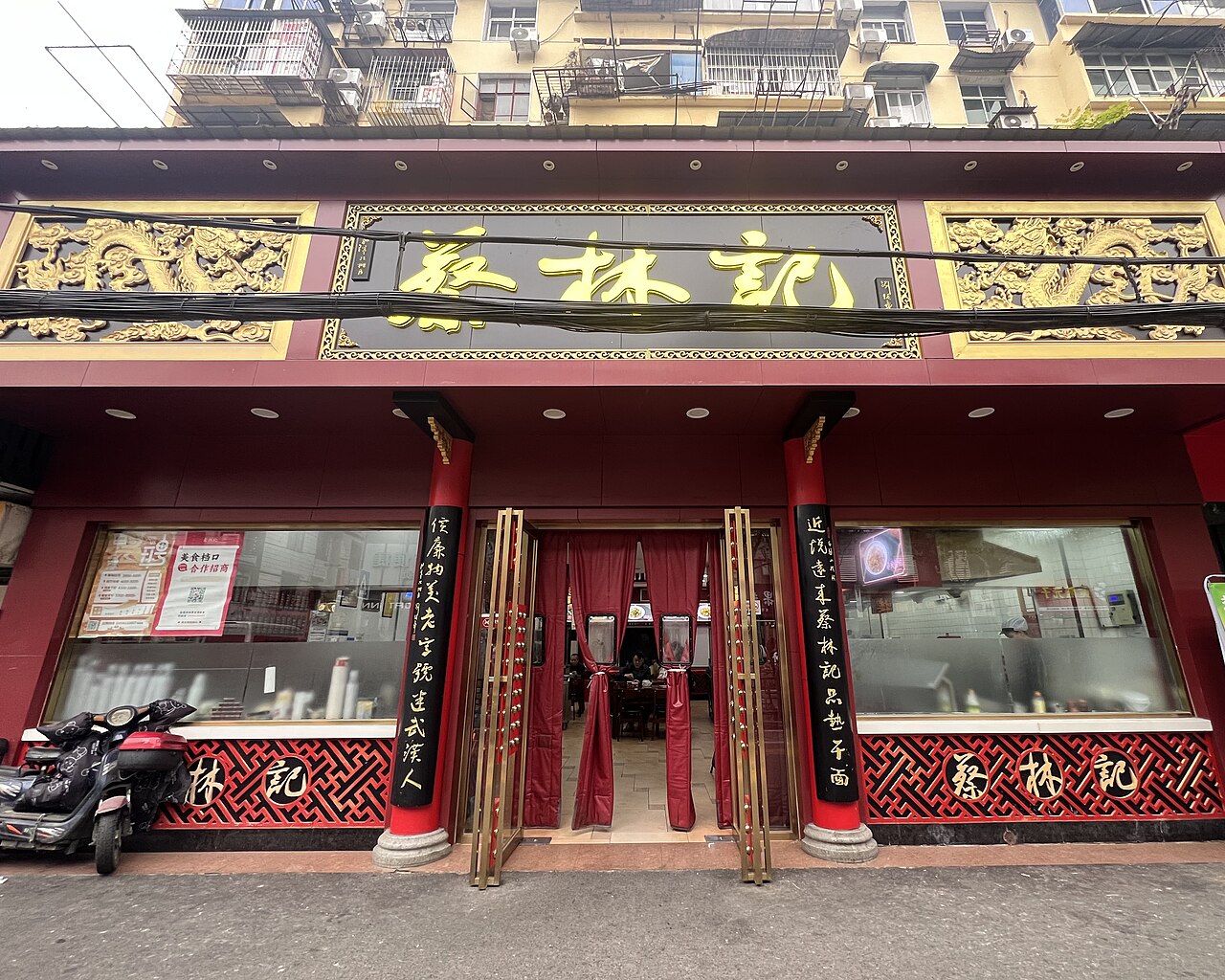
Inside modern central kitchens operated by chains like Changqing Maixiangyuan (over 1,000 stores), Cai Lin Ji, and wholesale wet-noodle specialists, automated stainless-steel lines replicate the old master’s touch at industrial scale. Vacuum dough mixers hydrate flour with metered sodium-carbonate solutions in oxygen-reduced chambers; seven-to-nine-stage compound rollers compress gluten sheets into uniform 1.6–1.8 mm round strands; steam-and-boil tunnels gelatinize starch to an exact core translucency before high-velocity sterile cooling fans and electrostatic oil misters coat every strand in a microscopic film of sesame or vegetable oil.
In 2024, Wuhan codified this industrial transformation under municipal standard DB 4201/T 699-2024 (Specification for Production Management of Wuhan Reganmian), formally classifying the midstream supply chain into six distinct commercial formats:
| Supply Chain Tier | Standardized Format / Node | Representative Hubs & Players | Core Technical Barrier | Primary Downstream Channel |
|---|---|---|---|---|
| Upstream Ag-Inputs | Specialty strong flour, high-oil sesame, fermented pickles | Yihai Kerry Wuhan, COFCO, Xiangyang sesame belt, Huangpi pickle plants | Wet-gluten stabilization (32%+), aflatoxin-free low-temp sesame roasting | Central noodle plants & sauce OEMs |
| Midstream Fresh/Chilled | Raw wet (shengshi), Parboiled (banshu), Quick-frozen (sudong) | Changqing Central Kitchen, Cai Lin Ji Central Plant, wholesale wet mills | Precision 80% starch gelatinization, mist-oiling, 0–10°C cold chain & -18°C IQF | 20,000+ Wuhan stalls, high-speed rail catering, nationwide chains |
| Midstream Shelf-Stable | Raw dried (shenggan), Instant dried, Instant fresh-lock wet | Dahankou (Dongxihu), Cai Lin Ji, Baixiang, Xiangnian, Bestore OEMs | Non-fried hot-air microporous drying; lactic-acid pH buffering + pasteurization | National supermarkets, livestream e-commerce, 20+ export markets |
| Ancillary Packaging | Micro-milled sauce sachets, PE-lined paper bowls, Guozao drinks | Fudafang Oils, Jinhuiquan Beverages, food-grade greaseproof paper mills | Anti-separation colloid milling; heat-resistant greaseproof bowl lamination | Street takeout stalls & retail meal kits |
Downstream Dual Engines: Neighborhood Stalls Meet Global New Retail
Downstream, the multi-billion-RMB economy runs on two complementary engines that reinforce rather than cannibalize one another.
The first engine is hyper-dense brick-and-mortar catering. Flagship chains like Cai Lin Ji and Changqing Maixiangyuan leverage centralized cold-chain logistics to standardize quality across shopping malls, metro concourses, airports, and overseas outposts in Singapore and Malaysia. Simultaneously, tens of thousands of independent neighborhood shops buy factory-parboiled noodles at wholesale (around 2.0–2.5 RMB per 500g) while fiercely guarding their proprietary ten-spice braising broths, house-infused chili oils, and raw-blanched beef toppings—preserving the soulful diversity that Wuhan locals prize.
The second engine is omni-channel packaged retail. Pioneered by Dongxihu’s Dahankou in non-fried dried blocks and supercharged post-2020 by Heritage brands, snack giants (Bestore), and fresh-lock innovators (Baixiang, Jinmiantang), packaged Reganmian has grown into a multi-hundred-million-RMB online category across Tmall, Douyin livestreaming, Sam’s Club, and Hema Fresh. What began as a dockworker’s quick morning fuel on the Hankou wharves now operates as a textbook study in how Chinese regional culinary heritage scales into modern food engineering without losing its streetwise soul.
- Wuhan Market Regulation Administration: Specification for Production Management of Wuhan Reganmian (DB 4201/T 699-2024)
- CBNData & Wuhan Catering Industry Association Annual Chinese Regional Noodle Industry Reports
- Hubei Provincial Department of Agriculture and Rural Affairs: High-Gluten Wheat & White Sesame Terroir Bulletins
❓ Frequently Asked Questions
How many bowls of Reganmian does Wuhan actually consume in a single day?
Industry associations and wholesale flour-mill data indicate that Wuhan consumes between 1,000 and 2,000 metric tons of parboiled alkaline wet noodles daily across morning Guozao and late-night stalls—translating to roughly 5 to 8 million individual bowls every twenty-four hours.
Do neighborhood Wuhan noodle shops make their alkaline noodles from scratch?
Very few do today. Because authentic Reganmian requires precise sodium-carbonate hydration, multi-stage roller sheeting, and 80%-cooked oil-tossed parboiling (danmian), over 85% of independent shops source pre-parboiled wet noodles delivered before 5:00 AM from automated central factories.
How do Hubei and neighboring Henan collaborate in the Reganmian supply chain?
While Wuhan anchors brand equity, sesame processing, and wet-noodle culinary standards, neighboring Henan—China's largest wheat-milling province—supplies vast quantities of high-gluten flour and hosts major dried and fresh-lock instant noodle factories such as Baixiang and Xiangnian.
✦ Cross-Referenced Chapters
Hubei Agricultural Terroir: Jianghan Wheat & Xiangyang Sesame
Tracing geographic-indication raw materials across Northern Hubei wheat belts and central Hubei high-oil white sesame farms.
Commercial Noodle Shop Batch Formula & SOP
Professional 25kg batch noodle parboiling, master spiced broth formulation, and high-volume breakfast rush workflow.
Official Technical Standards: Hubei DB42 Specifications Decoded
Key physicochemical, moisture, alkalinity, and sesame purity benchmarks codified in Hubei’s official regional standards.
Small Noodle Shop Unit Economics: Inside a 5-RMB Bowl
Breaking down per-bowl ingredient costs, paper bowl overhead, morning peak throughput, and neighborhood shop profitability.