Commercial Noodle Shop Batch Formula & SOP
25kg Wet Alkaline Noodle Parboiling, 10kg Ten-Spice Master Broth, Vat Sesame Emulsion, and Peak-Hour Portion Control
A complete operational manual and master batch formula for brick-and-mortar Reganmian shops. Covers 25kg staggered Danmian parboiling protocols, gram-exact 10kg botanical spiced soy broth, 10kg anti-separation sesame-peanut vat emulsification, portion-ladle calibration, and DB 4201/T 699 food-safety compliance.
🍜 Standardized Culinary Formula Card
Ingredients
- [Bulk Noodle Base] Commercial high-gluten wet alkaline noodles (moisture 31%–33%, pH 7.8–8.8, 1.75mm round): 25 kg
- [Danmian Oil Blend] Refined Grade-1 soybean oil (pre-heated to 170°C & cooled): 700g + Small-mill toasted sesame oil: 200g (900g total)
- [10kg Ten-Spice Lushui · Stock] Cracked pork femur bones: 1,500g, chicken frames: 500g, water: 8,000g
- [10kg Ten-Spice Lushui · Botanical Sachet] Star anise: 35g, cassia bark: 22g, deseeded black cardamom (tsaoko): 15g (3 pods), fennel seed: 18g, 3-year aged tangerine peel: 15g, bay leaves: 12g, licorice root: 12g, galangal: 15g, Hanyuan red Sichuan peppercorn: 18g, whole cloves: 3g (strictly capped)
- [10kg Ten-Spice Lushui · Aromatics & Soy] Oil-browned scallions/ginger/garlic/onion: 450g, premium brewed light soy sauce: 2,200g, mushroom dark soy sauce: 420g, yellow rock sugar: 480g, salt: 180g, MSG: 120g, chicken bouillon powder: 100g, 52%-ABV grain baijiu: 50g
- [10kg Commercial Sesame Vat] Stone-ground white sesame paste: 4,000g, smooth roasted peanut paste: 1,000g, toasted sesame oil: 600g, cooled cooked soybean oil: 1,000g, 45°C scallion-ginger steeped water: 3,250g, fine sugar: 80g, salt: 50g, MSG: 20g
Key Steps
- Brew 10kg Ten-Spice Master Lushui: Blanch pork bones and chicken frames, then simmer gently in 8,000g fresh water for 2 hours to yield ~6,200g clear bone stock. Rinse the 10 botanical spices in warm water for 10 minutes and tie in cheesecloth. Fry bruised scallions, ginger, garlic, and onion in a little oil until golden brown; transfer to the stock with the spice sachet and simmer 40 minutes. Add light soy, dark soy, rock sugar, and salt; simmer 20 minutes more. Stir in MSG, bouillon, and baijiu off-heat, steep covered for 40 minutes, strain, and chill rapidly.
- Emulsify 10kg Anti-Separation Sesame Vat: Combine 4,000g sesame paste and 1,000g peanut paste in a deep stainless drum. Pour in 600g sesame oil and 1,000g cooled cooked soybean oil; mix clockwise with a low-speed planetary or paddle mixer for 5 minutes until completely homogeneous. Stream in 3,250g of 45°C scallion-ginger water along with sugar, salt, and MSG in 5 staged additions, mixing until glossy, satin-smooth, and ribboning off a ladle. Rest covered for 30 minutes.
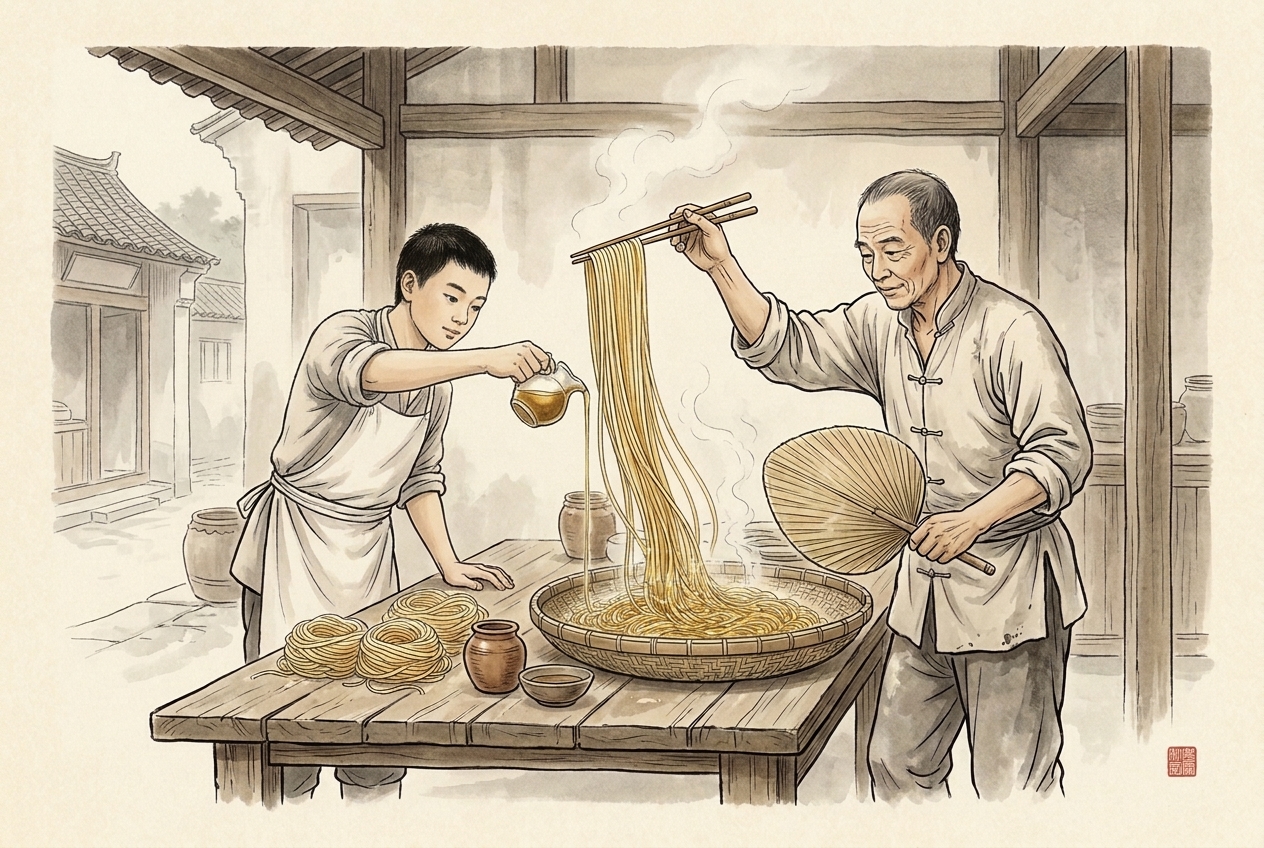
- Staggered 25kg Danmian Line: In a 100L roaring cauldron, parboil exactly 4.5kg of wet alkaline noodles per batch for 65–75 seconds to a pinhead white core. Snap-drain, spread onto a fan-cooled stainless table, vent steam for 25 seconds, mist evenly with 150g of the oil blend per batch (900g across 6 batches), and toss for 2 minutes until <30°C. Load loosely (<15cm deep) into cloth-lined ventilated totes.
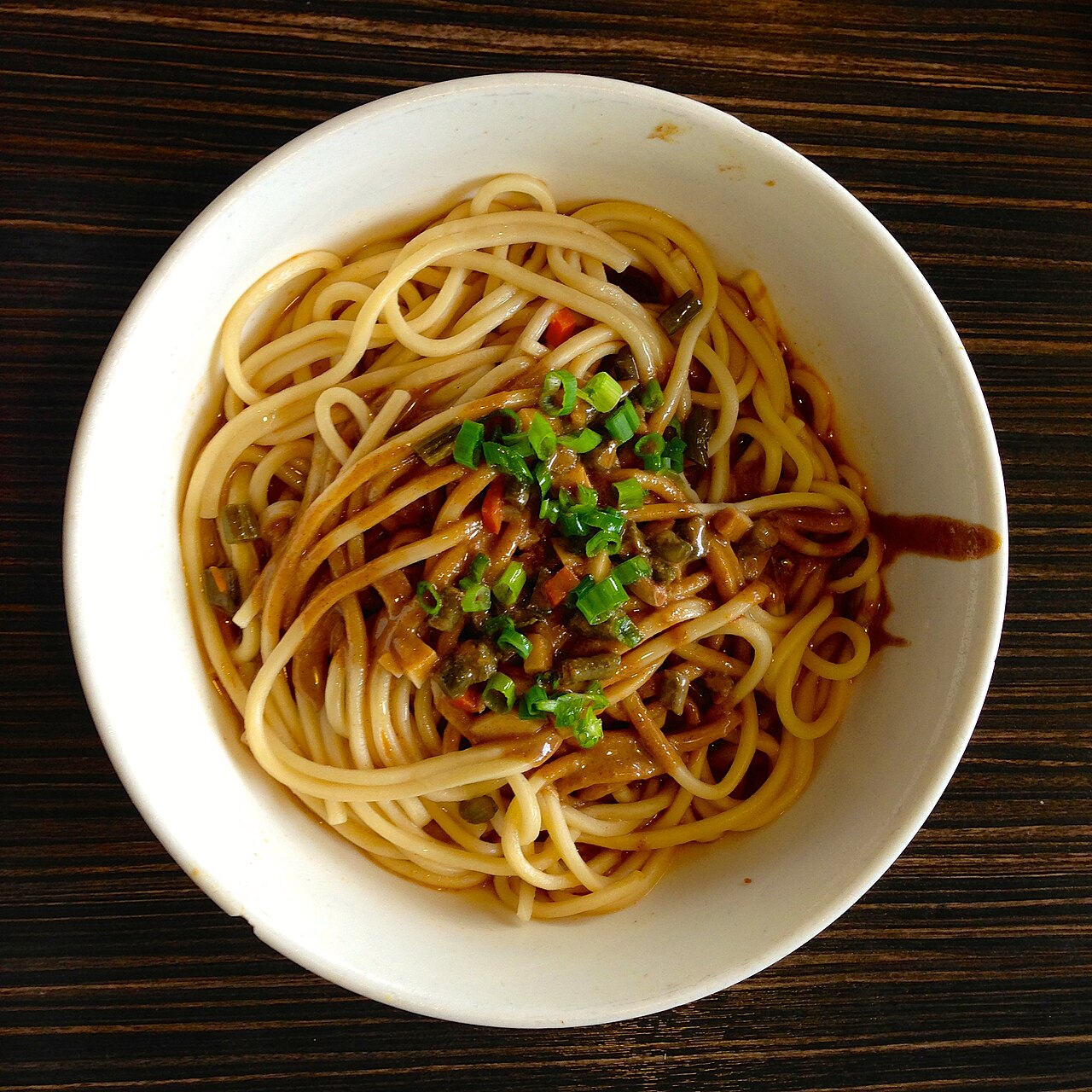
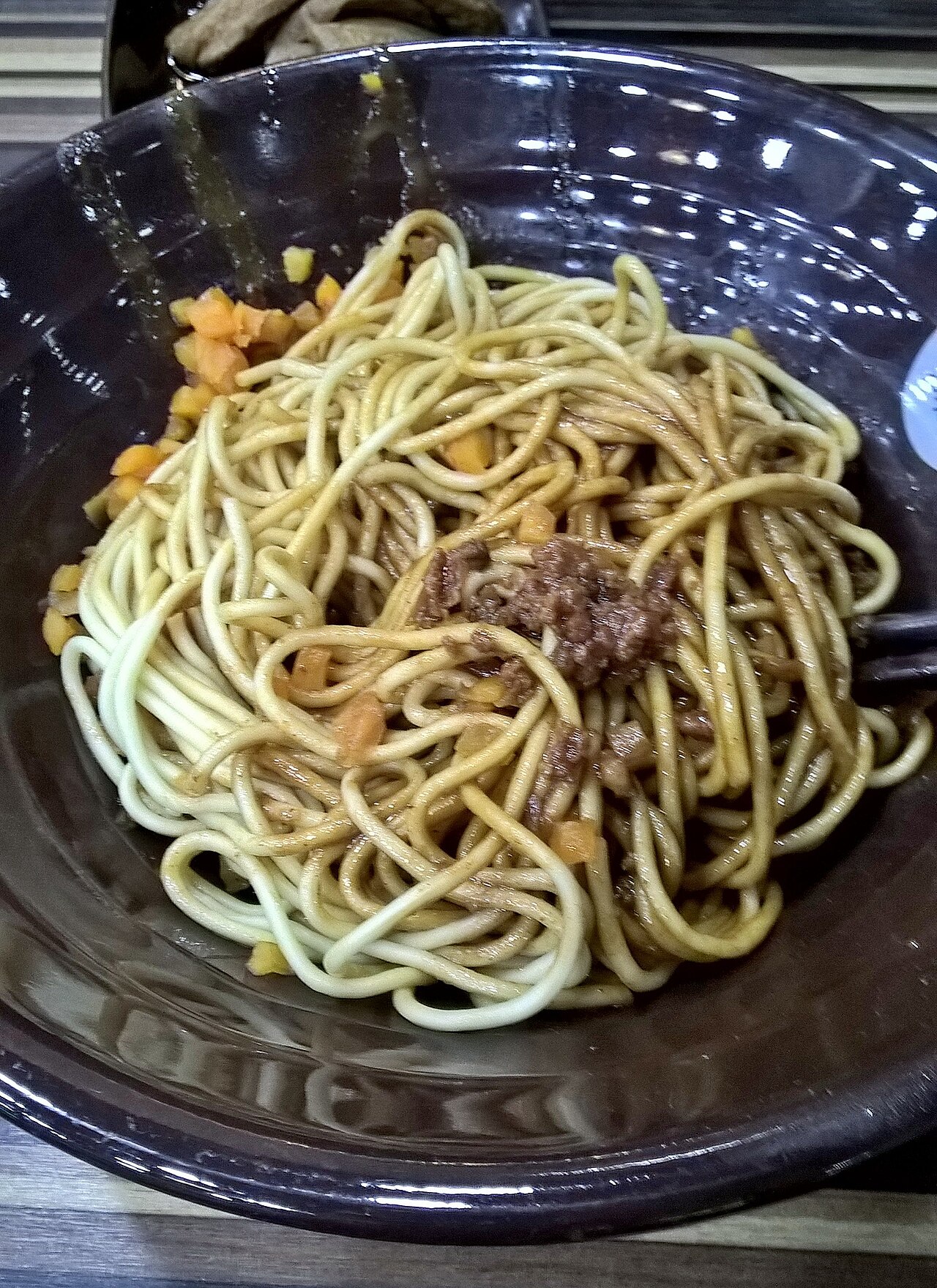
- Peak-Hour Counter SOP: Maintain blanching cauldron ≥98°C. Blanch 140g parboiled noodles in a conical bamboo strainer for 6–8 seconds, execute 'three tosses, two taps' into a paper bowl (~200g hot), and ladle calibrated portions: 18ml Lushui, 10ml fresh garlic water, 5ml light soy, 1.2g pepper-salt, 15g each pickled radish and sour cowpeas, 38g vat sesame paste, 5g scallions, and optional chili oil within 12 seconds.
Engineering Consistency at 800 Bowls a Morning
In Wuhan’s fiercely competitive Guozao breakfast economy, a 25-square-meter neighborhood shop routinely serves between 500 and 1,200 bowls between 5:30 AM and 10:00 AM. At that velocity, seat-of-the-pants cooking collapses instantly: if the 6:00 AM sesame paste flows like silk while the 9:00 AM bottom-of-the-crock paste turns into dry mortar, or if overloaded parboil batches turn mushy, neighborhood regulars defect across the street tomorrow.
Behind every enduring Wuhan noodle institution lies a ruthlessly standardized Standard Operating Procedure (SOP) calibrated in grams, seconds, and degrees Celsius. Aligned with Wuhan’s municipal standard DB 4201/T 699-2024 and proven shop-floor unit economics, here is the complete commercial production blueprint scaled to a one-shift 25-kilogram (50-jin, ~180-bowl) baseline.
“One hundred bowls tasting identical makes a shop; one thousand mornings without drift builds a heritage brand. Drift five grams per bowl, and thirty percent of your net margin vanishes.” — Operational maxim of Wuhan chain noodle operators
Pillar I: The 25-Kilogram Staggered Danmian Protocol
When contracting with a central wet-noodle factory, specify three non-negotiable raw parameters: wet gluten content ≥30%, raw dough hydration 31%–33%, and food-grade sodium carbonate pH between 7.8 and 8.8 (zero borax), cut to a 1.75mm round strand.
- The 78/22 Commercial Oil Blend: Using 100% toasted sesame oil for bulk Danmian not only inflates raw cost but risks heavy, stale lipid notes after four hours under cooling fans. The industry gold standard blends 700g refined soybean oil (pre-heated to 170°C to banish raw bean notes, then cooled below 50°C) with 200g pure small-mill sesame oil—a 3.6% oil-to-wet-noodle ratio. Never heat toasted sesame oil to smoking, or its delicate volatile aromatics evaporate into the hood.
- Six-Batch Discipline & Water Refresh: In a 100-liter high-output gas boiler, cap every drop at 4.5 kg (9 jin)—six sequential drops per 25kg sack. After every third drop, skim floating flour foam, drain 25% of the starchy alkaline water, and top back up from a side boiling tank so thermal transfer stays razor-sharp.
- 15-Centimeter Tote Limit: Cool strands to 28°C–30°C within two minutes on a dual-fan stainless cooling table. Store in food-grade perforated totes lined with breathable cotton gauze stacked no deeper than 15 cm. Packing warm noodles 40 cm deep compresses the bottom layer into an unusable block.
Pillar II: 10-Kilogram “Ten-Spice Master Lushui” Formulation
Novices assume soy sauce seasons Reganmian; insiders know the secret backbone is Ten-Spice Lushui (十香卤水)—an amber, savory-sweet botanical soy infusion built over light pork-and-chicken bone stock without greasy meat fat:
- Balanced Ten-Botanical Architecture (163g dry spices per 10kg yield):
- Monarch Notes (Sweet-Warm Body): Star anise 35g, cassia bark 22g;
- Minister Notes (Savory Depth & Deodorizing): Deseeded black tsaoko cardamom 15g (remove seeds to avoid astringency), galangal 15g, Hanyuan red Sichuan peppercorns 18g;
- Assistant Notes (Citrus-Herbal Lift): Fennel seeds 18g, 3-year aged Xinhui tangerine peel 15g (pith scraped), bay leaves 12g;
- Envoy Notes (Lingering Finish): Licorice root 12g, whole cloves strictly capped at 3g (exceeding 5g of eugenol overwhelms sesame paste!).
- Extraction Sequence: Simmer spices and golden-fried alliums in bone stock for 40 minutes before adding soy sauces and yellow rock sugar (high salinity early on inhibits essential-oil extraction). Finish off-heat with 50g of 52%-ABV grain baijiu to esterify aromatics. Ice-bath chill immediately and hold at 0°C–4°C for up to 72 hours.
Pillar III: 10-Kilogram Anti-Separation Sesame Vat
Nothing kills morning throughput faster than a sesame crock that weeps oil on top and cakes at the bottom. Commercial kitchens achieve 6-hour colloidal stability via 80/20 Sesame-Peanut Blending + Low-Shear Mechanical Emulsification:
- Strict Addition Sequence: Blend 4,000g stone-ground white sesame paste + 1,000g smooth roasted peanut paste with 600g toasted sesame oil + 1,000g cooled cooked soybean oil completely anhydrously for 5 minutes at low speed. Only then stream in 3,250g of 45°C scallion-ginger infusion in five increments alongside 80g sugar, 50g salt, and 20g MSG.
- Viscometric Ribbon Check: Lift a 40g flat ladle 20cm above the vat and tilt: the sauce must fall in an unbroken 1.5cm-wide satin ribbon whose surface folds melt smooth within 2.5 seconds. In winter (<5°C), increase warm water by 150–200g to offset cold thickening.
Standardized Per-Bowl Portioning & QC Table
Equip the assembly line with fixed-volume portioning ladles so every staff member hits identical flavor and food-cost targets:
| Sequence | Component | Exact Bowl Spec | Calibrated Tool | Quality-Control Rule |
|---|---|---|---|---|
| Step 1 | Parboiled Danmian | 140 g (~200g blanched) | Spot-checked by digital scale | 6–8s at ≥98°C; three-toss two-tap drain |
| Step 2 | Ten-Spice Lushui | 18 ml | 18ml oz-ladle (level) | Held warm at 55°C–65°C in bain-marie |
| Step 3 | Fresh Garlic Water | 10 ml | 10ml long-handle spoon | Mashed fresh daily; discard after 6 hrs if green/oxidized |
| Step 4 | Light Soy + Pepper-Salt | 5 ml + 1.2 g | Metered pump / dredge shaker | Halve automatically on “light salt” orders |
| Step 5 | Radish Dices + Sour Beans | 15 g + 15 g | Two 15g shallow scoops | Dry-wok sautéed with oil; zero raw brine puddles |
| Step 6 | Vat Sesame Paste | 38 g – 42 g | 40g flat-bottom paste ladle | Ribboned across center; stir vat bottom every 30m |
| Step 7 | Scallions + Chili Oil | 5 g + 8 g (on request) | Tongs / crisp-flake ladle | Air-dried fine green scallions; scoop crisp flakes with oil |
Mandatory Food Safety Checkpoints (DB 4201/T 699)
- Four-Hour Ambient Rule: Parboiled oiled noodles held at room temperature during warm months must be sold within 4 hours or held under ≤10°C refrigeration; never carry ambient leftovers into the next day’s batch.
- Mycotoxin Verification: Require batch certificates of analysis from sesame and peanut paste suppliers verifying Aflatoxin $B_1 \le 20,\mu\text{g/kg}$, acid value, and peroxide value compliance.
- DB 4201/T 699-2024: Specification for Production Management of Wuhan Reganmian, Wuhan Municipal Market Regulation Administration
- Wuhan Catering Industry Association Reganmian Committee Technical SOP Compendium
- GB 31654-2021: National Food Safety Standard—General Hygienic Specification for Catering Services
❓ Frequently Asked Questions
When prepping 25kg (50 jin) of fresh wet alkaline noodles, can we boil them in two giant batches?
Never overload the cauldron! Even in a 100-liter high-BTU commercial noodle boiler, each batch must be capped at 4.0 to 4.5 kg (8–9 jin)—six staggered batches for 25kg. Dumping 12kg at once crashes water temperature below 85°C, strips surface starch into glue, and ruins core uniformity. Skim foam and replenish 25% fresh boiling water after every third batch.
Why do most commercial Wuhan shops blend 20% roasted peanut butter and cooked soybean oil into their sesame paste vat?
While heritage purist flagships serve 100% stone-ground sesame paste, roughly 80% of neighborhood champions use an 80/20 white-sesame-to-peanut blend emulsified with a 1:1.6 mix of small-mill sesame oil and cooked neutral soybean oil. Roasted peanuts contribute sweet Maillard pyrazines that round off sesame hull bitterness, while neutral oil prevents heavy flavor oxidation and phase separation across a five-hour morning rush.
Is Reganmian master broth ('Lushui') recycled endlessly like braised meat master stock?
No. Unlike fatty meat braising liquids ('laolu'), Reganmian ten-spice Lushui is a clean, botanical-infused bone-and-soy essence. To preserve bright top notes and prevent summer souring or nitrite buildup, commercial shops brew fresh 10kg batches every 48 to 72 hours, chill rapidly in stainless buckets at 0°C–4°C, and decant daily counter portions.
✦ Cross-Referenced Chapters
Scallions, Garlic Water & Secret Spiced Braising Broth
Uncovering the hidden umami backbone: raw crushed garlic infusion and ten-spice star-anise soy broth at the bottom of the bowl.
The Core Art of "Danmian": Parboiling & Oil-Tossing
Step-by-step mastery of 80%-cooked boiling, fan-cooling, and sesame-oil tossing that keeps alkaline noodles springy for hours.
Street Blanching & The Golden Ten-Second Bowl
Deconstructing the street master’s 6-second boiling dip, triple wrist-shake drain, and rapid sauce ladling.
Official Technical Standards: Hubei DB42 Specifications Decoded
Key physicochemical, moisture, alkalinity, and sesame purity benchmarks codified in Hubei’s official regional standards.
Small Noodle Shop Unit Economics: Inside a 5-RMB Bowl
Breaking down per-bowl ingredient costs, paper bowl overhead, morning peak throughput, and neighborhood shop profitability.