Food Safety Standards & Fresh Alkaline Noodle Storage
Eliminating Illicit Borax, Enforcing Aflatoxin Limits, and Mastering Four-Zone Shelf-Life Windows for Fresh Danmian
Tracing Wuhan Reganmian's evolution from 1930s anti-spoilage street ingenuity to modern regulatory rigor: the criminal ban on borax, safe GB 2760 alkali-hydrocolloid replacements, GB 2761 aflatoxin B1 controls in sesame paste (≤20 μg/kg), and microbiological storage protocols for fresh oil-tossed alkaline noodles.
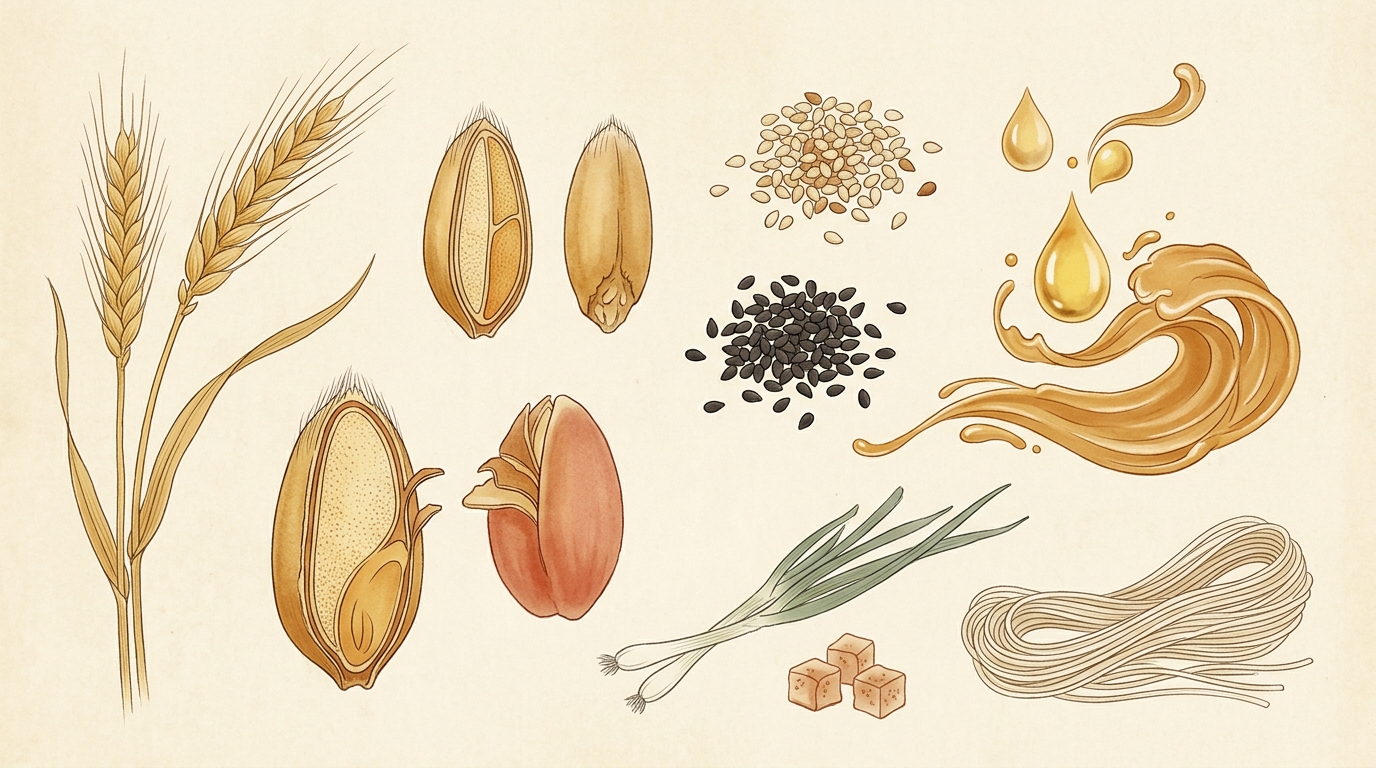
Born Against Spoilage: A Century of Food-Safety Evolution
There is a poetic irony at the heart of Wuhan culinary history: Reganmian owes its very existence to food preservation. In the sweltering, pre-refrigeration Hankou summer of the early 1930s, street vendor Li Bao parboiled his unsold raw noodles to 80% doneness, fanned them cool, and coated them in sesame oil to delay souring until the next morning’s rush. In food-engineering terms, Li Bao improvised an empirical hurdle-technology system—combining thermal vegetative-cell reduction, surface moisture evaporation, alkaline pH elevation, and a hydrophobic lipid coat.
Over the ensuing ninety years, Wuhan’s signature breakfast transitioned from open-air bamboo trays to automated sterile central kitchens governed by Hubei Provincial Local Standard DBS42/005 and municipal production codes. Understanding both the regulatory victories of modern noodle manufacturing and the microbiological boundaries of fresh alkaline noodles empowers every cook and diner to eat with complete confidence.
“Sesame oil once shielded noodles from a single summer dusk; science now guards them across oceans.” — Modern Wuhan Food Engineering Maxim
Banishing Borax: From Criminal Crackdowns to Clean-Label Elasticity
During the mid-20th century, before dedicated high-gluten noodle flours and cold-chain logistics were widely accessible, unscrupulous back-alley noodle makers across parts of East and Southeast Asia occasionally adulterated wet noodles with borax (sodium tetraborate decahydrate, $\text{Na}_2\text{B}_4\text{O}_7 \cdot 10\text{H}_2\text{O}$).
Why Borax Is Strictly Outlawed
While borate ions crosslink starch and protein chains into an unnatural rubbery chew, gastric hydrochloric acid immediately converts ingested borax into boric acid ($\text{H}_3\text{BO}_3$)—a cumulative cellular poison targeting the kidneys, liver, central nervous system, and reproductive organs (acute adult toxicity begins at just 1–3 grams).
In 2008, China’s Ministry of Health placed borax atop its First List of Illegal Non-Edible Substances in Food. Adding borax to noodles is prosecuted as a felony under Article 144 of the Criminal Law of the PRC (Producing and Selling Toxic or Harmful Foods). Municipal market inspectors across Wuhan conduct routine pre-dawn rapid turmeric-paper screenings and ICP-MS laboratory audits at wet markets and breakfast stalls, reducing illicit borax incidence in regulated channels to zero.
Safe, Compliant Modern Texture Engineering (GB 2760)
Legitimate Reganmian producers achieve crisp, snappy resilience transparently under China’s GB 2760 Food Additive Standard:
- High-Gluten Wheat Cores & Vital Wheat Gluten: Starting with 12%–13.5% protein flour supplies abundant natural glutenin polymers;
- Food-Grade Sodium & Potassium Carbonates: Cleanly elevate dough pH to 9.5–10.2 to catalyze natural disulfide crosslinking;
- Seaweed-Derived Sodium Alginate & Food-Grade Phosphates: Used in trace, regulated fractions in packaged wet noodles to lock hydration and prevent strand cracking during chilled transit.
Shopper’s Sensory Check: Authentic alkaline noodles smell faintly of toasted wheat and mild mineral soda, softening naturally over time. Avoid unbranded, unrefrigerated wet noodles at open stalls that remain eerily odorless and rubber-band stiff after sitting out for days in summer heat.
Microbiology of Fresh Danmian & The Four-Zone Storage Matrix
A common household misconception holds that because danmian noodles are already parboiled, alkaline, and oiled, they are shelf-stable on a warm kitchen counter. Food microbiology proves otherwise.
Fresh oil-tossed alkaline noodles retain 52%–58% moisture and a water activity ($a_w$) of 0.94–0.96. While pH ~9.5 slows certain acidophilic molds, heat-resistant endospores of Bacillus cereus—ubiquitous in cereal grains—survive initial parboiling effortlessly. Above 28°C (routine from May through September in Wuhan), B. cereus multiplies rapidly within 4 to 6 hours, secreting cereulide, a cyclic dodecapeptide emetic toxin so thermally indestructible (stable at 121°C for 90 minutes) that a six-second morning dip in boiling water will not neutralize it!
Follow this strict four-zone preservation protocol for fresh parboiled danmian noodles:
| Storage Environment | Typical Setting | Max Safe Shelf Life | Packaging & Handling Protocol | Mandatory Re-Blanching Step |
|---|---|---|---|---|
| Hot Ambient (>28°C) | Summer kitchen / open stall | 4–6 Hours Max | Spread loosely on sanitized ventilated trays under fly screens; never seal warm noodles in plastic bags or hold overnight | Boil 6–10 sec at 100°C; verify fresh wheat aroma |
| Cool Ambient (10–18°C) | Winter / early spring pantry | 12–18 Hours | Fan completely cool to dispel steam before covering lightly with clean breathable cloth | Boil 10–12 sec until core reaches ≥85°C |
| Refrigerated (0–4°C) | Home refrigerator | 24–48 Hours | Portion cooled noodles into airtight containers immediately to block moisture loss & Listeria cross-contact | Boil 15–20 sec to reverse starch firming |
| Deep Frozen (-18°C) | Home freezer | 30–45 Days | Coil single 160g portions into loose nests inside zip-top freezer bags; oil film prevents freezer burn | Do not thaw! Plunge frozen nest into rolling boil for 25–35 sec (95% fresh bounce!) |
(Absolute Discard Rule: If fresh noodles develop even a faint sour tang, fermented yeast odor, gray mold specks, or sticky, ropy mucilage threads between fingers, discard immediately—rinsing will not remove heat-stable bacterial toxins.)
Guarding the Jar: Aflatoxin B1 Screening & Sesame Paste Care
The second pillar of Reganmian food safety governs oilseeds. When sesame seeds or peanuts encounter monsoon humidity during harvest or storage (relative humidity >80%), Aspergillus flavus and Aspergillus parasiticus molds can synthesize Aflatoxin B1—classified by the WHO International Agency for Research on Cancer (IARC) as a Group 1 human hepatocarcinogen. Because Aflatoxin B1 decomposes only above 268–280°C, normal 175°C sesame roasting cannot destroy toxin already present in moldy raw seeds.
Under China’s mandatory GB 2761-2017 Mycotoxin Standard, sesame paste and peanut paste must contain $\le 20\ \mu\text{g/kg}$ of Aflatoxin B1 (leading Wuhan heritage brands enforce internal ceilings below $5\ \mu\text{g/kg}$). Modern mills achieve compliance via <7% moisture warehousing, high-speed optical color-sorters that eject discolored seeds in milliseconds, wet hulling, and batch HPLC-fluorescence testing.
At home, protect an opened jar of pure stone-ground sesame paste with three simple habits:
- Zero Water Intrusion: Always scoop with a completely dry, clean spoon—a few drops of tap water create localized high-$a_w$ pockets where mold can bloom inside an otherwise anhydrous oil matrix.
- Keep the Floating Oil Seal: Do not pour off the thin amber layer of separated sesame oil on top; it acts as an anaerobic barrier preventing atmospheric oxygen from turning unsaturated fats rancid.
- Cool, Dark Storage & Bitter-Seed Vigilance: Store tightly capped away from stove heat (<20°C), and discard any paste or seed batch that tastes sharp, acrid, bitter, or painty (halawei).
- National Food Safety Standard of China: Maximum Levels of Mycotoxins in Foods (GB 2761-2017) & Food Additives Standard (GB 2760).
- Hubei Provincial Food Safety Local Standard: Wuhan Reganmian (DBS42/005) & Wuhan Reganmian Production Management Specification.
- EFSA Panel on Biological Hazards (BIOHAZ). Risks for public health related to the presence of Bacillus cereus in foodstuffs.
❓ Frequently Asked Questions
Why was borax historically abused in artisanal Asian noodles, and what makes modern Reganmian safely springy?
Decades ago, rogue workshops occasionally added industrial borax (sodium tetraborate) to cheap low-protein flour to artificially toughen strands. Because borax converts to toxic boric acid in stomach acid—damaging kidneys and liver—China banned it as a criminal offense. Modern producers achieve superior bounce safely using high-gluten wheat flour, food-grade sodium/potassium carbonate, and trace seaweed-derived sodium alginate under GB 2760.
Can fresh parboiled and oil-tossed Reganmian ('Danmian') sit out overnight on a kitchen counter in summer?
Never. Fresh Danmian retains 52%–58% moisture and a high water activity (aw ~0.95). Left above 28°C for more than 4–6 hours, heat-resistant Bacillus cereus spores germinate and secrete cereulide—an emetic toxin that survives 100°C boiling water! Always refrigerate unused fresh noodles at 0–4°C promptly or freeze at -18°C.
Is the layer of clear oil floating on top of jarred pure sesame paste a sign of spoilage?
Quite the opposite—that supernatant sesame-oil layer forms a natural oxygen barrier that protects the paste underneath from lipid rancidity. Stir gently with a bone-dry spoon before scooping, never introduce water droplets into the jar, and store tightly capped in a cool, dark cupboard.
✦ Cross-Referenced Chapters
Origin Legends: Li Bao & Cai Mingwei Textual Inquiry
Investigating the two foundational 1930s Hankou accounts—street peddler Li Bao on Changdi Street and Cai Mingwei’s Cai Lin Ji.
Secrets of Alkaline Noodles (Jianshuimian)
High-gluten flour specifications, sodium carbonate ratios, 1.8mm round strand geometry, and signature springy chew.
Soul of the Bowl: Stone-Ground Sesame Paste Craft
Low-temperature roasting, stone-mill grinding, and the great culinary debate between 100% pure sesame vs. 80/20 sesame-peanut blends.
Guidance for Special Diets & Allergen Warnings
Tailored advice for endurance athletes, sensitive stomachs, sodium-restricted diets, and sesame/peanut/gluten allergies.
Official Technical Standards: Hubei DB42 Specifications Decoded
Key physicochemical, moisture, alkalinity, and sesame purity benchmarks codified in Hubei’s official regional standards.
Food Engineering Breakthroughs: Fresh-Lock Pouches & Microwave Bowls
How organic-acid pH control, nitrogen-flushed wet noodles, and micro-milled anti-separation sesame packs revolutionized shelf life.