Soul of the Bowl: Stone-Ground Sesame Paste Craft
Hubei White Sesame, Slow Bluestone Milling, and the Great Pure-vs.-80/20 Blend Debate
Exploring the aromatic heart of Wuhan Reganmian: how plump Hubei white sesame seeds are water-washed, gently roasted at 155°C, and cold-milled between slow bluestone wheels—plus an impartial look at the rivalry between 100% pure sesame purists and 80/20 peanut-blend shops.
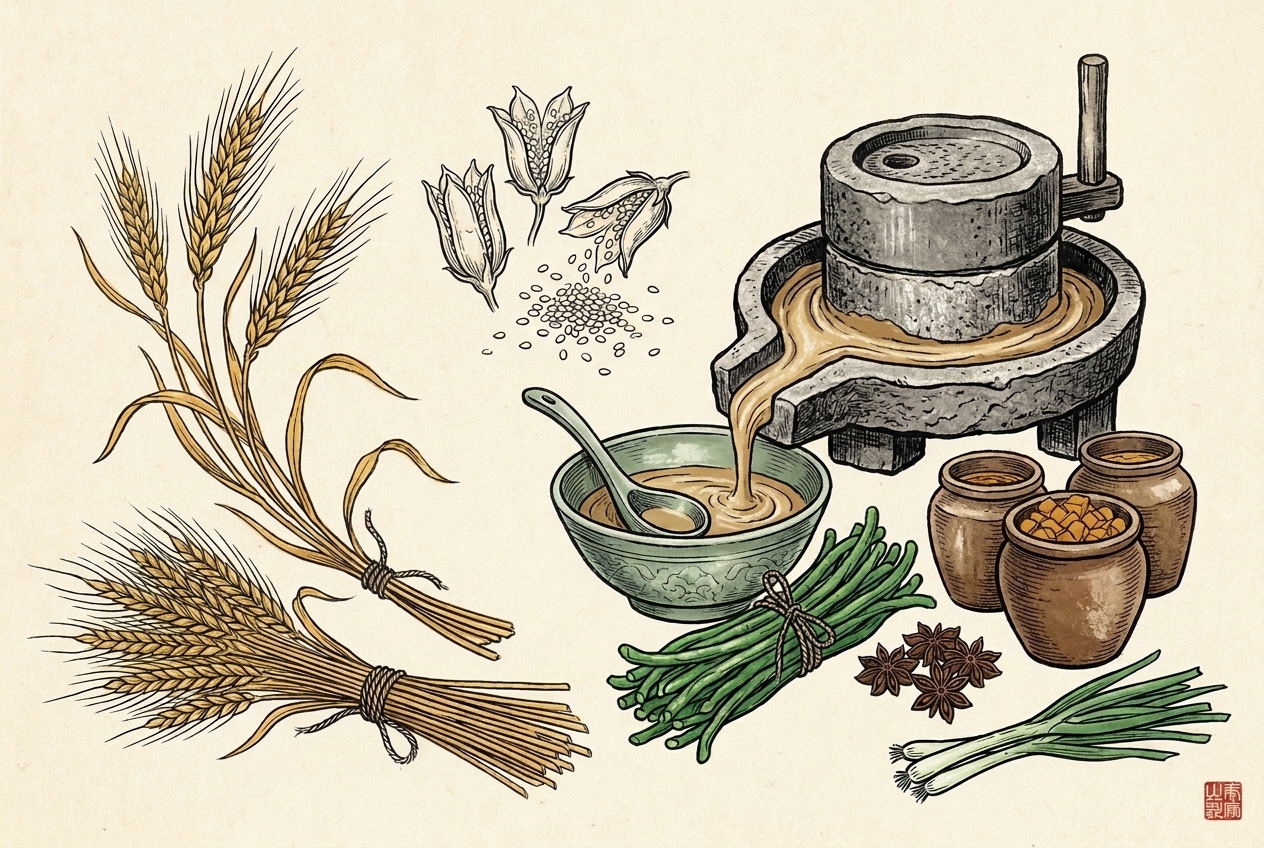
If Alkaline Noodles Are the Bone, Sesame Paste Is the Soul
Walk blindfolded down any residential lane in Wuhan at 6:30 AM, and your nose will map every Reganmian stall half a block away. When a bamboo strainer of piping-hot alkaline noodles lands atop a ladleful of stone-ground sesame paste, the rising thermal plume volatilizes dozens of roasted lipid aromatics into the morning mist. That single ladle—thick, glossy, ochre-gold, and unapologetically rich—is what separates Wuhan Hot Dry Noodles from every broth noodle and chili-oil noodle in China.
For international diners accustomed to Middle Eastern tahini, Chinese zhimajiang (芝麻酱) is a revelation. Whereas classic tahini grinds raw or barely warmed hulled seeds into a pale, bright, slightly grassy paste, Wuhan sesame paste relies on controlled whole-seed roasting and slow stone milling to build an intense Maillard architecture closer in spirit to artisanal espresso or dark-roasted hazelnut praline.
“Jade-white seeds enter the bluestone wheel; slow turns press forth liquid amber. Call it not a humble spoonful of paste—its fragrance commands three towns and a hundred streets.” — Old Hankou oil-mill verse
When Cai Mingwei refined the modern Reganmian formula in 1930s Hankou, his stall stood near traditional sesame-oil workshops along Manchun Road and Changdi Street. Watching millers crush roasted seeds on stone wheels, he realized that pure stone-ground sesame paste possessed both the caloric density dockworkers craved and the hydrophobic lipid richness needed to cling to oil-tossed alkaline noodles without soup.
Why True Wuhan Paste Shines Ochre-Gold: The Four-Stage Craft
Visitors occasionally encounter murky, dark-chocolate-colored sauces marketed elsewhere as Wuhan sesame paste. Veteran Wuhan masters—most notably the late Cai Hanwen, son of founder Cai Mingwei—spent decades correcting this misconception: authentic Wuhan sesame paste should be warm golden-ochre to light amber, never blackened brown. Achieving that luminous color and zero-acridity finish demands four exacting steps:
- Thin-Hulled Hubei White Sesame: Craftsmen select newly harvested white (or pale yellow-white) sesame cultivars from Hubei’s Xiangyang, Zaoyang, and Jingmen plains. Boasting 52% to 58% natural oil content and paper-thin seed coats low in oxalates and bitter tannins, white sesame yields a cleaner, sweeter finish than thick-hulled black or red-brown mixed seeds.
- Water Flotation & Hydration Buffering: Raw seeds are washed in clean water channels where stones sink and empty chaff floats away. Crucially, rinsing leaves trace moisture in the outer seed coat; inside the roaster, that surface water evaporates first, acting as a thermal buffer so the delicate hull never scorches before the oil-rich kernel cooks through.
- Gentle Drum Roasting (145°C–165°C): Seeds tumble over moderate heat in rotating drums. Between 145°C and 165°C (293°F–329°F), reducing sugars and sulfur-bearing amino acids undergo controlled Maillard browning, generating nutty pyrazines, sweet caramelic furans, and savory thiazoles. The roaster pulls the batch the instant a pinched seed snaps crisply to reveal an ivory-gold interior. Pushing past 185°C produces aggressive char notes that turn the paste dark brown and leave a harsh, burnt aftertaste.
- Low-Temperature Bluestone Milling: Cooled seeds feed between grooved natural sandstone or bluestone wheels rotating at a stately 20 to 30 revolutions per minute. Unlike industrial steel colloid mills spinning at 3,000 rpm—which spike slurry temperatures past 95°C, denaturing proteins and driving off fragile top-note aromatics—stone wheels keep the paste below 55°C–60°C. Ground to 100–120 mesh fineness, microscopic protein particles remain evenly suspended in native sesame oil, producing a satin mouthfeel that melts effortlessly on the tongue.
The Great Wuhan Schism: 100% Pure Sesame vs. The 80/20 Blend
Step behind the counters of Wuhan’s top noodle shops today, and you will uncover the city’s liveliest open secret: an ongoing culinary debate between Pure White Sesame Purists and Erba (80/20) Blend Pragmatists.
| Dimension | 100% Pure White Sesame School | 80/20 Blend School (Erba Jiang) | Heavy Peanut Compromise (≥ 40% Peanut) |
|---|---|---|---|
| Typical Champions | Time-honored heritage brands, old-guard Hankou purists | Cult neighborhood stalls, modern high-volume chains | Budget canteens, non-Wuhan imitations |
| Aromatic Profile | Deep, noble toasted-sesame purity with lingering resonance | Immediate sweet roasted-peanut lift over a warm sesame base | Candy-like peanut butter dominates; sesame character lost |
| Palate & Finish | Structured, savory-nutty, whisper of refined cocoa-like bitterness | Rounded, creamy, sweeter entry with zero astringency | Cloying, sticky, heavy palate fatigue halfway through bowl |
| Thinning Difficulty | High—demands generous small-mill sesame oil to glide smoothly | Moderate—peanut lipids lower viscosity and coat strands easily | Easy to thin, but stiffens rapidly as noodles cool |
| Allergen & Cost Note | Highest raw ingredient cost; single allergen (sesame) | ~10%–15% lower cost; introduces peanut allergen | Cheap shortcut; widely rejected by Wuhan locals |
Both major camps command fierce loyalty. 100% pure white sesame paste represents historical orthodoxy: its subtle, noble bittersweetness (huigan)—derived from natural lignans like sesamin and sesamolin—plays against savory spiced soy broth the way dark chocolate or espresso balances cream. Yet pure sesame paste is unforgiving; if under-thinned or made from inferior seeds, it can feel dry on the palate.
Starting in the late twentieth century, enterprising neighborhood masters adapted the 80/20 ratio (erba jiang: 80% stone-ground white sesame paste to 20% finely roasted peanut paste, occasionally 70/30)—importantly thinned with fragrant oil in the Wuhan manner rather than cold water as in northern Chinese hotpot dips. Twenty percent peanut paste rounds off any hint of hull bitterness and amplifies immediate crowd-pleasing sweetness. Even among blend advocates, however, Wuhan’s unwritten law holds firm: peanut must never exceed 30%, lest Wuhan’s proud sesame anthem turn into ordinary peanut noodles.
- Hubei Provincial Intangible Cultural Heritage Center, Dossier on Cai Lin Ji Reganmian Craft
- National Standard of the People's Republic of China, Sesame Paste (GB/T 22478)
- Oil Crops Research Institute of CAAS (Wuhan), Studies on Maillard Volatiles in Roasted Sesame
- Cai Hanwen Oral History Archives, Wuhan Literature and History Materials
❓ Frequently Asked Questions
How does Chinese roasted sesame paste (zhimajiang) differ from Middle Eastern tahini?
Middle Eastern tahini is typically milled from hulled raw or very lightly toasted sesame seeds, yielding a pale ivory color and grassy, delicate flavor. Wuhan zhimajiang roasts whole thin-skinned white sesame seeds at 145°C–165°C before stone-grinding, unlocking deep Maillard pyrazines, warm amber color, and a vastly richer toasted bouquet.
Which is more authentic: 100% pure sesame paste or an 80/20 sesame-peanut blend?
Historically, 100% pure white sesame paste is the orthodox standard codified by heritage lineages like Cai Lin Ji, prized for its pure aroma and subtle bittersweet finish. However, many beloved neighborhood stalls blend 80% sesame with 20% roasted peanut paste to add sweet top-notes, velvety glide, and milder astringency.
Why do traditionalists insist on slow stone mills over industrial steel colloid mills?
High-speed steel colloid mills spin at ~3,000 rpm, generating frictional heat above 90°C that denatures sesame proteins and flashes off volatile aromatics. Traditional bluestone wheels turn at 20–30 rpm below 60°C, preserving delicate top-notes and creating a stable, silk-smooth suspension.
✦ Cross-Referenced Chapters
Secrets of Alkaline Noodles (Jianshuimian)
High-gluten flour specifications, sodium carbonate ratios, 1.8mm round strand geometry, and signature springy chew.
Small-Mill Sesame Oil, Blending Fats & Chili Oil
Why oil-thinned sesame paste coats every strand superiorly to water-thinned paste, plus aromatic Wuhan chili oil infusion.
Hubei Agricultural Terroir: Jianghan Wheat & Xiangyang Sesame
Tracing geographic-indication raw materials across Northern Hubei wheat belts and central Hubei high-oil white sesame farms.
Food Chemistry: Alkaline Gluten Crosslinking & Sesame Phase Inversion
How sodium carbonate strengthens disulfide gluten bonds and tints flavonoids yellow, plus the rheology of sesame paste emulsion.
Micronutrient Powerhouse: Calcium, Sesamin & Vitamin E
Analyzing pure sesame paste’s remarkable calcium density, unsaturated fatty acids, and antioxidant lignans.
China’s Sesame-Sauce Noodle Lineage: Hot, Chilled & Tossed
Contrasting Wuhan’s hot oil-emulsified alkaline strands with Beijing chilled sesame noodles, Sichuan Liangmian, and Shaxian peanut noodles.