China’s Sesame-Sauce Noodle Lineage: Hot, Chilled & Tossed
From Wuhan’s Oil-Thinned Inferno to Beijing’s Courtyard Cool: How One Roasted Seed Spawned Five Regional Icons
An analytical genealogy of China’s roasted-sesame and peanut-paste noodle traditions—contrasting Wuhan Reganmian with Old Beijing Chilled Sesame Noodles, Tianjin Fermented-Curd Sesame Noodles, Sichuan Chuanbei Liangmian and Tianshuimian, and Fujian Shaxian Peanut Noodles through emulsion rheology and regional history.
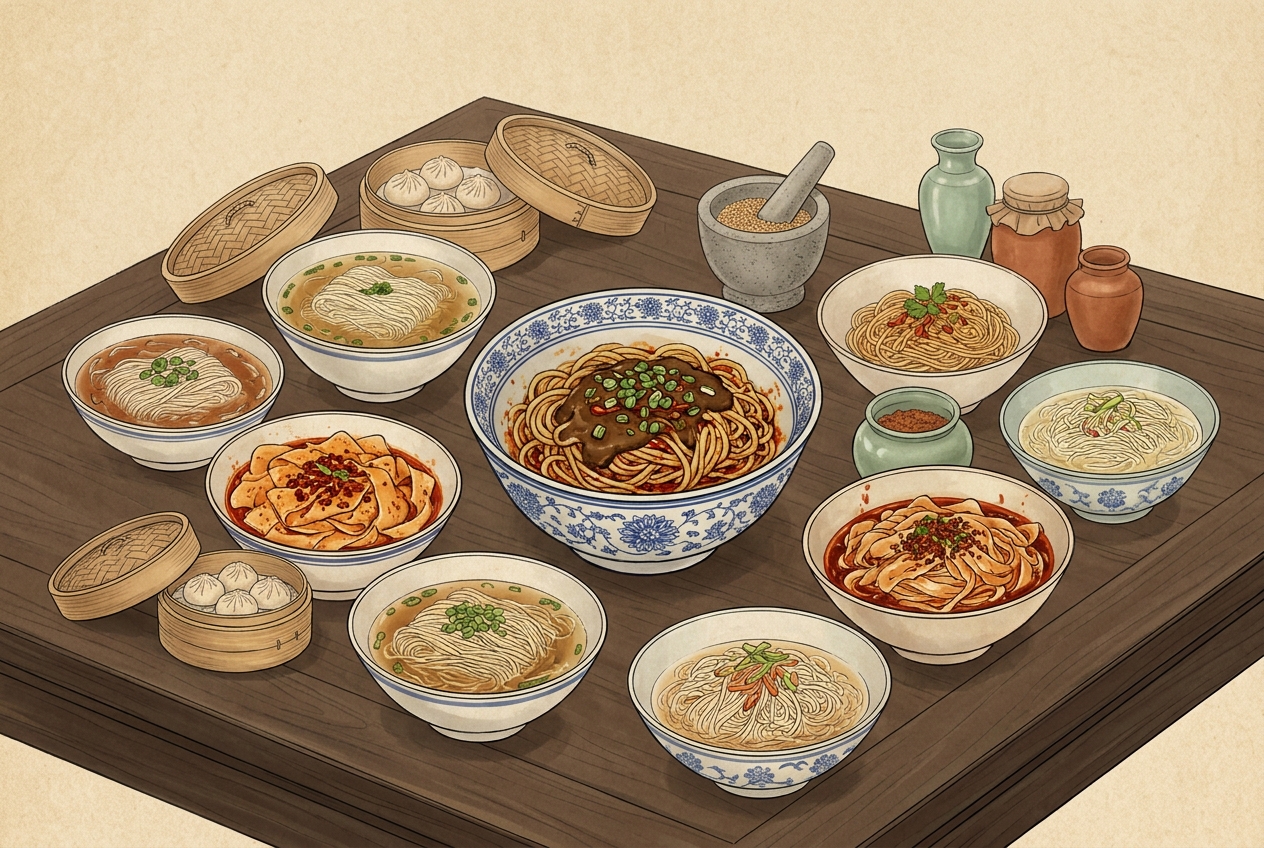
One Silk Road Seed, Five Regional Temperaments
When Han-dynasty diplomat Zhang Qian returned from Central Asia in the second century BCE bearing huma (“foreign hemp,” today’s Sesamum indicum), China gained more than an oilseed—it gained one of gastronomy’s greatest textural mediums. Crushed between slow-turning millstones so its cellular oil sacs rupture without scorching, roasted Chinese sesame paste (zhimajiang—far toastier and deeper in Maillard pyrazines than pale Mediterranean tahini made from hulled raw seeds) possesses an intoxicating aroma and an unruly physique. Left undiluted, it is a dense non-Newtonian sludge of ~55% lipid and ~45% microscopic protein and fiber solids.
Across China, five distinct noodle traditions rose to tame that paste. To a casual traveler, “Chinese sesame noodles” might sound like a single archetype. To a culinary scientist, Wuhan Reganmian, Old Beijing Chilled Sesame Noodles, Tianjin Sesame Lo Mein, Sichuan Tianshuimian & Cold Noodles, and Fujian Shaxian Peanut Noodles inhabit entirely different physical universes—divided by how they thin the paste, whether they embrace or banish heat, and how alkali shapes the strand.
“In a Beijing courtyard, sesame paste is tamed with well water and Sichuan peppercorn oil to hush the summer cicadas; on a Wuhan riverfront, it is loosened with pure sesame oil and thrown onto scalding alkaline steel to awaken a city.”
The Great Emulsion Divide: Water-Thinning vs. Oil-Thinning
The single most consequential technical boundary in China’s sesame-noodle family is the verb xie (澥)—the craft of thinning thick paste into a pourable sauce. Northern and central Chinese kitchens solve this problem through opposite laws of colloid chemistry.
In Beijing and Tianjin, cooks practice Water-Thinning (Shui Xie). Starting with Erba Jiang (an 80% sesame, 20% peanut blend prized for balancing sesame’s faint tannic bitterness with peanut sweetness), the cook adds a pinch of salt and trickles in 40°C warm water in three incremental stages while whipping strictly clockwise. At first, hydration causes sesame proteins and hydrophilic polysaccharides to swell violently; the paste seizes into a stiff, matte lump. Yet as more water is beaten in, the mixture crosses its phase-inversion threshold, flipping from an oil-continuous suspension into a glossy, pale-caramel oil-in-water (O/W) emulsion with the pourable drape of Greek yogurt. Because Beijing’s summer noodles are boiled soft and plunged into cold water (guoshui), each cool strand carries a microscopic film of water that welcomes an aqueous emulsion effortlessly.
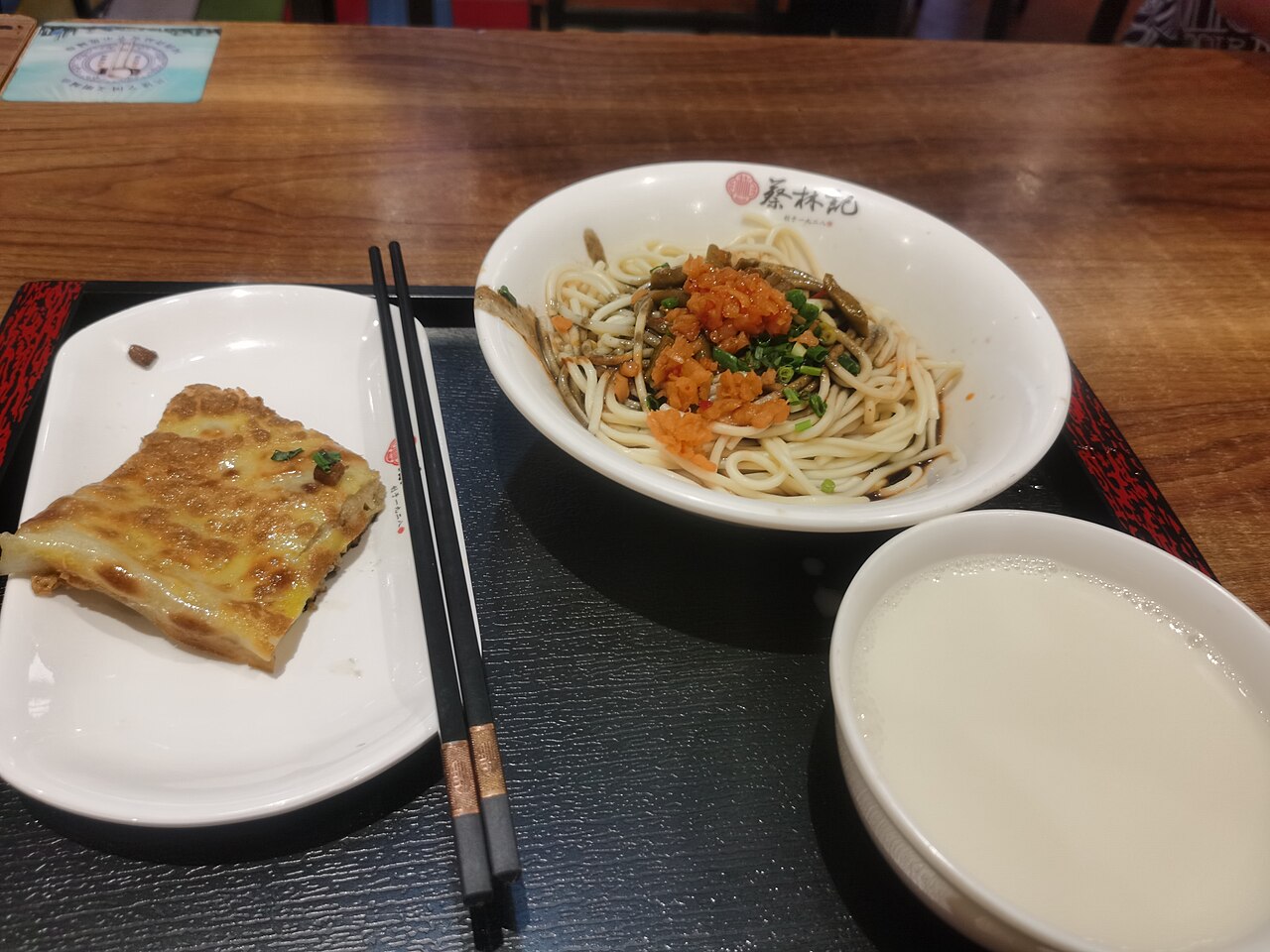
In Wuhan, adding water to the sesame vat is culinary heresy. Wuhan masters practice Oil-Thinning (You Xie), whisking fragrant small-mill sesame oil (or a calibrated blend of sesame and neutral vegetable oil) directly into 100% pure stone-ground white sesame paste. No water enters the crock. Why? Because Reganmian’s 1.8mm alkaline noodles have already been coated in oil during Danmian parboiling, and are dunked into roiling 100°C water for ten seconds before being shaken bone-dry. If you ladle a water-based Beijing sauce over 78°C dry alkaline wheat, the hot starch greedily drinks the free water out of the emulsion, breaking the sauce into chalky curds and welding the strands into a gummy brick within thirty seconds. An oil-continuous Wuhan paste, by contrast, experiences a sharp drop in viscosity the instant it touches steaming noodles—gliding across the pre-oiled strands like liquid satin and staying supple to the final bite.
Genealogical Matrix of China’s Sesame & Peanut Tossed Noodles
| Tradition | Regional Hub | Noodle Base & Prep | Paste Base & Thinning | Aromatics & Acid Engine | Signature Garnishes & Pairings | Serving Temp |
|---|---|---|---|---|---|---|
| Wuhan Reganmian | Wuhan, Hubei | 1.8mm alkaline round, oil-fanned (Danmian), re-blanched | 100% stone-ground white sesame (or 90/10), oil-thinned | 10-spice soy卤, garlic water, rice vinegar, charred chili oil | Crunchy Huangpi radish dices, sour fermented cowpeas, scallions; Danjiu | Scalding hot (75°C+) |
| Old Beijing Liangmian | Beijing | Hand-pulled/cut plain wheat, boiled & cold-water rinsed | Erba Jiang (80% sesame / 20% peanut), warm-water whipped | Sanheyou: soy sauce, aged vinegar & fried Sichuan-peppercorn oil | Crisp julienned cucumber, radish, blanched mung sprouts, raw garlic cloves | Chilled / Cool |
| Tianjin Majiangmian | Tianjin | Chewy cut plain wheat, rinsed cool | Pure sesame or Erba Jiang, water-thinned | Mashed red fermented bean curd (jiangdoufu) + chive-blossom paste | Braised wheat gluten (mianjin), mung-bean jelly ribbons (fenpi), cucumber | Cool / Room temp |
| Chengdu Tianshuimian & Liangmian | Chengdu / Nanchong | Chopstick-thick stiff wheat (Tianshuimian); oiled alkaline (Liangmian) | Spiced sweet soy + touch of sesame paste; red chili oil forward | Brown-sugar spiced fuzhi soy sauce, roasted chili oil, Hanyuan numbing pepper | Crushed roasted peanuts (Tianshuimian); poached chicken slivers & sprouts | Room temp |
| Shaxian Banmian | Shaxian, Fujian | Flat fresh alkaline or wheat ribbons, boiled to order | 100% roasted peanut paste, thinned with broth/lard | Crispy shallot pork lard (congyou), first-draw soy sauce, pinch of sugar | Chopped green scallions; universally paired with pork Bianrou wonton soup | Piping hot |
Hutong Rituals, Tianjin Maximalism, and the Yangtze Connection
Stepping beyond physics, each bowl mirrors the social theater of its hometown. In Beijing’s hutong courtyards, eating Majiang Liangmian during Erfu (the second ten-day stretch of high summer) hinges on Sanheyou (“Three-in-One Oil”): whole Sichuan peppercorns sizzled in sesame oil until blackened, strained hot over soy sauce and熏醋 (smoky grain vinegar), and drizzled atop the pale sesame emulsion alongside mounds of emerald cucumber matchsticks and whole cloves of raw purple garlic bitten between mouthfuls. Neighboring Tianjin takes that northern template and injects exuberant port-city maximalism—whisking crimson fermented tofu brine (jiangdoufu) and wild chive-blossom sauce (jiucaihua, familiar from northern lamb hotpot) straight into the sesame sauce, then piling on spongy wheat gluten to soak up every drop.
Follow the Yangtze River upstream into Sichuan, however, and an unexpected sibling bond appears. Chuanbei Liangmian (Northern Sichuan Cold Noodles) and classic Chengdu Chicken-Sliver Cold Noodles are built upon thin, golden alkaline wheat strands prepared by shan liangmian—parboiling until just al dente, drizzling with roasted rapeseed oil, and tossing beneath a bamboo fan until dry and bouncy. Technically, that process is identical to Wuhan’s Danmian. Early twentieth-century river trade linked Sichuan’s docks directly to Hankou’s Changdi Street; while Sichuan cooks kept their oiled alkaline strands cool beneath incandescent red chili oil, Baoning black vinegar, and just a whisper of sesame paste for body, Wuhan’s street peddlers plunged those same pre-oiled strands back into boiling cauldrons on damp winter mornings and inverted the condiment ratio—turning sesame paste from supporting actor into undisputed monarch. Meanwhile, down in Fujian’s hills, Shaxian Banmian proved the universal appeal of hot starch and roasted legumes by swapping sesame oil for aromatic pork-shallot lard and pure peanut paste—a cousinly salute from China’s southeast to Wuhan’s morning throne.
- Cui Daiyuan, Jingwei’er (Flavors of Old Beijing: Second-Fu Chilled Sesame Noodles), SDX Joint Publishing
- Dunlop, Fuchsia (2019). The Food of Sichuan (Chengdu Tianshuimian & Chicken Sliver Cold Noodles). W. W. Norton & Company
- Journal of the Chinese Cereals and Oils Association: 'Rheological Phase Inversion of Stone-Ground Sesame Paste Under Aqueous vs. Lipid Dilution'
❓ Frequently Asked Questions
Why can’t you use Beijing-style water-thinned sesame sauce on hot Wuhan Reganmian?
Beijing chilled noodles are rinsed in cold water, leaving a cool aqueous film that bonds seamlessly with water-emulsified sesame sauce. Wuhan Reganmian comes out of boiling water at 75°C+ with surface water shaken dry and a pre-existing oil film from 'Danmian'. Pouring water-thinned paste onto scalding dry alkaline noodles causes instant moisture absorption and starch retrogradation—clumping the bowl into glue within seconds. Oil-thinned paste, by contrast, melts into a glossy velvet coating on contact with heat.
What is Beijing’s famous 'Erba Jiang' (80/20 Paste)?
'Erba Jiang' blends 80% stone-ground roasted sesame paste with 20% roasted peanut butter. Northern noodle makers prize it because peanut paste contributes natural sweetness and rounded roast notes that soften the subtle phenolic bitterness of dark-roasted sesame.
How are Sichuan cold noodles (Liangmian) historically connected to Wuhan Reganmian?
Both dishes share an identical pre-cooking technique: parboiling thin alkaline wheat noodles until barely tender, then tossing them with oil in front of a breeze until cool and springy. Along the Yangtze river trade corridor in the early 20th century, Sichuan kept the noodles cool under fiery chili oil, while Hankou vendors re-blanched those oiled strands in boiling water for winter mornings and crowned them with thick sesame paste.
✦ Cross-Referenced Chapters
Soul of the Bowl: Stone-Ground Sesame Paste Craft
Low-temperature roasting, stone-mill grinding, and the great culinary debate between 100% pure sesame vs. 80/20 sesame-peanut blends.
Small-Mill Sesame Oil, Blending Fats & Chili Oil
Why oil-thinned sesame paste coats every strand superiorly to water-thinned paste, plus aromatic Wuhan chili oil infusion.
The Core Art of "Danmian": Parboiling & Oil-Tossing
Step-by-step mastery of 80%-cooked boiling, fan-cooling, and sesame-oil tossing that keeps alkaline noodles springy for hours.
Food Chemistry: Alkaline Gluten Crosslinking & Sesame Phase Inversion
How sodium carbonate strengthens disulfide gluten bonds and tints flavonoids yellow, plus the rheology of sesame paste emulsion.
Panoramic Matrix: Comparing All Ten of China’s Famous Noodles
Side-by-side structural comparison against Shanxi knife-cut, Sichuan Dandan, Beijing Zhajiang, Lanzhou beef, and Henan braised noodles.