Micronutrient Powerhouse: Calcium, Sesamin & Vitamin E
Inside Pure Stone-Ground Sesame Paste—Mineral Bioavailability, Furanofuran Lignans, and Tocopherol Synergy
An evidence-based nutritional and phytochemical deep dive into Reganmian's signature white sesame paste: evaluating its extraordinary 1,170 mg/100g calcium density, how hull-peeling and stone-milling overcome oxalate/phytate barriers, and how sesamin and sesamol amplify Vitamin E antioxidant activity.
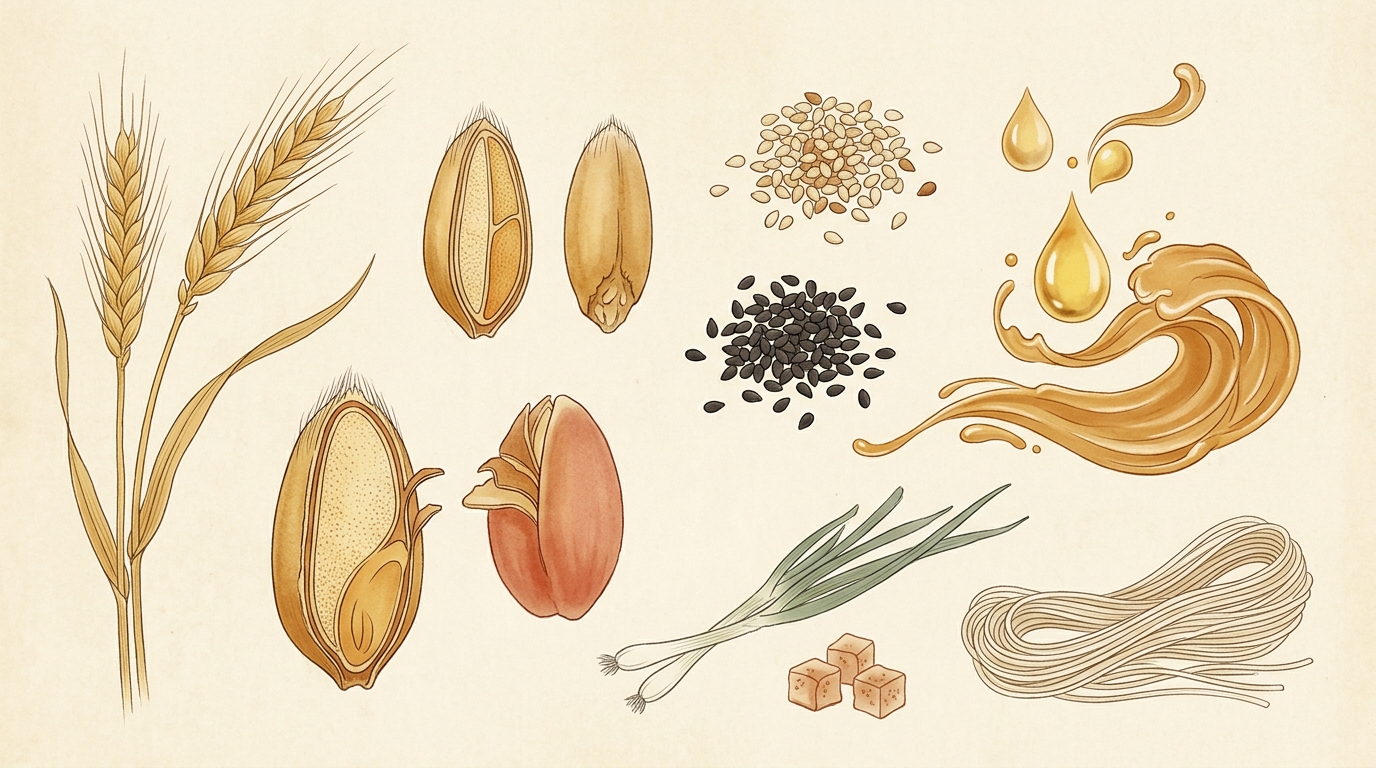
Beyond Calories: The Micronutrient Vault Atop the Bowl
In contemporary diet culture, calorie-dense condiments rarely receive charitable press. At 618 kilocalories per 100 grams, pure roasted sesame paste (chun zhimajiang) can easily intimidate anyone scanning only the top line of a nutrition label. Yet in classical Chinese dietetics—from the Han-dynasty Shennong Bencao Jing to Li Shizhen’s Compendium of Materia Medica—sesame (huma) has been revered for two millennia as the premier restorative seed for bone, liver, and vascular vitality.
Modern food chemistry validates that ancient esteem. The 25-gram ladle of pure stone-ground white sesame paste crowning an authentic bowl of Wuhan Reganmian is no mere textural lubricant; it is a concentrated micronutrient and phytochemical vault delivering dairy-rivaling calcium, abundant trace minerals, heart-healthy monounsaturated fats, and a uniquely synergistic family of oil-soluble lignans.
“Crush the white seed beneath cold granite stone; tenfold the milk-lime to steady the bone.” — Traditional Hubei Apothecary Couplet
The Calcium Equation: Density, Antinutrients & Stone-Mill Bioaccessibility
According to China CDC’s Food Composition Tables, 100 grams of pure sesame paste contains an astonishing 1,170 mg of calcium, alongside 9.8 mg of iron, 310 mg of magnesium, and 5.5 mg of zinc. By raw weight, that calcium concentration exceeds whole cow’s milk (~107 mg/100g) by nearly elevenfold.
Rigorous nutritional science, however, evaluates both serving size and bioavailability. Plant seeds store minerals alongside two notorious antinutritional chelators: oxalic acid and phytic acid (myo-inositol hexakisphosphate), which bind divalent cations ($\text{Ca}^{2+}$, $\text{Fe}^{2+}$, $\text{Zn}^{2+}$) into poorly soluble salts in the small intestine.
Remarkably, the traditional Wuhan craft of milling dehusked white sesame paste neutralizes much of this botanical defense through three processing steps:
- Wet Hulling Strips Oxalate Reservoirs: Botanical analyses demonstrate that 60%–75% of total oxalates in sesame reside as insoluble calcium oxalate crystals within the fibrous outer seed coat (hull). High-grade Wuhan sesame paste begins with plump Hubei white sesame seeds that are soaked and mechanically dehulled (renma) prior to roasting—preserving endosperm-bound bioavailable calcium while discarding the bulk of hull oxalates.
- Controlled Roasting Partially Degrades Phytates: Gentle drum roasting at 165–180°C thermally cleaves a portion of hexaphosphate rings into lower inositol phosphates with weaker mineral-binding affinity.
- 20-Micron Granite Stone Milling Ruptures Cell Walls: Swallowed whole, intact toasted sesame seeds resist mastication and pass largely undigested through the gastrointestinal tract. Slow, low-temperature granite stone grinding shears seed cotyledons down to 15–30 $\mu\text{m}$ particles, shattering aleurone protein bodies so gastric hydrochloric acid (pH 1.5–2.0) can solubilize trapped calcium, magnesium, and zinc ions.
In practical breakfast terms, a single 25-gram serving of pure white sesame paste in a 2-liang bowl contributes ~292 mg of elemental calcium—roughly 36.5% of China’s 800 mg adult Recommended Nutrient Intake (RNI) (or ~30% of the US 1,000 mg RDA). For East Asia’s vast lactose-intolerant population, Reganmian represents one of the most delicious non-dairy calcium vehicles in everyday street cuisine.
Head-to-Head Comparison: 25g Pure Sesame Paste vs. Everyday Staples
Note in particular the dramatic divergence between 100% pure sesame paste and peanut butter—a critical distinction whenever budget noodle shops dilute their sauce with peanut blends:
| Nutrient Metric | Pure Sesame Paste (per 100g) | 1 Bowl Ladle Sesame Paste (25g) | Whole Cow’s Milk (250 mL Cup) | Boiled Egg (1 Large, 50g) | Roasted Peanut Paste (25g) | Nutritional Takeaway |
|---|---|---|---|---|---|---|
| Energy (kcal) | 618 | 155 | 162 | 72 | 149 | Equal calories to a cup of whole milk |
| Calcium (mg) | 1,170 | 292 | 268 | 28 | 11 | Matches a glass of milk; 26× higher Ca than peanut paste |
| Iron (mg) | 9.8 | 2.45 | 0.75 | 1.0 | 0.5 | Rich non-heme iron; pair with Vitamin C greens to boost uptake |
| Magnesium (mg) | 310 | 77.5 | 27.5 | 5.0 | 42 | ~22% of daily adult Mg requirement for vascular tone |
| Zinc (mg) | 5.5 | 1.38 | 1.05 | 0.55 | 0.72 | Supports immune & enzymatic function |
| Vitamin E (mg) | 18.5–25.0 | 4.6–6.2 | 0.5 | 0.9 | 2.8 | Predominantly bioactive $\gamma$-tocopherol |
Sesamin, Sesamol & Vitamin E: The Hepatic Antioxidant Triad
Beyond minerals, cereal and lipid biochemists (pioneered by Prof. Mitsuo Namiki in Japan and Prof. Robert Parker at Cornell University) have uncovered a remarkable trio of lipid-soluble bioactives unique to Sesamum indicum:
1. Roast-Generated Sesamol and Natural Shelf Stability
Raw sesame oil has almost no aroma. During controlled roasting, Maillard reactions between free amino acids and reducing sugars generate nutty pyrazines and furans, while trace thermal hydrolysis converts sesamolin into sesamol (3,4-methylenedioxyphenol). Sesamol is an extraordinarily potent chain-breaking antioxidant that quenches peroxyl radicals—explaining why unrefined small-mill sesame oil and stone-ground paste resist rancidity (halawei) far longer than soybean, corn, or sunflower oils without a drop of synthetic BHA or BHT.
2. CYP4F2 Inhibition: How Sesamin Supercharges Vitamin E
Sesame paste is rich in $\gamma$-tocopherol, a form of Vitamin E prized for scavenging reactive nitrogen species (such as peroxynitrite) that damage arterial endothelium. Ordinarily, the human liver rapidly catabolizes dietary $\gamma$-tocopherol via cytochrome P450 enzyme CYP4F2 (tocopherol-$\omega$-hydroxylase). Landmark metabolic studies demonstrated that sesamin (0.4%–0.8% of sesame weight) acts as a potent competitive inhibitor of hepatic CYP4F2—slowing Vitamin E breakdown and elevating circulating and tissue tocopherol concentrations two- to threefold. Few whole foods in nature exhibit such an elegant built-in pharmacokinetic amplifier.
3. The 1:1 Oleic-Linoleic Lipid Balance & Phytosterols
Roughly 83%–85% of the fatty acids in sesame paste are unsaturated, split evenly between monounsaturated oleic acid (~40%, the flagship fatty acid of extra-virgin olive oil) and essential polyunsaturated linoleic acid (~44%), accompanied by 400–600 mg/100g of plant sterols (chiefly $\beta$-sitosterol) that compete with dietary cholesterol for micellar absorption in the gut. Enjoyed in mindful portions, the golden paste coating Wuhan’s morning noodles is functional lipid nutrition disguised as street comfort food.
- Yang, Y. X. (Ed.). China Food Composition Tables (6th Ed.). Peking University Medical Press.
- Namiki, M. (2007). Nutraceutical functions of sesame: A review. Critical Reviews in Food Science and Nutrition, 47(7), 651-673.
- Parker, R. S., Sontag, T. J., & Swanson, J. E. (2000). Cytochrome P4503A-dependent metabolism of tocopherols and inhibition by sesamin. BBRC, 277(3), 531-534.
❓ Frequently Asked Questions
Does pure sesame paste really contain ten times more calcium than cow's milk?
Gram for gram, yes: pure sesame paste averages 1,170 mg of calcium per 100g versus ~107 mg per 100g for whole milk. Because nobody drinks 250g of sesame paste at once, portion math matters: the standard 25g ladle on a bowl of Reganmian delivers ~292 mg of calcium—roughly matching an entire 250 mL glass of milk, though with slightly lower fractional absorption due to plant phytates.
Why does stone-ground sesame paste provide far more absorbable nutrition than whole toasted sesame seeds?
Intact sesame seeds are armored in tough, lignified outer hulls rich in insoluble calcium oxalate; uncrushed seeds largely pass through the human digestive tract undigested. Authentic Wuhan sesame paste uses water-dehusked white sesame seeds—stripping away up to 70% of hull oxalates—and grinds them between granite stones to ~20 microns, fully liberating intracellular minerals and lipids.
Why does pure sesame paste stay fresh for months without synthetic preservatives despite its high polyunsaturated fat content?
During gentle roasting (160–185°C), endogenous sesamolin partially cleaves into sesamol, a potent phenolic free-radical scavenger. Working alongside sesamin and natural gamma-tocopherol (Vitamin E), sesamol halts lipid peroxidation chains, giving toasted sesame oil and paste exceptional natural oxidative stability.
✦ Cross-Referenced Chapters
Soul of the Bowl: Stone-Ground Sesame Paste Craft
Low-temperature roasting, stone-mill grinding, and the great culinary debate between 100% pure sesame vs. 80/20 sesame-peanut blends.
Small-Mill Sesame Oil, Blending Fats & Chili Oil
Why oil-thinned sesame paste coats every strand superiorly to water-thinned paste, plus aromatic Wuhan chili oil infusion.
Hubei Agricultural Terroir: Jianghan Wheat & Xiangyang Sesame
Tracing geographic-indication raw materials across Northern Hubei wheat belts and central Hubei high-oil white sesame farms.
Food Chemistry: Alkaline Gluten Crosslinking & Sesame Phase Inversion
How sodium carbonate strengthens disulfide gluten bonds and tints flavonoids yellow, plus the rheology of sesame paste emulsion.
Caloric & Macronutrient Breakdown by Component
Exact kilocalorie, carbohydrate, protein, lipid, and sodium tables for standard 2-liang plain and beef-topped bowls.
Glycemic Index Dynamics & Mindful Weight-Loss Strategies
How sesame lipids moderate glycemic spikes and practical portion/topping adjustments for fitness and blood-sugar management.