Glycemic Index Dynamics & Mindful Weight-Loss Strategies
Resistant Starch Retrogradation, Sesame Lipid Gastric Braking, and the 'Greens-First, Half-Paste' Protocol
An endocrinological and food-structure analysis of Wuhan Reganmian: why alkaline gluten networks, Danmian cooling resistant starch (RS3/RS5), sesame lipids, and rice vinegar moderate early glucose spikes—plus a practical 4-step ordering and meal-sequencing blueprint for fat loss and glycemic control.
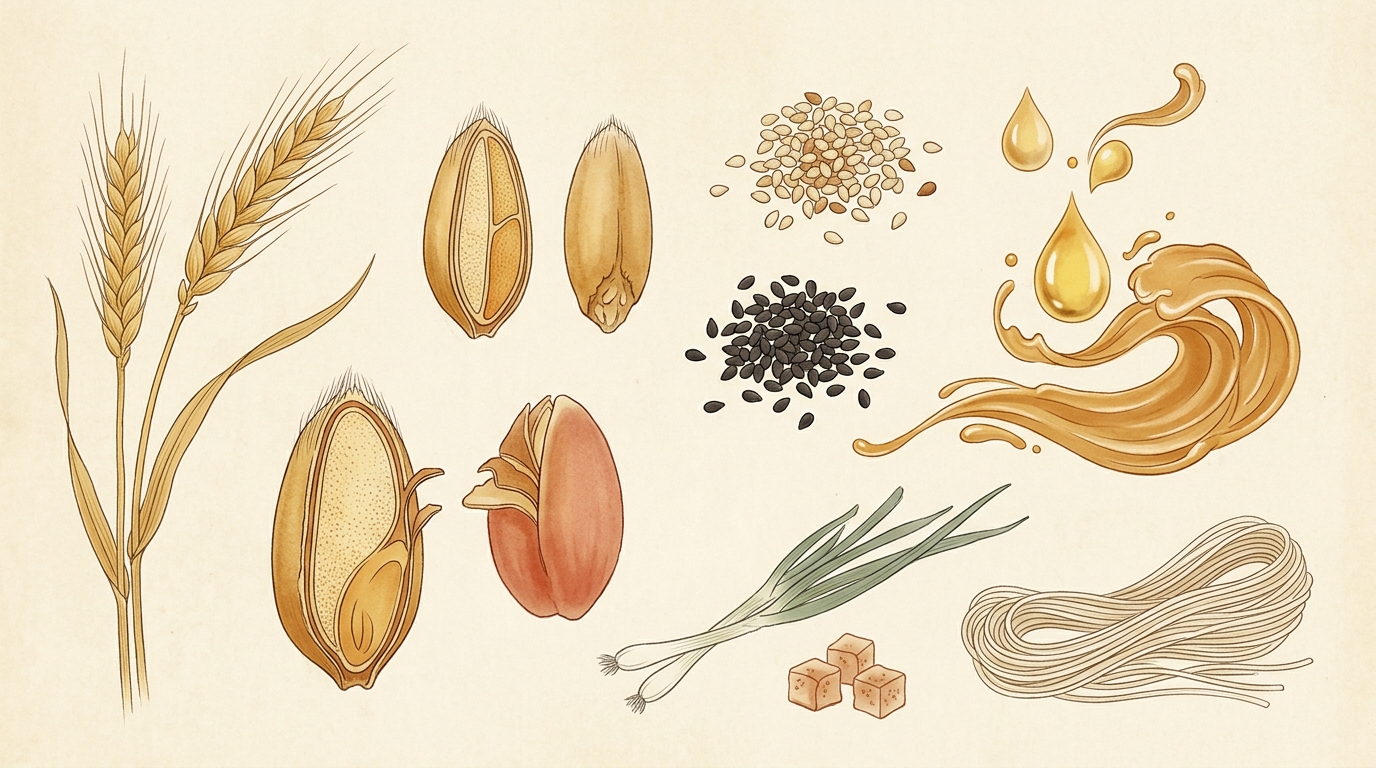
Rethinking the “Refined Carb” Stereotype on Continuous Glucose Monitors
On superficial inspection, Wuhan Reganmian looks like a metabolic storm: refined wheat noodles served for breakfast. Eat an equivalent bowl of overboiled white wheat noodles swimming in clear broth (GI ~78–85), and a continuous glucose monitor (CGM) will reliably trace a jagged Matterhorn peak within 45 minutes, followed by a mid-morning reactive crash.
Yet metabolic tracking of authentic Wuhan Hot Dry Noodles reveals a markedly different curve: a noticeably gentler 30-to-60-minute ascent. That surprise is no fluke of measurement—it is the direct physiological consequence of how alkaline polymer chemistry, danmian thermal cycling, stone-ground sesame lipids, and fermented organic acids interact inside the human gastrointestinal tract.
“Soft broth-noodles race into the bloodstream; springy oiled strands take the winding road.” — Contemporary Clinical Nutrition Maxim
Four Intrinsic Glycemic Brakes Inside the Bowl
1. The Alkaline Gluten Cage and Al Dente Microstructure
Just as extruded durum semolina pasta digests far more slowly than fluffy white bread made from identical wheat protein levels, Reganmian’s sodium-carbonate-reinforced disulfide gluten network physically encapsulates starch granules. Because street masters parboil noodles to 80% doneness and flash-blanch them for barely six seconds, strands retain high elastic firmness. Pancreatic $\alpha$-amylase must erode a dense protein barrier from the outside in rather than flooding fully ruptured starch gel.
2. Danmian Cooling: Generating Type 3 & Type 5 Resistant Starch
The defining pre-dawn ritual of Reganmian—parboiling noodles, fanning them rapidly down to room temperature, and tossing them with sesame oil (danmian)—accidentally engineers two distinct classes of Resistant Starch (RS):
- Type 3 Resistant Starch (RS3, Retrograded Amylose): Rapid forced-air cooling prompts leached linear amylose chains to realign into tight double-helical crystals resistant to small-intestinal enzymatic cleavage.
- Type 5 Resistant Starch (RS5, Amylose–Lipid Complexes): Coating warm parboiled strands with oleic- and linoleic-rich sesame oil allows fatty acid tails to slip inside single-helical amylose cavities, forming thermally stable V-type crystalline complexes that survive brief six-second re-blanching.
3. The Sesame Lipid & Protein Pyloric Brake
Roughly 25–31 grams of unsaturated lipids and 15 grams of combined wheat-and-sesame protein enter the duodenum alongside the starch. Nutrient sensors in the upper small intestine immediately release cholecystokinin (CCK) and glucagon-like peptide-1 (GLP-1), signaling the pyloric sphincter to throttle gastric emptying. Carbohydrates trickle into the jejunum over hours rather than rushing through all at once.
4. Acetic & Lactic Acid Disaccharidase Inhibition
Authentic bowls include a splash of rice vinegar and fermented sour long beans (suandoujiao). Clinical trials demonstrate that dietary acetic acid both slows gastric emptying and competitively inhibits brush-border sucrase and maltase complexes, trimming incremental postprandial glucose area-under-the-curve (iAUC) by 15%–20%.
The Catch: Glycemic Load (GL) and the “Pizza Tail” Effect
Why, then, must diners with prediabetes, Type 2 diabetes, or fat-loss goals still approach a classic bowl strategically? Because Glycemic Index (speed) is only half the equation; Glycemic Load (total carbohydrate volume) and lipid-induced late insulin resistance govern the rest:
$$\text{Glycemic Load (GL)} = \frac{\text{Mixed-Meal GI} \times \text{Net Available Carbohydrates (g)}}{100}$$
A standard 2-liang bowl delivers ~58g of net available carbohydrates. Even at a moderate mixed GI of ~60, that yields a GL of ~35 (well above the clinical High-GL threshold of 20). Moreover, pairing ~60g of starch with ~30g of fat can produce the well-documented “pizza effect”: early glucose stays deceptively flat at 60 minutes, only to hover in an elevated, drawn-out plateau 2 to 3.5 hours after eating as circulating free fatty acids transiently blunt peripheral glucose uptake.
| Dining Configuration | Net Carbs (g) | Total Energy (kcal) | Est. Mixed GI | Est. Meal GL | 0–3h Postprandial Glucose Signature |
|---|---|---|---|---|---|
| Control: Soft-Boiled White Soup Noodles (2-Liang) | 62 | 340 | ~80 (High) | ~49.6 | Sharp Spike & Crash: surges at 45 min; triggers 10:30 AM hunger |
| Classic: Full Red-Oil 2-Liang Plain Reganmian | 58 | 595 | ~62 (Moderate) | ~36.0 | Blunted Peak, Long Tail: gentle 1h rise, prolonged 2–3h plateau |
| Light Cut: 1.5-Liang, Half Paste, Vinegar, No Chili Oil | 42 | 378 | ~58 (Moderate) | ~24.4 | Controlled Arc: saves 217 kcal; returns to baseline by 2h |
| Metabolic Gold: 150g Greens + Egg $\to$ 1.5-Liang Light Bowl | 43 | 465 | ~48 (Low) | ~20.6 | Flatline Stability: fiber-protein pre-load suppresses both peak & tail |
The Four-Step Protocol for Fat Loss & Blood-Sugar Mastery
- Master the Window Customization Call Step up to the counter and order: “Yi-liang-ban (1.5 liang), half sesame paste, skip the chili oil, extra rice vinegar, light soy broth.” Swapping chili oil for dry crushed chili flakes or fresh chopped peppers plus halving the paste trims ~215 kcal immediately while keeping plenty of nutty stone-ground coating on a smaller noodle bed.
- Sequence Your Meal: Fiber & Protein Five Minutes Before Starch Clinical trials by Weill Cornell’s Dr. Alpana Shukla show that consuming vegetables and protein before carbohydrates slashes post-meal glucose excursions by up to 29%–37%. Order a side of blanched bok choy, lettuce, or kelp strips (tang qingcai) plus a spiced boiled egg or 50g of blanched lean beef—and finish them before tossing your noodles.
- Request a Brisk Blanch & Chew Deliberately Ask the cook not to over-blanch (“mian mo tang tai ruan”). Chewing springy strands twenty times per mouthful amplifies endogenous GLP-1 release, preventing accidental overeating before satiety signals reach the brain.
- Leverage Morning Circadian Sensitivity & a 15-Minute Walk Human skeletal muscle insulin sensitivity peaks between 7:00 AM and 10:00 AM—making Guozao far kinder metabolically than a midnight stall run. Follow your bowl with a brisk 15-minute walk along Wuhan’s tree-lined avenues; contracting leg muscles translocate GLUT4 glucose transporters directly to cell membranes independent of insulin, sweeping breakfast carbs cleanly into glycogen stores.
- ISO 26642 / WS/T 652-2019: Determination of the Glycemic Index (GI) and recommendation for food classification.
- Birt, D. F., et al. (2013). Resistant starch: Promise for improving human health. Advances in Nutrition, 4(6), 587-601.
- Shukla, A. P., et al. (2015). Food order has a significant impact on postprandial glucose and insulin levels. Diabetes Care, 38(7), e98-e99.
❓ Frequently Asked Questions
Since Reganmian is made from refined wheat flour, why does its initial blood-sugar spike rise more slowly than plain noodle soup?
Four food-matrix factors work together: (1) tightly crosslinked alkaline gluten and brief 6-second blanching keep strands firm, slowing amylase penetration; (2) parboiling, fan-cooling, and oil-tossing convert a fraction of starch into Type 3 retrograded and Type 5 amylose-lipid resistant starches; (3) ~25g of sesame lipids and protein stimulate cholecystokinin (CCK), delaying gastric emptying; and (4) rice vinegar inhibits brush-border disaccharidases.
If the mixed Glycemic Index is moderate, is a full bowl safe for people with Type 2 diabetes or insulin resistance?
Portion control remains essential. While sesame fats blunt the sharp 45-minute glucose peak, a full 2-liang bowl still carries ~58g of available carbohydrates (a high Glycemic Load of ~35) plus abundant lipid, which can create a prolonged 'delayed plateau' at 2–3 hours post-meal—much like pizza. Downsizing to 1–1.5 liang and eating leafy greens plus an egg first resolves both peaks and tails.
How should someone on a weight-loss diet customize their bowl at a traditional Wuhan stall?
Order a 1.5-liang portion ('yi-liang-ban'), ask for half sesame paste ('banshuo jiang'), skip chili oil in favor of crushed dry chili or fresh peppers, add extra rice vinegar, and pair with blanched greens plus a spiced egg. You preserve 90% of the roasted sesame soul while cutting ~215 kcal and boosting protein satiety.
✦ Cross-Referenced Chapters
The Core Art of "Danmian": Parboiling & Oil-Tossing
Step-by-step mastery of 80%-cooked boiling, fan-cooling, and sesame-oil tossing that keeps alkaline noodles springy for hours.
Street Blanching & The Golden Ten-Second Bowl
Deconstructing the street master’s 6-second boiling dip, triple wrist-shake drain, and rapid sauce ladling.
Creative & Low-Calorie Modern Adaptations
Whole-wheat light versions, konjac keto adaptations, chilled summer Reganmian, wok-fried night-market noodles, and fusion buns.
Food Chemistry: Alkaline Gluten Crosslinking & Sesame Phase Inversion
How sodium carbonate strengthens disulfide gluten bonds and tints flavonoids yellow, plus the rheology of sesame paste emulsion.
Caloric & Macronutrient Breakdown by Component
Exact kilocalorie, carbohydrate, protein, lipid, and sodium tables for standard 2-liang plain and beef-topped bowls.
Guidance for Special Diets & Allergen Warnings
Tailored advice for endurance athletes, sensitive stomachs, sodium-restricted diets, and sesame/peanut/gluten allergies.