Guidance for Special Diets & Allergen Warnings
Navigating Sesame, Gluten, and Hidden '80/20' Peanut Blends—Plus Clinical Protocols for Athletes and Sensitive Groups
A comprehensive clinical nutrition and food-allergy safety dossier for Wuhan Reganmian: covering heat-stable sesame proteins (Ses i 1/2), hidden peanut paste blends ('Er-Ba Jiang'), celiac gluten restrictions, and tailored medical guidance for endurance runners, pregnancy, hypertension, and biliary disorders.
Street-Food Universality Meets Individual Biochemistry
Along Wuhan’s morning avenues, Reganmian appears effortlessly democratic: construction crews, university professors, marathoners, and schoolchildren perch side by side on plastic stools over identical paper bowls. Yet as Wuhan welcomes millions of global travelers and exports packaged Hot Dry Noodles across North America, Europe, and Oceania, a dish built upon concentrated oilseed paste, high-gluten wheat, fermented soy, and generous sodium intersects with starkly diverse immunological and clinical profiles.
For an endurance runner, that combination is rocket fuel; for a diner carrying an epinephrine auto-injector for sesame or peanut anaphylaxis—or someone recovering from biliary inflammation—knowing exactly what hides beneath the scallions is a matter of medical safety.
“Know the seed inside the mill, and know the temper of the diner’s gallbladder.” — Contemporary Clinical Dietetic Maxim
The Four Allergen Pillars & The “Er-Ba Jiang” Peanut Trap
Under international allergen frameworks—including EU Regulation No. 1169/2011, Canada’s Priority Allergens, the landmark U.S. FASTER Act (which elevated sesame to America’s ninth major food allergen on January 1, 2023), and China’s updated GB 7718 Prepackaged Food Labeling Standard—authentic Reganmian implicates three guaranteed allergens and one perilous hidden fourth:
1. Sesame (Sesamum indicum — Ses i 1 through Ses i 8)
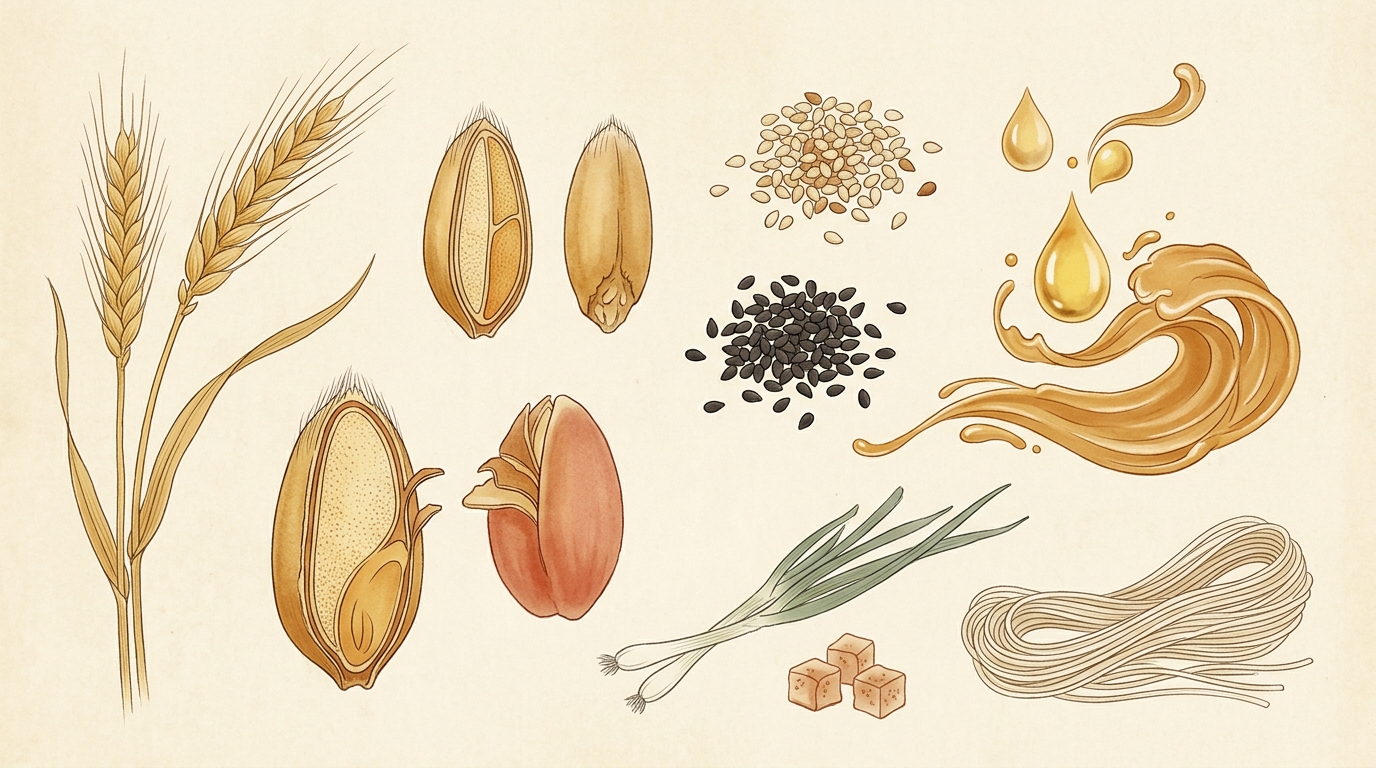
Sesame is omnipresent at every stage of preparation: ~25g of pure stone-ground sesame paste crowns the bowl, ~6g of toasted sesame oil thins the sauce, and sesame oil often coats the noodles during pre-dawn danmian parboiling (meaning even ordering “plain noodles without sauce” at a Reganmian stall carries severe sesame cross-contact!). Immunologically, sesame’s dominant 2S albumin storage proteins (Ses i 1 and Ses i 2) and 11S globulins (Ses i 6/7) are locked together by intramolecular disulfide bridges that survive 180°C roasting and gastrointestinal proteases intact. Anyone with an IgE-mediated sesame allergy must avoid Reganmian stalls entirely.
2. The Hidden Peanut Hazard: Er-Ba Jiang (80/20 Blends)
Travelers allergic to peanuts (Ara h 1, Ara h 2, Ara h 3) who safely tolerate Middle Eastern tahini frequently assume Wuhan sesame noodles are peanut-free. This can be a life-threatening assumption.
- The Blend Divide: While Wuhan purist institutions mandate 100% white sesame paste, numerous budget stalls, northern-influenced franchises, and commercial instant pouches formulate their sauce as Er-Ba Jiang (80% sesame / 20% peanut paste) or San-Qi Jiang (70/30) to amplify roasted top-notes and trim ingredient costs. Visually and aromatically, the dark amber sauce is virtually indistinguishable from pure sesame paste.
- Garnish & Shared Mills: Many shops also offer crushed fried peanuts (huasheng sui) right beside pickled radish bins, and small stone-milling workshops frequently grind peanuts and sesame on shared equipment. Always inspect allergen boldface declarations on packaged brands and show a written Chinese allergy card in person.
3. Wheat Gluten & Soybeans
- Wheat Gluten: Extruded from strong bread/noodle wheat flour (11.5%–13.5% protein) and dressed with wheat-brewed light and dark soy sauces, Reganmian is strictly off-limits for Celiac Disease, non-celiac gluten sensitivity, and wheat allergy. (At home, gluten-free konjac noodles or 100% rice vermicelli tossed with tamari and pure tahini replicate the flavor profile safely.)
- Soybeans: Present in light soy, dark soy, spiced lushui braising broth, and refined soybean oil often used to oil-toss parboiled noodles or blend sauces.
Clinical Adaptation Matrix Across Six Physiological Groups
| Population Group | Suitability | Primary Physiological Mechanism | Evidence-Based Ordering & Modification Protocol |
|---|---|---|---|
| 1. Endurance Athletes & Marathoners | ★★★★★ Optimal Fuel | Dense glycogen carbs + ~1,480 mg sodium replaces sweat electrolytes | Timing is critical: consume 3–4 hours pre-race or post-finish (as celebrated at Wuhan Marathon stations); avoid full-fat paste within 60 min of start to prevent GI cramping |
| 2. Pregnancy, Lactation & Adolescents | ★★★★☆ Highly Nutritious | ~292 mg non-dairy calcium, iron & unsaturated fats support fetal/bone growth | Choose reputable hygienic shops; skip raw unboiled tap-water garlic infusion (suanshui) to avoid foodborne pathogens; pair with a boiled egg and blanched greens |
| 3. Seniors, Toddlers & Chronic Gastritis | ★★★☆☆ Modify Texture | Mild noodle alkalinity buffers surface acid, but 6-sec blanched strands are very firm | Ask cook to blanch an extra 15–20 seconds until tender; cut sesame paste to 1/3, omit chili oil and raw garlic, and chew thoroughly to prevent reflux |
| 4. Hypertension & Chronic Kidney Disease | ★★☆☆☆ Strict Caution | ~1,480 mg hidden sodium; sesame paste is dense in phosphorus (~610 mg/100g) & potassium | Order 1.5-liang, request half soy broth and no salted pickles, never drink residual bottom liquid; late-stage CKD patients on phosphorus binders should limit sesame paste |
| 5. Gout & Hyperuricemia | ★★★☆☆ Plain Only | Refined wheat flour and pure sesame paste are low-purine foods (<50 mg/100g) | Classic plain vegetable Reganmian (light oil) is safe outside acute flares; strictly avoid high-purine braised tripe, intestine, or concentrated meat-broth toppings |
| 6. Gallstones, Cholecystitis & Pancreatitis | ★☆☆☆☆ Contraindicated | 25–32g lipid bolus triggers intense CCK surge and gallbladder contraction | Strictly avoid during acute episodes or symptomatic gallstones! In stable remission, eat only plain blanched noodles with soy/vinegar and zero or trace (<3g) paste |
Pocket Bilingual Allergy Alert for International Visitors
If you have a severe peanut allergy (but tolerate pure sesame) and are ordering in Wuhan, show this exact Chinese text to the shopkeeper before ordering:
【严重花生过敏提示 / Severe Peanut Allergy】 「老板您好!我对花生(花生酱、花生油、花生碎)严重过敏,误食会有生命危险!请问您家的芝麻酱是 100% 纯芝麻酱吗?有没有掺一点点花生酱(二八酱)或花生油?如果不确定,请一定告诉我,非常感谢!」 (Hello! I have a life-threatening allergy to peanuts, peanut paste, peanut oil, and crushed peanuts. Is your sesame paste 100% pure sesame with zero peanut blend or peanut oil? If unsure, please let me know!)
- U.S. Food and Drug Administration (FDA). Food Allergy Safety, Treatment, Education, and Research (FASTER) Act (Effective Jan 1, 2023).
- National Food Safety Standard of China: General Rules for the Labeling of Prepackaged Foods (GB 7718).
- Sicherer, S. H., & Sampson, H. A. (2018). Food allergy: A review and update on epidemiology, pathogenesis, diagnosis, prevention, and management. JACI.
❓ Frequently Asked Questions
I have a severe peanut allergy, but I can safely eat pure sesame tahini. Can I eat street Reganmian in Wuhan?
Proceed with extreme caution and verify explicitly! While heritage brands like Cai Lin Ji pride themselves on 100% pure white sesame paste, many neighborhood shops, out-of-province stalls, and packaged instant brands blend 10%–30% roasted peanut butter ('Er-ba jiang') into their sesame paste for aroma and cost savings, or garnish bowls with crushed peanuts. Never eat unverified street paste without confirming purity.
Does high-temperature roasting or stone-grinding destroy sesame allergens?
No. Sesame's primary major allergens—2S albumins Ses i 1 and Ses i 2—possess compact disulfide-bonded structures that withstand 180°C roasting and gastric pepsin digestion. Dry roasting Maillard reactions can even heighten IgE-binding affinity.
Why can a single full-sauce bowl of Reganmian trigger upper-right abdominal pain in people with gallstones?
Delivering 25–32 grams of concentrated lipids into the duodenum triggers a potent surge of cholecystokinin (CCK), causing forceful gallbladder contraction. In individuals with biliary sludge, gallstones, or chronic cholecystitis, this sudden squeeze can precipitate acute biliary colic or gallstone pancreatitis.
✦ Cross-Referenced Chapters
Soul of the Bowl: Stone-Ground Sesame Paste Craft
Low-temperature roasting, stone-mill grinding, and the great culinary debate between 100% pure sesame vs. 80/20 sesame-peanut blends.
Tourist Survival Guide & Local Ordering Slang
Spotting authentic neighborhood stalls versus tourist traps, plus decoding counter slang like "Er-liang Quanliao".
Caloric & Macronutrient Breakdown by Component
Exact kilocalorie, carbohydrate, protein, lipid, and sodium tables for standard 2-liang plain and beef-topped bowls.
Glycemic Index Dynamics & Mindful Weight-Loss Strategies
How sesame lipids moderate glycemic spikes and practical portion/topping adjustments for fitness and blood-sugar management.
Food Safety Standards & Fresh Alkaline Noodle Storage
Modern food-grade alkali regulations, microbial shelf-life windows for oil-tossed fresh noodles, and aflatoxin screening.
Wuhan Marathon Supply Stations & Reganmian Cultural Festivals
Mini bowls of sesame noodles fueling 40,000 runners beneath cherry blossoms during the Wuhan Marathon and annual food expos.