Tourist Survival Guide & Local Ordering Slang
Dodging assembly-line tourist traps and decoding counter slang like 'Er-liang Quanliao, Shao-mian Duo-jiang'
A street-smart field manual for visitors to Wuhan: five instant visual cues to spot authentic neighborhood stalls versus tourist traps, why a '2-liang' bowl weighs nearly half a pound, and a complete bilingual phrasebook of local counter slang.
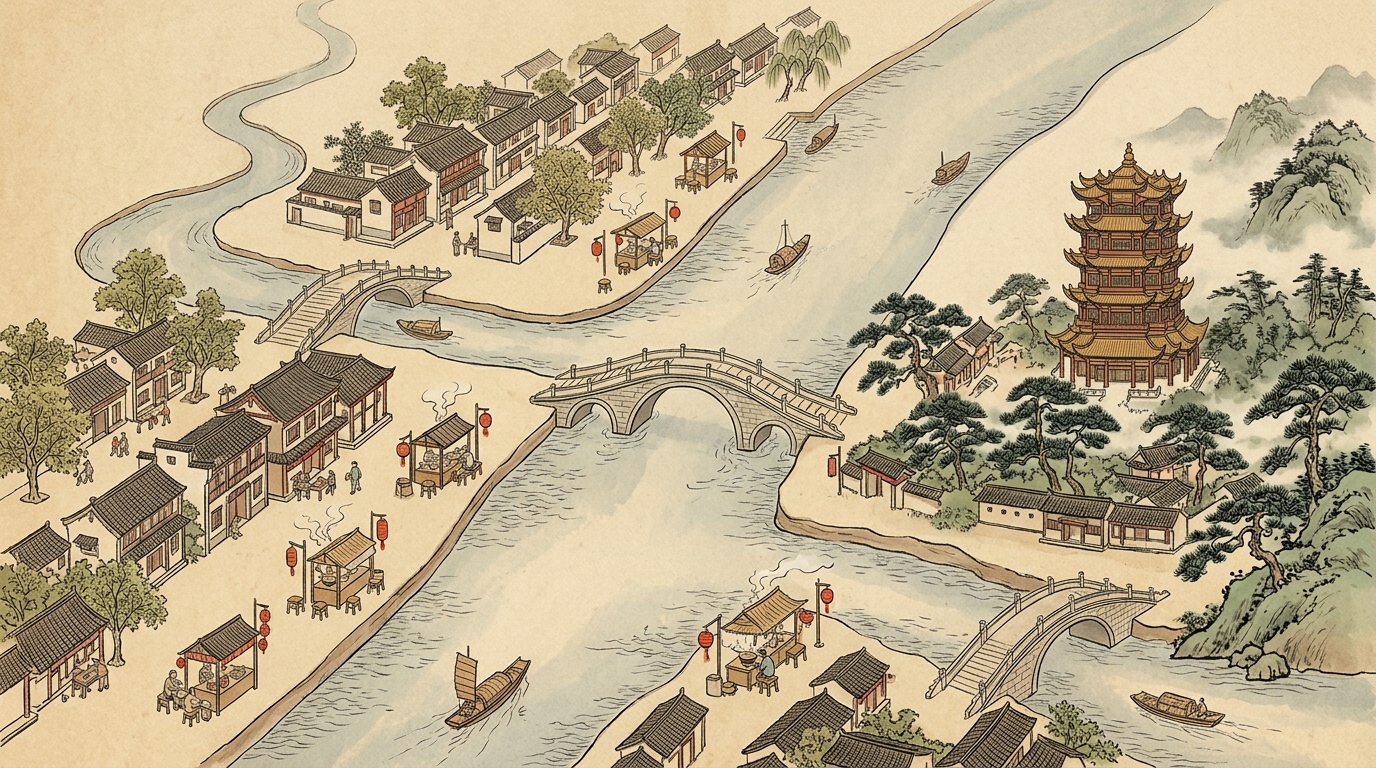
Spotting Traps in Five Seconds: The “Five Never-Eats” of Wuhan Sightseeing
Walk down any hyper-commercialized tourist alley near major landmarks at noon, and megaphones will bark promises of “TikTok-Famous Supreme King Reganmian.” Yet Hot Dry Noodles are unforgiving: ten seconds too long in stale water or ten minutes sitting pre-mixed on a steam table destroys their structural soul. Before scanning a QR payment code, run every stall through the local insider’s Five Never-Eat Rules:
- Never eat pre-mixed noodles sitting in metal trays: Authentic Reganmian has a golden lifespan of 120 seconds once lifted from boiling water. Any vendor who pre-mixes piles of brown noodles and tongs them into bowls is serving swollen, pasty starch.
- Never pay 25+ RMB for gimmicky luxury toppings: “Abalone Reganmian” or “Crab-Roe Waterfall Reganmian” exist solely to fleece tourists. Across every revered Wuhan neighborhood stall, a classic plain bowl costs 5 to 6 RMB, and a generous raw-blanched beef bowl costs 12 to 16 RMB.
- Never order if you don’t see the “Golden Mountain”: Glance past the window. An authentic stall always displays a wide bamboo basket heaped with gleaming, fan-cooled, sesame-oil-coated yellow parboiled strands (danmian). If raw white dried noodles are boiled from scratch to order, walk on.
- Never trust watery, pale sesame sauce: Proper oil-thinned stone-ground sesame paste ribbons off a wooden ladle like melted dark chocolate or amber satin. Runny, pale beige liquid signals cheap peanut-starch dilution.
- Avoid murky, foaming cauldron water after 11:00 AM: After blanching five hundred alkaline bowls, dissolved sodium carbonate turns pot water thick, yellow, and soapy-bitter. Conscientious masters refresh their boiling water mid-morning.
“Loudspeakers roar where tourists tread; slip one lane back where plane trees spread. Five yuan buys the River City’s truth.” — Local Traveler’s Rhyme
Cracking the Window Code: Speak Like a Wuhan Regular
During the 7:30 AM rush, a master blancher works two bamboo baskets simultaneously at breathtaking speed. Freezing at the window to ask “What’s good here?” jams the rhythm of the entire queue. Memorize this Four-Part Counter Formula, and you will order with effortless native poise:
Step 1: Call Your Portion (The Grain-Coupon Secret)
- “Gao wan er-liang!” (搞碗二两 — “Fix me a 2-liang bowl!”): The universal standard order. Historically rooted in grain-ration coupons, er-liang (100g) measures dry flour weight before water absorption—yielding ~200g of cooked noodles plus 50g of sauce.
- “Yi-liang-ban / Shao tiao dian mian!” (一两半 / 少挑点面 — “1.5 liang / Light on noodles!”): Essential Citywalk wisdom when saving stomach space for Doupi and Mianwo.
- “San-liang!” (三两 — “3 liang!”): The dockworker’s heavyweight bowl.
Step 2: Customize Your Condiments
- “Quan-liao!” (全料 — “All condiments!”): Gives you the full ten-element symphony: sesame paste, light/dark soy, garlic water, vinegar, white pepper, pickled radish, sour long beans, scallions, and chili oil.
- “Mian-qing / Mo fang cong!” (免青 / 莫放葱 — “Hold the greens / No scallions!”): In Chinese noodle-shop jargon, qing (“green”) means chopped scallions and cilantro.
- “Wei-la / Zhong-la!” (微辣 / 重辣 — “Mild chili / Heavy chili oil!”): Even spice-shy diners should try wei-la; Wuhan’s toasted chili oil is deeply nutty and aromatic rather than overwhelmingly capsaicin-hot.
Step 3: Calibrate Sauce-to-Moisture Ratio (Pro Moves)
- “Shao-mian duo-jiang!” (少面多酱 — “Less noodles, extra sesame paste!”): The ultimate connoisseur’s hack—30% fewer carbs drenched in 100% of the roasted sesame paste, leaving rich sauce at the bottom to mop up with crispy fried Mianwo.
- “Dai dian lu-shui / Shi yi-dian!” (带点卤水 / 湿一点 — “Add spiced broth / Slightly wetter!”): Ideal for newcomers who find dry-school paste too thick; half a ladle of ten-spice soy broth makes tossing effortless.
Step 4: Dine-In, Walk-and-Eat, or Takeout Survival
- “Duan-qi zou!” (端起走 — “Carrying it as I walk!”) vs. “Dai-zou mo ban!” (带走莫拌 — “Takeout, DO NOT toss!”): If carrying bowls back to a hotel, forbid the vendor from tossing them. Trapped steam fuses sauced noodles into an unmixable cake in five minutes; keep sauce unmixed on the side and revive with a teaspoon of hot water before tossing.
Pocket Wuhan Noodle Slang Phrasebook
| Phonetic Wuhan Counter Call | Chinese Script | Literal & Practical Meaning | Ideal For |
|---|---|---|---|
| “Gao wan er-liang quan-liao, wei-la!” | 搞碗二两全料,微辣! | Standard 2-liang bowl, all toppings, mild aromatic chili oil | 95% of first-time visitors—foolproof balance |
| “Shao-mian duo-jiang, dai dian lu-shui!” | 少面多酱,带点卤水! | Less noodles, extra sesame paste, splash of spiced broth | Citywalkers pacing carbs & loving silky richness |
| “Er-liang su-mian mian-qing, gan yi-dian!” | 二两素面免青,干一点! | Plain bowl, no scallions, zero extra broth (pure dry style) | Purists chasing old-Hankou chewy grip |
| “Sheng-tang niu-rou gai ding!” | 生烫牛肉盖顶! | 12-second raw-blanched tender beef ladled juicy on top | Meat lovers in Hanyang (Meigui St) & Hankou |
| “Wo ge lu-dan, da ge mian-wo!” | 卧个卤蛋,搭个面窝! | Add a spiced braised egg + crispy Mianwo donut on side | Classic carb-on-carb sauce-mopping bliss |
| “Da-bao mo ban, jiang mian fen-zhuang!” | 打包莫拌,酱面分装! | Pack to-go unmixed; separate sauce if traveling >10 mins | Hotel takeout or high-speed train travelers |
Final Street Etiquette
Once your steaming paper bowl lands in your left hand, never stand blocking the blanching window—take three brisk steps sideways so the next neighbor can call their order, grab bamboo chopsticks, and toss high and crosswise immediately before snapping photos. Wait thirty seconds for Instagram, and the gluten tightens; toss first while steam billows, and Wuhan’s greatest everyday masterpiece is yours at its peak.
- Wuhan Consumers Association & Wuhan Catering Association 'Authentic Street Snack Guide'
- Dictionary of Wuhan Dialect (ed. Zhu Jiansong, Wuhan Publishing House) — Culinary Lexicon
- Field Observation Logs from Neighborhood Noodle Windows Across Hankou, Wuchang, and Hanyang
❓ Frequently Asked Questions
Why do locals order 'Er-liang' (literally 100 grams / 3.5 oz), yet receive a hefty bowl weighing nearly half a pound?
Inherited from China’s mid-century grain-ration coupon era, 'liang' (50g) refers strictly to the dry raw wheat-flour weight BEFORE hydration, parboiling, and oiling. Once cooked and dressed with sesame paste and pickles, a '2-liang' bowl weighs 220–260 grams—a generous full meal for one adult.
What should first-time visitors say if they worry authentic Reganmian might feel too thick or dry?
Never pour plain water into your bowl! Instead, ask the cook at the window: 'Dai dian lushui, shi yidian!' ('Add a splash of spiced braising broth, make it slightly wetter!'). Half a ladle of savory ten-spice soy broth or beef bone stock turns the sesame paste silky-smooth without sacrificing roasted intensity.
Are 28-RMB 'abalone or crayfish Reganmian' bowls on tourist pedestrian streets worth trying?
Skip them completely. Reganmian’s magic lies in the high-heat emulsion of alkaline wheat strands, stone-ground sesame paste, and crunchy sour pickles. Pricy seafood toppings clash with nutty sesame paste and usually disguise limp factory noodles at pure tourist-trap stalls.
✦ Cross-Referenced Chapters
The Ten-Condiment Flavor Matrix & Layering Order
Exact gram ratios and sequencing of light/dark soy, rice vinegar, white pepper, sugar, and spiced sesame salt.
Street Blanching & The Golden Ten-Second Bowl
Deconstructing the street master’s 6-second boiling dip, triple wrist-shake drain, and rapid sauce ladling.
The Art of Eating While Walking & Cross-Tossing Etiquette
Mastering the Wuhan commuter’s signature one-handed bowl cradle and rapid cross-lifting chopstick toss without spilling a drop.
Wuhan Dialect Glossary: From "Guozao" to "Xufu"
Pronunciation, etymology, and lively street dialogues for over twenty authentic Wuhanese expressions heard at noodle stalls.