Wuhan Dialect Glossary: From 'Guozao' to 'Xufu'
Phonetics, Classical Etymologies, and Twenty-Plus Street Expressions Heard at Dawn Noodle Stalls
A linguistic and ethnographic field guide to Wuhanese ('Hanqiang') at the breakfast stall—unpacking tonal contours, classical verbs preserved in noodle craft, ordering shorthand, and the blissful sigh of 'Xufu'.
Acoustics of the Cauldron: How Wuhanese Tones Mirror the Bowl
Order a bowl of Hot Dry Noodles in crisp, broadcast-standard Mandarin, and the transaction works—yet something essential evaporates with the steam. Switch to Wuhanese (Wuhanhua or Hanqiang), however, and the syllables snap like bamboo chopsticks against porcelain. First-time visitors to Wuhan often mistake early-morning conversations around a noodle cauldron for an impending street brawl: voices pitch high, consonants land hard, and declarative sentences end on an assertive upward climb.
Linguistically, Wuhanese belongs to the Wutian subgroup of Southwestern Mandarin, meticulously charted by Central China Normal University linguist Zhu Jiansong in the Wuhan Dialect Dictionary. Its four-tone contour system explains its unmistakable muscularity: Yinping sits at a high-level 55, Yangping dips low before rising at 213, Shangsheng drops sharply at 42, and Qusheng surges upward at 35. Crucially, every historical Middle Chinese “entering tone” (rusheng) syllable—words that once ended in clipped -p, -t, -k stops, including re (hot), la (spicy), chi (eat), and bai (white)—merged uniformly into the 213 dipping-rising Yangping tone.
Say Re-gan-mian in authentic Wuhanese and feel the physics in your jaw: Re plunges into the chest before rebounding upward, gan shoots straight across at high pitch, and mian lifts cleanly at the end. Coupled with briskly loud street acoustics forged over a century of shouting above roaring boilers and riverfront cargo traffic, the dialect possesses the exact same chew, velocity, and forthright punch as alkaline noodles themselves.
Classical Fossils in Street Aprons: Guozao, Danmian, and Xiejiang
Beneath its rough-and-ready dockside reputation, Wuhanese preserves remarkably precise classical Chinese verbs that standard modern Mandarin has largely forgotten. Three terms anchor the entire Reganmian lexicon.
The first is Guozao (过早, guò zǎo), “to observe breakfast.” Across most of China, people simply “eat morning rice” (chi zaofan) or “drink morning tea” (he zaocha). In Chinese grammar, the verb guo is reserved for crossing major calendrical thresholds—Guonian (celebrating Lunar New Year), Guojie (observing a festival), or Guoshou (marking a milestone birthday). By pairing guo with zao (morning), nineteenth-century Hankou dockworkers and merchants elevated breakfast into an inviolable daily rite. As early as 1850 (the thirtieth year of the Daoguang reign), poet Ye Diaoyuan recorded the term in Hankou Bamboo-Branch Lyrics:
“Modest wives ape wealthy halls, waking late from morning dreams; / Wait to comb your hair—first guozao, gulping glutinous cakes and fried dumplings whole.”
Two equally exact classical verbs govern preparation behind the counter. Danmian (掸面, dǎn miàn) borrows the character dan—originally meaning to flick dust away with a feather duster—to describe lifting 80%-parboiled alkaline noodles in long chopsticks, drizzling them with sesame oil, and vigorously tossing and fanning them until every strand gleams dry and separate. Meanwhile, Xiejiang (澥酱, xiè jiàng) preserves the archaic hydro-culinary graph 澥 (xiè, medievally glossed as congealed paste or ice melting into fluid), naming the exact phase-inversion craft of whisking sesame oil or warm water into stone-ground sesame paste until stiff paste relaxes into a glossy, ribboning emulsion.
The Stall-Side Lexicon: Twenty Essential Wuhanese Expressions
From 5:30 AM cauldron ignition to the last satisfied sigh over an empty paper bowl, a compact vocabulary governs stall-side life. The table below decodes twenty authentic expressions every serious student of Reganmian culture should recognize:
| Category | Expression | Pronunciation & Gloss | Culinary Context & Cultural Nuance |
|---|---|---|---|
| Craft | 掸面 (Dǎn miàn) | dǎn miàn — “flick-toss noodles” | Parboiling alkaline noodles to 80%, coating in sesame oil, and fan-tossing to lock in springiness. |
| Craft | 澥酱 (Xiè jiàng) | xiè jiàng — “thin out paste” | Emulsifying dense stone-ground sesame paste with oil or water until silky and coatable. |
| Ordering | 过早冇 (Guò zǎo mǎo?) | guò zǎo mǎo — “Breakfasted yet?” | Wuhan’s quintessential dawn greeting among neighbors; mǎo means “not yet.” |
| Ordering | 搞碗二两全料 | gǎo wǎn èr liǎng quán liào | “Whip up a standard 2-liang bowl with all condiments!” Gǎo is Wuhan’s Swiss-Army action verb. |
| Ordering | 宽酱少醋 | kuān jiàng shǎo cù | Counter shorthand requesting an extra-generous ladle of sesame paste and just a splash of vinegar. |
| Ordering | 莫放葱 (Mò fàng cōng) | mò fàng cōng — “Hold scallions” | Preserves classical negative mò (do not); barked in half a second so the line never stalls. |
| Dining | 撮一顿 (Cuō yī dùn) | cuō yī dùn — “scarf down a feast” | Hearty, unpretentious eating with gusto, whether dawn noodles or midnight crayfish. |
| Dining | 苕吃哈胀 | sháo chī hā zhàng | Sháo = sweet potato (“silly”); stuffing oneself silly because the food is too good to stop. |
| Space & Kin | 刁角 (Diāo jiǎo) | diāo jiǎo — “hidden nook” | Tucked-away alley corners where locals swear Wuhan’s finest hole-in-the-wall noodle masters hide. |
| Space & Kin | 拐子 / 嫂子 | guǎi zi / sǎo zi | Warm street kinship titles—“big brother / sister-in-law”—creating instant wharf-style camaraderie. |
| Space & Kin | 落屋 (Luò wū) | luò wū — “settle home” | Returning home; travelers say they haven’t truly luò wū until they finish a bowl downstairs. |
| Spirit & Feel | 虚浮 (Xū fú) | xū fú — “blissfully comfy” | Playful phonetic cousin of shūfu (comfortable); the ultimate praise after hot noodles and egg wine. |
| Spirit & Feel | 灵醒 (Líng xǐng) | líng xǐng — “crisp, sharp, neat” | Praises both cleanly separated, non-clumping noodles and a brisk, sharp-witted noodle master. |
| Spirit & Feel | 扎实 (Zá shí) | zá shí — “solid, honest, filling” | High praise for generous portions and thick, unadulterated sesame paste that fuels a full morning. |
| Spirit & Feel | 不服周 (Bù fú zhōu) | bù fú zhōu — “never bow down” | Defiant Chu-kingdom grit; explains why neighborhood artisans fiercely guard their secret broths. |
| Spirit & Feel | 信了你的邪 | xìn liǎo nǐ dī xié | Mock-exasperated marveling: “I’ll be damned—lined up thirty deep in 38-degree heat for this bowl!” |
Overheard in the Alley: Decoding Dawn Dialogue
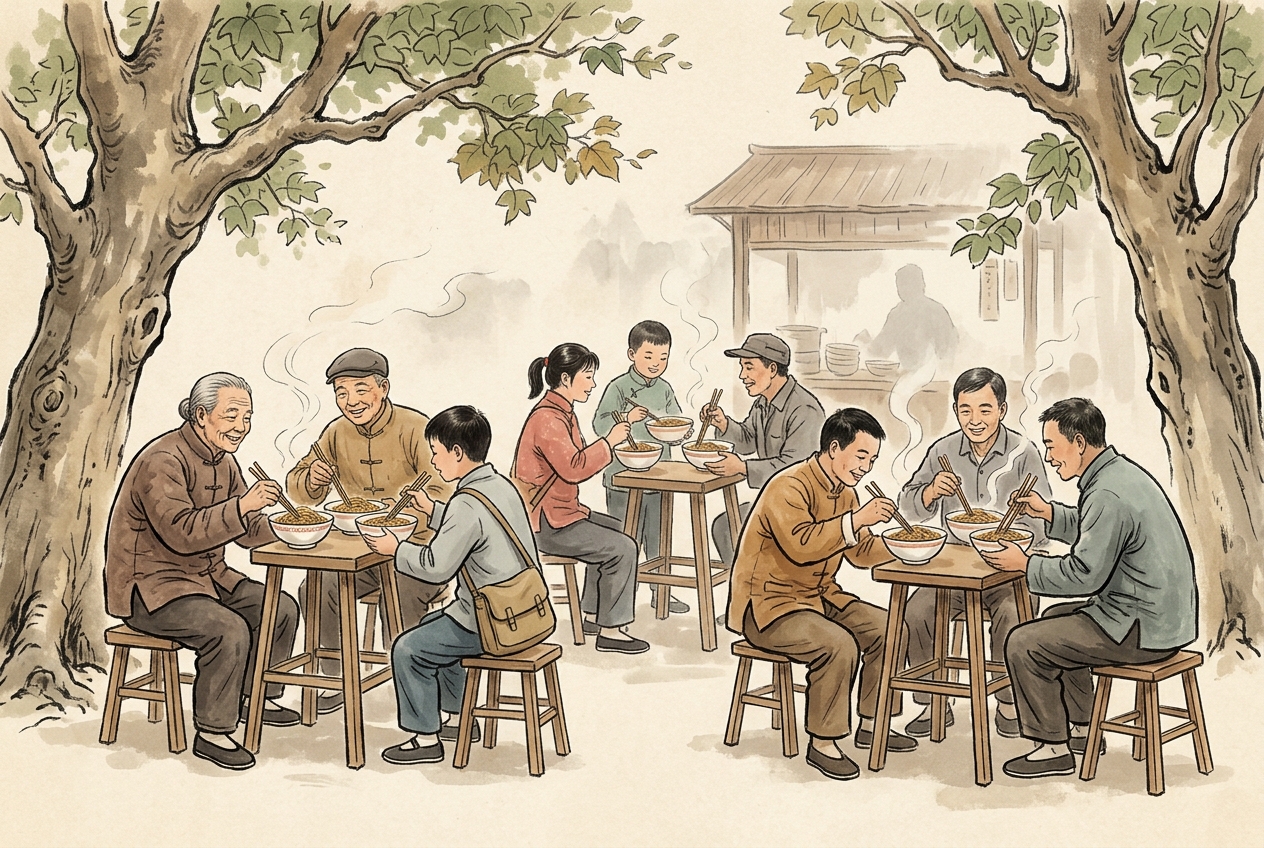
Stand beneath the plane trees on Shanhaiguan Road in Hankou or Liangdao Street in Wuchang at 6:45 AM, and these expressions interlock in rapid-fire polyphony:
“Guaizi, heading out early? Guozao mao?” “Not yet! Come on—that diaojiao stall up ahead whisks (xie) their sesame paste clean and bright, never pasty.” “Master, gao two bowls of two-liang all-in! Extra paste and heavy chili on mine, mo scallions on his—plus two bowls of danjiu!” (Six seconds in roiling water, three wrist-shakes of the bamboo cone, a dark swirl of sesame paste—ten rapid cross-lifts of the chopsticks later:) “Man alive—one bite piping hot chased with sweet rice-wine egg drop… man xufu lie!”
Nothing in that exchange is ornamental, and nothing is cold. In Wuhan’s linguistic ecology, bluntness is a form of honesty, volume is a byproduct of vitality, and a drawn-out “xufu” over a greased paper bowl remains the truest benediction the River City knows how to give.
- Zhu Jiansong (comp.), 'Wuhan Fangyan Cidian' [Wuhan Dialect Dictionary], Jiangsu Education Press, 1995
- Ye Diaoyuan, 'Hankou Zhuzhici' [Hankou Bamboo-Branch Lyrics], 1850 woodblock edition
- Wuhan Local Chronicles Committee, 'Wuhan Shizhi: Fangyan Zhi' [Gazetteer of Wuhan Dialect], Wuhan University Press
❓ Frequently Asked Questions
Why do Wuhan locals say 'man xufu lie' (literally 'very superficial/floating') to mean 'deeply comfortable'?
In colloquial Wuhanese ('Hanqiang'), retroflex Mandarin 'shū' in 'shūfu' (comfortable) often shifts through playful palatalization and folk homophony into 'xūfú' (虚浮). Uttered with a drawn-out particle after finishing hot sesame noodles and sweet egg rice wine, 'xufu' expresses bone-deep, pore-opening bliss.
Why is eating breakfast called 'Guozao' instead of simply eating morning meal?
In Chinese, the verb 'guo' (过, to observe or celebrate) is normally reserved for major milestones like 'Guonian' (Lunar New Year) or 'Guojie' (festivals). On 19th-century Hankou wharves, breakfast fueled grueling dock labor and merchant trade, elevating the morning meal into a daily civic ceremony.
What does the Wuhanese phrase 'bu fu zhou' mean in culinary culture?
Literally 'refusing to submit to the Zhou Dynasty'—popularly traced to the ancient State of Chu defying King Ding of Zhou, or phonetically to 'refusing to be pecked down'—it captures fierce grit and pride. Noodle artisans invoke it to describe uncompromising craft standards.
✦ Cross-Referenced Chapters
Wuhan "Guozao" Panorama: A Month Without Repeating Breakfast
Origins of the term "Guozao" and how Wuhan’s exuberant morning street-food universe revolves around Hot Dry Noodles.
Tourist Survival Guide & Local Ordering Slang
Spotting authentic neighborhood stalls versus tourist traps, plus decoding counter slang like "Er-liang Quanliao".
Sounds of Jiangcheng: Wuhan Folk Ballads, Dialect Rap & Soundscapes
From tender Hanyangmen folk melodies and fiery Wuhan-dialect hip-hop anthems to the percussive clatter of dawn noodle stalls.
Mirror of the Wharf: Directness, Warmth & Nine-Province Openness
How brisk blanching, generous sesame richness, and north-south condiment fusion embody Wuhan’s forthright civic character.
Standardized Chinese-English Reganmian Culinary Lexicon
Over 60 standardized bilingual entries covering noodle techniques, condiments, traditional utensils, Guozao companions, and Wuhan slang.