Spoken Folk Arts: Hubei Pingshu Storytelling, Wuhan Crosstalk & Noodle Lore
Master He Zuohuan’s Gavel, Urban Teahouse Comedy Sketches, and Streetwise Allegorical Sayings
Delving into Wuhan’s vibrant spoken-word performing arts—from National Heritage master He Zuohuan’s Hubei Pingshu tales of Old Hankou noodle halls to Wuhan Ballad & Crosstalk Troupe comedy routines and colorful local proverbs.
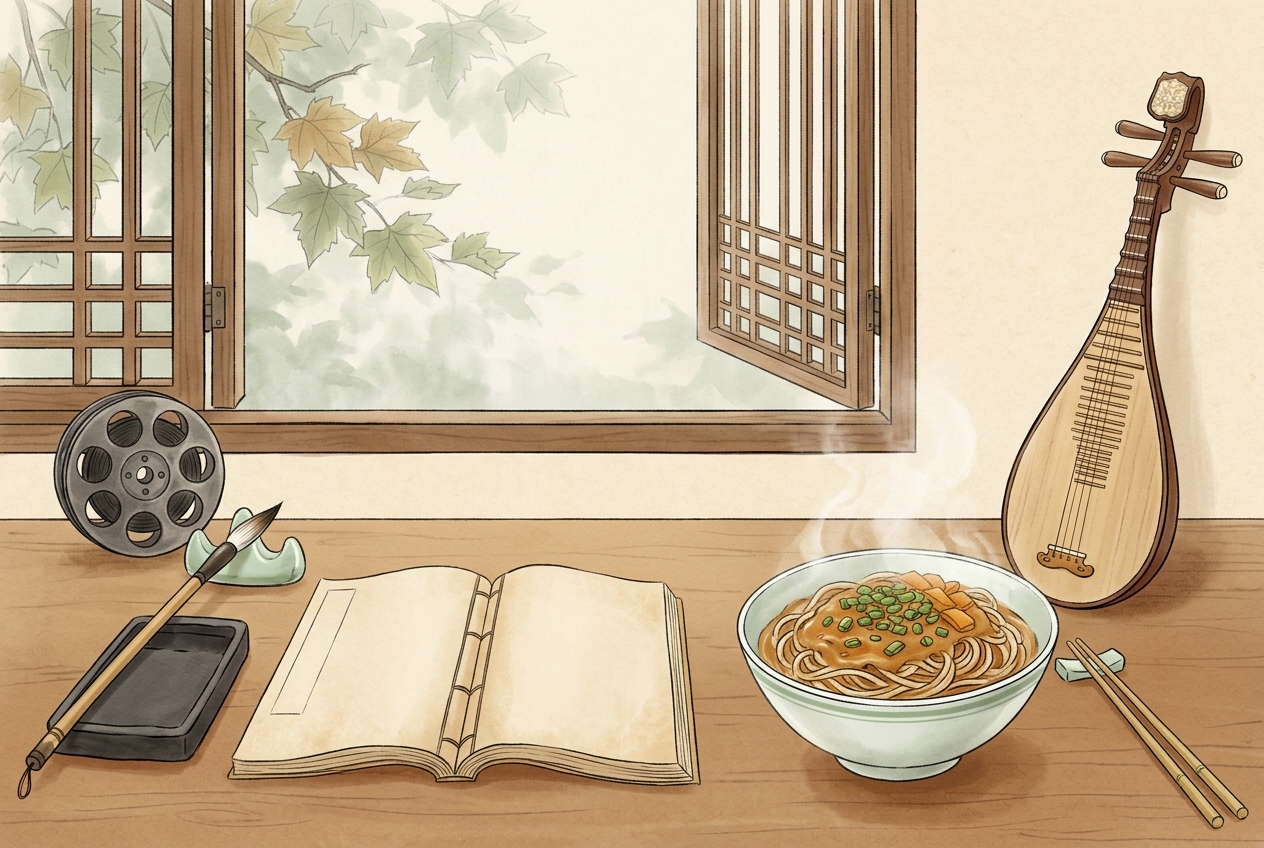
One Fan, One Gavel: He Zuohuan and Hubei Pingshu Wharf Lore
On a traditional Hubei teahouse stage, the performer needs neither orchestra nor painted backdrop—only a long gown, a folding paper fan (zheshan), and a rectangular hardwood gavel (xingmu, literally “waking-wood”). Strike that gavel once against the table, and a hundred years of Hankou wharf clamor leap into the room. No artist embodies this oral tradition more completely than He Zuohuan (b. 1941), National Intangible Cultural Heritage Representative Inheritor of Hubei Pingshu (湖北评书) and affectionately hailed by fellow citizens as the “Living Dictionary of the River City.”
Unlike northern pingshu traditions steeped in dynastic court intrigue or Suzhou pingtan sung in soft Jiangnan cadences, Hubei Pingshu grew up among the salt merchants, river boatmen, and bamboo-bed alleys of Hankou. Delivered in muscular, idiomatic Wuhan dialect, He Zuohuan’s classic tales—such as Marriage by Placard (Guapai Chengqin), Willow Bay (Yangliuwan), and The Son Who Sustains Life—alongside his historical essays treat neighborhood noodle stalls as miniature stages of human character.
Through He’s vivid vocal mimicry, modern listeners hear vanished acoustic customs of Republican-era Changdi Street and Hanzheng Street noodle halls—above all the art of tangtou (musical waiter cries). When a patron stepped across the threshold in the 1930s, an eagle-eyed server with a white towel slung over one shoulder sized up the customer’s coat and stride before launching a resonant chant toward the cauldron:
“Step right inside—two liang of Reganmian, heavy sesame oil, extra scallions, paired with sweet Xiaogan rice wine over poached egg, coming hot!”
In He Zuohuan’s storytelling, how a character eats breakfast betrays their moral fiber instantly: a tightfisted cloth-shop proprietor orders the cheapest plain noodles while shamelessly piling half the communal jar of free pickled radish onto his saucer; a generous dock foreman settling a guild dispute slams down a stack of bamboo tallies and treats the whole crew to deluxe bowls plus crispy mianwo. With a flick of his closed fan miming chopsticks lifting heavy paste, the master storyteller turns culinary memory into living theater.
Laughter in the Urban Teahouse: Han-Style Crosstalk & Dialect Comedy
Where Hubei Pingshu preserves historical texture, Han-style Crosstalk (Hanpai Xiangsheng) and Wuhan dialect sketch comedy mine the everyday comedy of eating a brothless, sauce-heavy noodle. Centered at the historic Wuhan Ballad & Crosstalk Troupe (Wuhan Shuochangtuan) and its wildly popular stage brand Urban Teahouse (Dushi Chazuo), this comedic lineage stretches from pioneering playwright Xia Yutian to National Class-A crosstalk artist Lu Ming (a disciple of Jiang Kun who brought Hubei humor to multiple CCTV Spring Festival Galas alongside partner Xu Yong) and beloved local dialect comedians Tian Kejing (famed for his persona “Chabazi”), Zhou Jintang, and Yin Beichen.
Across decades of teahouse performances and New Year comedy plays, three Reganmian comic routines never fail to bring down the house:
1. “Boss, Where’s My Soup?” — The Outsider’s Initiation
Crosstalk duos delight in dramatizing the culture shock of an out-of-town son-in-law visiting Wuhan for the first time. Handed a steaming bowl slathered in dark sesame paste, the polite newcomer peers anxiously inside and tiptoes back to the counter: “Excuse me, Chef—you’re awfully busy this morning; did you forget to ladle the soup into my bowl?” Worse still, when he chats politely for five minutes instead of tossing immediately, the cooling sesame paste cements the alkaline strands into an immovable monolith—so that lifting one chopstick hoists the entire bowl’s contents into the air like a giant candied hawthorn stick.
2. The Machine-Gun Custom Order (Guankou Tongue-Twister)
Testing the classic crosstalk skill of guankou (breathless rapid-fire patter), the comic lead impersonates an impatient family of seven shouting contradictory customizations at a bewildered noodle master:
“Listen close! One two-liang bowl: extra oil, light salt, scallions yes, chili no! One one-and-a-half-liang bowl: double chili, heavy vinegar, sour cowpeas yes, radish dices no! One three-liang beef bowl: half paste, double spiced broth, scallions packed separately—plus an empty cup with half a ladle of garlic water! Quick, Boss, how much is that altogether?”
3. First-Date Glamour vs. “Sesame Mustaches”
In Urban Teahouse romantic sketches, image-conscious young couples foolishly pick a street noodle stall for an early date. Determined to protect fresh lipstick and a crisp white shirt, both attempt dainty, microscopic nibbles—until the intoxicating aroma of roasted sesame shatters their restraint. Within sixty seconds, both are squatting knees-apart on low plastic stools slurping ferociously, looking up to discover matching amber-brown “sesame mustaches” ringing their mouths—melting awkwardness into shared laughter.
| Performing / Oral Genre | Key Masters & Troupes | Stage Props & Linguistic Style | Signature Noodle Comedy / Narrative | Cultural Function |
|---|---|---|---|---|
| Hubei Pingshu Storytelling | He Zuohuan (National Heritage Master) | Folding fan & hardwood gavel; rich Old Hankou vernacular | Wharf apprentice rules, 1930s musical tangtou waiter chants | Preserving oral histories of Hankou commerce & dining customs |
| Han-Style Crosstalk (Xiangsheng) | Xia Yutian, Lu Ming, Xu Yong / Wuhan Shuochangtuan | Two-person shuoxuedouchang banter; Mandarin-Wuhanese code-switching | Rapid-fire picky order guankou & the “missing soup” routine | Showcasing Wuhan’s quick wit on national broadcast stages |
| Dialect Teahouse Sketches | Tian Kejing (Chabazi), Zhou Jintang / Urban Teahouse | Mock street cauldrons & red plastic stools; physical slapstick | First-date sesame mustaches & balancing bowls on braking buses | Year-end communal comedy catharsis for Wuhan citizens |
| Street Xiehouyu Proverbs | Anonymous neighborhood wit across Wuhan’s Three Towns | Two-part punning riddles; blunt dockside candor | “Unstirred Reganmian: bland at the start, salty at the bottom” | Everyday folk philosophy distilled from breakfast physics |
Wisdom on the Curb: Wuhan’s Allegorical Noodle Proverbs (Xiehouyu)
Ultimately, Wuhan’s stage comedians draw their sharpest lines from the sidewalk itself. In Chinese folk linguistics, xiehouyu are playful two-part sayings in which a vivid concrete image sets up an unspoken punchline. Across Wuhan’s Three Towns, neighbors invoke Reganmian to comment on work, romance, and human folly:
- “Reganmian without sesame paste—utterly soulless (mao de hun).” Used for any speech, project, or performance that has all the outer trappings yet misses the essential heart.
- “Eating Reganmian without tossing it evenly—bland to death at the top, salty to death at the bottom.” A culinary warning applied to poor time management or unfair distribution of labor.
- “Chasing a public bus while cradling Reganmian—frantic in the feet, rock-steady in the hands.” High praise for someone who stays cool-headed and precise amid chaos.
- “Reganmian paired with sweet egg rice wine—a match made in heaven.” Thick savory sesame richness balanced by silky sweet rice wine, invoked to toast a well-matched couple.
- “Blanching Reganmian in lukewarm water—half-baked.” Aimed squarely at sloppy workmanship or premature boasting.
From the sharp crack of Master He Zuohuan’s gavel to the roar of a packed teahouse and a grandmother’s wry proverb at the alley gate, Wuhan’s spoken folk arts prove that Reganmian nourishes far more than morning appetites—it feeds the River City’s irrepressible comic spirit.
- National Intangible Cultural Heritage Dossier: Hubei Pingshu (Master He Zuohuan Oral Histories & Repertoire)
- Wuhan Ballad & Crosstalk Troupe (Wuhan Shuochangtuan) & Urban Teahouse (Dushi Chazuo) Stage Archives
- Selected Crosstalk Works of Xia Yutian, Lu Ming, and Xu Yong
- Compendium of Chinese Folk Literature: Hubei Wuhan Proverbs & Xiehouyu Volume
❓ Frequently Asked Questions
Who is He Zuohuan, and why is he vital to preserving Old Hankou’s food folklore?
Born in 1941, He Zuohuan is the National Intangible Cultural Heritage Representative Inheritor for Hubei Pingshu (solo dramatic storytelling) and is revered as the 'Living Dictionary of Wuhan.' Armed with only a folding fan and wooden gavel, his stories and cultural essays preserve vivid oral histories of Republican-era Hankou noodle shops, wharf etiquette, and musical waiter calls.
What are the classic comedy tropes about Reganmian in Wuhan crosstalk and sketches?
Performers from the Wuhan Ballad & Crosstalk Troupe—such as Lu Ming, Xu Yong, and dialect comedian Tian Kejing—routinely lampoon first-time visitors asking whether the chef forgot the broth, neglected bowls solidifying into a solid sesame brick, and rapid-fire tongue-twister orders from picky families.
How do Wuhan folk proverbs (xiehouyu) use Reganmian to teach everyday wisdom?
Wuhan’s two-part allegorical sayings turn noodle physics into life lessons—for instance, 'Eating Reganmian without stirring evenly: bland to death at the start, salty to death at the bottom,' warning against poor planning and uneven effort.
✦ Cross-Referenced Chapters
Old Hankou Wharf & Bamboo-Bed Street Roots
How dockworker labor intensity and summer bamboo-bed alleys shaped Reganmian’s brothless, calorie-dense, 10-second format.
The Art of Eating While Walking & Cross-Tossing Etiquette
Mastering the Wuhan commuter’s signature one-handed bowl cradle and rapid cross-lifting chopstick toss without spilling a drop.
Classical Bamboo-Branch Lyrics, Couplets & Modern Verse
Selected Qing-era Hankou folk quatrains, shopfront calligraphic couplets, and modern poems celebrating the bowl.
Wuhan Dialect Glossary: From "Guozao" to "Xufu"
Pronunciation, etymology, and lively street dialogues for over twenty authentic Wuhanese expressions heard at noodle stalls.