Old Hankou Wharf & Bamboo-Bed Street Roots
How Stevedore Sweat and Summer Bamboo-Bed Alleys Engineered the DNA of Reganmian
An anthropological exploration of how Old Hankou's Yangtze-Han River dockworker economy and summertime 'bamboo-bed arrays' shaped Reganmian's defining traits: ten-second blanching, brothless portability, dense sesame calories, and egalitarian street dining.
The Muscle and Timber of “China’s Chicago”
To understand why Wuhan Reganmian looks, feels, and eats unlike any delicate noodle soup of Jiangnan, one must begin at the water’s edge. After the Han River shifted course in the late fifteenth century to meet the Yangtze at Dragon King Temple (Longwangmiao), Hankou surged from a marshy sandbar into China’s premier inland entrepôt—celebrated in imperial gazetteers as “the Thoroughfare of Nine Provinces” and admired by nineteenth-century Western travelers as the “Chicago of the East.”
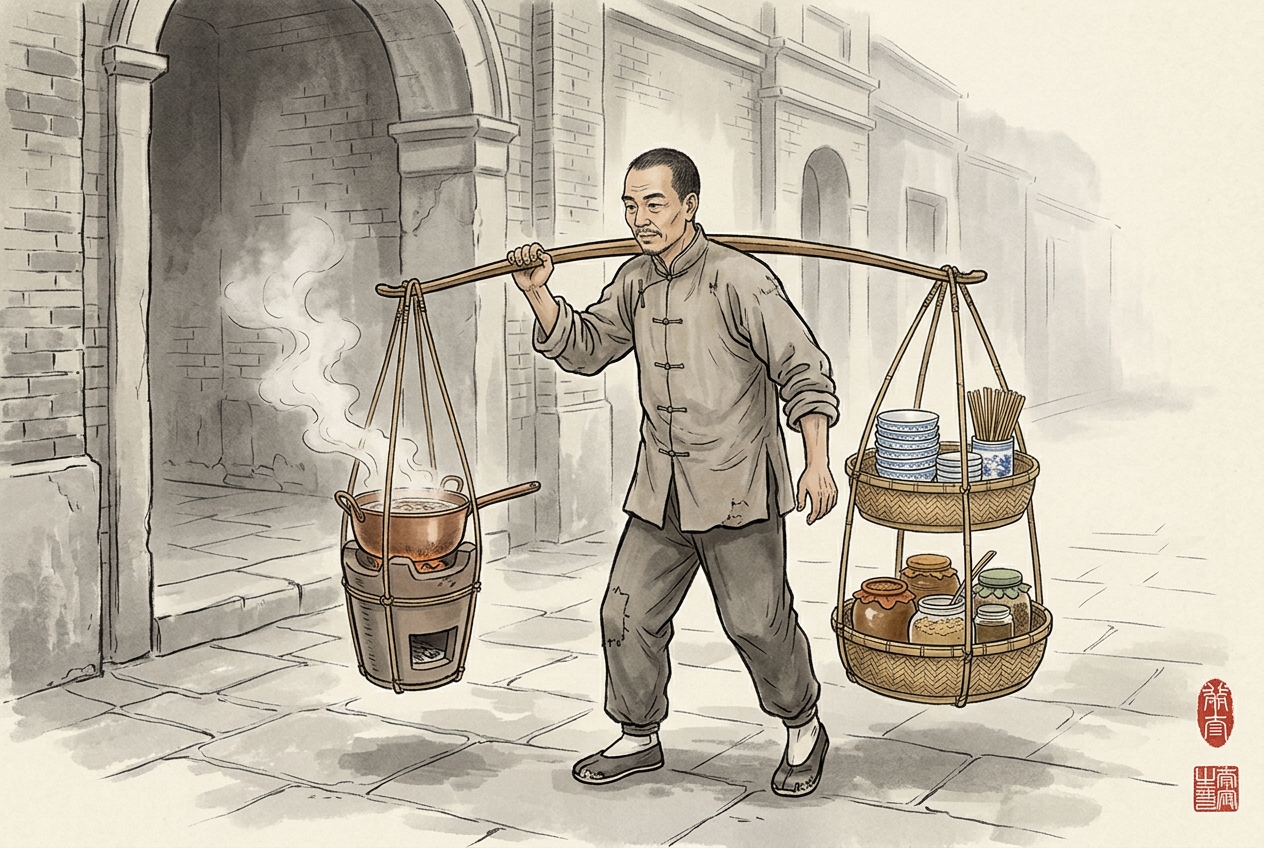
Along ten miles of riverfront stretching from Qiaokou and Jijiazui down to the foreign concessions, thousands of wooden junks and steamboats unloaded Sichuan salt, Hunan rice, Huaihe cotton, timber, hides, and central Hubei sesame. Yet the engine moving this mountain of freight was human muscle: tens of thousands of stevedores known in local slang simply as Biandan (“shoulder-poles”) or Banglaozi. From first light, barefoot men balanced 100-kilogram sacks across springy moso-bamboo poles, trotting up and down swaying gangplanks above muddy currents.
That punishing labor ecology dictated an unforgiving set of culinary specifications. Breakfast on the Hankou wharves could not be a leisurely teahouse affair; it had to function as high-octane, spill-proof, rapid-delivery fuel.
“Junks crowd Jijiazui, bamboo poles bend like bows; pour me no watery broth—toss two liang of dry gold to go.” — Old Han River stevedore work chant
Functional Design: How Wharf Labor Sculpted the Bowl
Viewed through the lens of food anthropology, every technical hallmark of Reganmian represents an ingenious street-level adaptation to dockworker life:
- The Six-Second Blanch vs. Steamship Whistles: Wharf stevedores were paid by the tally stick per load carried; waiting five minutes for raw dough to boil meant losing wages. Pre-parboiled, oil-fanned danmian strands needed just 6 to 10 seconds in a rolling cauldron to reach piping-hot elasticity—served faster than a customer could count out copper coins.
- Zero Broth vs. Tableless Streets: Crowded embankments and narrow Hanzheng Street lanes offered few sit-down dining rooms. Carrying a brimming bowl of hot soup while crouching on stone steps or striding toward a pier invited burns and wasted food. Draining the noodles bone-dry and binding flavor in a viscous sesame-oil emulsion made the bowl completely portable.
- Lipid-Starch Satiety & Electrolyte Recovery: Clear noodle soup distends the stomach briefly but leaves a heavy laborer ravenous by mid-morning. Combining dense, chewy alkaline wheat noodles with stone-ground white sesame paste—over 50% healthy plant lipids and 20% protein—slowed gastric emptying to sustain five hours of hauling. Meanwhile, savory soy lushui and tart, salty dices of pickled Huangpi radish replenished sodium lost to torrential summer sweat.
Changdi Street and the Summer “Bamboo-Bed Arrays”
If the river wharves forged Reganmian’s muscular physique, Old Hankou’s alleyways and summertime Bamboo-Bed Arrays (Zhuchuangzhen) infused its communal soul.
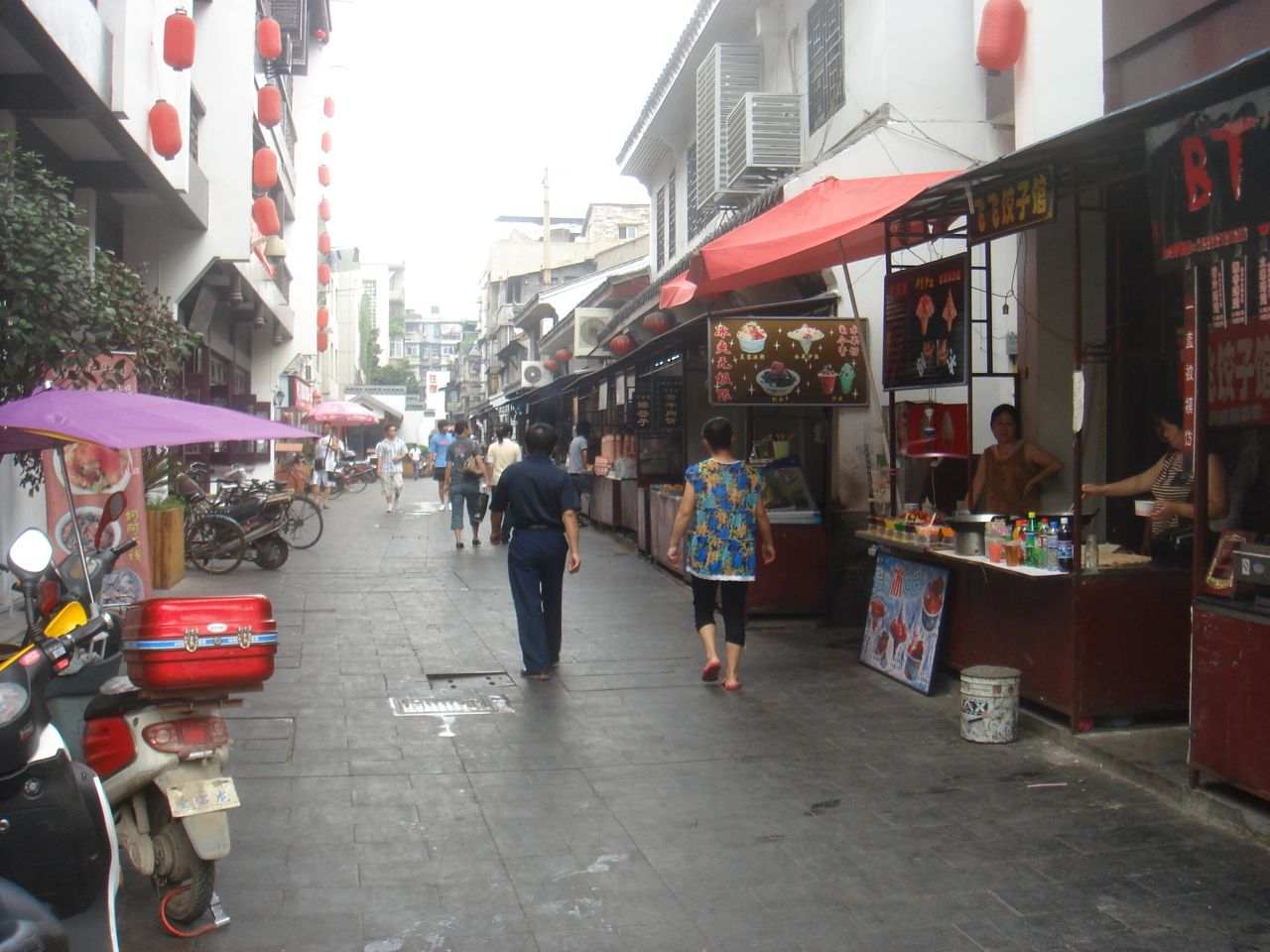
Just inland from the Han River docks ran Changdi Street—originally built in the late Ming Dynasty as an earthen flood dike, later swallowed by dense tenements, guildhalls, opera stages, sesame-oil mills, and temples. In these brick-and-timber lifen lanes, Wuhan’s notorious “furnace” summers turned upstairs lofts into ovens. Long before air conditioning arrived in the 1990s, dusk triggered a citywide ritual: thousands of households hauled out polished moso-bamboo cots, splashed them with buckets of cool well water, and lined them side-by-side down the pavement in kilometer-long Bamboo-Bed Arrays.
Neighbors waved cattail fans beneath the stars, swapped ghost stories, and listened to Peking or Chu opera broadcasts until dawn breezes drifted off the Yangtze. By 4:45 AM, noodle peddlers stationed at alley mouths uncapped their red-clay coal stoves. As plumes of alkaline wheat steam mingled with toasted sesame oil, sleepers stirred awake, propped their bamboo cots against brick walls, and stepped straight to the cauldron in undershirts and wooden clogs. Perching right on the edge of a folded bamboo bed to toss a morning bowl erased the boundary between private bedroom and public street—nurturing Wuhan’s famously direct, unpretentious, and warmhearted civic temperament.
Ecological Contrast: Hankou Wharf Dry Noodles vs. Jiangnan Teahouse Soup Noodles
| Anthropological Dimension | Old Hankou Reganmian (Wharf & Alley Ecology) | Classic Suzhou / Jiangnan Soup Noodles (Canal Teahouse Ecology) |
|---|---|---|
| Urban Economic Base | Bulk river-port transshipment & heavy manual stevedoring | Canal-town silk commerce, gentry gardens & literary teahouses |
| Archetypal Diner | Dock pole-carriers, rickshaw pullers, alley artisans, commuters | Morning tea patrons, merchants, scholars, leisurely townsfolk |
| Liquid Architecture | 100% brothless emulsion; clings tightly to strands on the move | Generous slow-simmered broth; prized for crystal clarity & aroma |
| Service Cadence | 6–10 seconds from order to handoff via pre-oiled danmian | Cooked from raw per order; savored slowly alongside steeped green tea |
| Caloric Profile | High-gluten alkali wheat + dense sesame lipids for 5-hour endurance | Delicate fine noodles + light bone/eel stock for refined morning appetite |
| Spatial Etiquette | Squatting by piers, sitting on bamboo beds, walking while tossing | Seated at square wooden tables; refined chopstick and spoon choreography |
Living Legacy on Today’s Sidewalks
The cargo junks of Jijiazui and the midnight bamboo-bed corridors of Changdi Street have long since yielded to container terminals and air-conditioned high-rises. Yet every morning at 7:00 AM, their spirit resurfaces across Wuhan’s Three Towns. Watch a surgeon, a delivery rider, and a retiree sit side by side outside a neighborhood stall—each hunching on a low stool while balancing a greaseproof bowl atop a taller plastic stool—and you are witnessing the living muscle memory of Old Hankou’s wharves: egalitarian, fiercely practical, and unapologetically full of life.
- William T. Rowe, Hankow: Commerce and Society in a Chinese City, 1796–1889 (Stanford University Press)
- Pi Mingxiu (ed.), History of Modern Urban Wuhan (China Social Sciences Press, 1993)
- Wuhan Municipal Gazetteer: Volume on Social Customs (Wuhan University Press)
- Qiaokou District Historical & Cultural Archives on Changdi Street and Han River Wharves
❓ Frequently Asked Questions
Why did Old Hankou dockworkers prefer brothless noodles over traditional soup noodles?
Dock stevedores worked against river tides and steamship schedules while squatting on curbstones or walking toward gangplanks. Scalding broth took too long to cool, splashed easily without tables, and digested quickly. Brothless alkaline noodles coated in thick, lipid-rich sesame paste delivered ~550 calories of slow-burning energy in under thirty seconds.
What were Wuhan's famous 'Bamboo-Bed Arrays' (Zhuchuangzhen)?
Before household air conditioning became widespread in the 1990s, Wuhan's 'furnace' summer nights drove entire neighborhoods out of stifling tenements. Families lined moso-bamboo cots end-to-end along alleys like Changdi Street, dousing the slats with cool water to sleep beneath the stars. At 5:00 AM, residents folded their bamboo beds right beside steaming Reganmian carts, cementing Wuhan's outdoor breakfast culture.
How did wharf culture influence modern Wuhan dining etiquette?
The wharf ethic prized speed, substance, and radical egalitarianism over formality. Even today, Wuhan's signature habits—eating while walking briskly, or sitting on a low stool while using a taller plastic stool as an improvised table ('bandeng dang zhuo')—descend directly from dockside pragmatism.
✦ Cross-Referenced Chapters
Origin Legends: Li Bao & Cai Mingwei Textual Inquiry
Investigating the two foundational 1930s Hankou accounts—street peddler Li Bao on Changdi Street and Cai Mingwei’s Cai Lin Ji.
Historical Gazettes, Bamboo-Branch Lyrics & Old Press
Archival excerpts from Qing/Republican Hankou poetry, local gazetteers, and early newspaper accounts of sesame alkaline noodles.
Wuhan "Guozao" Panorama: A Month Without Repeating Breakfast
Origins of the term "Guozao" and how Wuhan’s exuberant morning street-food universe revolves around Hot Dry Noodles.
Mirror of the Wharf: Directness, Warmth & Nine-Province Openness
How brisk blanching, generous sesame richness, and north-south condiment fusion embody Wuhan’s forthright civic character.