Historical Gazettes, Bamboo-Branch Lyrics & Old Press
Tracing 'Guozao' and Alkaline Cut Noodles Through 1850 Qing Poetry, 1915 Gazetteers, and Republican Newspapers
A philological and archival survey of primary texts documenting the prehistory and rise of Wuhan Reganmian—from Ye Diaoyuan's 1850 Hankou Bamboo-Branch Lyrics and Xu Huandou's 1915 Petite Gazetteer of Hankou to 1930s newspaper supplements and modern municipal chronicles.
Following the Paper Trail of a Street Classic
Reconstructing the history of a grassroots street food demands philological discipline. Elite banquet dishes leave recipes in imperial court manuals; working-class noodles leave clues scattered across folk-song anthologies, police commercial surveys, newspaper gossip columns, and tax ledgers. Although the exact three-character name Reganmian (热干面) entered official government registries in 1950, the culinary ecosystem that birthed it—Wuhan’s Guozao morning ritual, alkaline cut noodles (qiemian), and stone-milled sesame oil guilds—is richly attested across more than 170 years of primary Chinese texts.
Stepping chronologically through four strata of historical documents reveals how Qing Dynasty street verse evolved into modern gastronomic canon.
Stratum I: Qing Dynasty Bamboo-Branch Lyrics (1850) & Trade Compendia
During the mid-Qing commercial boom, Ye Diaoyuan, a keen-eyed scholar from Shaoxing residing in Hankou, composed 260 seven-character quatrains published in 1850 (Daoguang Year 30) as the Hankou Zhuzhici (Hankou Bamboo-Branch Lyrics). In his Seasonal Customs (Shiling) cycle, Ye captured a verse that every historian of Wuhan food knows by heart:
“For three days Guozao feasts outshine the norm; one wolfed morning meal makes lunch forgotten. Cut noodles (qiemian), bean-silk strips, dry rice-vermicelli; fish-paste meatballs tumbling in boiling chicken broth.” — Ye Diaoyuan, Hankou Bamboo-Branch Lyrics (1850)
Within twenty-eight Chinese characters, Ye bequeathed three foundational landmarks:
- First Print Attestation of Guozao: Annotating New Year market reopenings, Ye recorded the vibrant local verb guozao (“passing the morning” / eating breakfast). Another quatrain in the same anthology notes the breathless pace of Hankou mornings: “Hold off combing your hair, go guozao first—wolf down sticky-rice cakes and fried dumplings together!”
- Primacy of Qiemian (Alkaline Cut Noodles): Listed first among morning staples, qiemian denoted high-gluten wheat dough strengthened with mineral alkali (jian), compressed beneath a heavy bamboo lever, hand-cut into strands, boiled, and lightly oiled against humidity—the unmistakable technological ancestor of danmian.
- The Sesame Supply Chain: Earlier still, Fan Kai’s 1822 Hankou Congtan (Collected Talks on Hankou) documented fleets of Han River barges funneling premium white sesame (huma) from Xiangyang and Jingmen into Hanzheng Street’s stone-mill oil workshops—explaining why fragrant sesame paste became affordable enough in Hankou to drench a humble worker’s noodle bowl.
Stratum II: The 1915 Petite Gazetteer of Hankou (Hankou Xiaozhi)
Shortly after the 1911 Revolution, Xu Huandou compiled the 1915 Hankou Xiaozhi (Petite Gazetteer of Hankou), breaking with classical Mandarin disdain for commerce to catalog urban demographics, street guilds, and everyday diet.
In its chapters on Customs and Industry, the 1915 gazetteer distinguishes between northern-style banquet noodle restaurants, Jiangnan teahouses, and native Hankou “cut-noodle shops” (qiemianpu) clustering along Changdi Street, Hanzheng Street, and Dazhimen. Crucially, it notes that because Hankou’s sweltering summers soured raw dough within hours, local noodle makers relied on “heavy soda-ash kneading, parboiling, fan-cooling, and oil-brushing on bamboo sieves”—documenting the exact pre-gelatinization craft that Cai Mingwei would soon marry to stone-ground sesame paste.
Stratum III: 1930s–1940s Republican Press & New Market Verse
By the 1930s, the opening of Hankou’s New Market (Xinshichang, later People’s Paradise / Minzhong Leyuan) along Zhongshan Avenue turned neighboring Manchun Road and Changdi Street into a round-the-clock theater and snack district. Local dailies such as Xin Kuaibao, Da Gang Bao, and Wuhan Ribao ran lively fukan (literary supplement) columns chronicling street snacks, alongside Republican zhuzhici poems by local literati like Luo Han.
In these 1930s and 1940s clippings, writers rarely used the formal label Reganmian; instead, the dish appears unmistakably under its pre-1950 street name, Majiangmian (Sesame-Paste Noodles):
“Night opera lets out before New Market gates; charcoal stoves glow crimson at Manchun Road corner. One bowl of sesame-paste tossed cut noodles sends nutty warmth ten miles down the frosty street.” — 1930s Hankou newspaper feuilleton verse
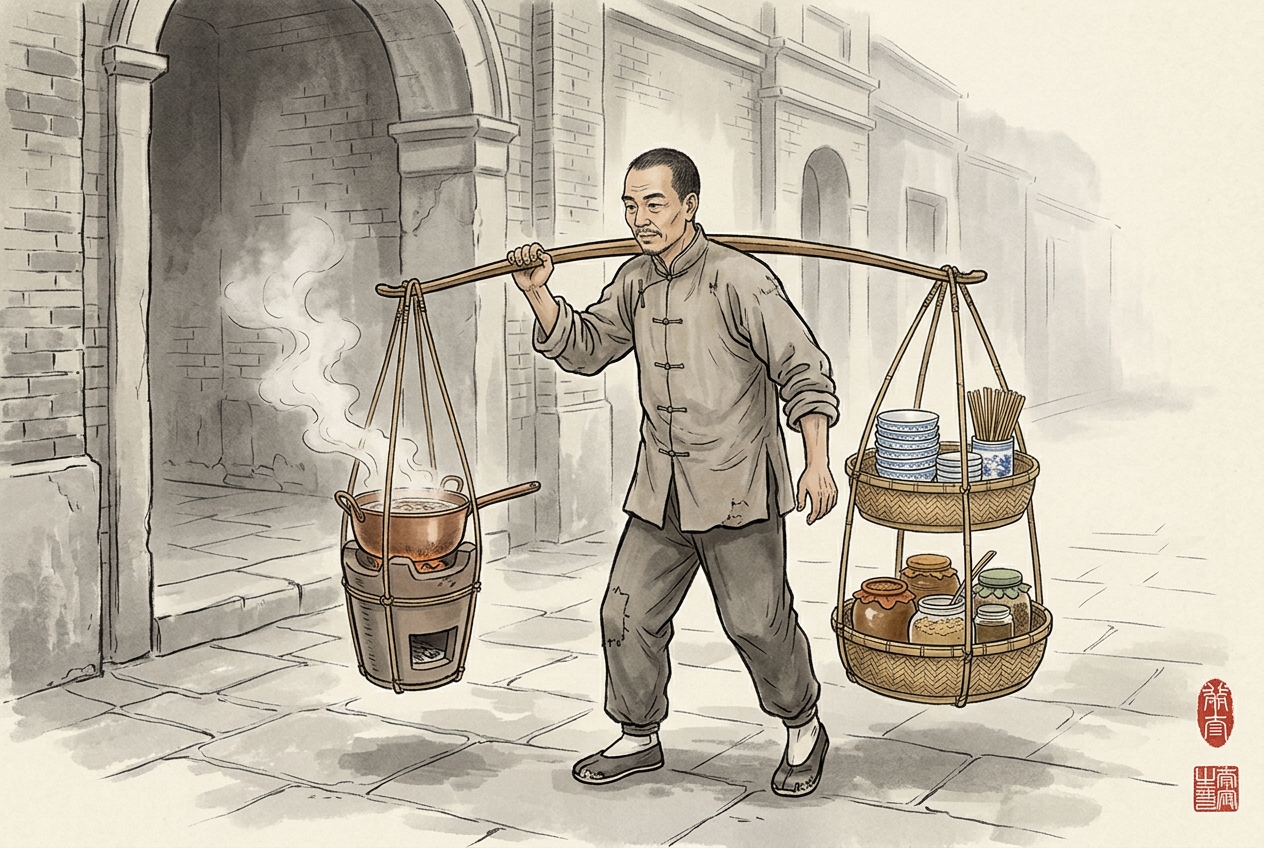
Columnists described opera-goers and dockworkers crowding beneath the chinaberry trees at Manchun Road as vendors shook golden alkaline strands from conical bamboo baskets and ladled over thick, aromatic sesame paste, soy lushui, and fiery chili oil—confirming that the modern sensory profile of Reganmian was fully mature prior to mid-century.
Stratum IV: Post-1950 Tax Ledgers & Official Municipal Gazetteers
Three post-1949 archival milestones completed the textual canonization:
- The 1950 Municipal Business & Tax Registry: During Wuhan’s commercial registration drive, fifteen-year-old Cai Hanwen inscribed 热干面 (Reganmian) on Cai Lin Ji’s official license—“Hot” (Re) for the boiling re-blanch, “Dry” (Gan) for the brothless sauce toss.
- Wuhan Municipal Gazetteer: Commerce Volume (1990): Published by Wuhan University Press after a decade of archival research, this state chronicle enshrined Cai Lin Ji Reganmian alongside Laotongcheng Doupi, Sijimei Soup Dumplings, and Xiaotaoyuan Broth as Wuhan’s “Four Great Traditional Snacks,” preserving exact 1945, 1955, and 1956 institutional records.
- Chronicles of Wuhan Gastronomy & 2011 ICH Dossiers: Synthesizing Qing poetry, Republican press clippings, and master oral histories into an unbroken scholarly lineage.
Chronological Index of Primary Textual Sources
| Year | Document / Archive Title | Author or Institution | Key Culinary Terms | Historical Significance |
|---|---|---|---|---|
| 1822 | Collected Talks on Hankou (Hankou Congtan) | Fan Kai (Qing) | Han River grain guilds, white sesame | Establishes Hankou’s dominance in Hubei sesame & wheat trade |
| 1850 | Hankou Bamboo-Branch Lyrics (Hankou Zhuzhici) | Ye Diaoyuan (Qing) | Guozao, Qiemian (cut noodles) | Earliest print record of Wuhan Guozao & alkaline cut noodles |
| 1915 | Petite Gazetteer of Hankou (Hankou Xiaozhi) | Xu Huandou (ed.) | Qiemianpu, alkali oil-brushing | Documents pre-1920s summer parboiling & oil-coating methods |
| 1930s–40s | Hankou Newspaper Supplements & Civic Verse | Luo Han & local press | Majiangmian, Manchun Road | Captures lively street consumption prior to 1950 naming |
| 1950 | Wuhan Commercial & Tax Registration Ledger | Wuhan Tax Bureau | Cai Lin Ji, Reganmian | First statutory government record of the name Reganmian |
| 1990–2011 | Wuhan Municipal Gazetteer & Wuhan Food Chronicles | Wuhan Chronicles Office | Danmian craft, ICH genealogy | Authoritative scholarly synthesis separating myth from history |
Across thread-bound woodblock pages and brittle newsprint, the documentary trail proves that Wuhan Reganmian was no overnight accident—it was a century-long dialogue between Jianghan agriculture, wharf ingenuity, and literary witness.
- Ye Diaoyuan, Hankou Bamboo-Branch Lyrics (1850 woodblock ed.; Hubei People's Press critical edition)
- Fan Kai, Collected Talks on Hankou (1822); Xu Huandou (ed.), Petite Gazetteer of Hankou (1915)
- Luo Han, New Market Bamboo-Branch Lyrics & Republican Hankou Newspaper Supplement Archives
- Wuhan Local Chronicles Committee, Wuhan Municipal Gazetteer: Commerce Volume (1990)
❓ Frequently Asked Questions
Where does the Wuhan dialect word 'Guozao' (eating breakfast) first appear in historical literature?
Its earliest known written record appears in 1850 (the 30th year of the Qing Daoguang reign) in poet Ye Diaoyuan's woodblock collection Hankou Bamboo-Branch Lyrics (汉口竹枝词), which vividly depicts merchants and laborers feasting on alkaline cut noodles, bean-starch ribbons, and rice-flour vermicelli at dawn.
What were 'Qiemian' in Qing and early Republican Hankou texts?
'Qiemian' referred to fresh wheat noodles kneaded with dietary soda ash (alkali), rolled under heavy bamboo poles, sliced with broad knives, parboiled, and brushed with oil to survive Hankou's humid heat. Wuhan culinary historians recognize Qiemian as the direct technological parent of 1930s Reganmian.
How did 1930s and 1940s Hankou newspapers refer to early Reganmian?
Before the dish was formally registered as 'Reganmian' on a 1950 Wuhan municipal tax form, feuilleton columns in Republican-era dailies like Xin Kuaibao and Da Gang Bao typically called the Manchun Road and New Market street specialty 'Majiangmian' (sesame-paste noodles) or 'sesame-oil tossed cut noodles.'
✦ Cross-Referenced Chapters
Origin Legends: Li Bao & Cai Mingwei Textual Inquiry
Investigating the two foundational 1930s Hankou accounts—street peddler Li Bao on Changdi Street and Cai Mingwei’s Cai Lin Ji.
Old Hankou Wharf & Bamboo-Bed Street Roots
How dockworker labor intensity and summer bamboo-bed alleys shaped Reganmian’s brothless, calorie-dense, 10-second format.
Wuhan "Guozao" Panorama: A Month Without Repeating Breakfast
Origins of the term "Guozao" and how Wuhan’s exuberant morning street-food universe revolves around Hot Dry Noodles.
Classical Bamboo-Branch Lyrics, Couplets & Modern Verse
Selected Qing-era Hankou folk quatrains, shopfront calligraphic couplets, and modern poems celebrating the bowl.