Classical Bamboo-Branch Lyrics, Shopfront Couplets & Modern Verse
From 1850 Qing Folk Quatrains on Hankou Cut Noodles to Regulated Verse and Free Poetry
An anthology and textual study tracing Wuhan’s morning noodle heritage through Ye Tiaoyuan’s 1850 Hankou Bamboo-Branch Lyrics, historic calligraphic shopfront couplets at Cai Lin Ji, and contemporary classical and modern poetry.
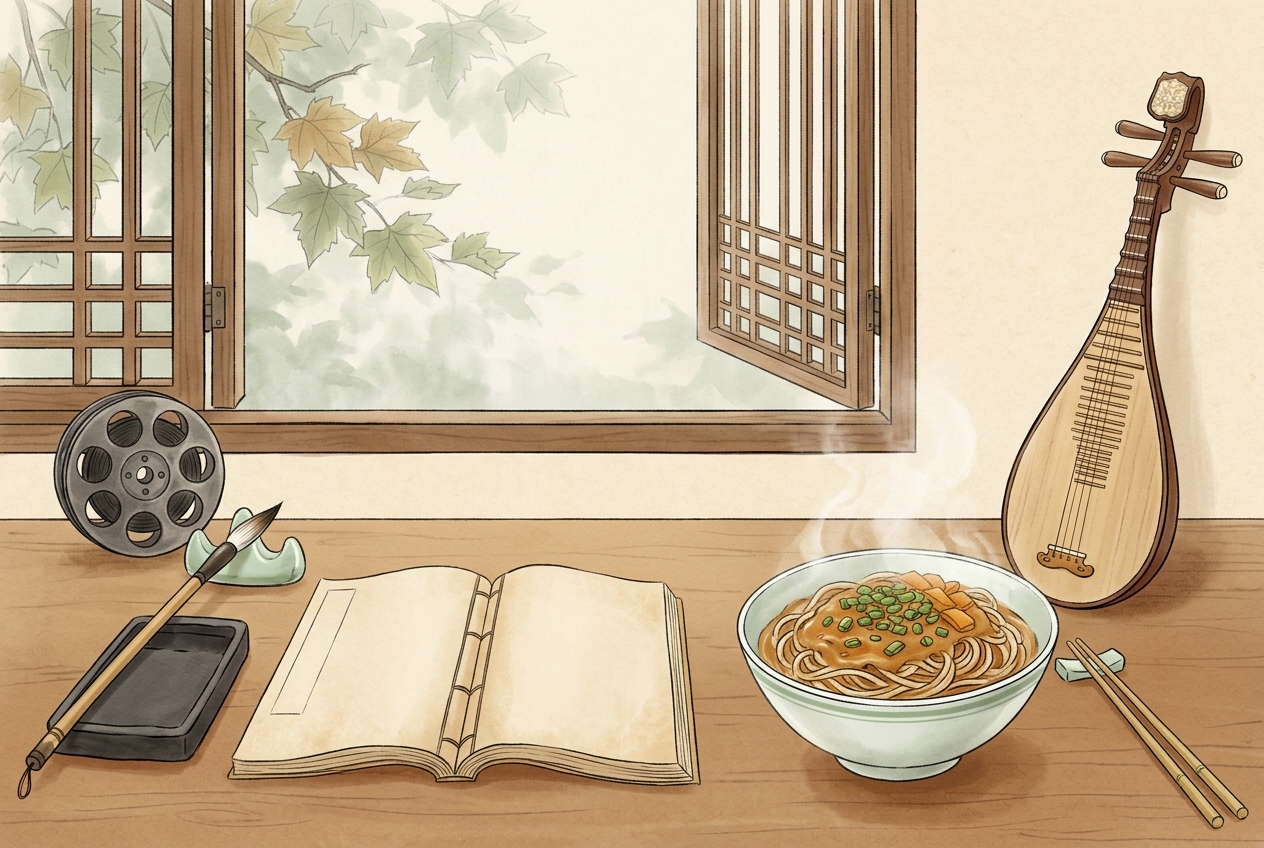
Daoguang-Era Folk Quatrains: Hankou Bamboo-Branch Lyrics (1850)
Long before cameras documented the bustling wharves where the Han River pours into the Yangtze, Chinese literati possessed a nimble poetic genre tailored for urban ethnography: Zhuzhici (“Bamboo-Branch Lyrics”). Originating with Tang Dynasty poet Liu Yuxi in the middle Yangtze region, Zhuzhici are brisk seven-syllable quatrains (qiyan jueju) written in lively vernacular to record local speech, commerce, and street customs.
In the thirtieth year of the Qing Daoguang reign (1850), scholar Ye Tiaoyuan—a native of Yuyao, Zhejiang, who lived and taught in Hankou for more than two decades—published his monumental six-volume Hankou Bamboo-Branch Lyrics (Hankou Zhuzhici), comprising 292 poems. At the time, Hankou stood as the foremost of China’s Four Great Commercial Towns, packed with salt guilds, grain barges, oil mills, and round-the-clock eateries. While modern sesame-coated Reganmian would not acquire its final name until the 1930s, Ye’s 1850 quatrains preserve the earliest poetic proof of its twin foundations: the civic institution of Guozao (eating breakfast out) and alkaline cut noodles (qiemian):
“Three days of Guozao outshine ordinary feasts; after such a hearty meal, lunch is quite forgotten. / Cut noodles, bean-starch ribbons, and dried rice vermicelli; fish balls and meat dumplings tumbling in boiling chicken broth.” — Ye Tiaoyuan, Hankou Bamboo-Branch Lyrics, Vol. 4 (1850)
In another quatrain, Ye explicitly notes the local slang: “Every mouth on the street casually declares: ‘Off to Guozao!’” (Xinkou ju yun qu guozao). The “cut noodles” (qiemian) leading his roster of morning staples were firm wheat dough kneaded with dietary alkali, hand-sliced with heavy cleavers, boiled, and dressed with fragrant oil pressed in Hankou’s famed small sesame mills (xiaomo xiangyou). Eighty years later, peddlers on Changdi Street and Manchun Road would parboil those same alkaline strands, fan them dry with sesame oil, and ladle stone-ground sesame paste on top to birth modern Reganmian.
During the early Republican era, scholar Luo Han continued this poetic chronicle in his Minzhong Leyuan Bamboo-Branch Lyrics, capturing the sensory clamor around Hankou’s New Market entertainment arcade, where noodle cauldrons steamed beside opera stages from dawn till midnight.
“Two Trees Make a Grove”: Brand Naming Lore & Shopfront Couplets
In traditional Chinese commercial architecture, a time-honored eatery announces its soul through bianlian—a horizontal calligraphic plaque overhead paired with vertical wooden couplets (yinglian) flanking the doorway. In Wuhan’s noodle genealogy, even brand names carry poetic wordplay, exemplified by Cai Lin Ji (蔡林记).
When husband-and-wife founders Cai Mingwei and丁氏 transitioned from a shoulder-pole stall to a storefront near Hankou’s Manchun Intersection around 1928, two tall chinaberry trees (kulianshu) shaded their threshold. Because merchants avoided the homophone ku (“bitterness”) in business names, neighborhood elders invoked the visual structure of the Chinese character Lin (林, “grove/forest”), formed by placing two Mu (木, “tree”) radicals side by side (shuang mu cheng lin). Thus Cai Lin Ji—“Record of the Cai Grove”—celebrated both verdant shade for summer diners and flourishing generational prosperity.
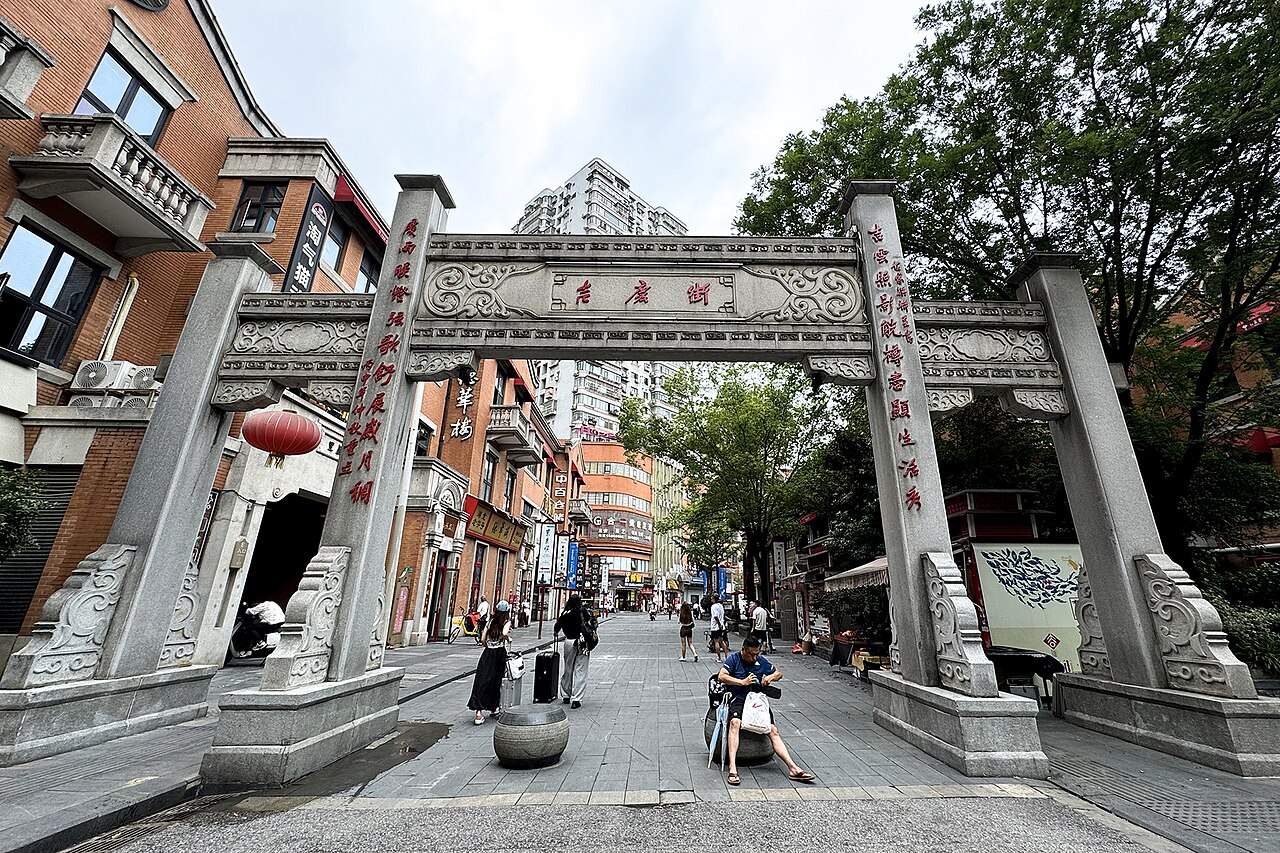
Across historic storefronts on Zhongshan Avenue, Jiqing Street, and Hubu Alley, black-lacquered couplets distill the craft and sociology of Reganmian into balanced parallel verse:
-
The Craft Couplet (On Mixing Technique):
Upper Scroll: Three turns and nine tosses—stone-ground sesame fragrance drifts ten miles; (San zhuan jiu ban, zhimajiang xiang piao shili) Lower Scroll: Slender strands and honest grain—Old Hankou’s morning heart remains devoted. (Ximian culiang, Lao Hankou guozao zhongqing) Here, “three turns and nine tosses” preserves practical table wisdom: because Reganmian is served without broth, diners must rotate the bowl and lift the strands rapidly while residual steam keeps the oil-emulsified paste fluid.
-
The Heroic River-City Couplet:
Upper Scroll: Golden alkaline threads lift sun and moon, rising from boiling bamboo in six seconds; Lower Scroll: Stone-milled sesame paste stirs spring and autumn, gathering a city’s hearth into one bowl.
-
The Egalitarian Humor Couplet:
Upper Scroll: Say not a brothless bowl is dry—one cup of sweet egg rice wine makes immortals envious; Lower Scroll: Scorn not the tall stool used as table—with sesame richness on the lips, dukes and lords are forgotten.
Regulated Classical Meter Meets Street Steam
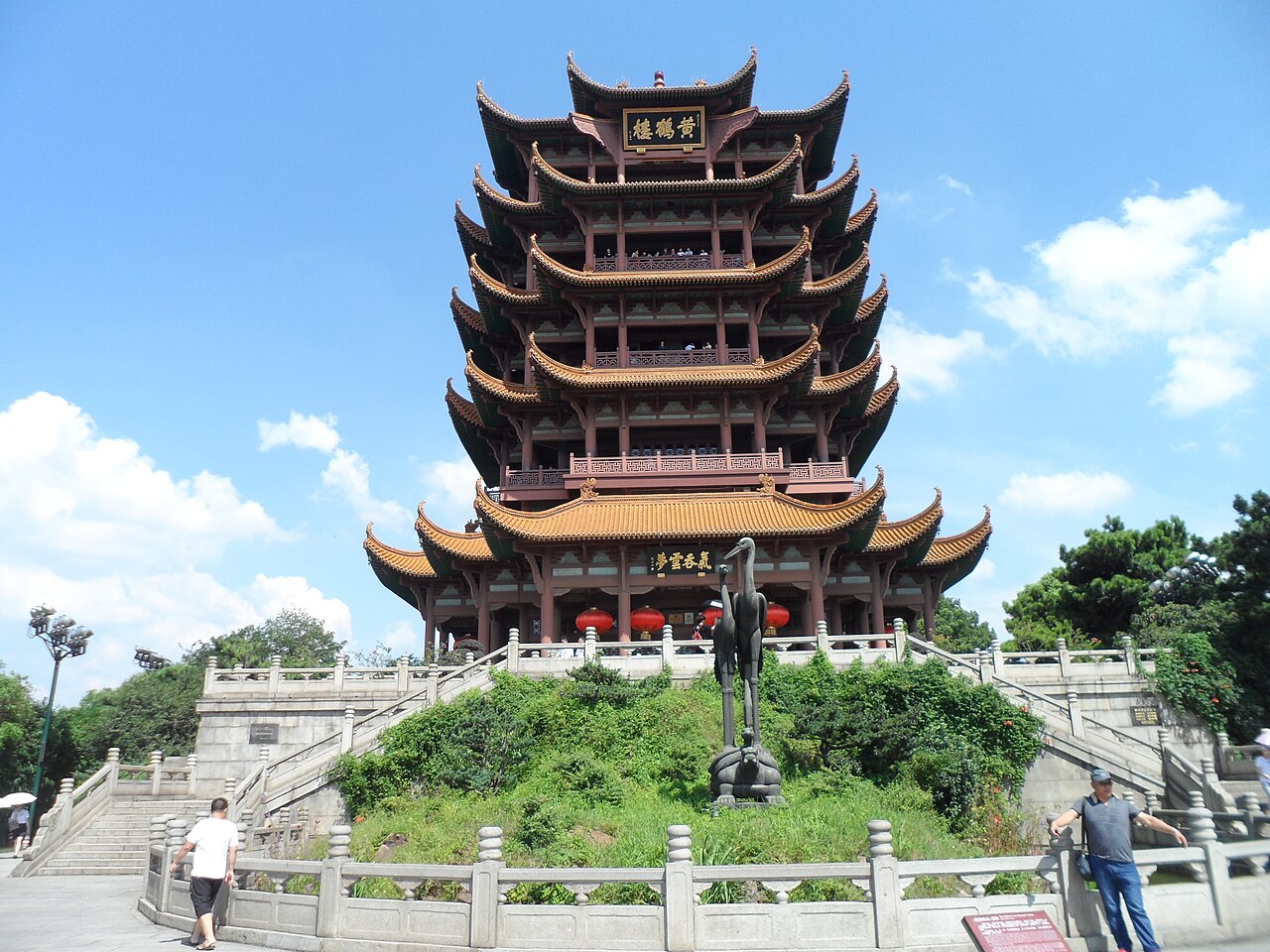
In 2009, the Poetry Society of China designated Wuhan the nation’s first provincial capital “City of Classical Poetry” (Zhonghua Shici zhi Shi), honoring a unbroken literary lineage stretching back to Cui Hao’s Tang Dynasty masterpiece Yellow Crane Tower. Rather than confining classical prosody (pingze tonal patterns) to lotus ponds and plum blossoms, members of the Hubei and Wuhan Classical Poetry Societies regularly compose regulated quatrains (qijue) and ci lyrics (Huanxisha, Zhegutian) dedicated to their morning noodles.
| Historical Period | Poetic Form | Representative Author / Source | Primary Imagery & Rhetorical Style | Notable Motif |
|---|---|---|---|---|
| Late Qing (1850) | 7-Syllable Zhuzhici | Ye Tiaoyuan, Hankou Bamboo-Branch Lyrics | Documentary street realism; earliest record of Guozao & qiemian | Cut alkaline noodles & bustling Hankou dawn feasts |
| Republican Era (1920s–40s) | Folk Quatrains & Plaques | Luo Han’s Minzhong Leyuan Lyrics; Manchun Rd stalls | Rise of sesame-dressed noodles & “Two Trees Make a Grove” lore | Cai Lin Ji naming & theater-district snack lanes |
| Reform Era (1980s–2000s) | Parallel Shop Couplets (Yinglian) | Flagship heritage halls & Wuhan Poetry Society | Encoding danmian parboiling & san zhuan jiu ban tossing into strict parallelism | Ten-mile sesame aroma & egalitarian plastic stools |
| Contemporary (2010s–Present) | Regulated Verse & Modern Free Poetry | Zhang Zhihao & Hanshui contemporary poets | Everyday poetics, diaspora homesickness, and post-2020 spring renewal | Morning fog folded into a warm paper bowl |
Consider how effortlessly classical four-line structure maps onto the four-stage preparation of Reganmian in contemporary Wuhan Zhuzhici:
“Lightly lifts the bamboo basket as white mist blooms; / Golden threads shed water to meet the cooling fan. / One ladle of stone-milled paste, rich as amber— / Stirring awake ten thousand miles of clear sky over the River City.”
Everyday Poetics: Free Verse and the Paper Bowl
Parallel to classical prosody, Wuhan has long stood as a powerhouse of modern Chinese free verse (xinshi), anchored by poets such as Lu Xun Literary Prize winner Zhang Zhihao, celebrated for his “poetics of everyday warmth.” Free from strict rhyme schemes, contemporary Wuhan poets zoom in on tactile, intimate micro-moments: the crinkle of a thin plastic liner stretched over a chipped ceramic bowl, the sharp sting of freshly pounded garlic water (dasuanshui) cutting through humid dawn air, and the collective catharsis of April 2020, when the scent of roasted white sesame returning to neighborhood corners announced that the city had survived winter. In both classical tonal meter and modern vernacular lines, Wuhan’s humblest breakfast has earned an enduring seat in Chinese letters.
- Ye Tiaoyuan (Qing Dynasty), annotated by Xu Mingting, Annotated Hankou Bamboo-Branch Lyrics, Hubei People’s Publishing House
- Xu Mingting (ed.), Wuhan Bamboo-Branch Lyrics (Wuhan Zhuzhici), Hubei People’s Publishing House, 1999
- Wuhan Local Chronicles Committee, Wuhan Municipal Gazetteer: Commerce & Catering Volume
- Hubei Classical Poetry Society, Selected Poems Celebrating River City Heritage
❓ Frequently Asked Questions
Did Qing Dynasty Bamboo-Branch poems mention Reganmian by name?
Because modern sesame-paste Reganmian crystallized in the 1930s, Ye Tiaoyuan’s 1850 Hankou Bamboo-Branch Lyrics does not use the exact term 'Reganmian.' However, it famously documents 'Guozao' (morning breakfast) and 'qiemian' (alkaline cut noodles) alongside Hankou’s small-mill sesame oil—the direct culinary ancestors of today’s dish.
What is the poetic story behind the brand name 'Cai Lin Ji'?
When founder Cai Mingwei opened his storefront near Manchun Road around 1928, two lush chinaberry trees stood before the entrance. Avoiding the character 'bitter' (ku) in chinaberry, locals invoked the auspicious Chinese idiom 'two trees make a grove' (shuang mu cheng lin), yielding the poetic name Cai Lin Ji.
How do traditional shopfront couplets (yinglian) reflect Reganmian’s culinary technique?
Classic wooden couplets hung flanking Wuhan noodle shop doors encode exact preparation steps—such as 'three turns and nine tosses' (san zhuan jiu ban) to coat strands evenly, six-second boiling basket dips, and stone-milled white sesame aroma drifting ten miles.
✦ Cross-Referenced Chapters
Origin Legends: Li Bao & Cai Mingwei Textual Inquiry
Investigating the two foundational 1930s Hankou accounts—street peddler Li Bao on Changdi Street and Cai Mingwei’s Cai Lin Ji.
Historical Gazettes, Bamboo-Branch Lyrics & Old Press
Archival excerpts from Qing/Republican Hankou poetry, local gazetteers, and early newspaper accounts of sesame alkaline noodles.
In Writers’ Ink: Chi Li, Yi Zhongtian & Wuhan Literary Prose
Literary close-readings of how celebrated Wuhan novelists and essayists immortalized morning steam and sesame aroma.
Spoken Folk Arts: Hubei Pingshu Storytelling & Wuhan Crosstalk
Humorous anecdotes and theatrical sketches about eating hot dry noodles from master Hubei storytellers and crosstalk performers.