Centennial Chronology (1920s–2020s)
From Republican Wharf Shoulder-Poles to a Multi-Billion-Yuan Global Culinary Industry
A comprehensive decade-by-decade chronicle of Wuhan Reganmian from the late 1920s to the 2020s, tracing early street stalls, 1956 state-private partnerships, grain-rationing queues, post-1978 private entrepreneurship, intangible heritage honors, and modern fresh-lock exports.
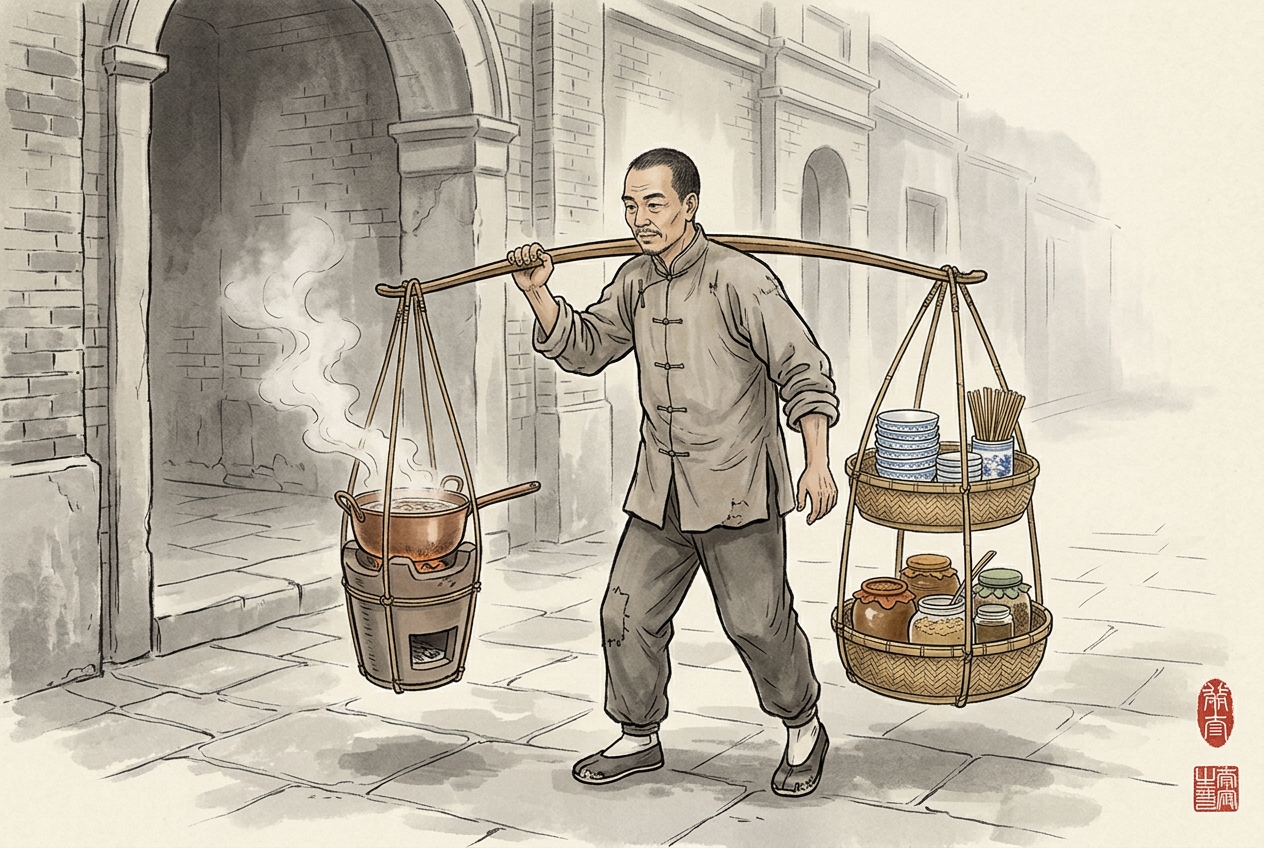
Modern Chinese Urban History in a Single Bowl
Few dishes anywhere in the world mirror a metropolis’s political, economic, and technological transformations as faithfully as Wuhan Reganmian. Over the course of nearly a hundred years, these golden, 1.8-millimeter alkaline wheat strands have traveled through treaty-port wharf capitalism, wartime displacement, 1950s socialist collectivization, grain-coupon queues, 1980s sidewalk entrepreneurship, and twenty-first-century cold-chain globalization.
To trace the centennial chronology of Hot Dry Noodles is to read an edible biography of modern Wuhan itself—a city where macro-historical shifts were tasted first at 6:00 AM over steaming cauldrons.
“One bamboo pole carried the rains of the Republic; ten thousand bowls held spring across the Yangtze. Call it not a humble sesame noodle—a century of human fortune turns inside the basin.” — Notes on River City Gastronomy
Era I: Wharf Genesis & Craft Codification (1920s–1949)
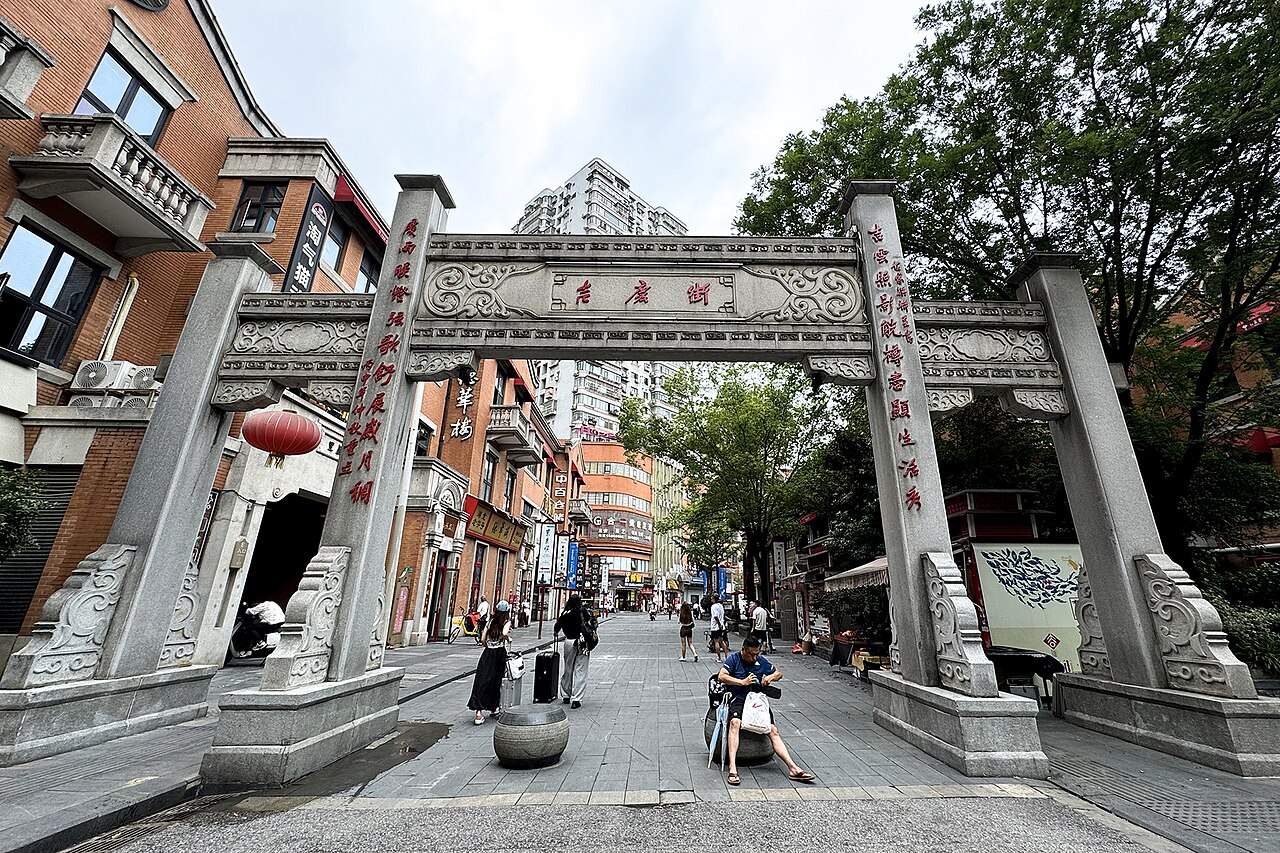
- 1928–1932 (Grassroots Experimentation): Young Huangpi native Cai Mingwei arrives in Hankou’s Changdi Street and Hanzheng Street mercantile district. Amid oppressive summer heat, street peddlers (memorialized in the Li Bao legend) and Cai Mingwei pioneer danmian—parboiling alkaline cut noodles and tossing them in oil to prevent spoilage.
- 1936–1937 (Rise of Majiangmian): On the eve of the Second Sino-Japanese War, Hankou’s port economy peaks. Cai Mingwei perfects the stone-ground white sesame paste emulsion, spiced soy lushui, and diced Huangpi pickled radish. Locals flock to his shoulder-pole cart calling the dish Majiangmian (sesame paste noodles).
- 1938–1944 (Wartime Survival): Through the Fall of Wuhan and wartime occupation, flour and sesame supplies tighten, yet alley noodle hawkers sustain working-class neighborhoods inside Hankou’s lifen courtyard lanes.
- 1945 (Founding of Cai Lin Ji): Following victory in World War II, Cai Mingwei and his brother Cai Mingjing open a permanent storefront at the Manchun Road intersection. Inspired by two chinaberry trees framing the doorway (“two trees make a forest”), they unveil the signboard Cai Lin Ji (蔡林记).
Era II: Collectivization & The Grain-Coupon Peak (1950–1977)
- 1950 (Official Baptism): During Wuhan’s first post-1949 commercial tax registration, Cai Mingwei’s eldest son Cai Hanwen writes Reganmian (热干面) onto the municipal business license, establishing the canonical name.
- 1955 (Move to Zhongshan Avenue): Cai Lin Ji relocates to 726–728 Zhongshan Avenue, directly opposite the landmark Hankou Water Tower, anchoring Wuhan’s busiest commercial boulevard.
- 1956 (Public-Private Partnership): Under nationwide socialist transformation of private industry (gongsi heying), Cai Lin Ji merges with neighboring noodle stalls into a joint state-private enterprise, with Cai Mingwei serving as manager and master technician. Division of labor—kneading, machine-cutting, cauldron parboiling, and stone-milling—scales daily output dramatically.
- 1966–1977 (State Enterprise & Relocations): Converted into a wholly state-owned enterprise in 1966 and briefly renamed “Wuhan Reganmian Restaurant,” the flagship serves 12,000 to 15,000 bowls daily for 8–12 fen plus a 2-liang grain ration coupon. Urban roadworks in 1974 prompt relocations around Minsheng Road and Jiaotong Road. Founder Cai Mingwei passes away in 1977.
Era III: Reform, Private Stalls & Street Proliferation (1978–1999)
- 1979–1984 (Revival & Sidewalk Boom): The historic Cai Lin Ji name is restored, earning the Ministry of Commerce’s “China Time-Honored Brand” (Zhonghua Laozihao) title. Simultaneously, economic reforms unleash thousands of family-run honeycomb-coal carts across Hankou alleys, Wuchang’s Liangdao Street, and Hanyang’s Xidajie.
- 1985–1992 (Deluxe Toppings & Commuter Culture): As grain rationing ends, creative stallkeepers introduce braised beef, spicy honeycomb tripe, zhajiang pork sauce, and fermented sour long beans (suandoujiao). Plastic-lined bowls and takeaway bags spark Wuhan’s iconic “eating while walking” morning rush.
- 1995 (Corporate Restructuring): Cai Lin Ji reorganizes into a joint-stock commercial company, experimenting with central kitchens and franchise stores, while early grease-proof paper bowls appear in model sanitary districts.
Era IV: Heritage Canonization, Legal Standards & Global Reach (2000–2020s)
- 2006 & 2011 (Intangible Cultural Heritage): “Cai Lin Ji Reganmian Craft” enters Wuhan’s First Municipal ICH List (2006, Code VIII-9) and ascends in June 2011 to Hubei Province’s Third Provincial Intangible Cultural Heritage List.
- 2010–2013 (Lineage Expansion & National Crown): Cai Hanwen publicly inducts apprentices, fueling modern chains such as Changqing Maixiangyuan and Zeng Mazi. In June 2013, at the inaugural China Noodle Culture Festival in Hangzhou, Wuhan Reganmian is voted #1 among China’s Top Ten Noodles.
- 2014–2019 (Codified Food Law): Hubei Province promulgates mandatory Food Safety Local Standard DBS42/005-2014, legally defining alkaline pH thresholds and minimum pure sesame content.
- 2020–2026 (National Solidarity & Fresh-Lock Exports): In spring 2020, “Cheer Up, Reganmian!” becomes a beloved national emblem of solidarity with Wuhan. Breakthroughs in non-fried hot-air drying and pasteurized semi-fresh pouches propel retail sales past 10 billion RMB. In 2024, Wuhan’s new Production Management Code classifies six industrial product types, shipping authentic bowls to supermarkets from New York and London to Tokyo and Sydney.
Summary Table: Five Epochs of Wuhan Reganmian
| Epoch | Key Years | Defining Milestones | Dominant Format & Vessel | Typical Price (2-Liang Bowl) |
|---|---|---|---|---|
| Wharf Genesis | 1928–1945 | Danmian invented on Changdi St; Cai Lin Ji opens at Manchun Rd | Bamboo shoulder-pole → shopfront; coarse porcelain bowls | Copper coins / Republican currency |
| State Collectivization | 1950–1977 | Named in 1950; 1955 Water Tower move; 1956 state-private merger | State noodle halls; porcelain bowls & customer aluminum tins | 0.08–0.12 RMB + 2-liang coupon |
| Private Revival | 1978–1999 | Sidewalk stall boom; beef toppings; 1995 corporate restructuring | Honeycomb-coal pushcarts; enamel bowls & plastic bag liners | 0.30 RMB → 1.50 RMB |
| Heritage & Chains | 2000–2015 | Municipal/Provincial ICH; #1 Top Ten Noodles; DBS42 standard | Central-kitchen chains; PE-coated greaseproof paper bowls | 2.00 RMB → 4.00 RMB |
| Global Supply Chain | 2016–2026 | 2020 solidarity icon; 2024 six-type code; 30+ country exports | Flagship eateries + global e-commerce; fresh-lock retail boxes | 5.00–6.00 RMB (classic plain) |
Nearly a century after dockworkers first huddled around charcoal braziers by the Han River, automated lines now seal tens of thousands of fresh-lock pouches an hour. Yet the alchemy at the heart of the ritual—six seconds in rolling water, a wrist-snap drain, and a ladle of fragrant stone-ground sesame paste—remains untouched by time.
- Wuhan Municipal Gazetteer: Commerce & Chronology Volumes (Wuhan University Press)
- Hubei Provincial Health Commission: Food Safety Local Standard for Wuhan Reganmian (DBS42/005-2014)
- Wuhan Municipal Administration for Market Regulation: Production Management Code for Wuhan Reganmian (2024)
- Hubei Provincial Third Batch Intangible Cultural Heritage Registry (2011)
❓ Frequently Asked Questions
What were the four major historical turning points for Wuhan Reganmian?
First, craft standardization and storefront founding (1928–1945); second, state-private collectivization in 1956, which scaled workshop techniques into high-volume urban canteens; third, the post-1978 explosion of private family stalls and savory toppings across Wuhan's Three Towns; and fourth, the post-2014 industrialization of non-fried fresh-pouch noodles for global retail.
How did people buy Reganmian during China's planned-economy rationing era?
From 1955 until the mid-1980s, ordering a standard 2-liang (100g dry-flour equivalent) bowl at a state-run noodle shop required handing over both cash—typically 8 to 12 fen—and a 2-liang Hubei local or national grain coupon (liangpiao). Sesame paste allocations were likewise rationed monthly by municipal grain bureaus.
How did the events of 2020 transform Reganmian's place in Chinese culture?
During Wuhan's 76-day lockdown in early 2020, 'Cheer Up, Reganmian!' (热干面加油) became China's most endearing personification of civic resilience. Simultaneously, nationwide home dining accelerated breakthroughs in air-dried non-fried noodles and lactic-acid fresh-lock pouches, turning a 10-second street dish into a pantry staple exported to over 30 countries.
✦ Cross-Referenced Chapters
Origin Legends: Li Bao & Cai Mingwei Textual Inquiry
Investigating the two foundational 1930s Hankou accounts—street peddler Li Bao on Changdi Street and Cai Mingwei’s Cai Lin Ji.
Intangible Cultural Heritage Dossier & Lineage
Official Hubei provincial heritage classifications, master inheritor lineages, and traditional craft preservation standards.
Genealogy of Time-Honored Brands & Schools
Mapping the historical splits, apprenticeships, and brand evolutions from Cai Lin Ji to Cai Mingwei, Changqing, and Zeng Mazi.
The Multi-Billion RMB Reganmian Supply Chain Ecosystem
From dedicated wheat mills and automated central wet-noodle factories to tens of thousands of storefronts and live-stream retail.