Mirror of the Wharf: Directness, Warmth & Nine-Province Openness
How Dockworker Velocity, Unadulterated Sesame Richness, and North-South Fusion Embody Wuhan's Civic Soul
An urban-anthropological reading of Reganmian as an edible portrait of Wuhan: ten-second blanching reflects river-port briskness, thick sesame paste mirrors blue-collar generosity, and multi-regional condiments embody 'Thoroughfare of Nine Provinces' cosmopolitanism.
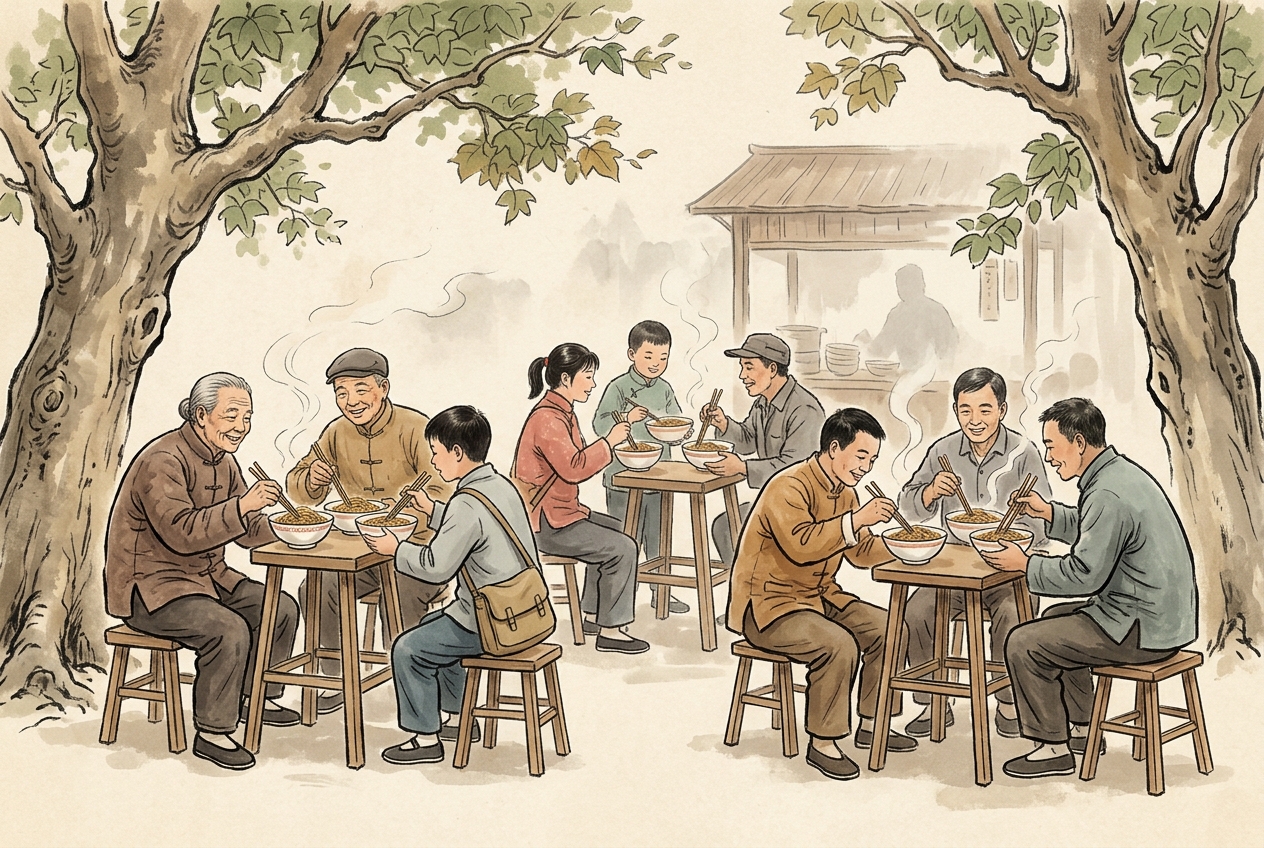
Where Two Rivers Collide: Culinary Architecture of a Port City
If you want to take the psychological pulse of a Chinese city, watch how it eats noodles at seven in the morning.
In Beijing, zhajiangmian arrives flanked by seven neat saucers of julienned vegetables—unhurried, ceremonial, courtly even in a courtyard alley. In Suzhou, aozaomian floats in jewel-clear crimson or ivory broth, sipped delicately before the morning mist lifts off the canals. In Guangzhou, bamboo-pressed wonton noodles belong to a lingering yum cha table of tea pots and folded newspapers. Then step onto a sidewalk in Wuhan, where the muddy colossus of the Yangtze absorbs the emerald rush of the Han River: a bamboo cone plunges into roiling water, emerges six seconds later with three sharp flicks of the wrist, takes a dark, unapologetic ladle of stone-ground sesame paste, and lands in the palm of a commuter who tosses it at a brisk walk and finishes the bowl before reaching the next intersection.
That kinetic urgency was forged on the docks. After the Han River shifted its lower course in the late fifteenth century, Hankou erupted into one of late-imperial China’s four great commercial towns, celebrated along Hanzheng Street and Changdi Street in Qing chronicler Fan Kai’s Collected Notes on Hankou:
“Flanking both riverbanks a market rises; ten thousand hulls stack prow to stern in trade—masts blotting out the sky, cargo piled like hills, clamor never ceasing day or night.”
Following Hankou’s opening as a treaty port in 1861, miles of steamship bunds, tea warehouses, and cotton piers employed tens of thousands of shoulder-pole stevedores (biandan) and river boatmen.
On the wharf, time was measured by steam whistles and river tides, and labor burned four thousand kilocalories a day. Scalding broth took too long to cool and spilled on gangplanks; cold rations sat like lead in winter. Wuhan’s answer—alkaline wheat noodles pre-tossed in oil, flash-revived in ten seconds, drained bone-dry, and armored in lipid-rich sesame paste—was industrial ergonomics disguised as street food.
First Mirror: Ten-Second Blanching and Wuhan’s Forthright Briskness
Outsiders encountering Wuhanese society for the first time are often startled by its tempo and candor. People speak fast, cut straight to the point, and have zero patience for euphemism or bureaucratic hedging—a trait locals prize as shuangli (爽利: brisk, clean-cut, decisive).
Reganmian embodies shuangli down to its moisture physics. A proper bowl tolerates not a single stray spoonful of stagnant cooking water at the bottom. During danmian preparation, sesame oil and electric fans arrest gelatinization at eighty percent doneness so the gluten core stays taut and springy. At service, six seconds too long in the cauldron ruins the bite; ten seconds of hesitation before tossing causes the sesame emulsion to seize.
In his celebrated urban-culture treatise Reading Cities (Du Cheng Ji), scholar Yi Zhongtian—who lived and taught at Wuhan University for over a decade—described Wuhan as China’s quintessential plebeian “citizen metropolis” (shimin shehui). Unlike imperial capitals shaped by court hierarchy or coastal enclaves polished by colonial comprador etiquette, Wuhan grew upward from artisans, merchants, and dockhands. Like alkaline noodles that push firmly back against the teeth rather than melting compliant on the tongue, Wuhan’s civic temperament is spiky, direct, and refreshingly free of pretension.
Second Mirror: Uncut Sesame Paste and Blue-Collar Loyalty
If the alkaline strand supplies Wuhan’s spine, the thirty-five-gram blanket of stone-ground white sesame paste supplies its heart: substantial, generous, and fiercely allergic to watering things down.
Consider the culinary audacity of the formula. Most working-class street noodles stretch modest ingredients with a quart of seasoned broth so the diner feels full on liquid volume. Reganmian refuses the illusion. Every bowl delivers concentrated roasted sesame lipids, high-gluten wheat protein, fragrant sesame oil, and ten-spice soy reduction—dense, honest sustenance that carries a worker or student straight through to noon without a mid-morning crash.
Novelist Chi Li, chronicler laureate of Wuhan’s alleyways, has spent decades portraying characters cut from this exact cloth: sharp-tongued stallholders and tough-minded matriarchs who never utter sentimental flattery, yet show up unasked with cash, muscle, and hot food the moment a neighbor falls into trouble. Locals call it “knife-edged mouth, bean-curd heart,” or simply zashi (扎实—solid all the way through). A bowl of Reganmian does not flatter your eyes with porcelain plating; it lines your ribs for the day’s fight.
Third Mirror: Nine Provinces in One Bowl
Situated at China’s geographic bullseye—historically hailed as Jiusheng Tongqu (九省通衢, “Thoroughfare of Nine Provinces”)—Wuhan has absorbed migrants from northern plains, western gorges, southern lakes, and eastern deltas for five centuries. Every wave of newcomers left an imprint inside the paper bowl:
| Bowl Layer | Geographic & Culinary Lineage | Wharf Utility | Civic Trait Reflected |
|---|---|---|---|
| High-Gluten Alkaline Noodles | Northern winter wheat married to southern jianshui alkali craft | Anti-spoilage resilience, springy chew, slow digestion | Grit, backbone, and bu fu zhou defiance |
| Six-Second Flash Blanch | Conical bamboo strainer & triple wrist-shake drain | Zero wait time; spill-free eating on the move | Brisk efficiency and impatience with artifice |
| Stone-Ground White Sesame Paste | Jianghan Plain & northern Hubei sesame, oil-emulsified | High-calorie fuel for heavy manual and mental work | Unwatered generosity and blue-collar honesty |
| Sour Long Beans & Huangpi Radish | Hubei farmhouse crock fermentation & sun-wilted pickles | Bright crunch and lactic acidity cutting heavy fat | Pragmatic wit and resourcefulness under harsh climates |
| Chili Oil, Rice Vinegar & Spiced Soy | Sichuan-Hunan heat, Shanxi-Jiangnan tang, five-spice braise | Customizable balance across every palate | Radical inclusivity of an immigrant crossroads |
Across much of China, culinary borders are policed with fierce orthodoxy: northerners champion sesame paste and raw garlic, southerners insist on alkaline bounce and pickled greens, westerners demand scorched chili oil, easterners favor aromatic soy and a whisper of sugar. On a Hankou street corner, those rival creeds dissolve effortlessly into a single cross-tossed whirlpool.
That is the ultimate lesson of the wharf. Because everyone’s ancestors arrived by boat or rail from somewhere else, Wuhan erected no aristocratic walls against outsiders. Sit down on a low plastic stool, stir the dark sesame paste upward until every golden strand shines, and let the chili oil warm your brow—the River City asks nothing of your pedigree and welcomes you straight into the fray.
- Yi Zhongtian, 'Du Cheng Ji' [Reading Cities], Shanghai Literature and Art Publishing House
- Pi Mingxiu (ed.), 'Jindai Wuhan Chengshi Shi' [Modern Urban History of Wuhan], China Social Sciences Press
- Chi Li, 'Shenghuo Xiu' [Life Show], Writers Publishing House
- Fan Kai (Qing Dynasty), 'Hankou Congtan' [Collected Notes on Hankou], Hubei People's Publishing House
❓ Frequently Asked Questions
How did Hankou's river wharves directly shape Reganmian's brothless design?
Tens of thousands of dockworkers ('biandan' shoulder-pole porters) and boatmen worked against tight cargo schedules along the Han and Yangtze rivers. Sloshing bowls of scalding soup were impractical to eat standing up or walking back to the pier. Pre-parboiled alkaline noodles revived in 6–10 seconds, drained dry, and coated in calorie-dense sesame paste delivered maximum fuel in minimum time.
What does 'Thoroughfare of Nine Provinces' (Jiusheng Tongqu) mean in a bowl of Reganmian?
Sitting at China's inland crossroads, Wuhan absorbed migrants from every compass point. Reganmian fuses northern wheat and sesame paste, Cantonese-style alkaline noodle elasticity, Sichuan-Hunan chili oil, Jiangnan soy-vinegar balance, and Hubei crock-fermented pickles into one harmonious bowl.
Why do cultural critics compare Wuhan's civic personality to Hot Dry Noodles?
Scholars like Yi Zhongtian and novelist Chi Li note that Wuhan is an unpretentious 'citizen's city'—blunt on the surface, fiercely loyal underneath, and allergic to empty ceremony. Like Reganmian, which skips decorative broth in favor of pure, substantial sesame richness, Wuhanese character prizes substance over veneer.
✦ Cross-Referenced Chapters
Old Hankou Wharf & Bamboo-Bed Street Roots
How dockworker labor intensity and summer bamboo-bed alleys shaped Reganmian’s brothless, calorie-dense, 10-second format.
Wuhan "Guozao" Panorama: A Month Without Repeating Breakfast
Origins of the term "Guozao" and how Wuhan’s exuberant morning street-food universe revolves around Hot Dry Noodles.
In Writers’ Ink: Chi Li, Yi Zhongtian & Wuhan Literary Prose
Literary close-readings of how celebrated Wuhan novelists and essayists immortalized morning steam and sesame aroma.
Wuhan Dialect Glossary: From "Guozao" to "Xufu"
Pronunciation, etymology, and lively street dialogues for over twenty authentic Wuhanese expressions heard at noodle stalls.
Street Sociology: The Egalitarian Republic of Plastic Stools
Tall stool as table, short stool as seat—an ethnographic look at how sidewalk noodle dining dissolves social hierarchy.