The Ten-Condiment Flavor Matrix & Layering Order
Exact Gram Ratios, Heritage Sesame Salt, White Pepper, and the Thermodynamics of Assembly
A quantitative culinary breakdown of Wuhan Reganmian's complete ten-condiment formula for a standard 200g bowl: exact gram weights, the lost art of toasted sesame salt, why Hubei cooks insist on white pepper, and why layering liquid under noodles and paste on top is critical.
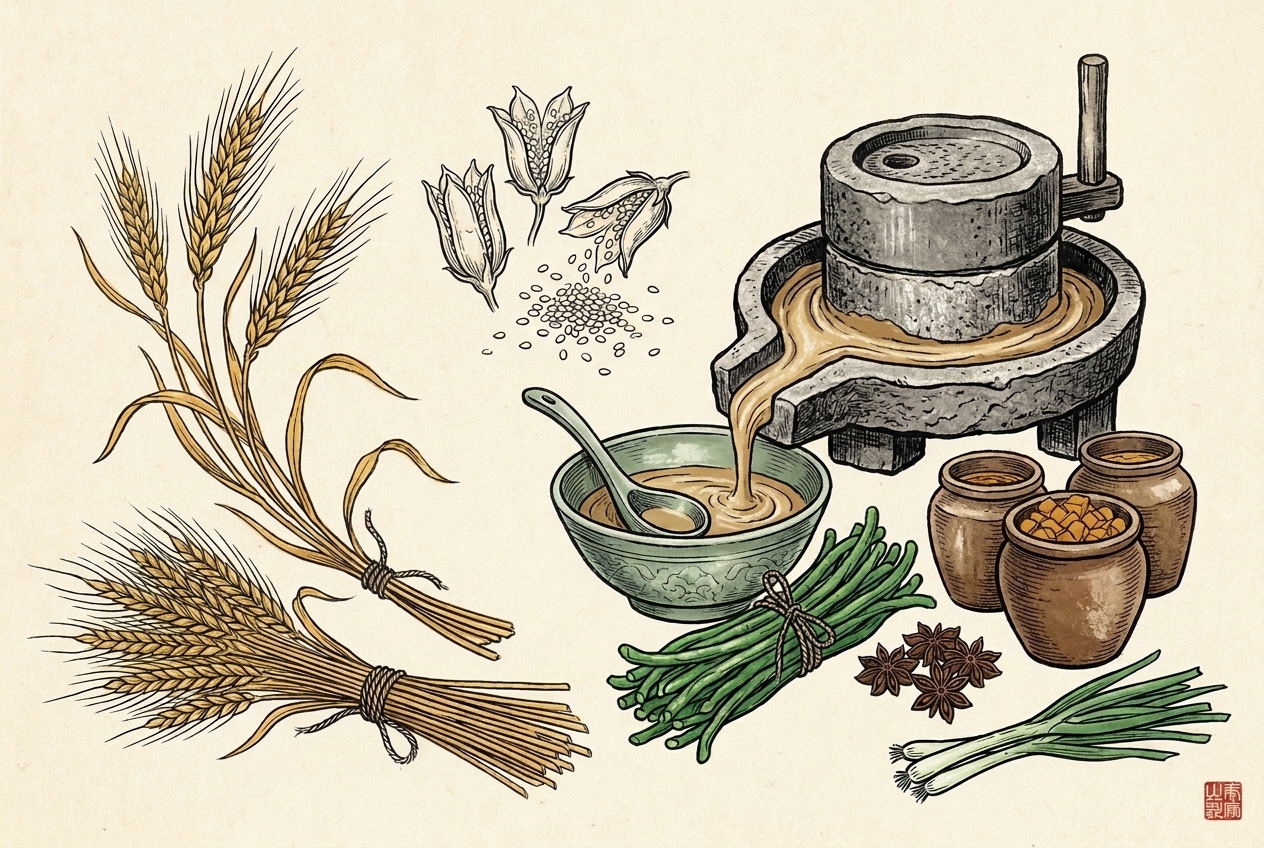
Three Seconds, Eight Ladles: Street-Corner Precision Engineering
Stand beside the counter of a busy Hankou breakfast shop at 7:00 AM and time the assembly of a bowl. Left hand cradling a grease-proof paper bowl, the master’s right hand blurs across a battery of stainless-steel canisters—a flick of powder, two flashes of dark amber liquids, a pale splash of garlic infusion, a golden arc from a long-spouted brass oil pot, and one generous wooden scoop of sesame paste crowning the steaming heap. Total elapsed time: barely three seconds. Yet from first strand to final bite, salt, umami, roasted fat, lactic snap, and warm spice lock into effortless equilibrium.
What looks like improvisational street theater is in fact a tightly calibrated Ten-Condiment Flavor Matrix. Developed across nearly a century of high-volume dockside service, each of the ten components occupies a narrow gram window and a deliberate vertical position inside the bowl.
“Soy sets the salt, aged broth brings the soul; one pinch of white pepper warms the whole. Hide sugar and vinegar out of sight, and crown the hot peak with sesame’s might.” — Old Hankou noodle vendor’s mnemonic
Master Gram Table: Standard “Two-Liang” Bowl (190g Cooked Noodles)
In Wuhan ordering parlance, a standard Er-Liang (“two-liang”) serving refers to ~140g of raw flour dough, yielding 180g to 200g of parboiled, oil-tossed alkaline noodles. Against that 190g noodle canvas, the benchmark ten-condiment specification breaks down as follows:
| Layer Order | Condiment Component | Benchmark Weight | Primary Sensory & Chemical Role | Failure Mode if Out of Spec |
|---|---|---|---|---|
| 1st | Compound Soy (Light + Dark) | 13.0g (10.5g light + 2.5g dark) | Glutamate salinity and warm mahogany sheen | >5g dark soy turns noodles muddy and bitter |
| 2nd | Ten-Spice Braising Broth | 18.0g (15g–20g) | Gelatin body, star-anise bone umami & aqueous phase | >30g creates watery soup; 0g makes bowl dry/choking |
| 3rd | Cold-Steeped Garlic Water | 14.0g (12g–15g) | Even water-soluble allicin lift; neutralizes alkali | Raw chopped garlic burns tongue; 0g leaves alkali edge |
| 4th | Heritage Sesame Salt | 1.5g (4:1 crushed sesame:salt) | Even sodium dispersion + dry-roasted seed texture | Plain coarse salt sinks and creates harsh salty last bites |
| 5th | White Pepper + Sugar + Umami | 2.5g (0.5g pepper + 1g sugar + 1g MSG) | Signature Hubei warming heat; trace sugar tames bitterness | Black pepper clashes sharply; >3g sugar tastes cloying |
| 6th | Aged Rice Vinegar | 3.0g (2g–4g) | Volatile ester lift that lightens dense sesame lipids | >8g turns bowl overtly sour and masks nutty aroma |
| 7th | Oil-Thinned Sesame Paste | 38.0g (35g–42g) | Commanding protagonist: velvety roasted-nut coat | <25g feels thin and joyless; >50g fatigues the palate |
| 8th | Small-Mill Sesame Oil | 4.5g (4g–5g) | Lipid lubricant and explosive low-boiling top aroma | Omitting dulls bouquet and doubles tossing resistance |
| 9th | Crunchy Pickle Duo | 28.0g (14g radish + 14g beans) | Acoustic crunch and lactic acid palate refreshment | Un-seared wet pickles water down the sesame emulsion |
| 10th | Xinzhou Scallions + Chili Oil | 5g scallion + 0–10g chili oil | Fresh green sulfide lift & smoky capsaicin crescendo | Thick-cut white onion overpowers; chili tailored to order |
Summed together, 190 grams of hot alkaline noodles carry roughly 128 grams of layered sauces and garnishes—a precise 3:2 solid-to-condiment mass ratio that coats every strand lavishly while leaving zero free liquid pooling at the bottom.
Two Forgotten Signatures: Heritage Sesame Salt & Hubei White Pepper
Two micro-ingredients in this matrix reveal authentic Wuhan pedigree: First is Zhimayan (Toasted Sesame Salt). In the 1930s, soy sauces had lower amino-nitrogen umami than modern brews, yet sprinkling raw table salt onto brothless noodles caused undissolved salt crystals to sink into unbearably briny final bites. Cai Mingwei solved this by mortar-crushing roasted sesame seeds with dry-toasted fine salt at a 4:1 ratio. Oil-moistened sesame crumbs carry tiny salt crystals evenly across oiled strands while adding an intoxicating dry-roasted whisper.
Second is pure ground white pepper. Positioned in the humid middle Yangtze basin, Hubei (Chu) cuisine treats husked white peppercorn as an essential warming spice across every morning staple, from Doupi to Shaomai. Earthy piperine and woody pinenes in white pepper marry seamlessly with star-anise beef broth and roasted sesame; substituting coarse Western black pepper introduces citrusy-charred notes that immediately betray a non-native hand.
The Thermodynamics of Sequencing: Why “Liquids Below, Paste on Top” Wins
Why do home bowls so often refuse to toss smoothly? Because intuition tempts cooks to spoon thick sesame paste into the empty bowl first. Against a room-temperature bowl floor, viscous paste acts like mortar, sticking stubbornly in the bottom crease out of reach of chopsticks.
Street masters obey thermal rheology:
- Bottom Pool: Thin aqueous liquids (soy, spiced broth, garlic water, vinegar, soluble powders) go into the empty bowl first—zero sticking, instant salt dissolution.
- 85°C Thermal Core: Freshly blanched, briskly drained alkaline noodles land directly over the liquid pool, flashing garlic and spiced soy steam upward.
- Gravity-Melted Crown: Oil-thinned sesame paste and small-mill sesame oil are ladled directly onto the steaming 85°C summit. Rising heat cuts the paste’s yield stress nearly in half within three seconds, causing golden ribbons to melt downward by gravity between round strands.
- Crosswise Fold: Six brisk upward-and-over lifts of the chopsticks pull bottom spiced broth up into descending warm sesame paste—completing a flawless emulsion mid-bowl in under ten seconds.
- Hubei Provincial Intangible Cultural Heritage Registry, Standard Operating Formula of Cai Lin Ji Reganmian
- Wuhan Commercial Service College Culinary Department, Quantitative Standardization of Wuhan Snacks
- Wuhan Municipal Administration for Market Regulation, Service Guidelines for Wuhan Reganmian
- Chinese Cuisine Journal, The Flavor Matrix and White Pepper Tradition of Chu Gastronomy
❓ Frequently Asked Questions
Why does sesame paste clump stubbornly at the bottom of the bowl when I make Reganmian at home?
Because you spooned cold, viscous sesame paste into the empty bottom of a cool bowl before adding noodles! Chilled against the bowl floor, thick paste glues itself to the corners. Always place soy, spiced broth, and garlic water at the bottom, pile 85°C steaming noodles in the middle, and ladle sesame paste right onto the hot peak so rising steam melts its viscosity downward.
What is traditional 'sesame salt' (Zhimayan) in heritage Reganmian recipes?
Pioneered by Cai Mingwei in the 1930s, sesame salt blends four parts coarsely crushed roasted sesame seeds with one part dry-toasted fine salt. Coating salt micro-crystals in nutty sesame meal prevents harsh salty pockets at the bottom of a brothless bowl while adding a subtle dry-roasted crunch.
Does authentic Wuhan Reganmian really contain sugar and vinegar?
Yes, in sub-threshold culinary amounts—roughly 1g of fine sugar and 3g of aged rice vinegar. You should never taste overt sweetness or sourness; instead, sugar rounds off alkaline and sesame-hull bitterness while volatile vinegar esters lift heavy fats on contact with steam.
✦ Cross-Referenced Chapters
Soul of the Bowl: Stone-Ground Sesame Paste Craft
Low-temperature roasting, stone-mill grinding, and the great culinary debate between 100% pure sesame vs. 80/20 sesame-peanut blends.
Small-Mill Sesame Oil, Blending Fats & Chili Oil
Why oil-thinned sesame paste coats every strand superiorly to water-thinned paste, plus aromatic Wuhan chili oil infusion.
Crunchy Counterpoints: Pickled Radish & Sour Long Beans
How sun-wilt Huangpi radish dices and crock-fermented sour cowpeas cut through rich sesame paste with bright acidity and crunch.
Scallions, Garlic Water & Secret Spiced Braising Broth
Uncovering the hidden umami backbone: raw crushed garlic infusion and ten-spice star-anise soy broth at the bottom of the bowl.
Street Blanching & The Golden Ten-Second Bowl
Deconstructing the street master’s 6-second boiling dip, triple wrist-shake drain, and rapid sauce ladling.
Infographic Atlas: Eight-Layer Bowl Anatomy & Process Diagrams
Architectural cross-sections dissecting all eight flavor strata from bottom spiced soy broth to top scallion confetti.
Quantitative Culinary Guide: Scaling Home & Commercial Ratios
Companion reference to our interactive calculator—mastering ingredient scaling ratios across 1-bowl home tests to 50-bowl shop batches.