Infographic Atlas: Eight-Layer Bowl Anatomy & Process Diagrams
An Architectural Cross-Section from Basal Ten-Spice Broth to Crown Scallions, Plus the Six-Stage Thermal Workflow
A structural food-engineering breakdown of a standard 225g bowl of Wuhan Reganmian across all eight vertical flavor strata and the six-step thermal-moisture trajectory from raw alkaline dough to ten-second street blanching.
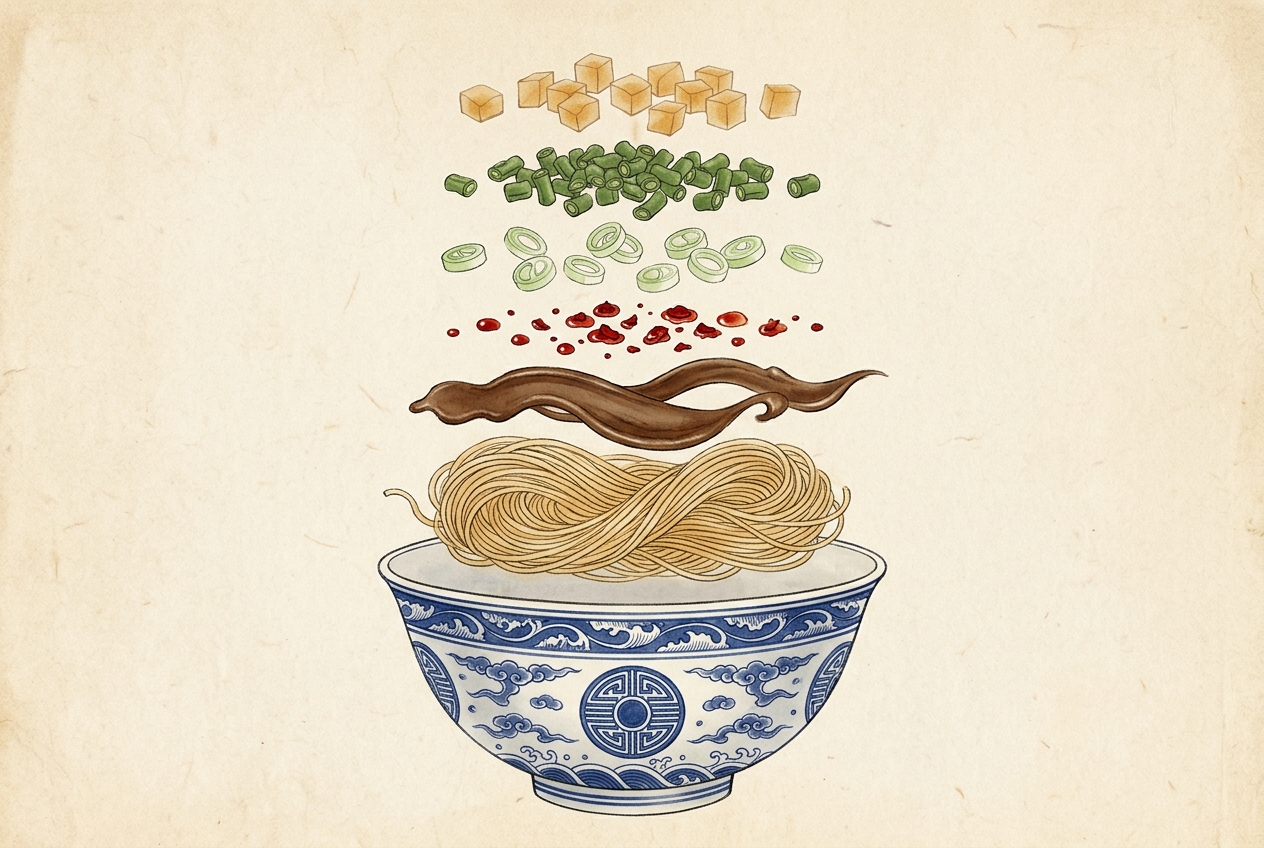
Edible Architecture: Inside a 140-Millimeter Paper Bowl
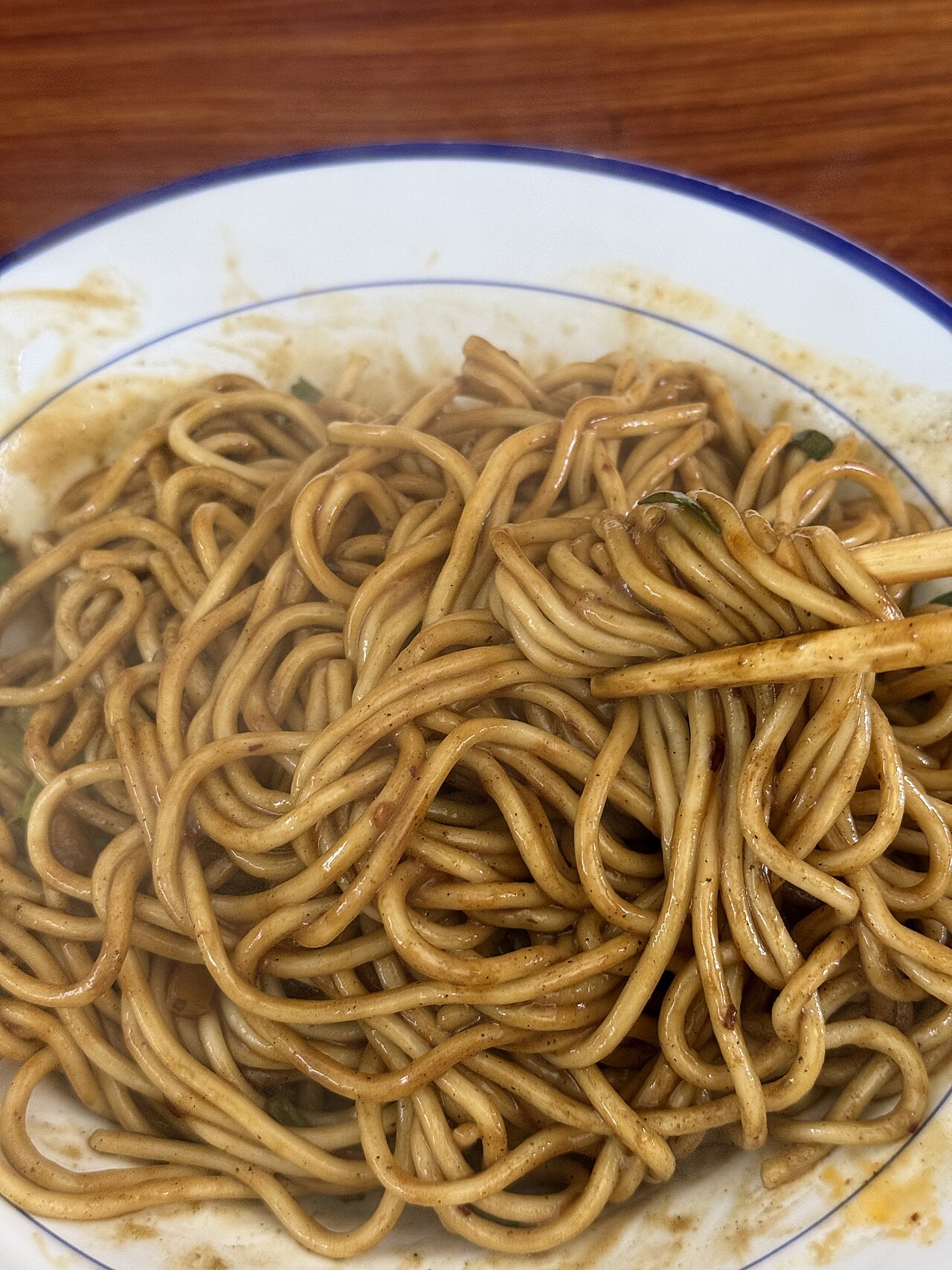
To an uninitiated passerby, Wuhan Reganmian looks disarmingly simple—a tangle of warm yellow noodles draped in dark, nutty sesame sauce. Slice vertically through an untossed er-liang quanliao (standard full-works) paper bowl right as it crosses a neighborhood stall window, however, and you uncover an intricate eight-layer culinary structure.
Behind a ten-well stainless condiment counter, a veteran Wuhan noodle master builds a bowl in scarcely five seconds. Yet every flick of the ladle obeys strict colloidal physics: aqueous umami on the floor, crystalline enhancers above it, an 85°C alkaline gluten matrix in the center, pseudoplastic sesame paste and aromatic oils over the dome, and high-acid crunchy counterpoints crowning the summit. This chapter serves as the structural blueprint for our visual anatomy diagrams.
‘Ten-spice broth sleeps at the base; golden strands bridge the middle sky; thick sesame and ruby chili drape the ridge; crisp radish and jade scallion command the crest.’ — Traditional Hankou noodle-bench mnemonic
Vertical Cross-Section: The Eight Flavor Strata Explained
Using a standard 140mm-wide grease-proof kraft paper bowl holding a 225g finished serving as our benchmark, the table below maps each stratum from Layer 1 (Bowl Floor) up to Layer 8 (Volatile Crown):
| Stratum (Bottom → Top) | Architectural Name | Core Components | 2-Liang Target Dose | Physicochemical & Sensory Role |
|---|---|---|---|---|
| Layer 1 (Floor) | Basal Umami Pool | Ten-spice aged soy broth (lushui) + light/dark soy + raw garlic water | 8ml broth + 6ml soy + 6ml garlic water | Aqueous Catalyst: Supplies aromatic salinity, allicin bite, and essential moisture for upward emulsification |
| Layer 2 (Bed) | Crystalline Enhancer Bed | Fine salt + MSG/umami crystals + pinch of sugar + ground white pepper | ~2.5g–3.0g combined | Thermal Solute: Dissolves instantly beneath 85°C noodles; sugar rounds out trace alkali bitterness |
| Layer 3 (Core) | Alkaline Gluten Matrix | 1.8mm round high-gluten jianshuimian (80% parboiled, 8s blanched) | 140g–150g wet weight (85°C) | Structural Engine: Disulfide-crosslinked chewiness; stores thermal energy to liquefy top sauces |
| Layer 4 (Mantle) | Sesame Emulsion Mantle | Stone-ground white or black sesame paste thinned 35%–45% with sesame oil | 26g–32g youxiejiang | Pseudoplastic Coat: Shear-thins on hot contact to wrap every strand 360° in roasted pyrazine depth |
| Layer 5 (Glaze) | Aromatic Lipid Drizzle | Small-mill toasted sesame oil + charred-aroma Wuhan red chili oil | 3ml sesame oil + 5g–10g chili oil | Lubricity & Sheen: Lowers inter-strand friction, imparts amber specular gloss and smoky heat |
| Layer 6 (Acoustic) | Acid-Crunch Counterpoint | Sun-wilted Huangpi radish dices + crock-fermented sour cowpeas | 12g radish + 12g sour beans | Lipid Cleaver: Lactic acidity and audible crunch prevent palate fatigue from dense sesame fats |
| Layer 7 (Deluxe) | Protein Crown (Optional) | Flash-blanched raw sliced beef (shengtang), braised tripe, tendon, or zhajiang | Omitted in plain; 45g–60g deluxe | Savory Enrichment: Myoglobin-rich meat juices meld with sesame paste for heightened umami |
| Layer 8 (Summit) | Volatile Herb Confetti | Freshly sliced green scallion rings (+ optional splash of aged rice vinegar) | 5g scallions (+ 3ml vinegar opt.) | Aromatic Release: Steam-bloomed sulfur volatiles and emerald contrast during the first chopstick lift |
Fluid Dynamics of the Thirty-Second Cross-Toss
Why does layering order determine whether a bowl tastes sublime or clumpy? In colloidal food science, an untossed bowl of Reganmian acts as a thermally driven bidirectional mixer:
- Preventing Bottom-Corner Seizing: If thick sesame paste were spooned into the bottom of a cool paper bowl first and buried under 150 grams of noodles, paste would compact into the bowl’s lower crease and resist chopsticks. Draped across the hot noodle summit instead, 85°C conductive heat slashes the apparent viscosity of oil-thinned sesame paste by over 40% within five seconds, letting it cascade naturally between round strands.
- Upward Vapor & Solute Transport: Simultaneously, the hot noodle mass warms the 20 milliliters of spiced soy broth and garlic water pooled at Layer 1, dissolving Layer 2’s sugar, white pepper, and umami crystals. When the diner executes the Cross-Lifting Toss (shizi tiaoban—plunging chopsticks to the floor and lifting perpendicularly nine to twelve times), bottom aqueous broth is pulled upward into top lipid sesame paste, locking onto strands with zero watery runoff.
Temporal Process Flow: Six Critical Control Nodes
Across time, every strand of authentic Reganmian traverses six precisely governed thermal and moisture milestones:
- Node 1: Alkaline Dough Sheetings (25°C, 33% moisture, pH 8.2) — High-gluten wheat flour (≥30% wet gluten) hydrated with a 0.7% sodium carbonate solution is rested and sheeted through six progressive rollers, tightening disulfide protein bonds before slitting into 1.8mm round strands.
- Node 2: Parboiling to 80% Gelatinization (99°C rolling boil, 90–110s) — Raw strands cook until the outer 80% starch gelatinizes while preserving a hairline 0.3mm ungelatinized white core for structural resilience.
- Node 3: Forced-Air Oil-Tossing / Danmian (5 m/s fan breeze, 120s, moisture drops to 56%) — Strands are lifted high with 42cm bamboo chopsticks under high-velocity fans while 2.8% small-mill sesame oil coats every strand in a hydrophobic anti-stick film.
- Node 4: Conical Basket Flash-Blanching (98–100°C boil, 6–10s) — Individual portions plunge into boiling water just long enough for heat to pierce the oil film and gelatinize the remaining 20% core.
- Node 5: Centrifugal Wrist-Shake Drain (2s, Sandian Liangdou, moisture locked at 62%) — Five sharp wrist snaps expel ~12ml of free cauldron water so the bowl stays authentically ‘dry’ at an 85°C core temperature.
- Node 6: Five-Second Layering & Thirty-Second Diner Toss — Eight strata assemble in five fluid seconds at the counter, handing the baton to the diner’s chopsticks while thermal fluidity peaks.
- Hubei Provincial Intangible Cultural Heritage Dossier: Cai Lin Ji Reganmian Craft Specifications
- Wuhan Municipal Administration for Market Regulation: Wuhan Reganmian Production Management Code (2024)
- Key Laboratory of Deep Processing of Bulk Grains and Oils (Wuhan Polytechnic University) Rheology Studies
❓ Frequently Asked Questions
Why do Wuhan masters ladle spiced soy broth and garlic water underneath the noodles rather than on top of the sesame paste?
Placing low-viscosity aqueous seasonings at the bottom beneath 85°C noodles generates gentle upward steam while keeping thick sesame paste from sticking to the dry floor of the paper bowl. When tossed vertically with chopsticks, bottom liquid and top lipid paste meet mid-bowl in a seamless emulsion.
What is the exact weight ratio of noodles to sesame sauce and garnishes in a classic 2-liang bowl?
Out of ~225g finished weight: blanched alkaline noodles account for ~145g (64.5%), oil-thinned stone-ground sesame paste ~28g (12.4%), spiced soy broth and garlic water ~20ml (8.9%), pickled radish and sour cowpeas ~24g (10.7%), and finishing oils, dry spices, and scallions ~8g (3.5%).
Why must Reganmian noodles be cooked twice (parboiled during Danmian, then blanched for 8 seconds)?
Single-stage boiling to 100% doneness leaches sticky amylose onto the noodle surface, causing catastrophic clumping once sesame paste is added. Parboiling to 80%, fan-cooling, and sealing in sesame oil locks the gluten exterior so the final 8-second plunge finishes the core cleanly.
✦ Cross-Referenced Chapters
Secrets of Alkaline Noodles (Jianshuimian)
High-gluten flour specifications, sodium carbonate ratios, 1.8mm round strand geometry, and signature springy chew.
Soul of the Bowl: Stone-Ground Sesame Paste Craft
Low-temperature roasting, stone-mill grinding, and the great culinary debate between 100% pure sesame vs. 80/20 sesame-peanut blends.
The Ten-Condiment Flavor Matrix & Layering Order
Exact gram ratios and sequencing of light/dark soy, rice vinegar, white pepper, sugar, and spiced sesame salt.
The Core Art of "Danmian": Parboiling & Oil-Tossing
Step-by-step mastery of 80%-cooked boiling, fan-cooling, and sesame-oil tossing that keeps alkaline noodles springy for hours.
Street Blanching & The Golden Ten-Second Bowl
Deconstructing the street master’s 6-second boiling dip, triple wrist-shake drain, and rapid sauce ladling.