Quantitative Culinary Guide: Scaling Home & Commercial Ratios
Flour-Basis and Noodle-Basis Mathematical Formulas from a Single Home Bowl to a 25kg Morning Shop Batch
The companion engineering manual to our interactive ratio calculator, codifying exact percentages for alkaline dough hydration, seasonal sesame-oil paste dilution, non-linear commercial batch scaling, and calorie-controlled emulsions.
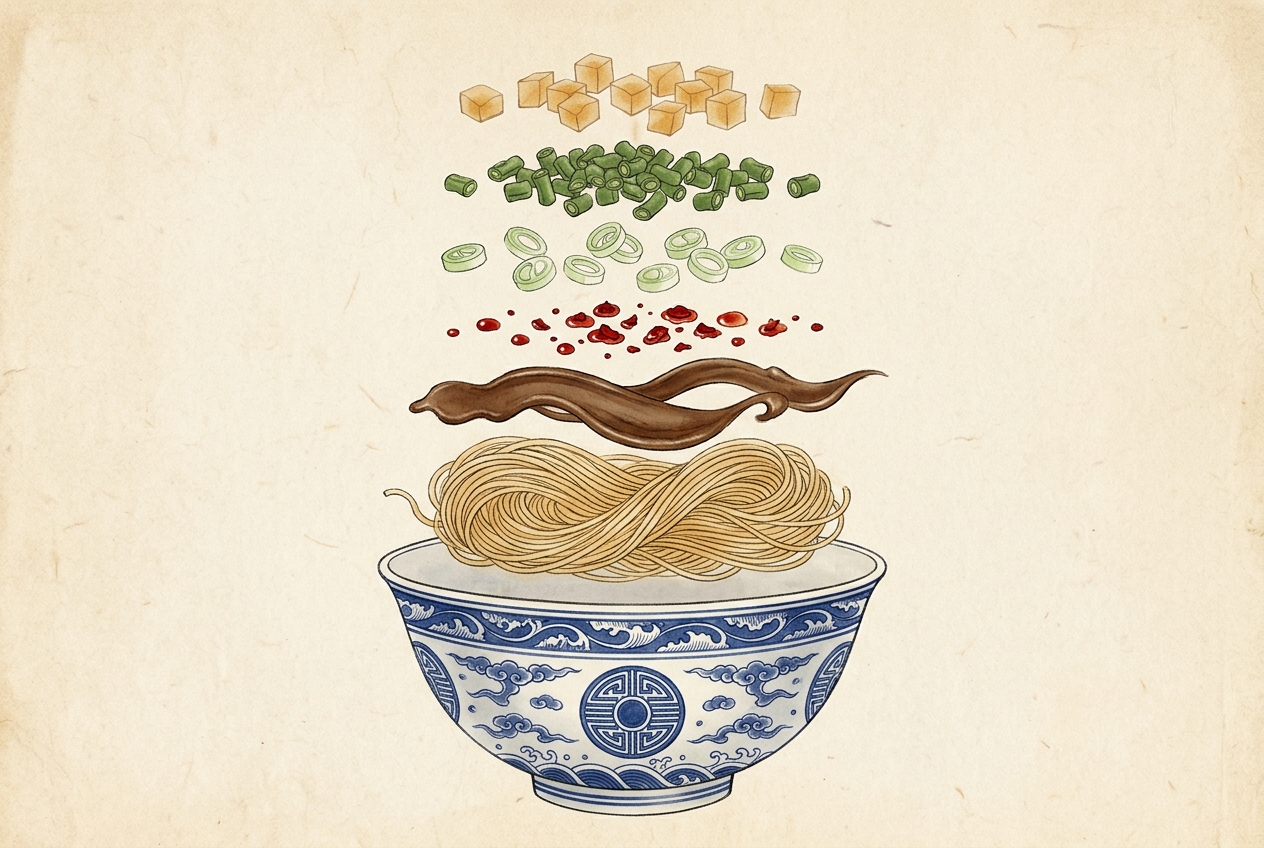
Precision Over Intuition: Two Reference Coordinate Systems
Traditional Chinese street-food apprenticeships run on muscle memory—a flick of alkali, a ladle of sesame, broth by eye. While poetic beside a steaming Hankou cauldron, intuition breaks down when a home cook in Toronto tries to scale brunch for six, or when a culinary entrepreneur standardizes a morning rush of five hundred bowls.
Designed as the analytical companion to the interactive calculator on reganmian.com, this manual establishes two rigorous percentage systems:
- Flour-Basis Baker’s Percentage (
Flour = 100%), governing raw alkaline dough hydration, carbonate pH tuning, and Danmian parboiling yield. - Blanched-Noodle Percentage (
Drained Hot Noodles = 100%), governing the exact balance of lipids, aqueous umami, crystals, and acidic crunch inside every bowl.
‘Weigh the flour, tune alkali to the season; thin paste by winter frost or summer heat; calibrate reduction to the pot—when grams are true, a hundred bowls sing as one.’ — Six-Character Maxim of Quantitative Noodle Craft
System I: Seasonal Alkaline Dough & Danmian Yield Math
Authentic 1.8mm round Wuhan jianshuimian demands low hydration and firm mechanical sheeting. Because gluten extensibility and microbial activity shift sharply between Wuhan’s 4°C winters and 38°C summers, master noodle makers adjust water and alkali along a seasonal sliding scale (indexed to 1,000g high-gluten wheat flour = 100%):
- High-Gluten Wheat Flour (
100%/1,000g): Wet gluten≥30%(12.2%–13.5%protein), low ash (≤0.55%) for bright flavonoid gold and snappy tensile recovery. - Hydration (
32.0%Summer ·33.5%Spring/Autumn ·35.0%Winter): Yields crumbly, low-moisture dough flakes pressed six times through steel rollers. Exceeding38%water produces slack strands that collapse on second boiling. - Food-Grade Alkali Salts (
0.80%Summer ·0.70%Mild Seasons ·0.60%Winter): A60:40blend of sodium carbonate ($\text{Na}_2\text{CO}_3$) and potassium carbonate ($\text{K}_2\text{CO}_3$) dissolved in mixing water. Slightly higher summer alkalinity tightens disulfide bonds against heat-softening and delays souring. - Fine Salt (
1.5%/15g): Tightens protein network smoothness. - Conversion Yield & Oil-Tossing Factor:
1,000gflour yields~1,340graw cut noodles, which hydrate during 95-second parboiling and fan-cooling into~1,750gof finished Danmian. Small home batches require 3.0% sesame oil (~52g) relative to parboiled weight to coat pan and chopsticks, whereas a25kgcommercial mound requires only 2.4% (600g) due to reduced surface-to-volume loss.
System II: Master Scaling Matrix (Solo Bowl to 100-Bowl Rush)
Anchored to drained, blanched wet alkaline noodles (100%), the reference matrix below scales seamlessly across a Standard 2-Liang Solo Bowl, a 4-Bowl Family Brunch, a Light Calorie-Smart Bowl, and a 100-Bowl Commercial Prep Batch:
| Component & Specification | Bowl % (Classic) | 1 Standard Bowl (2-Liang / 145g) | 4-Bowl Family Batch (580g) | 1 Light Fitness Bowl (110g) | 100-Bowl Shop Prep (14.5kg) |
|---|---|---|---|---|---|
| Blanched Alkaline Noodles (Drained) | 100.0% | 145 g | 580 g | 110 g (+ 80g bok choy) | 14,500 g |
| Pure Stone-Ground Sesame Paste | 13.8% | 20 g | 80 g | 11 g | 2,000 g |
| Thinning Sesame Oil (at 20°C = 40%) | 5.5% | 8 g | 32 g | 0 g (whisk 15ml warm broth) | 800 g (900g winter / 700g summer) |
| Ten-Spice Aged Soy Broth (Lushui) | 6.2% | 9 ml | 36 ml | 6 ml (reduced sodium) | 880 ml (ladle-loss adjusted) |
| Light/Dark Soy Blend (85:15) | 4.1% | 6 ml | 24 ml | 4 ml | 580 ml |
| Raw Crushed Garlic Water (1:4 w/v) | 4.1% | 6 ml | 24 ml | 8 ml (aromatic lift) | 600 ml (prepared fresh daily) |
| Dry Enhancer Mix (Salt:MSG:Sugar:Pepper 2:2:2:1) | 1.9% | 2.8 g | 11.2 g | 1.5 g | 260 g (pre-blended Premix) |
| Huangpi Radish Dices + Sour Cowpeas | 16.5% | 24 g (12g each) | 96 g | 20 g (briefly rinsed) | 2,400 g |
| Finishing Sesame Oil + Wuhan Chili Oil | 5.5% | 3ml oil + 5g chili | 12ml + 20g | 1ml oil + 3g chili | 280ml oil + 600g chili |
| Fresh Green Scallions (+ Opt. Vinegar) | 3.4% | 5 g (+ 3ml vinegar) | 20 g | 8 g (+ 6ml aged vinegar) | 500 g |
Three Non-Linear Laws of Culinary Scaling
When moving across batch sizes or dietary targets, apply three food-physics corrections:
- Temperature–Viscosity Compensation for Sesame Paste: Because stone-ground sesame paste behaves as a temperature-sensitive non-Newtonian suspension, apply our empirical shop formula: $\text{Oil (g)} = \text{Raw Paste (g)} \times [0.48 - 0.004 \times T_{\text{room}}(^\circ\text{C})]$. At
10°C,100gof paste needs44gof oil; at30°C,36gachieves the exact same ribboning shear viscosity. - Stockpot Evaporation Geometry: Simmering
500mlof ten-spice soy broth in an18cmhome saucepan boils off~35%water in 40 minutes, whereas a deep45cmcommercial pot simmering15Lloses only~14%. Multiply raw water inputs by0.78when scaling home broth recipes to commercial vats so your lushui stays intensely concentrated. - Aqueous Phase-Inversion Substitution for Light Bowls: Cutting oil-thinned sesame paste in half without adding moisture makes noodles dry and chalky. Instead, start with
11gof unthinned pure sesame paste, omit the8gof thinning oil (instantly saving72 kcalof pure lipid), and vigorously whisk in15mlof45°Cwarm spiced broth past the phase-inversion hump into a glossy oil-in-water ribbon—trimming a full bowl from~580 kcaldown to~395 kcalwithout sacrificing roasted sesame soul.
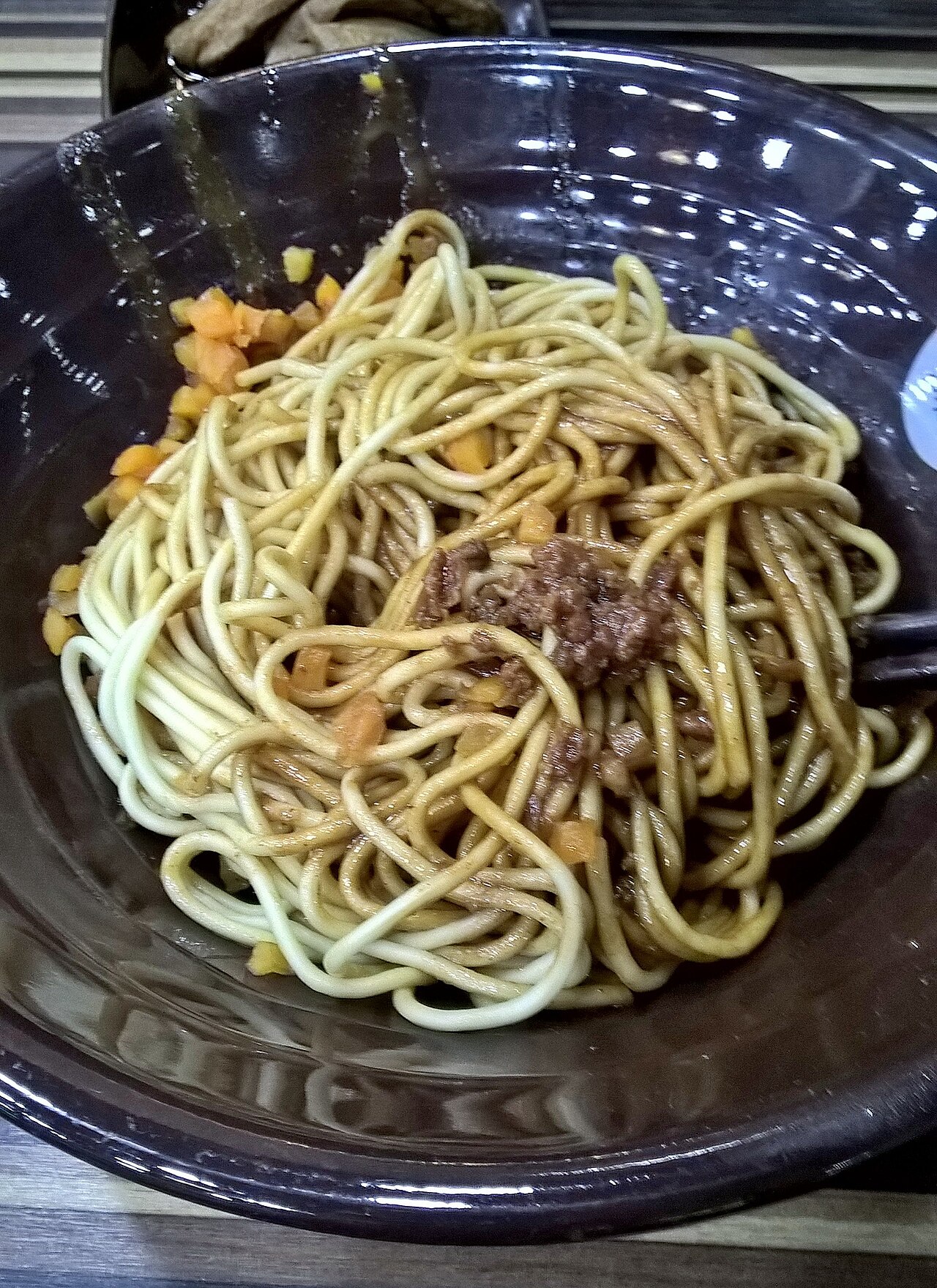
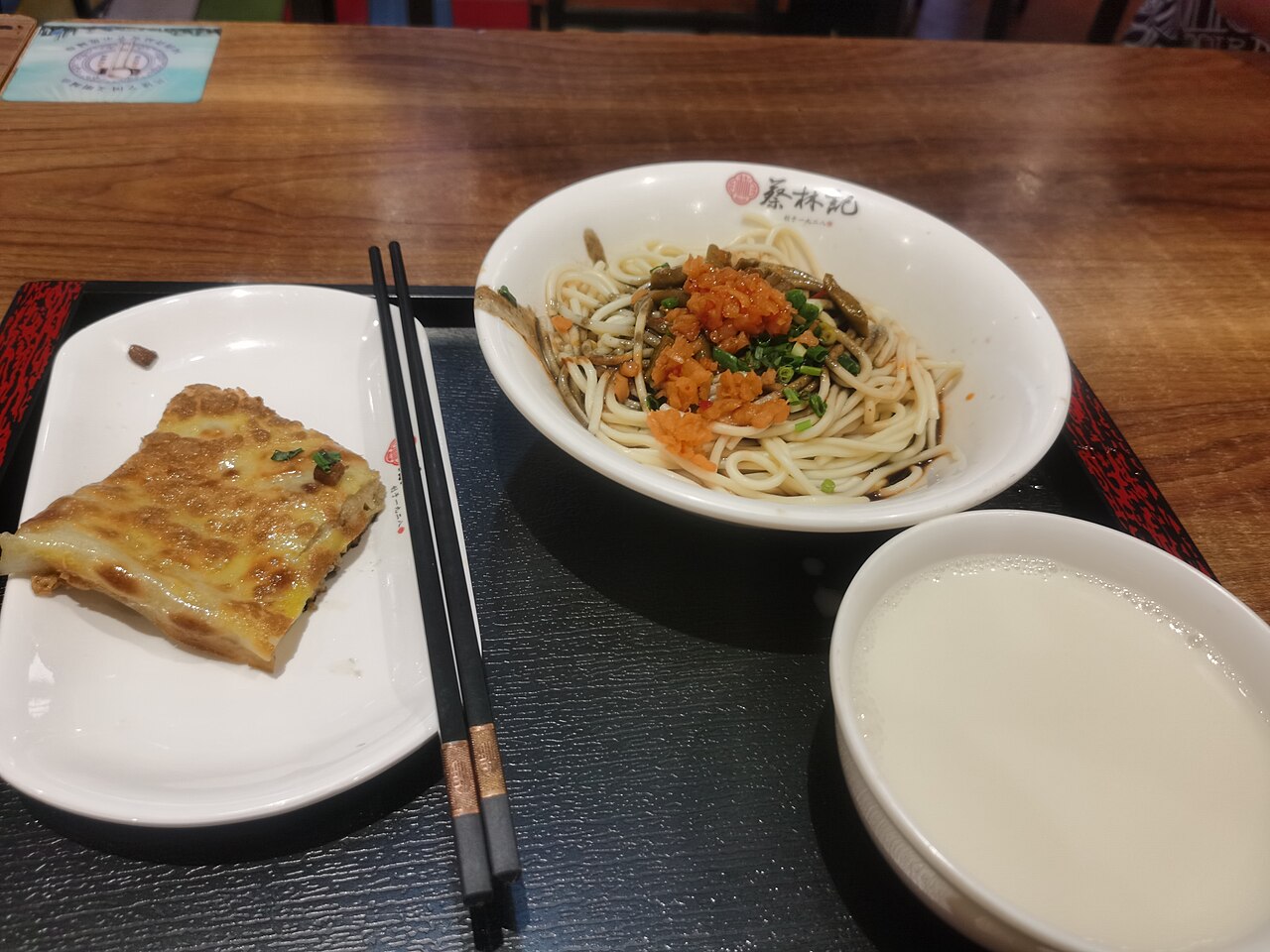
- Hubei Food Safety Local Standard DBS42/005: Wuhan Reganmian Physicochemical Benchmarks
- Modern Wheat Noodle Science & Rheology Scaling Models (China Light Industry Press)
- Wuhan Neighborhood Breakfast Stall Commercial SOP Field Measurements
❓ Frequently Asked Questions
Why does a '2-liang' (100g) order at a Wuhan noodle stall actually weigh over 220 grams in the bowl?
Wuhan stalls price portions using a historic grain-ration convention based on ~100g of dry wheat flour. Once kneaded, parboiled, and blanched, those noodles hydrate to ~145g wet weight; adding ~80g of sesame paste, spiced soy broth, and crunchy pickles brings the finished bowl to roughly 225g.
Why can’t you simply multiply a single-bowl home recipe by 100 to open a noodle shop?
Culinary scaling is physically non-linear: a 25kg mound of parboiled noodles loses far less surface oil to board adhesion and evaporation than a 200g home batch, while a deep commercial stockpot evaporates half as much water per hour as a small saucepan—requiring 0.78–0.90 scaling coefficients.
How does ambient room temperature change the sesame paste oil-thinning ratio?
Sesame lipids thicken dramatically in winter cold. At 30°C in July, 35g of toasted sesame oil per 100g of stone-ground paste flows like silk; at 8°C in January, masters increase oil to 44–45g (often blending 50% neutral refined oil to prevent chilling haze) for identical cling.
✦ Cross-Referenced Chapters
The Ten-Condiment Flavor Matrix & Layering Order
Exact gram ratios and sequencing of light/dark soy, rice vinegar, white pepper, sugar, and spiced sesame salt.
Foolproof Home Kitchen Recipe (Plus Baking-Soda Hack)
Complete home recipe including homemade sesame sauce emulsion, spiced soy broth, and the baking-soda pantry hack for dried noodles.
Commercial Noodle Shop Batch Formula & SOP
Professional 25kg batch noodle parboiling, master spiced broth formulation, and high-volume breakfast rush workflow.
Food Chemistry: Alkaline Gluten Crosslinking & Sesame Phase Inversion
How sodium carbonate strengthens disulfide gluten bonds and tints flavonoids yellow, plus the rheology of sesame paste emulsion.
Caloric & Macronutrient Breakdown by Component
Exact kilocalorie, carbohydrate, protein, lipid, and sodium tables for standard 2-liang plain and beef-topped bowls.