Curated Visual Gallery: Street Photography & Ink-Wash Art
Capturing Backlit Bamboo-Strainer Steam, Amber Sesame Sheen, and Traditional Chinese Ink-and-Wash Illustrations
An editorial guide to the visual archive of The Reganmian Canon, detailing macro culinary lighting for oil-emulsified sesame noodles, dawn documentary photography across Wuhan’s Three Towns, and our bespoke twelve-volume ink-wash illustration system.
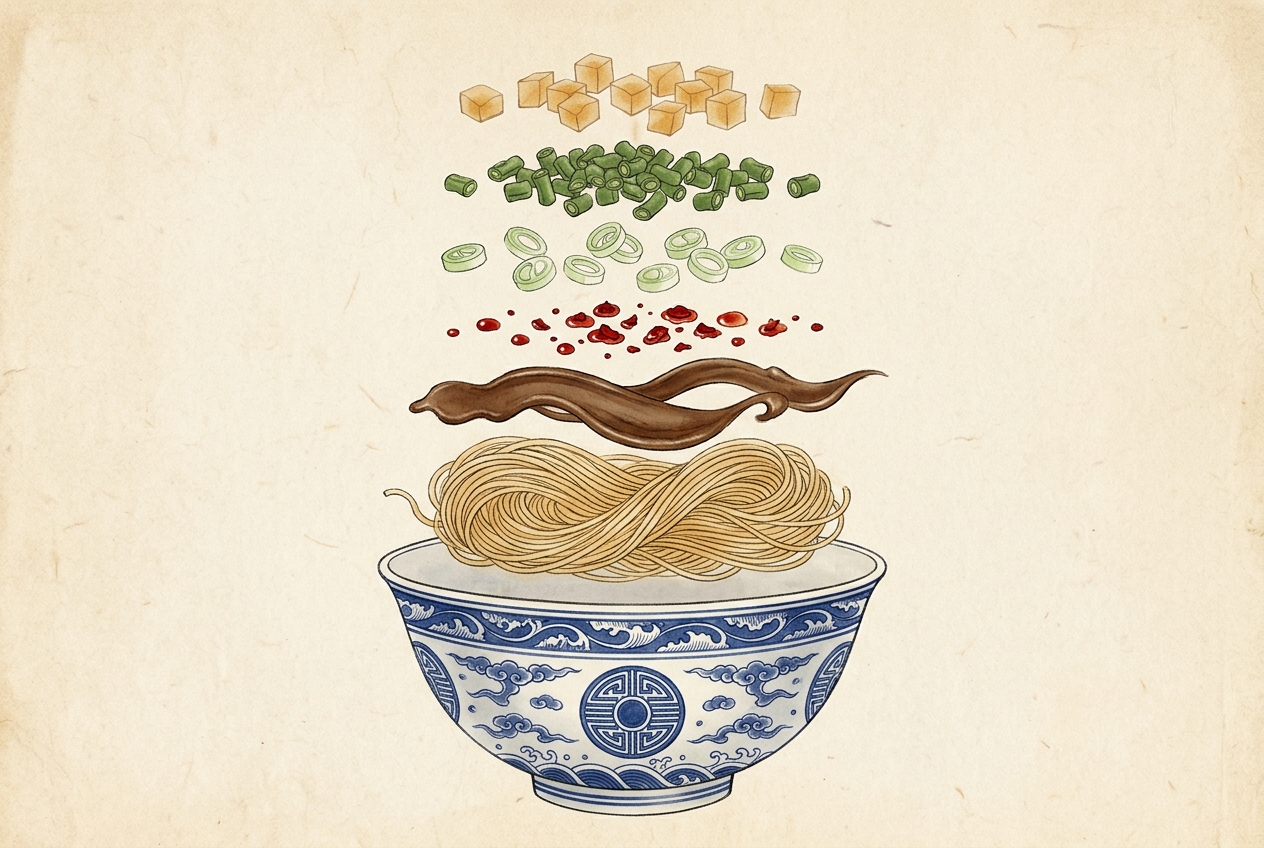
Visual Historiography: Seeing a City Through a Single Bowl
Classical Chinese encyclopedias long observed the principle of zuo tu you shi—placing visual plates on the left and historical text on the right, seeking tangible form in imagery and underlying principle in prose. Few dishes reward close visual study quite like Wuhan Reganmian (Hot Dry Noodles). Stripped of decorative soup bowls or elaborate banquet garnishes, an authentic bowl relies on stark kinetic and textural contrasts: the springy geometry of 1.8-millimeter golden alkaline strands, the mahogany velvet of stone-ground sesame paste, confetti bursts of emerald scallion and ruby chili oil, and the theatrical billow of white steam erupting from a street cauldron before dawn.
In Volume XII, our Curated Visual Gallery organizes visual documentation of Reganmian into four complementary disciplines—macro food styling, dawn street photojournalism, bespoke Chinese ink-and-wash (shuimo dancai) illustration, and century-spanning archival plates.
‘At first light down Changdi Lane, the bamboo basket raises clouds from the first cauldron; never call sesame brown plain—even fine ink struggles to paint living hearth-smoke.’ — Contemporary Wuhan Guozao quatrain
Macro Culinary Optics: Lighting Alkaline Gold and Sesame Velvet
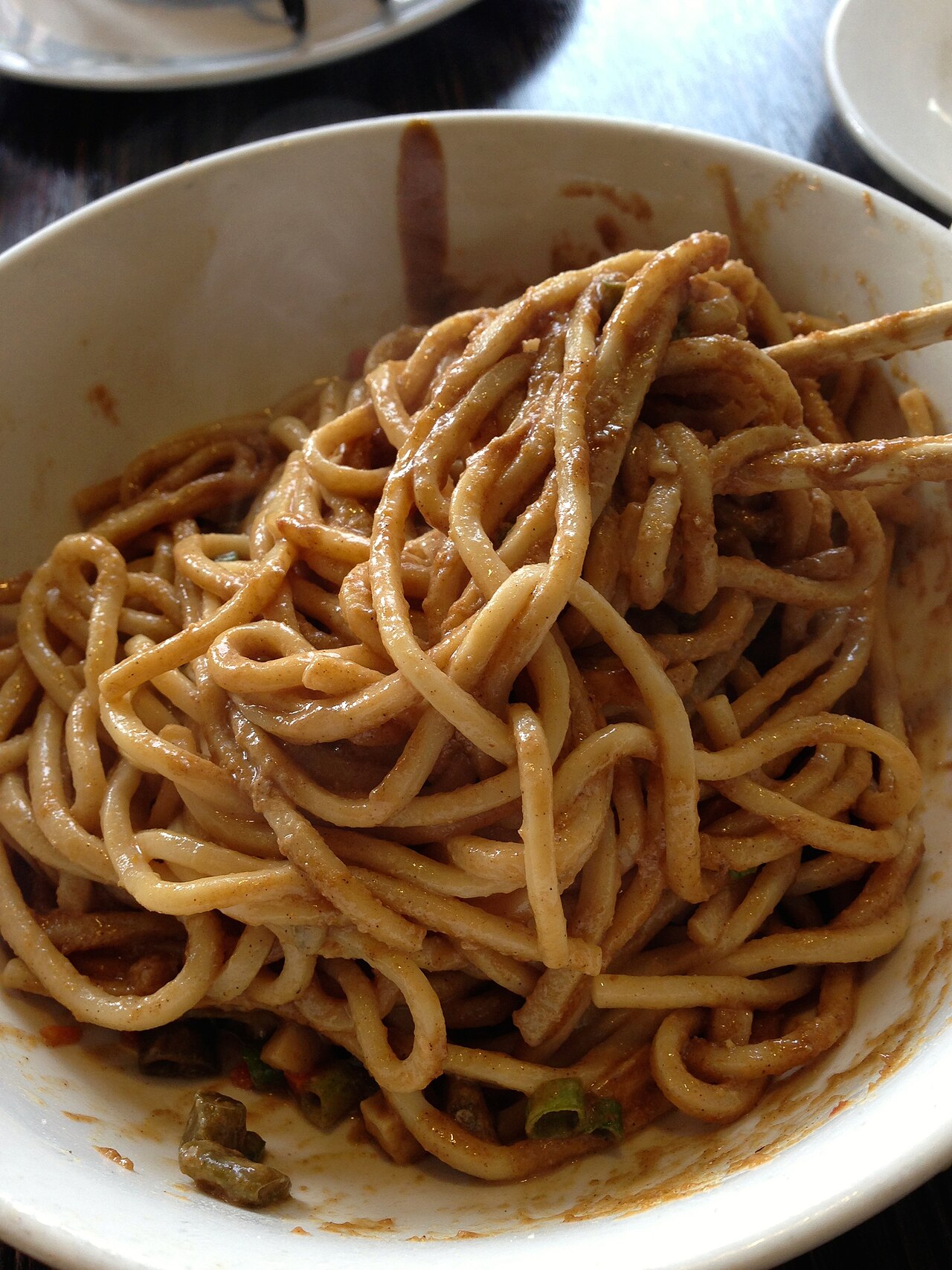
To commercial food photographers and documentary cinematographers alike, Reganmian presents a fascinating optical puzzle. Unlike Lanzhou beef noodles or Japanese ramen, whose shimmering broths act as natural mirrors, Hot Dry Noodles are coated in a viscous, anhydrous sesame-oil emulsion (youxiejiang) layered over dark ten-spice soy essence. Lit flat from the front, the sauce absorbs light and appears heavy; lit with precision, every strand glows.
- The Ninety-Second Thermal Window: Straight out of a 98°C boiling cauldron, blanched alkaline noodles sit near 85°C. For roughly ninety seconds, thermal energy keeps the sesame paste fluid and glossy while a micro-film of small-mill sesame oil creates delicate specular highlights. Once surface starch cools and absorbs free oil, the sheen dulls rapidly. Professional shoots always calibrate lighting on a stand-in bowl so the hero bowl can be captured within forty-five seconds of tossing.
- 135-Degree Backlit Grazing: Positioning a diffused key light at 120° to 145° behind the grease-proof paper bowl rakes light across the curved ridges of round noodles, revealing the translucent pale-yellow hue produced naturally by wheat flavonoids in an alkaline pH. A subtle white bounce card opposite the key preserves roasted-granule texture inside the dark sesame mantle.
- Freezing the Cross-Lifting Toss: Capturing bamboo chopsticks lifting glistening strands upward requires shutter speeds of
1/500sto1/800sto suspend droplets of charred-aroma chili oil mid-air, whereas a slower1/40sshutter renders rising cauldron steam with painterly motion.
| Visual Series | Primary Subjects | Optical / Medium Specifications | Editorial Focus |
|---|---|---|---|
| Macro Craft | 8-layer cross-sections, sesame cling, 1.8mm strand bounce, pickle dices | 100mm f/2.8 Macro, f/5.6–f/8, 135° diffused backlight | Revealing natural flavonoid gold and anhydrous sesame silkiness |
| Dawn Documentary | Danmian oil-tossing fans, wrist-shake draining, plastic-stool diners | 35mm / 50mm f/1.4, blue-hour ambient vs. 2800K stall bulbs | Human warmth, commuter choreography, and wharf egalitarianism |
| Ink-Wash Plates | Twelve volume frontispieces, 1930s shoulder-pole cabinets, stone mills | Xuan-paper ink linework with gamboge, burnt ochre & cinnabar | Bridging Song-dynasty urban scroll craft with Wuhan street lore |
| Historic Archives | 1950s state-private shops, 1980s grain-coupon boards, bamboo beds | Digitized silver-gelatin prints & archival press halftones | Tracing utensil evolution and forty years of civic memory |
Dawn Street Photojournalism: Blue Hour Meets Cauldron Fire
If macro photography dissects Reganmian’s anatomy, street photography captures Wuhan’s pulse. Across the historic lanes of Hankou’s Shanhaiguan Road and Lanling Road, Wuchang’s Liangdao Street, and Hanyang’s Meigui Street, the magic hour unfolds between 5:45 AM and 7:15 AM from late autumn through early spring.
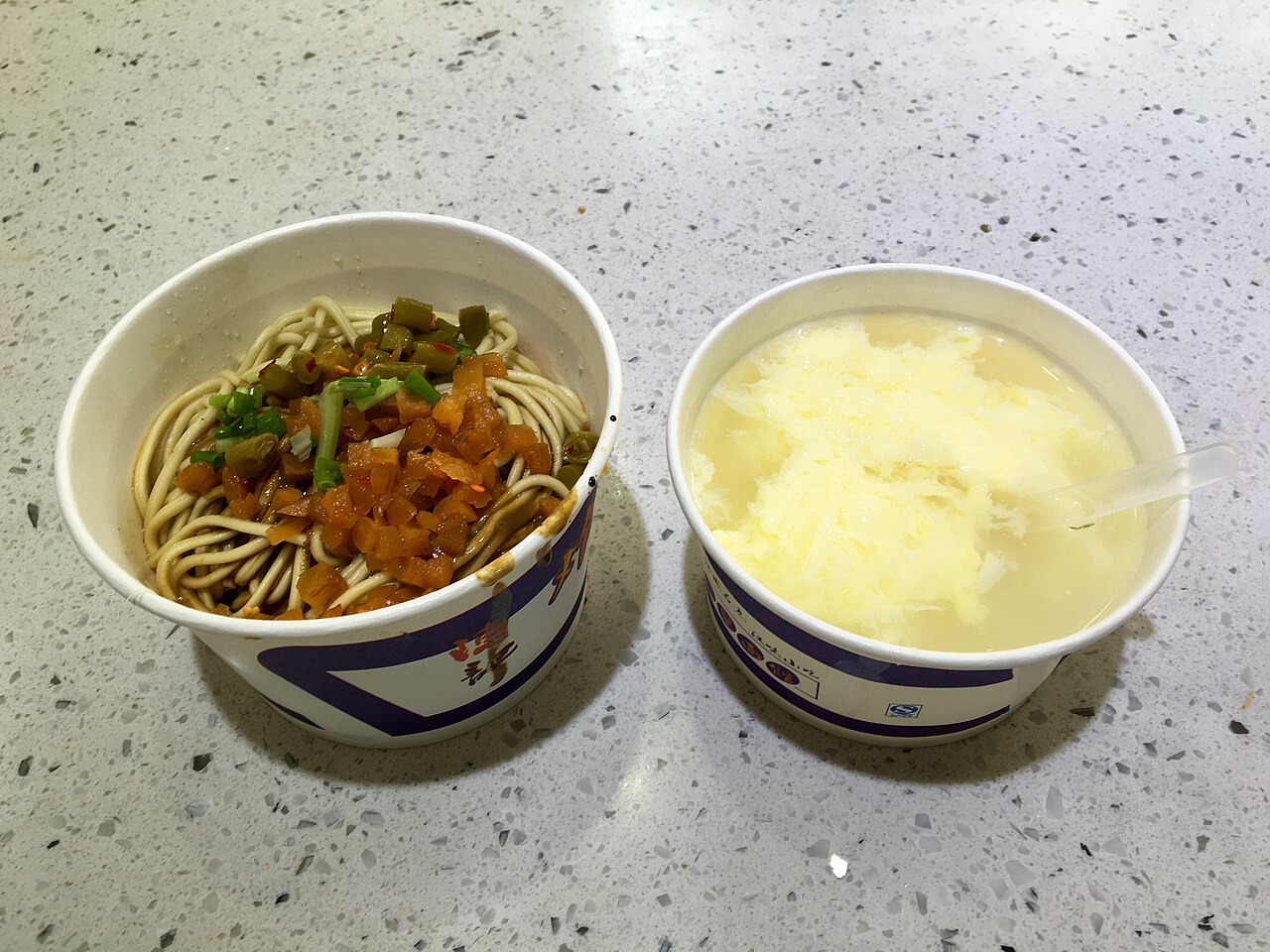
At daybreak, ambient alley skies register a cool 7500K cobalt twilight, while bare tungsten bulbs above condiment counters and roaring gas burners beneath wide-mouth cauldrons cast a 2900K amber glow. When crisp winter air meets rolling boiling water, towering plumes of condensation envelop the stallkeeper’s rhythmic sandian liangdou (triple toss and double wrist-shake). Outside on the pavement, commuters cradle paper bowls in five-fingered pedestals while neighbors in quilted pajamas hunch over red plastic stools—an unscripted theater of civic equality.
Ink & Mineral Pigment: The Twelve-Volume Illustration System
To anchor The Reganmian Canon (reganmian.com) in classical Chinese book arts, our twelve volume header illustrations (/images/illustrations/vol-01.png through vol-12.png) employ a unified Neo-Hankou Ink-and-Wash aesthetic:
- Architectural & Utensil Linework: Drawing inspiration from Song-dynasty observational scrolls and Republican-era Hankou pen-and-watercolor sketches, crisp sumi-ink strokes faithfully document mortise-and-tenon peddler chests, handwoven conical bamboo strainers (zhu zhaoli), and baroque Hankou arcade facades.
- Four-Pigment Restraint: Color washes are restricted to four classical mineral tones—gamboge yellow (tenghuang) for springy alkaline noodles, burnt ochre (zheshi) for stone-milled sesame paste, vermilion cinnabar (zhusha) for chili oil and carved volume seals, and botanical green (zhilü) for chopped scallions and split bamboo. Together, camera lens and calligraphy brush honor a humble five-yuan breakfast with encyclopedic dignity.
- Cinematography Notes from A Bite of China Season 2, Episode 7 'Three Meals' (CCTV-9, 2014)
- Old Hankou Lifen Lanes & Municipal Photographic Archives (Wuhan Publishing House)
- Traditional Chinese Mineral Pigments and Urban Genre Painting Manuals
❓ Frequently Asked Questions
Why is Wuhan Reganmian notoriously tricky to photograph compared with broth noodles?
Clear soup noodles naturally bounce specular highlights off liquid broth, whereas Reganmian is a dense, dark-toned sesame emulsion clinging to brothless strands. Direct front lighting flattens it into a muddy brown mass; photographers must use 135-degree side-backlighting within 90 seconds of blanching to reveal golden alkaline translucency and velvety sesame ribbons.
What artistic tradition inspires the twelve volume illustrations in The Reganmian Canon?
Our twelve frontispieces synthesize Song-dynasty architectural genre painting (jiehua) with the warm, observational brushwork of 20th-century Chinese urban sketchers, rendered on textured xuan paper tones using gamboge, ochre, cinnabar, and indigo washes.
Where and when can travelers capture the most atmospheric Guozao street scenes in Wuhan?
Visit between November and March from 6:00 to 7:30 AM along east-west alleys like Shanhaiguan Road, Lanling Road, or Liangdao Street, where crisp winter air turns cauldron steam into billowing clouds illuminated by low morning sunlight.
✦ Cross-Referenced Chapters
Utensil & Cart Evolution: Poles, Bamboo Strainers & Paper Bowls
A material history from wooden shoulder-poles and conical bamboo baskets to iconic grease-proof paper bowls.
The Art of Eating While Walking & Cross-Tossing Etiquette
Mastering the Wuhan commuter’s signature one-handed bowl cradle and rapid cross-lifting chopstick toss without spilling a drop.
Documentary Lenses: A Bite of China & Breakfast in China
Episode guides, cinematography highlights, and memorable narration from landmark culinary documentaries.
Brush & Palette: Old Hankou Watercolors, Ink Art & Culinary Comics
Appreciating urban sketchbooks, traditional xieyi ink paintings, woodblock prints, and whimsical food illustrations.
Infographic Atlas: Eight-Layer Bowl Anatomy & Process Diagrams
Architectural cross-sections dissecting all eight flavor strata from bottom spiced soy broth to top scallion confetti.