Secrets of Alkaline Noodles (Jianshuimian)
High-Gluten Wheat, Sodium Carbonate Chemistry, and the 1.85-Millimeter Golden Geometry
An authoritative cereal-chemistry and craft examination of Wuhan's signature alkaline noodles: why wet gluten above 30%, 0.8%–1.2% food-grade sodium carbonate, low hydration, and a round 1.85mm cross-section create an irreplaceable springy bite.
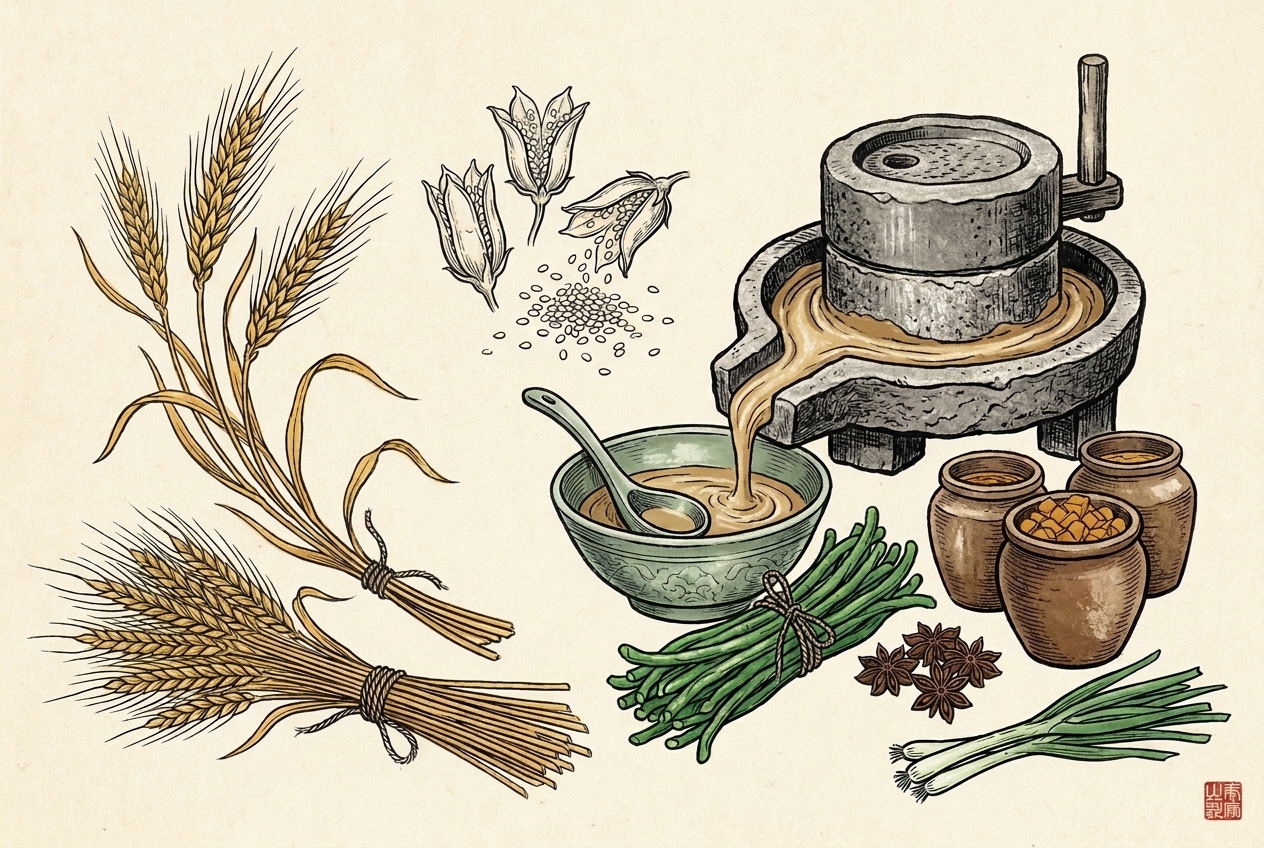
The Structural Spine of Wuhan’s Morning Bowl
Before a single ladle of stone-ground sesame paste touches the paper bowl, the destiny of a bowl of Reganmian (Wuhan Hot Dry Noodles) has already been decided at the noodle mill. Stand before any dawn stall in Hankou or Wuchang and observe the mounds of pre-parboiled noodles resting on bamboo trays: they are neither ivory-white like northern Chinese wheat noodles nor translucent like southern rice vermicelli. Instead, they gleam a warm beeswax gold, cut into taut, cylindrical strands that spring back stubbornly when pinched between thumb and forefinger.
In Wuhan culinary parlance, this foundational ingredient is Jianshuimian (碱水面, alkaline-water noodles). Born along the sweltering, humid wharves of 1920s and 1930s Hankou—where summer temperatures routinely exceed 38°C (100°F) long before mechanical refrigeration existed—alkaline dough solved two existential street-vendor challenges at once. First, raising the dough’s alkalinity inhibited wild lactic-acid bacteria and souring enzymes, allowing parboiled noodles to survive half a day on a shoulder pole without spoiling. Second, alkali transformed ordinary wheat flour into a muscular, chew-resistant matrix capable of enduring two separate boiling baths while still standing up to one of the heaviest, most viscous sauces in world noodle cuisine.
“Without alkali there is no bone; without sesame oil there is no soul. Keep the water scarce by three parts, and let the round blade set the law.” — Traditional Hankou noodle-maker’s maxim
Flour, Low Hydration, and Disulfide Chemistry
Attempt to toss standard Italian spaghetti, Japanese udon, or plain northern yangchun noodles in thick Wuhan sesame paste, and the failure is immediate: soft starches slough off the noodle surface, absorb moisture from the sauce, and bind the bowl into a gluey, throat-clogging brick within sixty seconds. Authentic Jianshuimian prevents this catastrophe through three tightly calibrated cereal-chemistry parameters.
First is high-protein core wheat flour. Commercial Wuhan wet-noodle mills specify refined heart-of-endosperm wheat flour with a wet gluten content (湿面筋) of at least 30.0% to 32.0%, crude protein between 11.5% and 13.0%, and low ash content ($\le 0.55%$) so bran specks never sever gluten films or muddy the golden color.
Second is true alkali salt chemistry. Rather than weak sodium bicarbonate (baking soda), authentic Wuhan noodle makers dissolve food-grade sodium carbonate ($\text{Na}_2\text{CO}_3$, known locally as shiyong jianmian)—occasionally paired in a 9:1 ratio with potassium carbonate ($\text{K}_2\text{CO}_3$)—at 0.8% to 1.2% of flour weight, alongside 1.0%–1.5% table salt. Under Hubei’s official regional standards (DBS42/005-2022 and DB 4201/T 699-2024), finished noodle blocks maintain a strictly regulated pH window of 7.2 to 9.2. Within this alkaline regime, three molecular transformations occur simultaneously:
- Sulfhydryl-to-Disulfide Crosslinking: Hydroxide ions catalyze the oxidation of free sulfhydryl groups ($-\text{SH}$) on glutenin and gliadin chains into tight intermolecular disulfide bridges ($-\text{S}-\text{S}-$). The gluten network contracts into a dense, elastic lattice with unmistakable toothsome bounce (jindao).
- Natural Flavonoid Chromogenesis: Colorless apigenin-C-glycoside flavonoids native to wheat endosperm undergo electronic rearrangement in alkaline media, shifting into the visible yellow spectrum. That signature canary-gold tint requires zero egg yolk and zero synthetic tartrazine dye.
- Elevated Starch Gelatinization Threshold: Sodium carbonate and sodium chloride retard surface starch granule swelling during boiling, keeping the exterior cuticle glassy and non-tacky even after parboiling and re-blanching.
Third is stingy hydration. Where hand-pulled noodles use 48%–55% water, Wuhan alkaline dough is mixed at just 30% to 34% hydration. Leaving the mixer, the dough does not even form a cohesive ball; it resembles damp, crumbly snow (“bean-curd dregs” in mill slang) that must rest for 20–30 minutes before heavy steel rollers compress and laminate the crumbs across six to eight progressive passes into a dense, satin sheet.
Why 1.85 Millimeters Round? The Physics of Sauce Adhesion
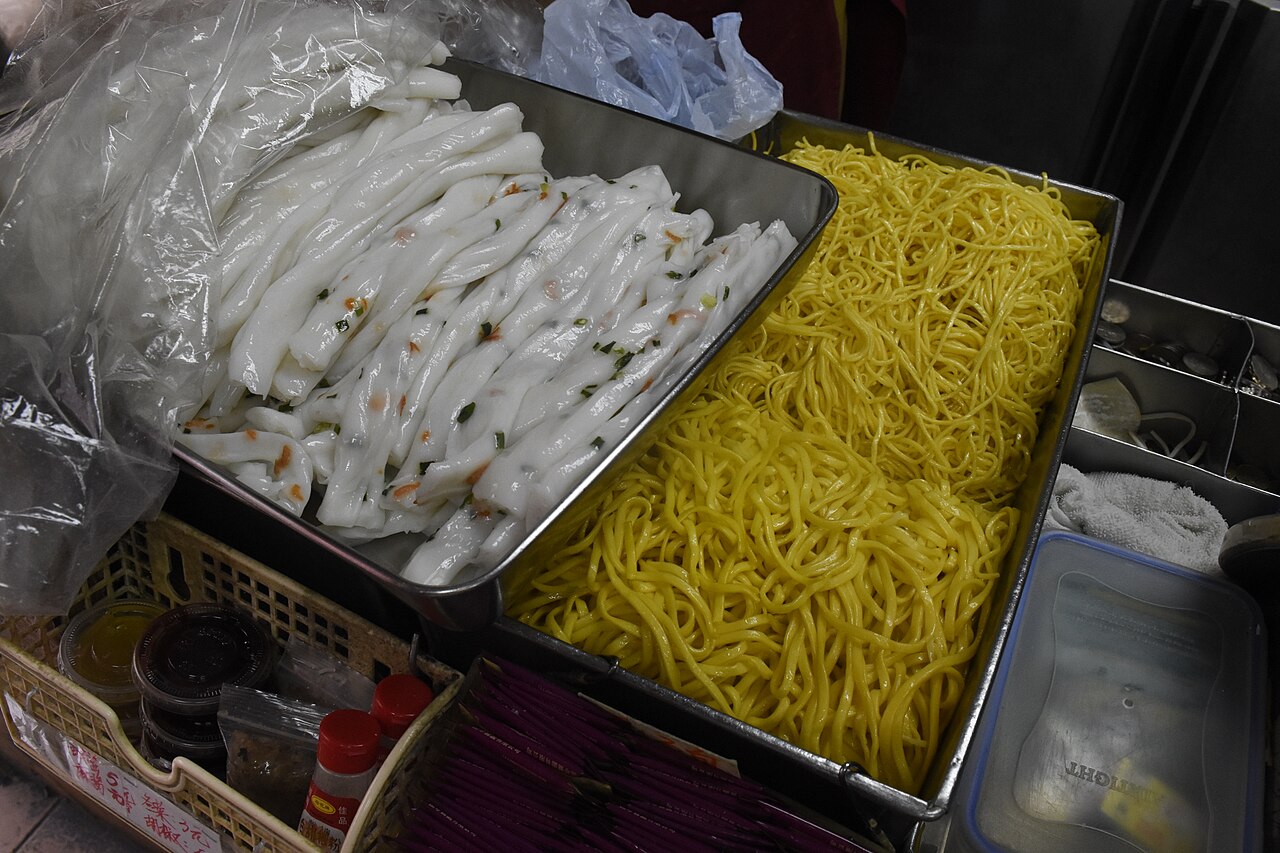
Across Asia’s alkaline noodle map—from paper-thin Cantonese wonton strands (0.9 mm) to wide Lanzhou erxi ribbons—Wuhan Reganmian insists upon a medium-thick circular cross-section cut through semicircular grooved rollers (No. 9 round blades). Raw strand diameter falls between 1.6 mm and 2.0 mm, with 1.80–1.85 mm revered as the industry sweet spot (swelling to ~2.1 mm after parboiling).
| Strand Geometry | Typical Width / Diameter | 6-Second Re-Blanch Resilience | Sesame Emulsion Coating Behavior | Suitability for Reganmian |
|---|---|---|---|---|
| Hair-Thin Round | Cantonese Wonton (0.8–1.1 mm) | Overcooks instantly; loses core snap | Excess surface area drinks sauce dry into clumps | ★☆☆☆☆ (Too fragile) |
| Medium Round Benchmark | Wuhan Jianshuimian (1.85 mm) | Heats to 85°C+ core while keeping al dente spine | 360° wrap; tangent contact leaves air channels | ★★★★★ (Gold standard) |
| Thick Round Cord | Udon / Xinjiang Latiaozi (3.2–4.5 mm) | Center stays cool during brief street dip | Sauce slides off thick exterior; bland interior | ★★☆☆☆ (Under-seasoned bite) |
| Flat Ribbon | Jiuye / Tagliolini-style (3.5–6.0 mm wide) | Flat faces trap cold pockets in strainer | Wet faces suction together, blocking sauce entry | ★★☆☆☆ (Clumps severely) |
The geometry is pure applied physics. Two cylinders stacked together meet only along a hair-thin line of tangency, leaving triangular interstitial channels throughout the bowl. During danmian (parboiling and fan-cooling with oil), cool air and sesame oil circulate freely around every strand. During the street vendor’s six-second plunge into rolling boiling water, thermal transfer reaches the center almost instantaneously without turning the exterior mushy. Finally, when chopsticks lift and fold the bowl in rapid crosswise strokes, viscous sesame paste glides smoothly into those inter-strand capillaries, enveloping each golden cord like velvet armor without cementing the mass together.
Cut to a disciplined 32 to 38 centimeters in length—long enough for a satisfying slurp, short enough to toss cleanly inside a compact paper bowl without splattering commuters’ shirts—Wuhan’s alkaline noodle is cereal engineering disguised as humble street fare.
- Hubei Provincial Health Commission, Food Safety Local Standard: Wuhan Reganmian (DBS42/005-2022)
- Wuhan Municipal Administration for Market Regulation, Wuhan Reganmian Production Specification (DB 4201/T 699-2024)
- Hou, G. G. (Ed.), Asian Noodles: Science, Technology, and Processing (Wiley, 2010)
- Wuhan Local Chronicles Compilation Committee, Commercial & Culinary Annals of Wuhan
❓ Frequently Asked Questions
Why are authentic Wuhan alkaline noodles yellow without eggs or food coloring?
Wheat flour naturally contains colorless flavonoid pigments—primarily apigenin-C-glycosides. When food-grade sodium carbonate raises the dough pH into the 7.2–9.2 range, these flavonoids undergo structural isomerization that shifts their light absorption into the visible spectrum, turning the strands a warm canary gold.
Can regular pantry baking soda replace sodium carbonate at home?
Raw baking soda (sodium bicarbonate, pH ~8.3) is far weaker than sodium carbonate (pH ~11.5 in solution) and yields a softer, paler noodle. However, baking dry baking soda in an oven or dry skillet at 150°C (300°F) for 15–20 minutes thermally converts it into genuine sodium carbonate—a classic food-science kitchen hack.
Why must Reganmian strands be round rather than flat ribbons?
Flat ribbons press flush against one another after cooling, creating suction seal zones that block sesame paste during tossing. Cylindrical 1.85mm strands touch only along thin tangents, preserving microscopic air channels that allow boiling water to penetrate in 6 seconds and thick sesame emulsion to coat 360 degrees.
✦ Cross-Referenced Chapters
Soul of the Bowl: Stone-Ground Sesame Paste Craft
Low-temperature roasting, stone-mill grinding, and the great culinary debate between 100% pure sesame vs. 80/20 sesame-peanut blends.
The Core Art of "Danmian": Parboiling & Oil-Tossing
Step-by-step mastery of 80%-cooked boiling, fan-cooling, and sesame-oil tossing that keeps alkaline noodles springy for hours.
Food Chemistry: Alkaline Gluten Crosslinking & Sesame Phase Inversion
How sodium carbonate strengthens disulfide gluten bonds and tints flavonoids yellow, plus the rheology of sesame paste emulsion.
Food Safety Standards & Fresh Alkaline Noodle Storage
Modern food-grade alkali regulations, microbial shelf-life windows for oil-tossed fresh noodles, and aflatoxin screening.
Official Technical Standards: Hubei DB42 Specifications Decoded
Key physicochemical, moisture, alkalinity, and sesame purity benchmarks codified in Hubei’s official regional standards.
Atlas of Asian Alkaline Noodles: Jianshui, Kansui & Penghui
Tracing alkaline salt chemistry across Wuhan Reganmian, Cantonese bamboo-pressed wonton noodles, Lanzhou pulled noodles, and Japanese Ramen.