Atlas of Asian Alkaline Noodles: Jianshui, Kansui & Penghui
From Inner Mongolian Soda Lakes to Wuhan Cauldrons and 1910 Tokyo: How Potassium and Sodium Carbonate Rewrote Wheat Chemistry
A cereal-chemistry cartography of East Asia’s great alkaline wheat noodles—explaining how alkaline salts trigger disulfide crosslinking and flavonoid yellowing, while comparing Wuhan’s sodium-carbonate Jianshuimian, Cantonese bamboo-pressed wonton noodles, Lanzhou Penghui pulled strands, and Japanese Ramen Kansui.
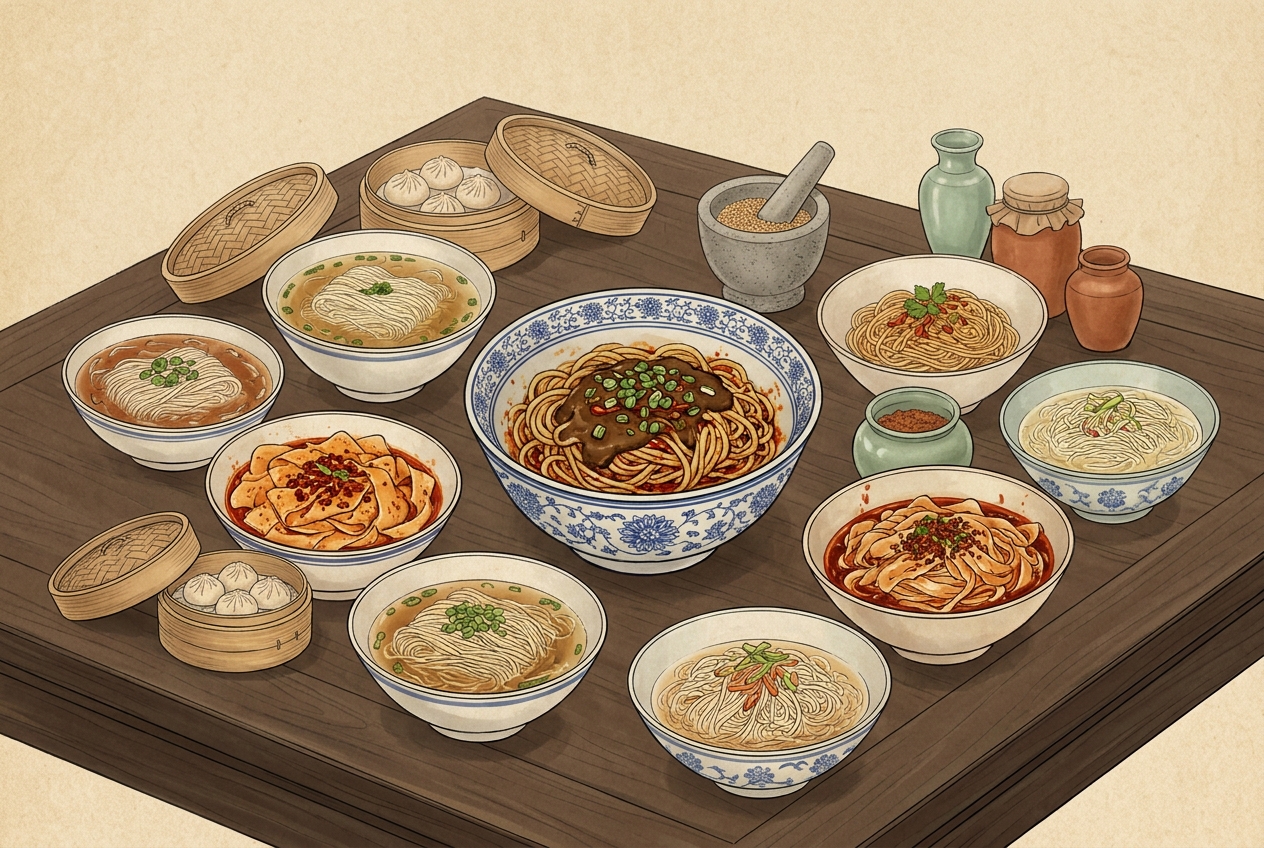
East Asia’s Cereal Alchemy: Turning Soft Wheat into Golden Steel
Draw a line across the map of Old World grain cookery and a profound botanical puzzle appears. Around the Mediterranean basin, Italian pasta makers inherited tetraploid durum wheat (Triticum turgidum subsp. durum), naturally packed with amber carotenoid pigments and dense, inextensible gluten capable of holding an al dente bite with nothing more than water. Across East Asia, however, agriculture revolved around hexaploid common bread wheat (Triticum aestivum)—softer in protein, pale in endosperm, and vulnerable to rapid enzymatic slumping and sour bacterial fermentation during humid monsoon summers.
Centuries ago, Chinese millers and street cooks unlocked a chemical workaround that transformed global gastronomy: alkaline salts. Whether harvested as evaporated trona crust from Inner Mongolian soda lakes, leached from burned desert saltwort ash along the Silk Road, or refined into modern food-grade carbonates, a tiny dose of alkali—just 0.4% to 1.0% of flour weight—rewrites wheat’s molecular destiny. Pale dough blushes canary yellow, flabby gluten tightens into elastic cable, and boiling noodles release that unmistakable, mineral-sweet aroma beloved from Hankou alleys to Fukuoka yatai stalls. Anchored in central China by Wuhan’s jianshuimian, this alkaline continuum links Cantonese bamboo-pressed noodles, Lanzhou pulled filaments, and every bowl of Japanese ramen on earth.
“Without alkali, monsoon wheat collapses into porridge; with a pinch of carbonate salt, dormant sulfur bridges awaken and pale flour turns to spun gold.”
Inside the Dough: Flavonoid Ionization, Disulfide Bridges, and Cation Physics
Cereal chemists point to three simultaneous reactions triggered the moment carbonate ions ($CO_3^{2-}$) push dough alkalinity into the pH 9.0–10.5 window:
- Chromogenic Flavonoid Shift (The Eggless Yellow Mystery): First-time diners almost universally assume Wuhan Reganmian or Tokyo ramen owes its sunny hue to egg yolks. In reality, wheat endosperm harbors colorless water-soluble flavonoid glycosides (chiefly apigenin C-diglycosides). Neutral in water, these phenolic rings deprotonate at alkaline pH, shifting light absorption into the blue-violet spectrum and turning the dough a vibrant, translucent yellow—a built-in pH indicator inside every bowl.
- Sulfhydryl Oxidation & Disulfide (
-S-S-) Crosslinking: Gluten’s strength depends on covalent disulfide bridges linking long glutenin polymers. High pH promotes oxidation of free sulfhydryl (-SH) groups into tight intermolecular-S-S-crosslinks while inhibiting endogenous wheat proteases that otherwise chew dough into slack paste in warm weather. Simultaneously, carbonate ions elevate starch gelatinization temperature by several degrees, preventing surface starch from sloughing off into cloudy, gummy cooking water. - The Potassium vs. Sodium Divide ($K^+$ vs. $Na^+$): Not all alkalis feel alike between the teeth. Following Hofmeister ion-hydration physics, potassium carbonate ($K_2CO_3$) tightens gluten aggressively, creating a crisp, snappy, almost glass-like fracture when bitten. Sodium carbonate ($Na_2CO_3$, soda ash) fosters smoother hydration and cohesive elasticity, yielding a bouncier, muscular chew. Every classic Asian alkaline noodle is calibrated around the ratio between these two cations.
Comparative Matrix of Asia’s Four Great Alkaline Noodle Systems
| Noodle System | Alkaline Agent & Ion Profile | Hydration Rate | Dough pH | Shaping & Thermal Craft | Iconic Dish | Signature Mouthfeel |
|---|---|---|---|---|---|---|
| Wuhan Jianshuimian | Food-grade soda ash (~100% $Na_2CO_3$, 0.4–0.6% flour wt.) | 32%–34% | 9.5–10.2 | Sheet-rolled 1.8mm round + Danmian parboil & oil-fanning | Wuhan Reganmian | Muscular, springy rebound; resists breakage during fierce tossing |
| Cantonese Zhushengmian | Jianshui lye water (~80% $K_2CO_3$ + 20% $Na_2CO_3$) | 28%–30% (100% duck egg, zero water) | 9.8–10.5 | Kneaded beneath a rider bouncing on a giant Mao bamboo pole | Hong Kong Shrimp Wonton Noodles | Ultra-thin, translucent “rubber-band” crisp snap; zero mealiness |
| Lanzhou Penghuimian | Penghui solution (burned Halogeton ash, $K_2CO_3$-rich + $Na^+$) | 48%–52% (soft extensible dough) | 9.0–9.6 | Hand-worked (liutiao) & stretched in seconds into 8 geometric gauges | Lanzhou Clear-Broth Beef Noodles | Extreme extensibility while raw; silky yet firm snap once boiled |
| Japanese Kansui Ramen | Codified Kansui ($Na_2CO_3$, $K_2CO_3$, optional phosphates) | Hakata 26% / Sapporo 38%+ | 9.2–10.0 | Hakata ultra-thin straight; Sapporo aged, hand-crinkled wavy | Hakata Tonkotsu & Sapporo Miso Ramen | Hakata barikata steely core vs. Sapporo glossy, high-bounce wave |
Four Regional Masterworks Across the Alkaline Map
Trace those numbers across East Asia’s geography and culinary history comes alive:
In Wuhan, artisans standardized on pure sodium carbonate ($Na_2CO_3$) at ~33% hydration for good reason. Reganmian strands are relatively thick (1.8mm round) and endure a punishing two-stage lifecycle: parboiled to 80% doneness before dawn, blast-cooled with fans, tossed in oil, plunged back into boiling water for ten seconds at breakfast rush, and violently cross-lifted in viscous sesame paste. Too much potassium carbonate would make a 1.8mm retrograded strand brittle enough to splinter under chopsticks; sodium carbonate delivers supple, steel-spring resilience codified today under Hubei’s strict DB42/T 1168 food-safety standard.
Down south in Guangzhou and Hong Kong, Cantonese wonton mein masters pursued the opposite sensation: razor-thin strands floating in scorching flounder-and-shrimp-roe broth that never turn soggy. Their answer was high-potassium jianshui (~80% $K_2CO_3$) mixed with rich duck eggs instead of water. Because a 28%-hydration egg-and-potassium dough is far too stiff for human wrists to knead, cooks straddle a thick Mao bamboo pole (zhusheng) anchored to the wall, hopping rhythmically hundreds of times to compress gluten sheets into crisp, snappy silver threads.
Far northwest in Lanzhou, hand-pulled noodle masters historically harvested wild desert saltlover (Halogeton arachnoideus, pengpengcao), burning the dried plants in pits to fuse mineral-rich penghui ash块. Dissolved in water and massaged into high-hydration dough during liutiao (rhythmic twisting and slamming that aligns glutenin fibers longitudinally), penghui performs a rheological tightrope walk—allowing a single rope of dough to stretch eight folds into over a thousand unbroken strands (maoxi) before snapping firm the instant it hits simmering beef consommé.
Finally, cross the East China Sea to Japan, where kansui (かん水—literally the Japanese pronunciation of Chinese jianshui / xianshui) gave birth to modern ramen. After Yokohama opened to foreign trade in 1859, Chinese settlers in Yokohama’s Chinatown (Nankinmachi) began serving golden alkaline soup noodles dubbed Nankin-soba. In 1910, Japanese entrepreneur Kan’ichi Ozaki recruited twelve Chinese chefs from Yokohama to open Rairaiken (来来軒) in Tokyo’s Asakusa district—serving thousands of bowls a day and igniting Japan’s century-long ramen obsession. Today, Japanese noodle engineers tune kansui with laboratory precision: Fukuoka’s Hakata tonkotsu pairs ultra-low 26% hydration with high-$Na_2CO_3$ kansui for straight, floury 15-second barikata strands, while Sapporo miso ramen pairs 38%+ hydration with potassium-forward kansui and 48-hour cold aging for glossy, crinkled waves that trap fiery lard-sealed broth. Fittingly, Japan’s most revered craft noodle mills still import natural trona crystals harvested from Inner Mongolia’s ancient soda lakes—selling it proudly under the name Mōko-ō Kansui (“Mongolian King Alkaline Salt”), a living tribute to the continental roots of Asia’s golden strand.
- Fu, B. X. (2008). 'Asian noodles: History, classification, raw materials, and processing.' Food Research International, 41(9), 888–902
- Morris, C. F. (2018). 'Determinants of wheat noodle color.' Journal of the Science of Food and Agriculture, 98(14), 5171–5180
- Kosuge, Keiko (1998). Nippon Ramen Monogatari (The Story of Japanese Ramen). Kodansha
❓ Frequently Asked Questions
Why are Wuhan Reganmian and Japanese ramen noodles yellow even when they contain zero eggs?
Wheat flour naturally contains colorless flavonoid pigments—primarily apigenin C-glycosides. Under neutral or acidic pH they remain invisible, but when alkaline salts raise dough pH above 9.5, phenolic hydroxyl groups ionize and shift their optical absorption spectrum, turning the dough a luminous golden yellow without a single drop of egg yolk or food coloring.
What is the chemical difference between Cantonese Jianshui, Lanzhou Penghui, and Wuhan Jianshui?
All three are carbonate buffers, but their potassium-to-sodium ratios create distinct textures. Wuhan alkaline noodles rely primarily on sodium carbonate (Na2CO3) for smooth, muscular rebound; Cantonese wonton noodles pair an ~80:20 potassium-to-sodium carbonate 'lye water' with duck eggs under a giant bamboo pole for brittle, rubber-band snap; traditional Lanzhou Penghui (burned desert Halogeton ash) balances potassium carbonate with trace minerals to allow extreme hand-stretching without tearing.
Did Japanese ramen’s 'Kansui' originate in China?
Yes. The Japanese word 'kansui' (かん水 / 鹹水) is a direct borrowing of Chinese alkaline water terminology. Introduced by Chinese immigrants making 'Nankin-soba' in Yokohama’s Chinatown after 1859 and popularized nationwide in 1910 when Tokyo’s Rairaiken hired twelve Chinese chefs from Yokohama, kansui remains the legal defining ingredient of Japanese ramen—with artisan shops still prizing 'Mōko-ō Kansui' mined from Inner Mongolian soda lakes.
✦ Cross-Referenced Chapters
Secrets of Alkaline Noodles (Jianshuimian)
High-gluten flour specifications, sodium carbonate ratios, 1.8mm round strand geometry, and signature springy chew.
The Core Art of "Danmian": Parboiling & Oil-Tossing
Step-by-step mastery of 80%-cooked boiling, fan-cooling, and sesame-oil tossing that keeps alkaline noodles springy for hours.
Food Chemistry: Alkaline Gluten Crosslinking & Sesame Phase Inversion
How sodium carbonate strengthens disulfide gluten bonds and tints flavonoids yellow, plus the rheology of sesame paste emulsion.
Official Technical Standards: Hubei DB42 Specifications Decoded
Key physicochemical, moisture, alkalinity, and sesame purity benchmarks codified in Hubei’s official regional standards.
Panoramic Matrix: Comparing All Ten of China’s Famous Noodles
Side-by-side structural comparison against Shanxi knife-cut, Sichuan Dandan, Beijing Zhajiang, Lanzhou beef, and Henan braised noodles.