Hubei Agricultural Terroir: Jianghan Wheat & Xiangyang Sesame
How Northern Hubei's Winter-Wheat-to-Summer-Sesame Rotation, Wuhan's 'Zhongzhi' Germplasm Bank, and Suburban Market Gardens Built the Bowl
Mapping the agricultural geography inside every bowl of Wuhan Reganmian: tracing Northern Hubei's medium-strong winter wheat and high-oil Zaoyang white sesame rotation, Wuhan's world-leading CAAS sesame research institute, Jianghan low-erucic rapeseed oil, and suburban heirloom vegetables.
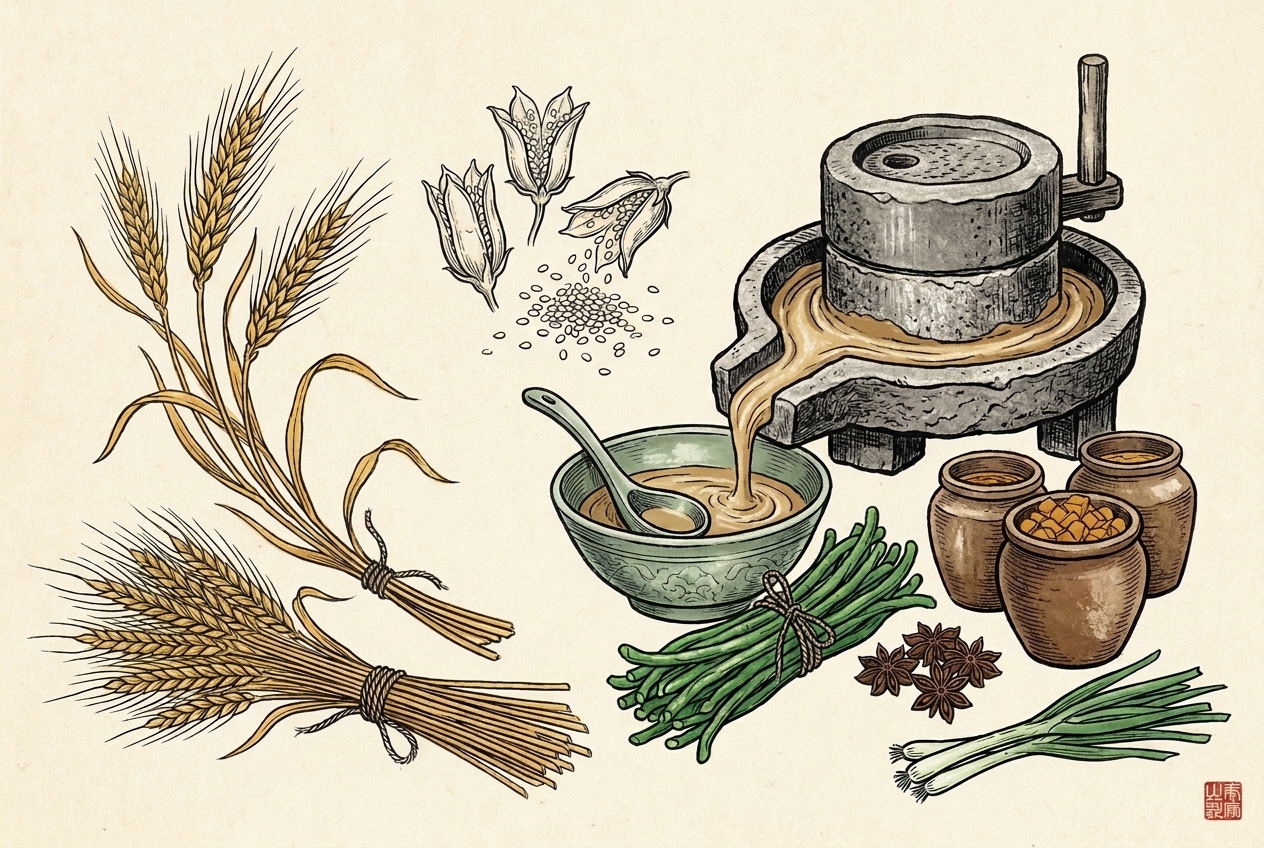
An Edible Map of Hubei: Where North China’s Wheat Meets the Yangtze Basin
Culinary historians often credit Wuhan’s rise as a noodle metropolis to nineteenth-century Hankou’s river-port commerce—the famed “Thoroughfare of Nine Provinces.” Yet step back from the wharves and examine a topographical map of central China, and a deeper ecological truth emerges: Wuhan sits squarely on the agricultural fault line between northern wheat China and southern rice-and-oilseed China.
Spanning latitudes 29°N to 33°N, Hubei Province encloses an extraordinary diversity of microclimates within a three-hour radius of Wuhan’s boiling noodle cauldrons. Northern provinces boast strong wheat but rely on imported sesame and winter cabbage; southern river deltas enjoy year-round greens and fragrant rapeseed oil but grow soft, low-protein wheat unsuited to chewy alkaline strands. Hubei alone commands the complete pantry—making a bowl of Reganmian an edible landscape portrait of the Jianghan Plain and the Han River corridor.
“Han River waters nurse the golden wheat; Zaoyang white sesame shines beneath clear skies. Call it not humble street-corner fare—every strand holds the freshness of Chu mountains and streams.” — Seasonal Verses of Jingchu Terroir
One Field, Two Souls: The “Winter Wheat – Summer Sesame” Rotation
Follow the Han River two hundred kilometers northwest of Wuhan, and wet rice paddies give way to rolling, sun-drenched hills known to agronomists as the Northern Hubei Uplands (Ebei Gangdi, encompassing Xiangyang, Zaoyang, Suizhou, and northern Jingmen). Receiving 1,900 to 2,100 hours of annual sunshine across well-drained yellow-brown loams and calcareous sandy soils, these uplands practice a centuries-old double-cropping rhythm that seems custom-designed by nature for Reganmian:
- October to May — Medium-Strong Winter Wheat: Sown after autumn rains, Northern Hubei winter wheat fills its grain during warm, dry May afternoons with 10°C+ diurnal temperature swings. Harvesting at 12.0% to 13.5% crude protein and 30%–33% wet gluten, Xiangyang upland wheat combines the elastic gluten strength of northern China with a finer, silkier bran coat—milling into core flour that endures alkaline crosslinking without turning coarse.
- Late May to September — Thin-Hulled White Sesame: Within days of the May wheat harvest, farmers plant summer white sesame directly into the warm stubble. Sesame thrives in summer heat (28°C–34°C) while detesting waterlogged roots; the gentle gradients of Zaoyang, Zhongxiang, and Tianmen shed monsoon downpours effortlessly. Harvested in September, Zaoyang White Sesame boasts paper-thin ivory hulls, plump kernels (thousand-seed weight > 2.8–3.1g), and a remarkable 52% to 60%+ natural oil content (far surpassing the ~48% national average), brimming with antioxidant sesamin and sweet nutty precursors.
In a poetic stroke of agronomy, the exact same upland plot yields the alkaline noodle’s wheat spine in spring and its stone-ground sesame soul in autumn.
Wuhan’s Secret Scientific Crown: The Global “Zhongzhi” Sesame Vault
Few commuters slurping noodles on a Wuchang sidewalk realize they are standing blocks away from the world headquarters of sesame science. Founded in 1960 on Xudong Avenue in Wuchang, the Oil Crops Research Institute of the Chinese Academy of Agricultural Sciences (CAAS) houses the world’s largest research sesame germplasm bank, safeguarding more than 8,000 genetic accessions from across the globe and leading the international sequencing of the Sesamum indicum genome.
Over six decades, Wuhan researchers have bred China’s celebrated “Zhongzhi” (中芝) cultivar series—from space-mutagenesis high-yield varieties like Zhongzhi 11 to thin-hulled aromatic white sesame tailored specifically for stone-ground paste and water-substituted oil, and recent shatter-resistant breakthroughs (Zhongzhi NS16 and Zhongzhi 53) that allow combine harvesters to reap sesame without losing seeds in the field. Ancient street craft and cutting-edge genomics share the same city zip code.
Concentric Rings of Freshness: The Three-Hundred-Kilometer Pantry
Plot Wuhan’s river confluence at the center of three concentric circles, and every ingredient in Volume II snaps into geographical focus:
| Terroir Ring | Signature Hubei Origin | Soil & Microclimate Advantage | Role in the Bowl | Peak Harvest Season |
|---|---|---|---|---|
| 30 km Suburban Ring | Xinzhou Red-Root Scallions | Fine sandy alluvium along the Daoshui & Jushui rivers | Sweet, hollow-stemmed emerald scallion confetti | Year-round; sweetest after frost |
| 50 km Northern Foothills | Huangpi Sheshui White Radish | Sandy river loam south of Dabie Mountains; crisp frosts | Sun-wilted spicy radish dices with audible crunch | Late Nov – Dec post-frost |
| 120 km Alluvial Plain | Yingcheng Purple Garlic & Tianmen Cowpeas | Sulfur-rich Jianghan tidal loam; warm humid summers | High-allicin garlic water & clay-crock sour beans | May fresh garlic; July–Sept beans |
| 180 km Golden Blossom Belt | Jingmen & Jingzhou Double-Low Rapeseed | Yangtze basin winter canola heartland (low erucic acid) | Fragrant danmian tossing oil & 3-pour chili oil | May seed pressing |
| 280 km Upland Corridor | Xiangyang Wheat & Zaoyang White Sesame | Sunny, well-drained yellow-brown uplands; wheat-sesame rotation | 1.85mm golden alkaline noodles + ochre stone-ground paste | May wheat / Sept sesame |
From dew-wet scallion beds in Xinzhou to bamboo radish-drying racks in Huangpi, and from Jingmen’s million-acre sea of yellow rapeseed blossoms to Zaoyang’s alternating waves of wheat and white sesame, every bowl of Wuhan Reganmian distills the fertile abundance of Hubei’s rivers, plains, and hills into ten steaming seconds.
- Hubei Provincial Department of Agriculture and Rural Affairs, Atlas of Hubei Geographical Indication Products
- Oil Crops Research Institute of CAAS (Wuhan), Germplasm Archives & 'Zhongzhi' Cultivar Monographs
- Xiangyang Municipal Chronicles Committee, Agricultural Gazetteer of Xiangyang & Zaoyang White Sesame
- Wuhan Academy of Agricultural Sciences, Suburban Specialty Vegetable Terroir Records
❓ Frequently Asked Questions
Isn't Hubei a southern rice province? How does it grow high-gluten wheat and world-class sesame?
Hubei straddles China's 29°N–33°N climatic divide. While the southern Jianghan wetlands grow rice, the Northern Hubei Uplands (Xiangyang, Zaoyang, Suizhou) form the sunny, well-drained southern rim of China's winter-wheat belt—blessed with mineral-rich yellow-brown loams ideal for both strong-gluten wheat and drought-loving white sesame.
What is the 'Winter Wheat – Summer Sesame' crop rotation?
Across the Han River uplands, farmers harvest golden winter wheat in late May and immediately sow summer white sesame into the warm, rain-moistened stubble for a September harvest. Remarkably, the very same fields produce both the high-gluten flour for alkaline noodles and the high-oil white sesame for stone-ground paste.
Why is Wuhan considered the global scientific capital of sesame breeding?
Headquartered in Wuhan's Wuchang District since 1960, the Oil Crops Research Institute of the Chinese Academy of Agricultural Sciences (CAAS) curates the world's largest sesame germplasm repository (>8,000 accessions), sequenced the sesame genome, and bred China's flagship 'Zhongzhi' high-oil white sesame varieties.
✦ Cross-Referenced Chapters
Secrets of Alkaline Noodles (Jianshuimian)
High-gluten flour specifications, sodium carbonate ratios, 1.8mm round strand geometry, and signature springy chew.
Soul of the Bowl: Stone-Ground Sesame Paste Craft
Low-temperature roasting, stone-mill grinding, and the great culinary debate between 100% pure sesame vs. 80/20 sesame-peanut blends.
Small-Mill Sesame Oil, Blending Fats & Chili Oil
Why oil-thinned sesame paste coats every strand superiorly to water-thinned paste, plus aromatic Wuhan chili oil infusion.
Crunchy Counterpoints: Pickled Radish & Sour Long Beans
How sun-wilt Huangpi radish dices and crock-fermented sour cowpeas cut through rich sesame paste with bright acidity and crunch.
The Multi-Billion RMB Reganmian Supply Chain Ecosystem
From dedicated wheat mills and automated central wet-noodle factories to tens of thousands of storefronts and live-stream retail.
Hubei’s Noodle Constellation: Xiangyang, Yichang & Jingzhou
Exploring Reganmian’s provincial siblings: fiery Xiangyang beef-tallow noodles, Yichang red-oil noodles, and Jingzhou rich-broth Zaotangmian.