Food Engineering Breakthroughs: Fresh-Lock Pouches & Microwave Bowls
Hurdle-Technology Wet Noodles, Anti-Retrogradation Starch Science, and Micronized Sesame Emulsions
Unpacking the food science behind modern shelf-stable and chilled Reganmian—how buffered organic acids and gentle pasteurization preserve alkaline wet noodles without sourness, how modified starches defeat 4°C retrogradation in 60-second microwave bowls, and how Stokes'-Law micronization stops sesame oil separation.
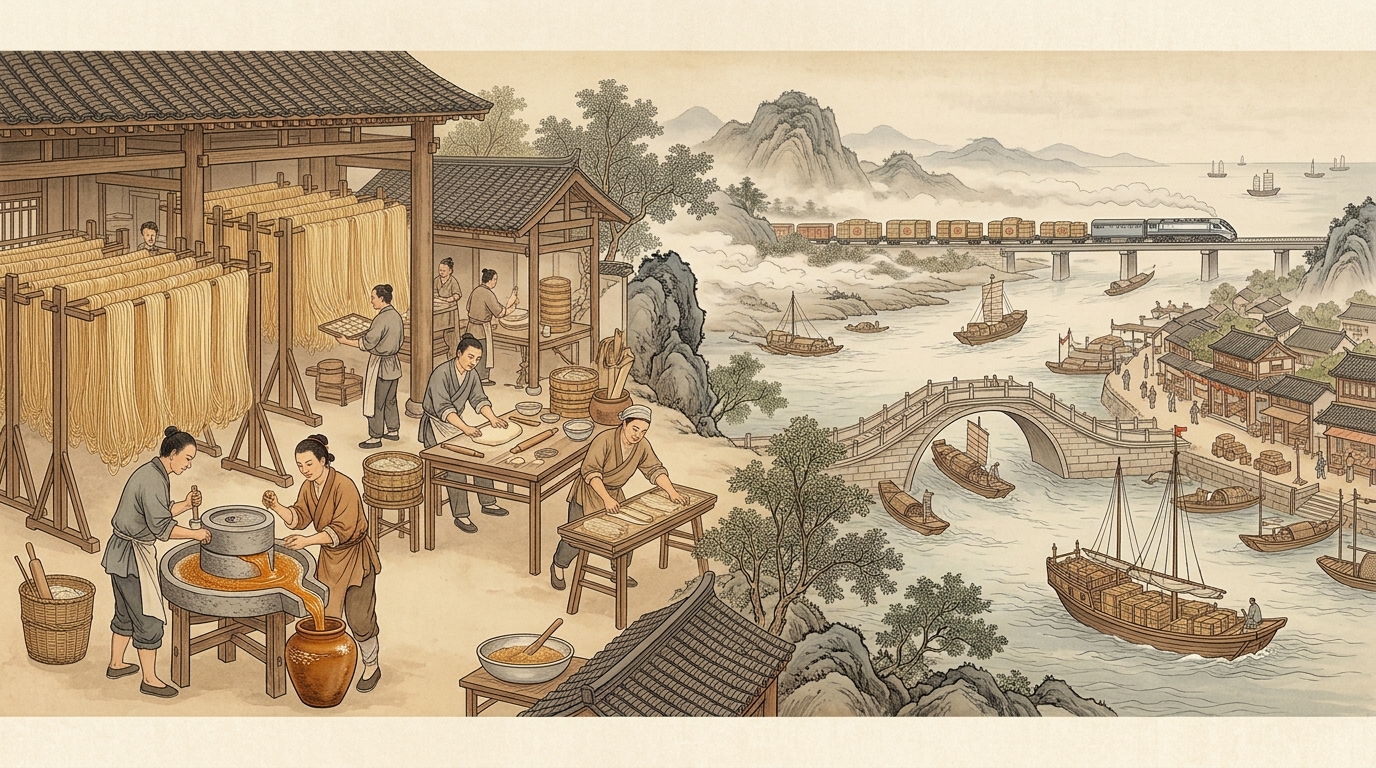
Breaking the 24-Hour Curse: When Street Craft Meets Cereal Chemistry
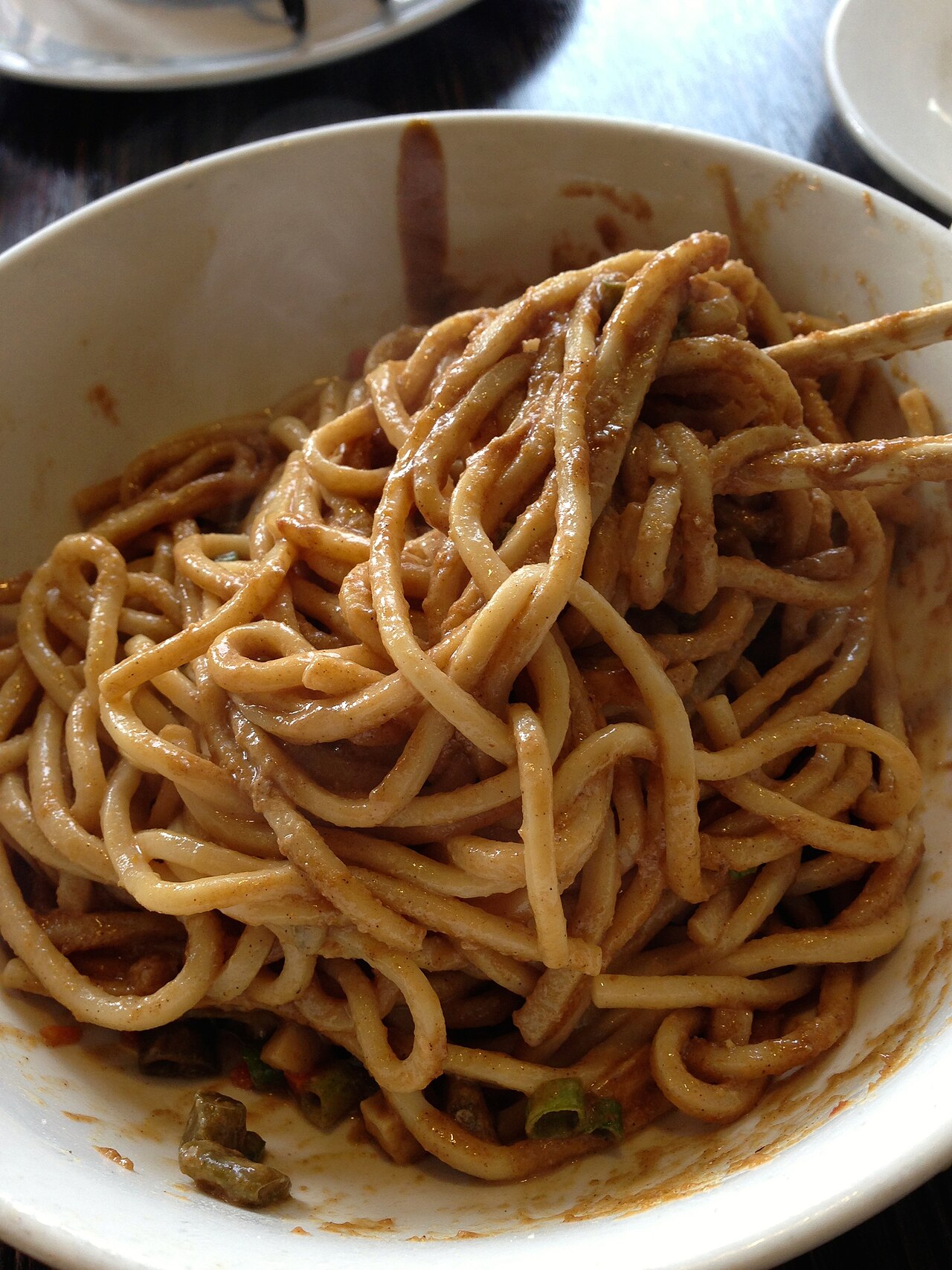
In its native habitat on a Wuhan sidewalk, freshly parboiled danmian is an ephemeral marvel—and a microbiological ticking clock. Containing 52% to 60% moisture with a water activity ($A_w$) above 0.94, oil-tossed alkaline noodles offer an ideal banquet for Bacillus cereus and ambient molds within twelve to twenty-four hours. Worse still, stashing cooked noodles in a 4°C refrigerator triggers rapid $\beta$-starch retrogradation: gelatinized amylopectin chains snap back into rigid crystalline lattices, turning springy strands brittle and chalky.
“Where a bamboo fan and sesame oil once guarded freshness from dawn till dusk, buffered ions, steric starch shields, and vacuum sublimation now carry that morning bounce across continents and seasons.”
Over the past decade, delivering authentic, ninety-second shop-quality bounce without palm-oil deep frying has sparked an intense R&D race across Wuhan’s food-engineering labs—yielding three breakthrough technologies that quietly power today’s multi-billion-RMB retail boom.
Breakthrough I: Solving the “Alkaline-Core, Acid-Shield” Paradox in Wet Pouches
Flip over a package of 90-second fresh-lock wet Reganmian (such as Baixiang Xianmianchuan or gourmet meal kits) and a curious chemical riddle appears on the ingredient panel: sodium carbonate (alkali) sits right beside lactic acid and sodium lactate (acid). Why don’t they cancel each other out?
The answer lies in spatial-temporal phase separation combined with Leistner’s Hurdle Technology:
- Locking the Alkaline Core First: During vacuum mixing, multi-roller sheeting, and
98°Csteam-tunnel gelatinization, sodium carbonate works unopposed inside the dough—crosslinking glutenin disulfide bonds (-S-S-) for snappy chew and shifting wheat flavonoids to their signature canary yellow. Once thermally set, that internal protein architecture is permanent. - Applying a Microscopic Buffered Acid Shield: High-moisture noodles cannot survive
121°Cretort canning without turning into mush; yet gentle90°Cpasteurization alone cannot kill heat-resistant Bacillus spores unless the environment is mildly acidic. Immediately after chilled water cooling, parboiled strands glide for seconds through a precision Lactic Acid–Sodium Lactate Buffer Bath. Unlike raw vinegar or unbuffered acid—which imparts a harsh sour bite—the lactate buffer gently pins the noodle’s outer cuticle pH between 4.2 and 5.0, arresting spore germination while keeping titratable sourness barely perceptible. - Biopreservatives + MAP + Gentle Water-Bath Pasteurization: Food-grade natural peptides—Nisin and $\varepsilon$-polylysine—join the buffer to perforate Gram-positive bacterial membranes. Sealed inside oxygen-scavenged Modified Atmosphere Packaging (MAP,
<0.5%residual $O_2$), pouches undergo gentle water-bath pasteurization at88°C–95°Cfor 15–20 minutes. When the home cook plunges the noodles into boiling water for 90 seconds and drains the pot, the surface lactate buffer washes cleanly down the sink—leaving pure, springy alkaline wheat behind.
Breakthrough II: 60-Second Micro-Pressure Microwave Bowls
Step into a 7-Eleven, Lawson, or Today convenience store in Wuhan at midnight, grab a chilled Reganmian bowl from the 4°C open case, and microwave it for 60 seconds: the strands emerge glossy, elastic, and clump-free without adding a drop of water. Behind that effortless midnight snack lies sophisticated anti-retrogradation rheology:
- Steric Hindrance via Modified Starches & Hydrocolloids: Chilled storage (
0–8°C) sits squarely inside wheat starch’s peak recrystallization zone. Formulators blend hydroxypropyl distarch phosphate (modified waxy tapioca starch) and propylene glycol alginate (PGA) into high-gluten flour. Bulky hydroxypropyl side groups act as molecular wedges between starch chains, physically blocking hydrogen-bond realignment and syneresis (water weeping) across multi-day cold-chain transit. - Micro-Emulsified Lipid Coating: Electrostatic misting nozzles coat parboiled strands in a micron-thin oil-in-water emulsion that prevents localized microwave dehydration (“hard edges”).
- Self-Venting Micro-Pressure Steam Film: The heat-sealed bowl lid features a pressure-sensitive micro-valve. Under 800–1500W microwave excitation, moisture from the bottom spiced-soy broth vaporizes into a pressurized
102°Csteam dome, evenly re-gelatinizing every strand in 60 seconds flat before venting safely.
| Engineering Platform | Primary Scientific Mechanism | Critical Process Parameters | Reconstitution Method | Sensory Fidelity & Ideal Use Case |
|---|---|---|---|---|
| Non-Fried Hot-Air Microporous Dry | Controlled convective dehydration lowering $A_w < 0.60$ | Moisture ≤ 14.0%; pre-gelatinization > 85% | Stovetop rolling boil: 5–7 min | Firmest muscular wheat snap, zero acid trace; pantry & ocean export king |
| Buffered Hurdle Fresh-Lock Wet | Lactate surface pH shield + Nisin + MAP pasteurization | Cuticle pH 4.2–5.0; 90°C bath 18 min | Boiling dip or kettle steep: 90 sec | Silky, hydrated shop-like bounce; dorms, offices & gourmet kits |
| Anti-Retrogradation Chilled Bowl | Modified starch/PGA steric hindrance + steam-valve lid | Continuous 0–8°C cold chain; micro-steam dome | Microwave high: 60 sec (zero water) | Ultimate grab-and-go convenience; 24h convenience stores & bullet trains |
| Aerospace Vacuum Freeze-Drying (FD) | Direct ice-to-vapor sublimation below water’s triple point | -35°C blast freeze; chamber < 30 Pa vacuum |
Boiling water pour: 5 sec | Preserves 96% volatile aroma & cellular crunch; scallions, beef & Danjiu |
Breakthrough III: Stokes’-Law Sesame Micronization & Freeze-Dried Danjiu
Even the finest engineered noodle fails if its sesame paste arrives separated into an oily puddle atop a concrete-hard puck—a notorious flaw of early instant packs shipped across summer heatwaves.
Condiment engineers solved phase separation without resorting to artificial trans-fat stabilizers by applying Stokes’ Law of sedimentation ($v = \frac{2gr^2(\rho_p - \rho_f)}{9\eta}$). Because solid particle settling velocity scales with the square of particle radius ($r^2$), halving sesame particle diameter slashes separation speed fourfold. Modern Hubei sauce plants run roasted seeds through nitrogen-blanketed, chilled three-stage colloid and horizontal ball mills kept strictly below 55°C (preventing scorched bitterness). Grinding seed hulls and protein matrices down to $D_{90} \le 25\ \mu\text{m}$ creates an ultra-fine colloidal lattice that traps sesame oil by capillary force—extruding like warm satin straight from the sachet after nine months on the shelf.
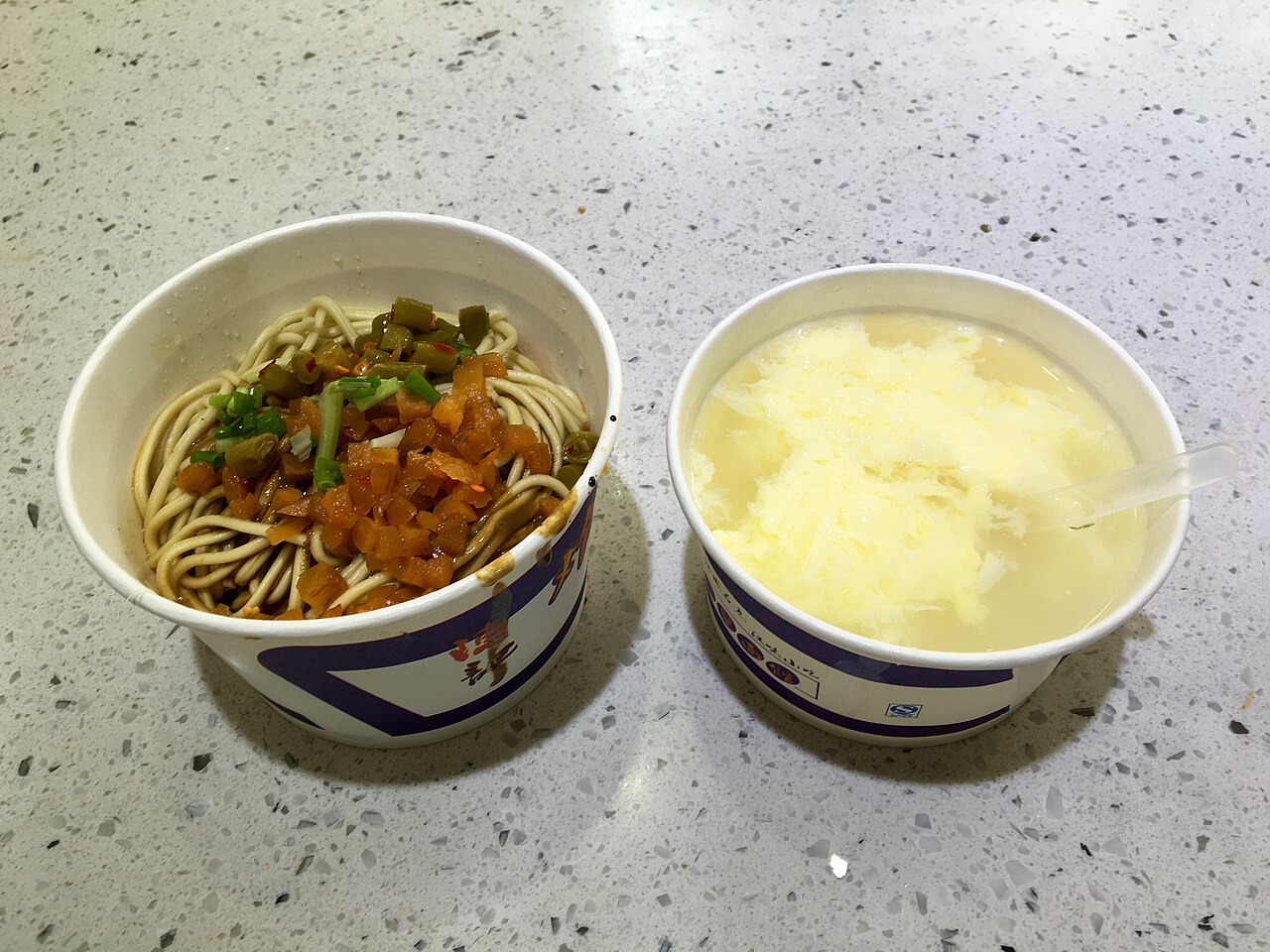
Meanwhile, Vacuum Freeze-Drying (FD) has brought Wuhan’s beloved breakfast pairing into the instant age. Flash-frozen at -35°C and sublimated under deep vacuum, FD Xinzhou green scallions, FD braised beef cubes, and FD Xiaogan Osmanthus Egg Rice Wine (Danjiu) blocks retain microscopic honeycomb pores. Add boiling water to a mug alongside your freshly tossed noodles, and in five seconds ribbons of golden poached egg unfurl in fragrant fermented sweet rice wine—completing a triumph of modern culinary engineering.
- Journal of Cereal Science & Food Science (Shipin Kexue): Hurdle Technology & Organic-Acid Buffering in High-Moisture Pasteurized Noodles
- Leistner Microbial Hurdle Theory Applied to Ambient Shelf-Stable Asian Wet Noodles
- Convenience Store Cold-Chain Ready-Meal Engineering Protocols & DBS 42/005 Technical Dossiers
❓ Frequently Asked Questions
If Reganmian is an alkaline noodle, why do fresh-lock wet pouches list lactic acid and sodium lactate on the label?
Food engineers use a clever 'alkaline-core, acid-shield' dual-phase process. Sodium carbonate is mixed into the dough first to build internal disulfide gluten elasticity and golden color during steaming. Afterward, the parboiled strands pass briefly through a mild lactic-acid/sodium-lactate buffer bath that lowers only the microscopic outer surface pH to 4.2–5.0 to block heat-resistant bacterial spores. A 60-second dip in boiling water rinses off the surface buffer, restoring pure alkaline flavor.
Why don't convenience-store chilled Reganmian bowls turn hard and crumbly in the refrigerator like leftover home-cooked noodles?
Standard cooked wheat starch crystallizes rapidly at 0–8°C (starch retrogradation). Convenience-store microwave bowls incorporate waxy modified tapioca starch and propylene glycol alginate (PGA) to lock bound water in place, paired with a self-venting micro-pressure steam film that re-gelatinizes strands evenly in 60 seconds.
How do top brands stop oil from separating and hardened sediment from forming inside sesame paste packets?
According to Stokes' Law, solid particle settling velocity scales with the square of particle radius. By grinding roasted sesame seeds in nitrogen-chilled three-stage colloid and ball mills down to D90 ≤ 25 microns, solid seed fibers form a self-supporting suspension matrix that holds sesame oil evenly for months without hydrogenated stabilizers.
✦ Cross-Referenced Chapters
Food Chemistry: Alkaline Gluten Crosslinking & Sesame Phase Inversion
How sodium carbonate strengthens disulfide gluten bonds and tints flavonoids yellow, plus the rheology of sesame paste emulsion.
Food Safety Standards & Fresh Alkaline Noodle Storage
Modern food-grade alkali regulations, microbial shelf-life windows for oil-tossed fresh noodles, and aflatoxin screening.
Official Technical Standards: Hubei DB42 Specifications Decoded
Key physicochemical, moisture, alkalinity, and sesame purity benchmarks codified in Hubei’s official regional standards.
Head-to-Head Review of Top Packaged Reganmian Brands
Benchmarking Cai Lin Ji, Dahankou, Bestore, Baixiang, Xiangnian, and Jinmiantang across noodle bounce, sauce aroma, and value.