Oral Histories of 3:00 AM Noodle Artisans
Before the River City wakes: thirty years of calloused palms, medicated plasters, and boiling cauldrons in Wuhan’s back alleys
Intimate oral-history portraits of Wuhan’s street-level Reganmian guardians—from husband-and-wife couples who turned 1990s factory layoffs into beloved neighborhood shrines, to second-generation custodian Cai Hanwen’s dying charge, deaf-run silent stalls, and post-80s innovators.
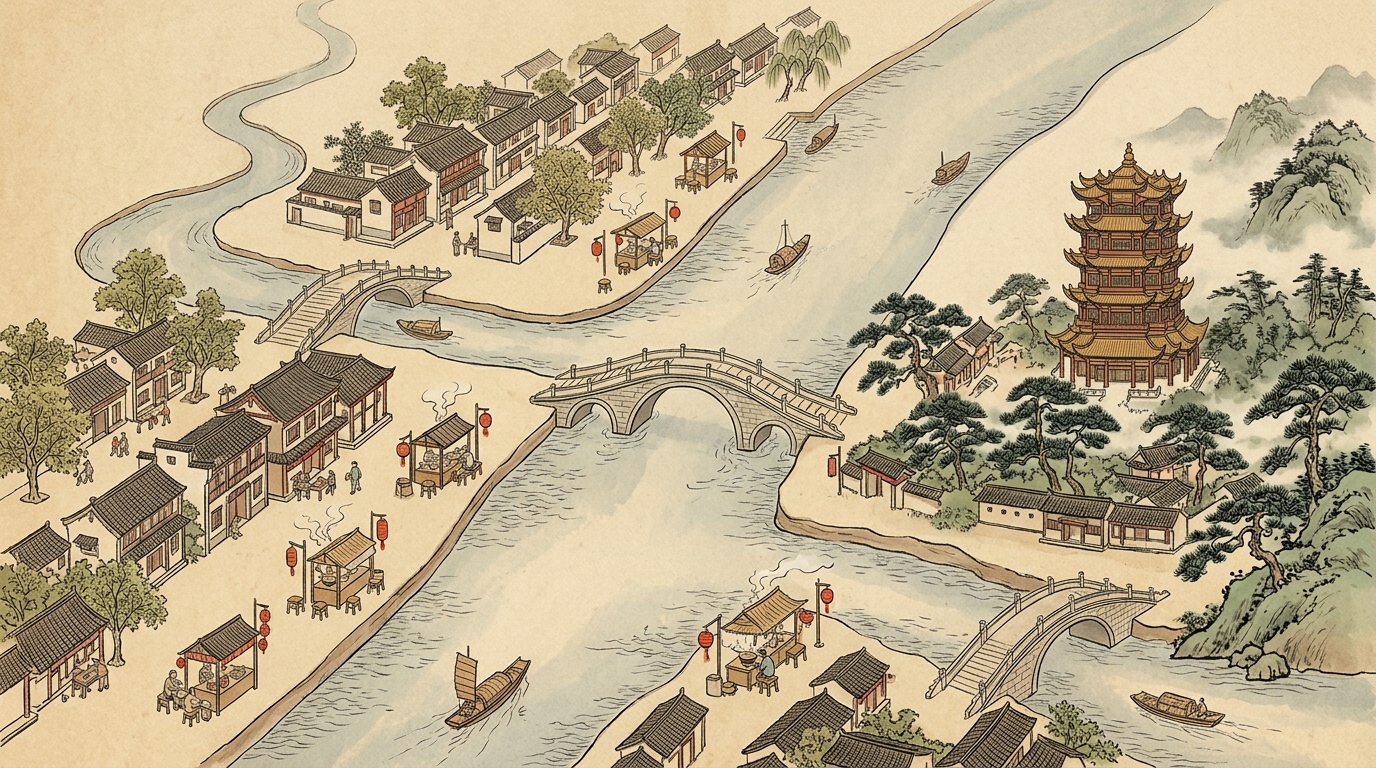
2:50 AM: The Blue Flame That Wakes a Metropolis
At 2:50 AM, while mist hangs heavy over the dark Yangtze and twelve million residents sleep, corrugated iron shutters roll upward with a metallic rattle along Changdi Street, Dacheng Road, and Meigui Street. Single bare bulbs flicker on inside fifteen-square-meter storefronts. Long before commuters savour their ten-second morning bowl at 7:30 AM, Wuhan’s street artisans enter a solitary, two-and-a-half-hour crucible of steam, muscle, and roasted sesame oil.
To chronicle The Reganmian Canon solely through chemical formulas or restaurant directories would be to miss its beating heart: the human beings whose calloused hands have tended those cauldrons for thirty or forty unbroken years.
“A lifetime isn’t grand. If you make two hundred pounds of noodles obey your chopsticks at four in the morning, and never cheat a neighbor out of pure sesame paste, you’ve honored your stove.” — Master Zhang, 30-year Hankou alley stallkeeper
Voice I: The 1990s Husband-and-Wife Cart — “A Life Simmered Together”
Synthesized from documented oral interviews with thirty-year husband-and-wife neighborhood stallkeepers in old Hankou:
“People ask whether waking up before three in January hurts. The first three winters, you wanted to cry pulling back the quilt. After thirty years, the alarm clock lives inside your bones—my eyes open at 2:45 on their own. Back in 1997, my wife and I were laid off within three months of each other from the Hankou textile and machinery plants. Our son was eight. We borrowed eight hundred yuan, hired a carpenter to nail together a wooden pushcart, bought a cast-iron cauldron, and claimed a corner under the plane trees.
Winters were merciless. Washing radishes and scallions under an outdoor tap at 3:30 AM, my wife’s knuckles swelled with purple chilblains that split open; whenever salt or chili oil touched those cracks, she bit her lip white without making a sound. Come July and August, Wuhan’s ‘furnace’ summer pushed pavement temperatures past 40°C—and nearly 60°C beside the roaring burner. Our cotton shirts soaked through, dried stiff, and soaked again until you could shake white salt crystals off the fabric at noon.
Outsiders think boiling noodles is easy. The real battle is hand-parboiling (danmian) a hundred kilos of fresh alkaline noodles at 3:45 AM. You can’t trust a wall timer because winter tap water and summer flour behave differently. You pinch a strand between your fingers: the instant a hairline white core (baixin) remains at dead center—eighty percent cooked—out it comes onto the wooden board! While my wife drizzles sesame and soybean oil, I crank the floor fan to high and lift-and-shake the strands hundreds of times with foot-long bamboo chopsticks. In my forties, my shoulders ached so fiercely at night that our bedroom smelled stronger of herbal pain plasters than sesame paste. People told me to buy a mechanical mixer. Never! Iron claws tear delicate gluten; human wrists feel when every strand breathes.”
Voice II: The Sculptor-Custodian — Cai Hanwen’s Final Charge
A different, deeply poignant testimony comes from Cai Hanwen (1933–2017), eldest son of Cai Lin Ji founder Cai Mingwei. Trained as a classical sculptor at the Guangzhou Academy of Fine Arts, Cai Hanwen devoted his seventies and eighties to rescuing authentic Reganmian craft from industrial shortcuts.
In archival interviews recorded between 2009 and 2016, the silver-haired elder recalled his father’s 1940s Manchun Street workshop: “My father threw out pot after pot of test noodles, inviting rickshaw pullers and dockworkers to critique every batch for free until the alkali snap and stone-ground paste sang in harmony. His lifelong rule was simple: cooking is conscience. Roast plump Hubei white sesame slowly over gentle heat, grind on stone, and thin strictly with small-mill sesame oil. Earn three cents less profit rather than ever adulterate pure sesame paste with cheap peanut paste or synthetic fragrance.”
By opening his family’s closely guarded ratios to dedicated apprentices regardless of surname, Cai Hanwen ensured that Republican-era craftsmanship survived into the modern community-chain era.
Voice III: Silent Cauldrons & Post-80s Torchbearers
On Jiang’an District’s Qiuchang Road and tucked-away Wuchang lanes, several cherished “silent noodle shops” (wusheng mianguan) run by deaf husband-and-wife teams embody another facet of Wuhan’s street grace. Here, no orders are shouted. Regulars step up to the steam window and flash familiar hand signs: two fingers for a standard 100-gram bowl, a flat palm for full condiments, a gentle wave for no scallions. Unburdened by noise, the proprietors read water turbulence and sesame viscosity with razor-sharp visual focus—earning Qiuchang Road Reganmian a Bronze Medal in Wuhan’s 2014 citywide blind-tasting championship.
Meanwhile, younger artisans like Hanyang’s post-80s champion Luo Sisi carry the torch forward with digital scales and thermometer-calibrated spiced broths, proving that reverence for tradition and culinary innovation can share the same 3:00 AM lamplight. When overseas Wuhanese drag wheeled suitcases straight from Hankou Railway Station to their childhood alley stall before even unlocking their parents’ apartment door, every predawn hour at the cauldron finds its reward.
The 24-Hour Rhythm of a Traditional Wuhan Noodle Stall
| Time Window | Craft Stage | Physical & Technical Demands | Alleyway Atmosphere |
|---|---|---|---|
| 02:50 – 03:15 | Igniting the Cauldron | Fill deep 80cm iron pot; bring first water to a rolling boil; inspect fresh alkaline noodles | Dark, silent lane broken only by exhaust fan hum |
| 03:15 – 04:30 | Hand Danmian Parboiling | Boil to 80% hairline white core; oil-drizzle and lift hundreds of strokes before high-speed fans | Clouds of steam; sweat beading in winter cold |
| 04:30 – 05:15 | Emulsifying Sesame Paste | Whisk small-mill sesame oil in three stages into stone-ground paste; crush fresh garlic water | Nutty roasted sesame and charred chili perfume the block |
| 05:15 – 06:30 | First-Wave Regulars | 6-second blanching for street sweepers, night-shift taxi drivers, and early market vendors | Streetlights still glowing; quiet slurps on low stools |
| 06:30 – 09:30 | Peak Guozao Storm | Dual bamboo baskets cycling non-stop (300–800 bowls); periodic water refresh to control alkalinity | Long neighborhood queues; rapid-fire dialect orders |
| 13:00 – 14:30 | Scrubbing & Midday Rest | Scrape wooden boards, scrub sauce crocks and cauldron; apply shoulder plasters for afternoon sleep | Sunlight slanting across stacked bamboo baskets |
- Changjiang Daily & Chutian Metropolis Daily Documentary Series: 'Wuhan’s 3:00 AM Stall Keepers'
- Oral History Transcripts of Cai Hanwen on Traditional Reganmian Stewardship (2009–2016)
- Wuhan Intangible Cultural Heritage Protection Center Fieldwork Interviews with Master Inheritors
❓ Frequently Asked Questions
Why must traditional artisans wake up at 3:00 AM to parboil ('dan') noodles instead of refrigerating them overnight?
Refrigeration triggers starch retrogradation in 80%-cooked wheat noodles, turning the exterior pasty and the core brittle upon reheating. Hand-parboiling, oiling, and fan-cooling fresh batches at 3:30 AM keeps the gluten network lively and springy throughout the 6:00–9:30 AM rush.
Why were so many famous Wuhan neighborhood noodle stalls founded in the late 1990s?
During China’s late-1990s state-enterprise restructuring, thousands of skilled textile, machinery, and steel workers in Hankou and Hanyang were laid off. Resilient couples pooled modest savings to build wooden pushcarts, bringing disciplined industrial work ethic and honest portions to neighborhood breakfast corners.
How do Wuhan’s famous 'silent noodle stalls' operate during chaotic morning rushes?
At beloved deaf-run shops like Qiuchang Road Reganmian in Jiang’an District, regulars communicate via effortless hand signals—two fingers for a 2-liang bowl, a flat palm for all condiments, a wave to skip scallions. Freed from chatter, these masters achieve extraordinary precision in blanching timing.
✦ Cross-Referenced Chapters
Intangible Cultural Heritage Dossier & Lineage
Official Hubei provincial heritage classifications, master inheritor lineages, and traditional craft preservation standards.
The Core Art of "Danmian": Parboiling & Oil-Tossing
Step-by-step mastery of 80%-cooked boiling, fan-cooling, and sesame-oil tossing that keeps alkaline noodles springy for hours.
Livelihood Barometer: Forty Years of Bowl Prices
Tracking the price of a 2-liang bowl from grain-coupon dimes in the 1980s to today’s 5-RMB neighborhood benchmark.
Warmth of the River City: Suspended Charity Bowls & Silent Stalls
True stories of free winter bowls for street sweepers, pay-it-forward wall vouchers, and beloved deaf-run neighborhood shops.