Seasonal Folkways: Fighting Dog-Day Heat with Hot Noodles
Sweating Out 39°C 'Furnace' Summers, Bamboo-Bed Alleys at Dawn, and the Neighborhood Initiation Rite
Exploring Wuhan's seasonal customs around Reganmian: why locals eat piping-hot sesame noodles during 39°C 'Sanfu' dog days to sweat out damp heat, how historic summer bamboo-bed alleys flowed into dawn cauldrons, and how neighborhood stalls initiate new residents.
Paradox of the Furnace City: Steaming Bowls Under 39°C Cicadas
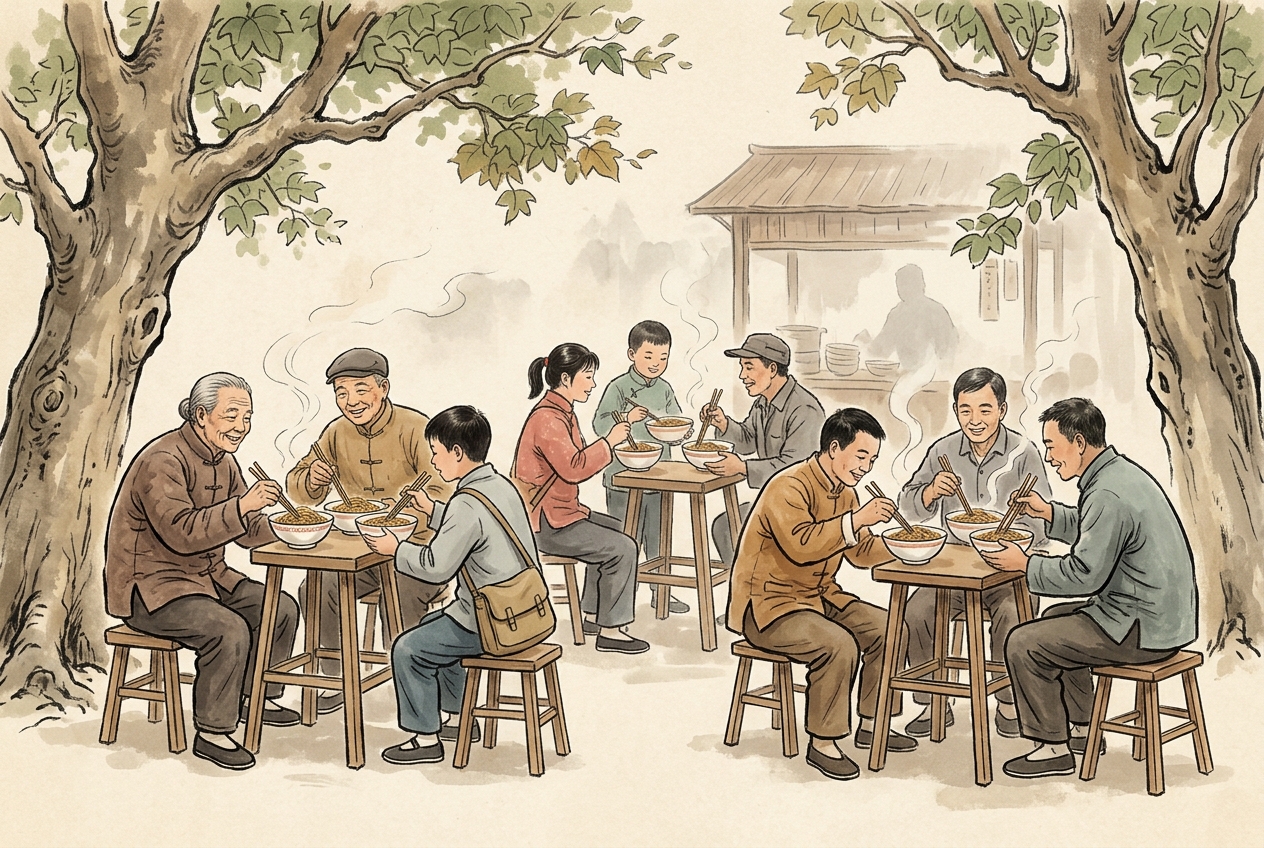
Step onto a Wuhan sidewalk in late July—the peak of Sanfu (三伏, the forty “Dog Days” of high summer)—and you will confront a scene that defies every textbook rule of warm-weather dining. Cicadas scream from the canopy of French plane trees, asphalt shimmers above 38°C, and river humidity hangs thick as bathhouse steam. Yet right beside a roaring three-foot noodle cauldron, a dozen locals in cotton singlets sit calmly on low stools, cross-tossing piping-hot, sesame-coated alkaline noodles while beads of sweat roll down their temples.
Visitors inevitably ask the same bewildered question: Why on earth aren’t they eating cold noodles?
Chilled summer noodles (liangmian) certainly exist in Wuhan, yet four out of five morning diners never abandon their steaming bowl. Their loyalty rests on an age-old Yangtze-basin folk physiology known as yi re zhi re (以热制热)—“fighting heat with heat.” Wuhan’s historic reputation as one of China’s “Four Furnaces” stems not from desert aridity, but from stagnant water vapor rising off two rivers and more than a hundred urban lakes. In traditional Chinese medicine, this climate breeds shushi (“summer dampness”): when people retreat into icy rooms and gulp frozen drinks, surface capillaries constrict, trapping internal heat and dampness until limbs feel leaden and appetite collapses.
Wuhan’s counter-strategy strikes at 6:30 AM before the sun turns fierce. Raw crushed garlic water awakens sluggish digestion; white pepper and ten-spice soy warm the stomach; scorched chili oil and 80°C alkaline strands trigger a clean, thorough flush of perspiration across the shoulders. As an old Hankou alley proverb puts it:
“One steaming bowl at dawn drives dampness out through every pore; chase it with iced sour-plum soup, and even the Dog Days feel like a river breeze.”
Then comes the masterstroke: chasing the rich sesame finish with a frost-beaded cup of old-style Hankou osmanthus sour-plum soup (guihua suanmeitang) or chilled mung-bean soup. Fire opens the pores; tart plum ice resets the palate; the first river breeze turns sweat into natural air conditioning.
Dawn Over the Bamboo-Bed Alleys
For anyone who grew up in Wuhan prior to the mid-1990s air-conditioning boom, summer Reganmian is inseparable from the vanished nocturnal spectacle of the Zhuchuangzhen (竹床阵)—the Bamboo-Bed Formations.
On sweltering evenings from June through August, residents of densely packed neighborhoods like Liuduqiao, Changdi Street, and Simenkou carried buckets of tap or well water outside at sunset to douse sun-baked stone lanes, sending up clouds of hissing steam. Families then hauled out polished split-bamboo cots, lining sidewalks and arcades for miles in communal open-air dormitories. Grandparents waved palm-leaf fans, children counted satellites overhead, and neighbors traded gossip until midnight.
By 4:45 AM, when the coolest breeze of the twenty-four-hour cycle drifted off the Yangtze, the bamboo-bed city stirred. First awake were the neighborhood noodle couples, stoking honeycomb-coal stoves and lifting lids off cauldrons of star-anise lushui spiced broth. As that unmistakable clove-and-soy perfume drifted across the rows of cots, elders sat up, propped their bamboo beds upright against brick walls, slipped into wooden clogs or plastic flip-flops, and shuffled five yards to the boiling pot: “Old Zhang, first pot boiling yet? Whip up two liang to wake my bones!” Nighttime survival flowed straight into morning celebration without a single wasted beat.
The Four-Season Reganmian Calendar
Though the core bowl endures 365 days a year, seasoned Wuhan diners subtly tune their condiments and drink pairings to the rhythm of the solar terms:
| Season | Wuhan Microclimate | Subtle Bowl Adjustments | Signature Seasonal Drink | Living Folk Scene |
|---|---|---|---|---|
| Spring (Mar–May) | Cherry blossoms & misty river rains | Classic 2-liang all-in with extra bright spring scallions | Hot osmanthus Humijiu fermented rice soup | 40,000 Wuhan Marathon runners fueling on mini bowls under pink petals |
| Summer (Jun–Aug) | Sanfu furnace heat & dense humidity | Extra raw garlic water (antibacterial) & crisp sour cowpeas | Frosty osmanthus sour-plum brew or Erchang soda | Sweating under plane-tree shade; historic dawn fold-up of bamboo beds |
| Autumn (Sep–Nov) | Crisp skies & new-harvest Hubei sesame | Extra-generous ladle of freshly milled first-press sesame paste | Velvety hot Danjiu (poached-egg sweet rice wine) | 300,000+ university freshmen tasting their inaugural campus bowl |
| Winter (Dec–Feb) | Damp, bone-piercing river chill | Heavy sesame oil + blanched tender beef or braised tripe | Simmering white-radish & beef-bone broth | Thick white cauldron steam enveloping dawn street sweepers & commuters |
The Neighborhood “Door-Recognition Rite”
Beyond marking the seasons, the neighborhood noodle stall presides over an unspoken civic initiation that old residents affectionately call the Renmenli (认门礼)—the Door-Recognition Rite.
In historic Hankou lifen alleyway compounds like Xian’anfang or Shanhaiguan Road, the downstairs family noodle shop serves as town hall, post office, and neighborhood watch rolled into one. When a young couple or newly graduated renter first moves into an apartment upstairs, the proprietor greets them with polite formality: “Morning! Two liang or three? Chili and scallions okay?”
Keep showing up for two weeks, however, and one Tuesday morning you will step sleepy-eyed through the iron courtyard gate to find the owner already dropping a bamboo cone into the boiler at the sight of your silhouette: “Morning! Same two liang—light noodles, extra Huangpi radish, mild chili, splash of vinegar, hold the scallions, right?”
In Wuhan’s moral economy, that unprompted sentence is worth more than a stamped lease. It signals that the alley now knows your face and claims you as its own. From that morning onward, upstairs grandmothers will pull your laundry indoors when a sudden thunderstorm hits, and couriers can leave urgent parcels safely beneath the noodle counter until you get off work. Across scorching summers and frosty winters, a five-yuan bowl binds strangers into neighbors.
- Wuhan Local Chronicles Committee, 'Wuhan Shizhi: Shehui Zhi — Minsu Pian' [Folklore Gazetteer of Wuhan], Wuhan University Press
- Liu Qianding, 'Old Hankou Bamboo-Bed Culture and Urban Memories', Hubei People's Publishing House
- 'Huangdi Neijing: Suwen' [Yellow Emperor's Inner Canon], Chapter 2 on seasonal yang regulation
❓ Frequently Asked Questions
Why do Wuhan locals still eat steaming-hot Reganmian when summer temperatures approach 40°C?
Wuhan sits amid over a hundred lakes and two giant rivers, creating oppressive subtropical humidity alongside high heat. Following traditional Chinese wellness ideas ('nurturing yang in summer' and 'expelling dampness through sweat'), eating a hot, garlic-and-chili-laced bowl in the early morning opens the pores, triggers evaporative cooling, and banishes sluggish 'summer-damp' fatigue.
What were Wuhan's famous 'Bamboo-Bed Formations' (Zhuchuangzhen), and how did they connect to Reganmian?
Before household air conditioning became widespread in the 1990s, families doused scorching alleyways with buckets of water at dusk and lined thousands of cool split-bamboo beds outdoors to sleep under the stars. Around 5:00 AM, just as sleepers folded up their bamboo beds in the cool dawn breeze, neighborhood Reganmian cauldrons came to a boil—turning night cooling seamlessly into morning feasting.
What is the 'Door-Recognition Rite' (Renmenli) at an old Wuhan community noodle stall?
In historic Hankou 'lifen' lanes and Wuchang residential compounds, the gate-side noodle stall functions as the neighborhood's town square. When a newcomer visits often enough that the proprietor calls out their exact customization—say, 'Two liang, light noodles, extra radish, no scallions!'—without asking, the newcomer is officially accepted into the neighborhood mutual-aid network.
✦ Cross-Referenced Chapters
Old Hankou Wharf & Bamboo-Bed Street Roots
How dockworker labor intensity and summer bamboo-bed alleys shaped Reganmian’s brothless, calorie-dense, 10-second format.
Creative & Low-Calorie Modern Adaptations
Whole-wheat light versions, konjac keto adaptations, chilled summer Reganmian, wok-fried night-market noodles, and fusion buns.
Seasonal Sips: Simmered Beef Broth in Winter & Chilled Plum Drink in Summer
Pairing steaming radish beef soup in January and icy Hankou sour-plum brew or Erchang soda during Wuhan’s furnace summers.
Oral Histories of 3:00 AM Noodle Artisans
Intimate portraits of husband-and-wife stallkeepers and third-generation masters tending boiling cauldrons before dawn.
Street Sociology: The Egalitarian Republic of Plastic Stools
Tall stool as table, short stool as seat—an ethnographic look at how sidewalk noodle dining dissolves social hierarchy.