Beyond Sunrise: Late-Night Stalls & Midnight Reganmian
From Neon-Lit Crayfish Alleys on Wansongyuan to the 2:30 AM Taxi Shift Change
Shattering the myth that Hot Dry Noodles belong solely to morning hours: inside Wuhan's sleepless midnight noodle culture across Jiqing Street, Wansongyuan, and Baocheng Road, how nocturnal stalls recalibrate parboiling schedules and spice ratios, and why 2:30 AM bowls sustain the city's night-shift workers.
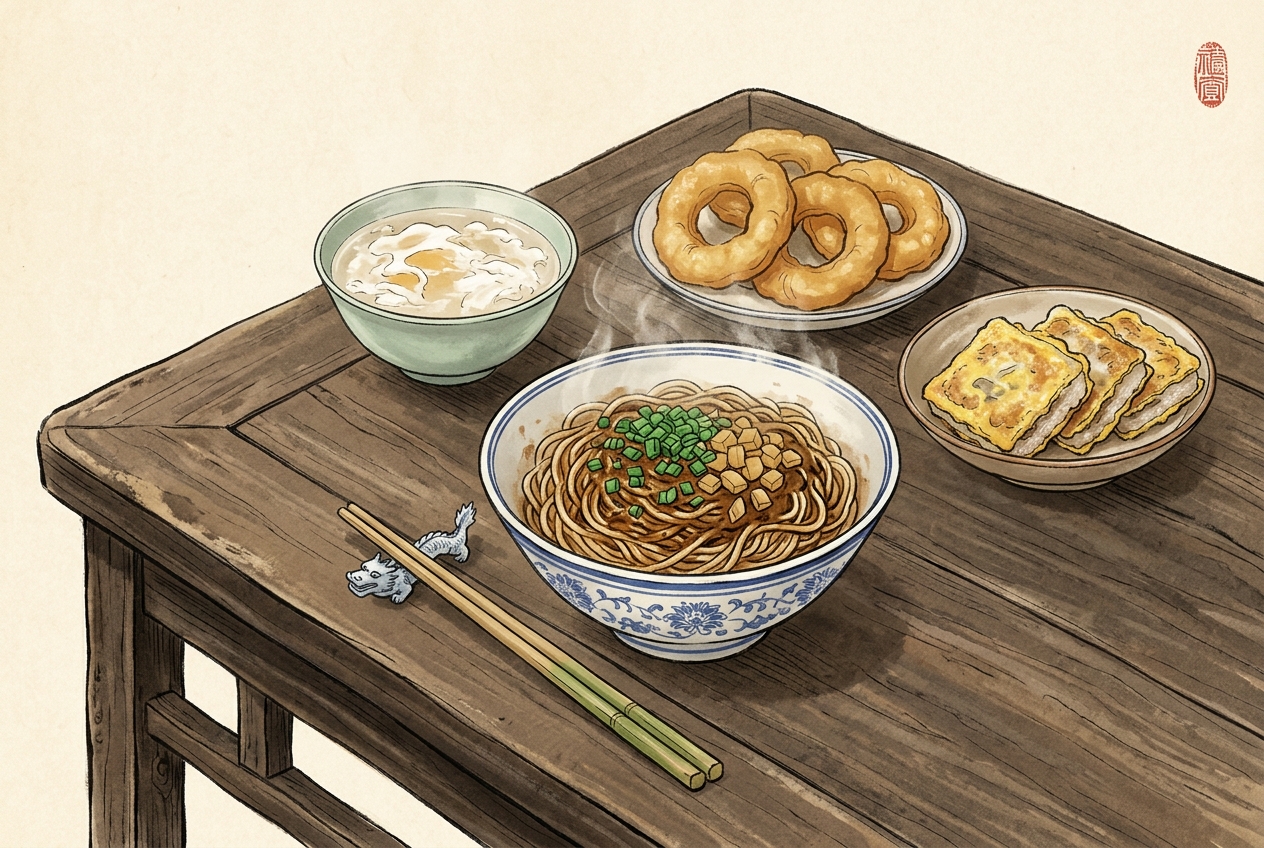
Breaking the Dawn Curfew: Wuhan’s Twenty-Four-Hour Sesame Clock
Nearly every out-of-town travel guide issues the same stern warning to first-time visitors: “Eat your Reganmian before 10:00 AM, because shops sell out and close by noon.” While perfectly true for traditional morning-only neighborhood windows, that advice misses the second half of Wuhan’s circadian rhythm. Once neon signs flicker across Hankou’s colonial facades and midnight settles over the Yangtze bridges, an entirely separate nocturnal universe of Hot Dry Noodles roars to life.
For centuries, Hankou’s river wharves operated on round-the-clock steamer and cargo schedules; night-shift stevedores and disembarking passengers needed hot, substantial fuel at 1:00 AM just as urgently as day laborers did at 6:00 AM. Today, in a sleepless metropolis of over twelve million residents renowned for fiery late-night dining—locally dubbed Xiaoye or Guowan (“celebrating the evening”)—Reganmian bridges the hours between dusk and daybreak without missing a beat.
“Guozao at daybreak drives the wharf; Xiaoye at midnight melts a thousand cares— / So long as the cauldron boils beneath the streetlamp, two liang of sesame paste will see you home.” — Chezhan Road late-night stall proverb
Three Neon Geographies: Jiqing Street, Wansongyuan & Baocheng Road
Follow the unmistakable perfume of roasted sesame paste and sizzling chili oil through Wuhan after midnight, and three distinct late-night ecosystems emerge:
1. Jiqing Street & Chezhan Road: Folk Ballads and Dawn-Closing Legends
Immortalized in Wuhan novelist Chi Li’s acclaimed novella Life Show (Shenghuo Xiu), Jiqing Street transforms after dark into an open-air theater where folk musicians play Hubei drum ballads and accordions tableside. Alongside platters of spicy braised duck necks and pan-fried soup buns, steaming bowls of Reganmian anchor the midnight spread. A ten-minute walk east toward Chezhan Road, Lanling Road, and the Baocheng Road Night Market, cult nocturnal specialists keep their cauldrons rolling strictly from late afternoon until 4:00 AM—most famously Changzi Reganmian (长子热干面) and neighboring corrugated-iron alley stalls (tiepengzi), where night-market shoppers and live-house musicians queue under bare tungsten bulbs at 1:30 AM.
2. Wansongyuan & Enshi Street: The Spicy Crayfish Grand Finale
On sultry summer nights along Hankou’s Wansongyuan (Xuesong Road) or Qingshan’s Enshi Street, thousands of diners pack sidewalk tables for Wuhan’s other culinary obsession: mountains of youmen daxia (thirteen-spice oil-braised crayfish) and cumin-dusted charcoal skewers washed down with icy local lagers. Yet no Wuhan Xiaoye feels complete without a closing carbohydrate curtain call. Revelers either duck into a 24-hour alley noodle shop next door for a fiery, vinegar-brightened bowl of Reganmian, or order a plate of plain, freshly blanched alkaline danmian strands to toss directly into the crimson,roe-infused crayfish sauce left simmering in their wok—an indulgent local mashup where chewy jianshui bounce meets crustacean umami.
3. University Night Markets: Wok-Charred Stir-Fried Reganmian
Around Wuhan’s vast university districts—from Huquan Night Market to Optics Valley—midnight street carts perform a smoky variation rarely seen at breakfast: Tieban Chao Reganmian (铁板炒热干面, Wok- or Griddle-Fried Hot Dry Noodles). Parboiled alkaline strands hit a smoking-hot iron griddle with beaten farm eggs, shredded cabbage, crisp mung-bean sprouts, sour cowpeas, chili flakes, and a thinned splash of sesame-soy glaze. Seared over high flame until edges blister with smoky wok hei, it is the ultimate midnight study fuel.
How Midnight Bowls Differ from Morning Bowls
Make no mistake: a great 1:00 AM bowl of Reganmian is never leftover morning stock reheated. Dedicated nocturnal stalls re-engineer four crucial details to suit the night:
| Culinary Dimension | Dawn “Guozao” Bowl (05:30–09:30 AM) | Midnight “Xiaoye” Bowl (09:30 PM–04:00 AM) | Culinary & Sensory Rationale |
|---|---|---|---|
| Parboiling Schedule | Parboiled (danmian) at 3:30–4:30 AM | Freshly parboiled in a 3:30–4:30 PM evening batch | Fresh oil-tossed noodles lose springiness after ~10 hours; afternoon prep guarantees midnight snap |
| Condiment Balance | Rounded, nutty, sesame-forward; mild to medium heat | Extra toasted chili oil, sharper garlic water & aged vinegar | Cuts through cold beer, barbecue smoke, and late-night palate fatigue |
| Popular Toppings | ~70% classic plain sesame with Mianwo or Danjiu | Braised honeycomb tripe, pork intestines, beef tendon & sliced beef | Midnight diners crave rich, chewy five-spice offal upgrades as celebratory comfort |
| Portion & Soup Side | Standard 2-liang (150g wet noodles) to fuel half a workday | Nimble 1- or 1.5-liang bowls + seaweed egg-drop soup | Satisfies late cravings without uncomfortable pre-sleep heaviness |
2:30 AM Under the Tungsten Bulb: Fueling the Night Watch
Wait past 2:00 AM—after the last crayfish tables clear and neon bar signs dim—and Wuhan’s midnight noodle stalls reveal their quietest, most moving civic role.
Along wide avenues near Machangjiao, Fujiapo, and major municipal hospital emergency wings, a row of mint-green and blue-and-white night-shift taxis pulls smoothly onto the curb alongside designated-driver (daijia) folding e-bikes. Drivers stiff from six hours behind the wheel step into the cool river breeze, stretch their shoulders, and call out familiar shorthand to the husband-and-wife team behind the steam cloud: “Small bowl with braised tripe—extra garlic water, heavy white pepper, and a bowl of seaweed soup!”
Within thirty seconds, strangers from every corner of the nocturnal city sit side by side on low plastic stools: a young emergency-room resident still in scrubs beneath a jacket, an early-morning sanitation worker resting a bamboo broom against a plane tree, a long-haul cold-chain trucker, and veteran cabbies swapping traffic tips. Nobody rushes, and nobody puts on airs. In the quietest hour before dawn, five renminbi buys a steaming bowl of toasted sesame, springy wheat, and garlicky warmth that steadies tired hands and chases chill from the stomach.
By 4:15 AM, as the last night-shift cab clicks its turn signal back into the mist, the midnight vendor wipes down the condiment crocks—just in time to smell fresh sesame oil rising from the Guozao shop awakening three doors down. In Wuhan, the flame beneath the noodle cauldron never truly goes out.
- Chi Li, 'Life Show' (Shenghuo Xiu — Literary Chronicle of Jiqing Street Nightlife), October Literature & Art Publishing House
- Wuhan Municipal Bureau of Commerce, 'Wuhan Nighttime Economy Atlas & Historic Street Culinary Guide'
- Hubei Daily Media Group, 'Twenty-Four Hours in Jiangcheng: 3:00 AM Stallkeepers and Night Voyagers'
❓ Frequently Asked Questions
Isn't Reganmian strictly a breakfast dish? Do Wuhan locals actually eat it past midnight?
Constantly. In Wuhan, 'Guozao' (celebrating the morning) has an equally storied nocturnal twin called 'Xiaoye' or 'Guowan' (celebrating the night). Whether capping off rounds of spicy braised crayfish and cold beer at midnight or fueling taxi drivers and hospital staff at 2:30 AM, freshly blanched Reganmian is a beloved round-the-clock staple.
Does midnight Reganmian taste any different from a 7:00 AM breakfast bowl?
Yes—top nocturnal shops make four deliberate adjustments: they parboil a fresh afternoon batch of alkaline noodles so strands never turn stale; they dial up toasted chili oil, raw garlic water, and rice vinegar to awaken tired or beer-coated palates; they offer nimble 1-to-1.5-liang snack portions; and they feature indulgent braised offal toppings like honeycomb beef tripe and pork intestines.
Where should a visitor go to experience Wuhan's authentic late-night Reganmian scene?
Head to Hankou's classic night triangle: Jiqing Street for open-air folk musicians and heritage snack stalls; Wansongyuan's Xuesong Road to pair spicy crayfish with alley-stall noodles; or the Chezhan Road / Baocheng Road Night Market corridor, home to cult evening-to-dawn institutions like Changzi Reganmian (open roughly 4:00 PM to 4:00 AM).
✦ Cross-Referenced Chapters
Deluxe Toppings Compendium: Sliced Beef, Tripe & Zha Jiang
Expanding beyond classic plain sesame to blanched tender beef, braised honeycomb tripe, beef tendon, and duck-neck dices.
Creative & Low-Calorie Modern Adaptations
Whole-wheat light versions, konjac keto adaptations, chilled summer Reganmian, wok-fried night-market noodles, and fusion buns.
Wuhan "Guozao" Panorama: A Month Without Repeating Breakfast
Origins of the term "Guozao" and how Wuhan’s exuberant morning street-food universe revolves around Hot Dry Noodles.
Flagship Heritage Brands: Cai Lin Ji, Cai Mingwei & Changqing
Detailed profiles of Wuhan’s historic benchmark chains, flagship locations on Jiqing Street, and signature flavor profiles.
Cult Neighborhood Stalls Across Hankou, Wuchang & Hanyang
An insider’s dossier on beloved alley shops—Luo Shi Raw-Blanched Beef, Zhao Shifu Oil-Pie & Reganmian, Changzi, and Xiaoqiu.
Robotic Noodle Kiosks & 24-Hour Smart Stations
Inside Wuhan-engineered 45-second automated blanch-and-sauce robotic arms deployed at high-speed rail hubs and hospitals.
In Writers’ Ink: Chi Li, Yi Zhongtian & Wuhan Literary Prose
Literary close-readings of how celebrated Wuhan novelists and essayists immortalized morning steam and sesame aroma.