Flagship Heritage Brands: Cai Lin Ji, Cai Mingwei & Changqing
From two chinaberry trees on Manchun Street to thousands of storefronts: decoding Wuhan’s benchmark Reganmian dynasties
An authoritative dossier on Wuhan’s defining Reganmian heritage houses and flagship chains—Cai Lin Ji, Cai Mingwei, Changqing Maixiangyuan, Zeng Mazi, and Sanzhen Minsheng Sweet Shop—tracing their lineages, flagship addresses, and distinct sesame paste philosophies.
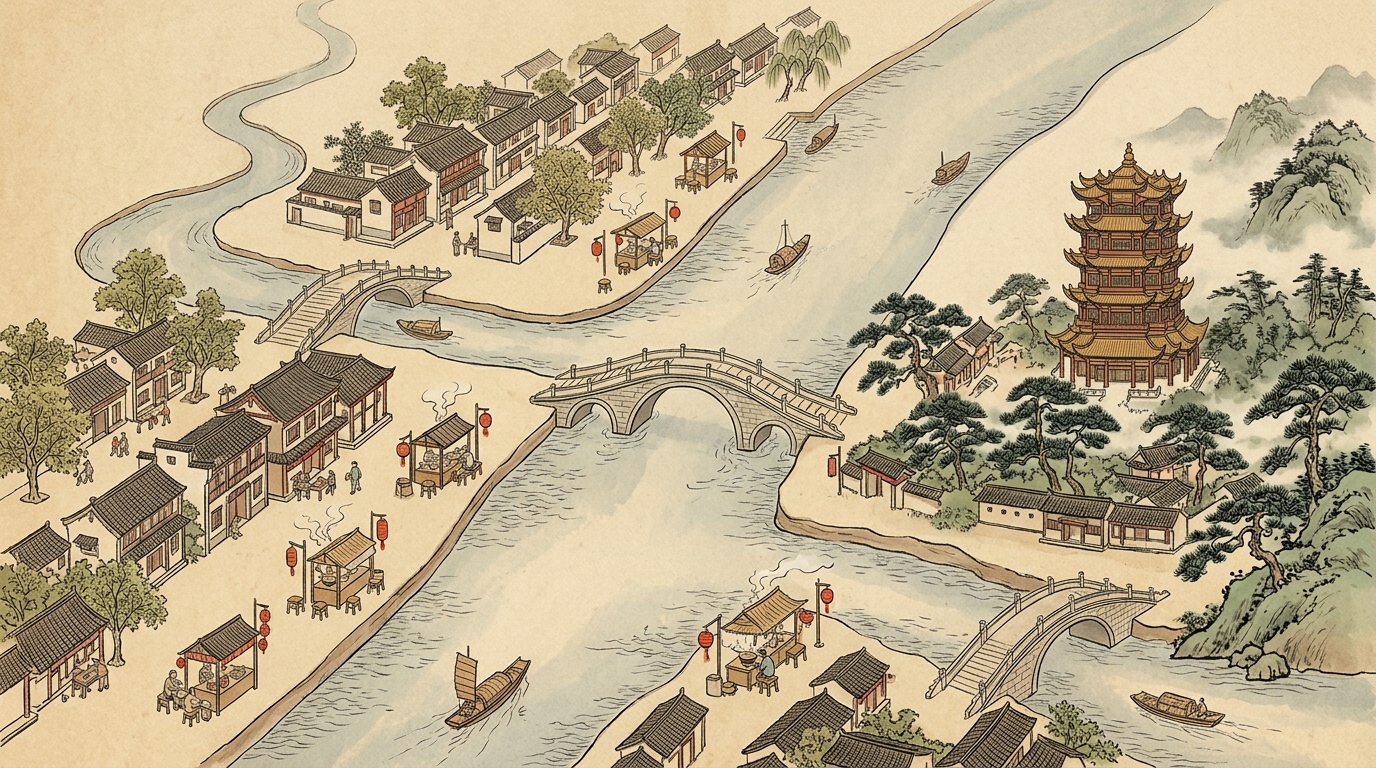
Two Trees Make a Forest: The Birth of a Civic Emblem
To understand how a humble street-peddler’s breakfast bowl evolved into the culinary coat of arms of a twelve-million-person metropolis, one must trace the tangled, resilient family tree of Wuhan’s flagship heritage brands. In the late 1920s, Cai Mingwei—a resourceful young vendor from CaiZhai Township in Huangpi—walked the cobblestone lanes around Hanzheng Street and Changdi Street in Hankou with a wooden shoulder pole, refining parboiled, oil-tossed alkaline noodles dressed in stone-ground sesame paste. When World War II ended in 1945, Cai leased a permanent storefront at the intersection of Manchun Road in Hankou. Two lush chinaberry trees (kulianshu) stood outside his doorway. At the suggestion of a neighborhood scholar, Cai named the shop Cai Lin Ji (蔡林记)—literally “Cai’s Forest Shop”—playing on the visual pun of two wood radicals forming a forest (lin, 林) and the auspicious promise of sweetness emerging after bitter hardship.
Following the state-private joint ownership reforms of 1955, Cai Lin Ji relocated to prime commercial real estate at 854 Zhongshan Avenue opposite the iconic Hankou Water Tower. Throughout the ration-coupon decades of the 1960s through the 1980s, dawn queues outside its steaming cauldron stretched half a block. As market reforms and intangible cultural heritage initiatives reshaped Wuhan’s dining landscape at the turn of the twenty-first century, that single historical trunk branched into four major institutional pillars—Cai Lin Ji, Cai Mingwei, Changqing Maixiangyuan, and Zeng Mazi—flanked by mid-century state-cooperative institutions like Sanzhen Minsheng Sweet Shop.
“Two trees cast their shade across Manchun Lane; a single ladle of roasted sesame anchored a century of mornings.” — Old Hankou Culinary Chronicle
Inside Wuhan’s Five Benchmark Institutions
1. Cai Lin Ji (Jiqing Street Flagship): The Black-Sesame Ambassador
Recognized by China’s Ministry of Commerce as a China Time-Honored Brand (Zhonghua Laozihao) and guardian of Hubei’s provincial intangible cultural heritage designation for Reganmian craft, contemporary Cai Lin Ji serves as Wuhan’s official culinary drawing room. While hundreds of branches operate nationwide, connoisseurs gravitate toward the Jiqing Folk Street Flagship Store (677 Zhongshan Avenue, Jiang’an District, Hankou) and its sister landmark inside Wuchang’s Hubu Alley.
What sets modern Cai Lin Ji apart on the palate is its signature stone-ground black-sesame paste blend. Whereas most neighborhood stalls rely exclusively on hulled white or golden sesame seeds, Cai Lin Ji roasts aromatic Hubei black sesame alongside white sesame to create an obsidian-brown emulsion of remarkable depth and nutty bittersweetness. Ladled generously over springy 1.6-millimeter alkaline strands with crunchy sour long beans, pickled radish dices, and braised beef slices, the dark glossy sauce clings to every noodle. Pairing their Quanliao (all-condiment) bowl with sweet osmanthus fermented rice soup (Humijiu) remains the quintessential initiation for travelers arriving in Hankou.
2. Cai Mingwei: Custodianship of the Golden Original
Why does Wuhan also boast a prominent chain bearing the founder’s personal name, Cai Mingwei (蔡明纬)? The answer lies in the lifelong devotion of the founder’s eldest son, Cai Hanwen (1933–2017). Trained as a sculptor at the Guangzhou Academy of Fine Arts, Cai Hanwen spent his retirement campaigning against commercial shortcuts—such as diluting sesame paste with cheap peanut butter or masking weak flour with synthetic spices—that threatened to erode his father’s craft.
Stores operating under the Cai Mingwei banner strictly codify the pre-1950 family orthodoxy: high-gluten alkaline noodles parboiled to a firm, resilient bite; 100% pure golden-white sesame paste thinned solely with small-mill sesame oil (xiaomo xiangyou); and bright, clean aromatics anchored by freshly crushed raw garlic water, light soy sauce, rice vinegar, and crisp carrot-and-radish dices. Free of heavy star-anise broth or overpowering chili grease, it offers a velvety, purist benchmark of Republican-era Hankou flavor.
3. Changqing Maixiangyuan & Zeng Mazi: Third-Generation Community Titans
In 2009, determined that his family’s techniques belong to the public rather than vanish behind closed doors, Cai Hanwen formally accepted apprentices outside the Cai surname—most notably Li Yajuan, founder of Changqing Maixiangyuan (常青麦香园), and Zeng Fanming, founder of Zeng Mazi (曾麻子热干面).
Originating in Hankou’s sprawling Changqing Garden residential community, Changqing Maixiangyuan revolutionized breakfast logistics by pioneering cold-chain central-kitchen danmian (parboiled oil-tossed wet noodles) delivered before 5:00 AM to hundreds of neighborhood storefronts. Its flavor profile balances fragrant golden sesame paste with a signature bright, mildly fiery chili oil that commuters adore. Fellow apprentice brand Zeng Mazi, founded in 2010 and deeply rooted across Qiaokou and Jianghan districts, leans into old-school Hankou lushness: slightly finer, supple strands lubricated by a spoonful of ten-spice soy braising broth at the bottom of the bowl, allowing the rich sesame paste to coat every strand within five effortless tosses of the chopsticks.
4. Sanzhen Minsheng Sweet Shop: A Living Time Capsule on Shengli Street
No survey of Wuhan’s institutional flagships is complete without Sanzhen Minsheng Sweet Shop (三镇民生甜食馆) at 86 Shengli Street in Jiang’an District, Hankou. Established in the 1950s inside the former Hankou concession quarter, this bustling hall preserves the nostalgic rhythm of mid-century state dining halls: patrons purchase color-coded tokens or slips at the cashier desk before collecting dishes from specialized steam windows. Under one roof, silver-haired locals share tables over classic old-Hankou Reganmian, pan-seared Three-Delicacy Doupi, black-pepper heavy-oil Shaomai, and sizzling Mianwo savory donuts—an unvarnished museum of Guozao biodiversity.
Comparative Matrix of Wuhan’s Heritage & Chain Flagships
| Brand Name | Flagship / Historic Address | Town & District | Sesame Paste Profile | Noodle Texture | Classic Pairing Order |
|---|---|---|---|---|---|
| Cai Lin Ji | 677 Zhongshan Ave (Jiqing St) | Hankou · Jiang’an | Deep ebony roasted black-and-white sesame paste | Medium-thick (1.6mm), glossy & bouncy | Signature Black-Sesame Bowl + Poached Egg Rice Wine |
| Cai Mingwei | Xuesong Rd (Wansongyuan) / Minsheng Rd | Hankou · Jianghan | Pure golden-white stone-ground sesame paste | Firm core, pronounced wheat aroma | Classic Original Reganmian + Thin-Skin Pork Wontons |
| Changqing Maixiangyuan | Changqing Garden / Xinhua Rd | Hankou · Multi-District | Silky golden sesame + fragrant roasted chili oil | Crisp, uniform daily-parboiled bounce | Spicy Sliced Beef Reganmian + Crispy Fried Mianwo |
| Zeng Mazi | Gutian / Beihu Flagships | Hankou · Qiaokou & Jianghan | Amber oil-rich paste + spiced bottom soy broth | Slightly slender, ultra-smooth coating | Traditional Braised-Broth Reganmian + Sweet Rice Soup |
| Sanzhen Minsheng | 86 Shengli St (nr. Hezuo Rd) | Hankou · Jiang’an | Robust old-cooperative dark amber sesame paste | Hand-tossed, hearty & nostalgic chew | Plain Reganmian + Pan-Fried Doupi + Humijiu |
Tasting Protocol: Visiting Flagships Like an Insider
Even at standardized heritage flagships, timing dictates quality. Arrive between 6:30 AM and 9:00 AM, when morning turnover keeps the boiling cauldron crystal-clear—preventing excess dissolved alkali from dulling the noodles’ snap—and the freshly oil-thinned sesame paste sits at peak aromatic emulsion. Step aside from the pickup counter, cradle the grease-proof bowl in your palm, and lift the strands high in rapid crosswise strokes while steam still billows; within seconds, ninety years of Hankou culinary history locks onto every golden strand.
- Wuhan Municipal Gazetteer: Volume of Commerce (Wuhan University Press)
- Ministry of Commerce 'China Time-Honored Brand' (Zhonghua Laozihao) Registry Dossier
- Hubei Daily & Changjiang Daily Oral History Archives on Cai Hanwen and Reganmian Lineage
❓ Frequently Asked Questions
Why do both 'Cai Lin Ji' and 'Cai Mingwei' exist as separate restaurant chains in Wuhan?
Both trace back to founder Cai Mingwei, who opened Cai Lin Ji in 1945. During the 1950s state-private partnership reforms, Cai Lin Ji became a state-owned time-honored enterprise and later modernized into a national chain. Decades later, the founder’s eldest son, Cai Hanwen, guided the launch of the independent 'Cai Mingwei' brand to preserve his father’s original 1940s pure white-sesame family recipe.
Which Cai Lin Ji location offers the best experience for first-time visitors to Wuhan?
The Jiqing Folk Street Flagship Store (677 Zhongshan Avenue, Jiang’an District, Hankou) is widely considered the premier cultural showcase. Surrounded by historic Republican-era arcades and bronze street-musician sculptures, it serves freshly blanched black-sesame Reganmian alongside classic companions like egg rice wine (Danjiu) and three-delicacy Doupi.
How are Changqing Maixiangyuan and Zeng Mazi connected to the Cai family?
Before his passing in 2017, second-generation custodian Cai Hanwen openly mentored dedicated apprentices to safeguard authentic craft. Both Li Yajuan (founder of Changqing Maixiangyuan) and Zeng Fanming (founder of Zeng Mazi) apprenticed under Cai Hanwen around 2009, scaling traditional parboiling and sesame-oil emulsification into beloved community chains.
✦ Cross-Referenced Chapters
Origin Legends: Li Bao & Cai Mingwei Textual Inquiry
Investigating the two foundational 1930s Hankou accounts—street peddler Li Bao on Changdi Street and Cai Mingwei’s Cai Lin Ji.
Genealogy of Time-Honored Brands & Schools
Mapping the historical splits, apprenticeships, and brand evolutions from Cai Lin Ji to Cai Mingwei, Changqing, and Zeng Mazi.
Cult Neighborhood Stalls Across Hankou, Wuchang & Hanyang
An insider’s dossier on beloved alley shops—Luo Shi Raw-Blanched Beef, Zhao Shifu Oil-Pie & Reganmian, Changzi, and Xiaoqiu.
Trademark Chronicles & Collective Geographical Branding
Landmark intellectual-property cases, time-honored trademark stewardship, and building Wuhan Reganmian’s regional brand equity.