100 Questions & Answers: The Definitive Reganmian FAQ
Authoritative Answers Across History, Cereal Chemistry, Home Troubleshooting, Guozao Etiquette, Nutrition, and Wuhan Travel
The flagship synthesis of our searchable Q&A database—debunking top culinary myths and answering essential questions on why Reganmian has no broth, how wheat flavonoids turn yellow without dye, why sesame paste seizes with water, and how to order like a local.
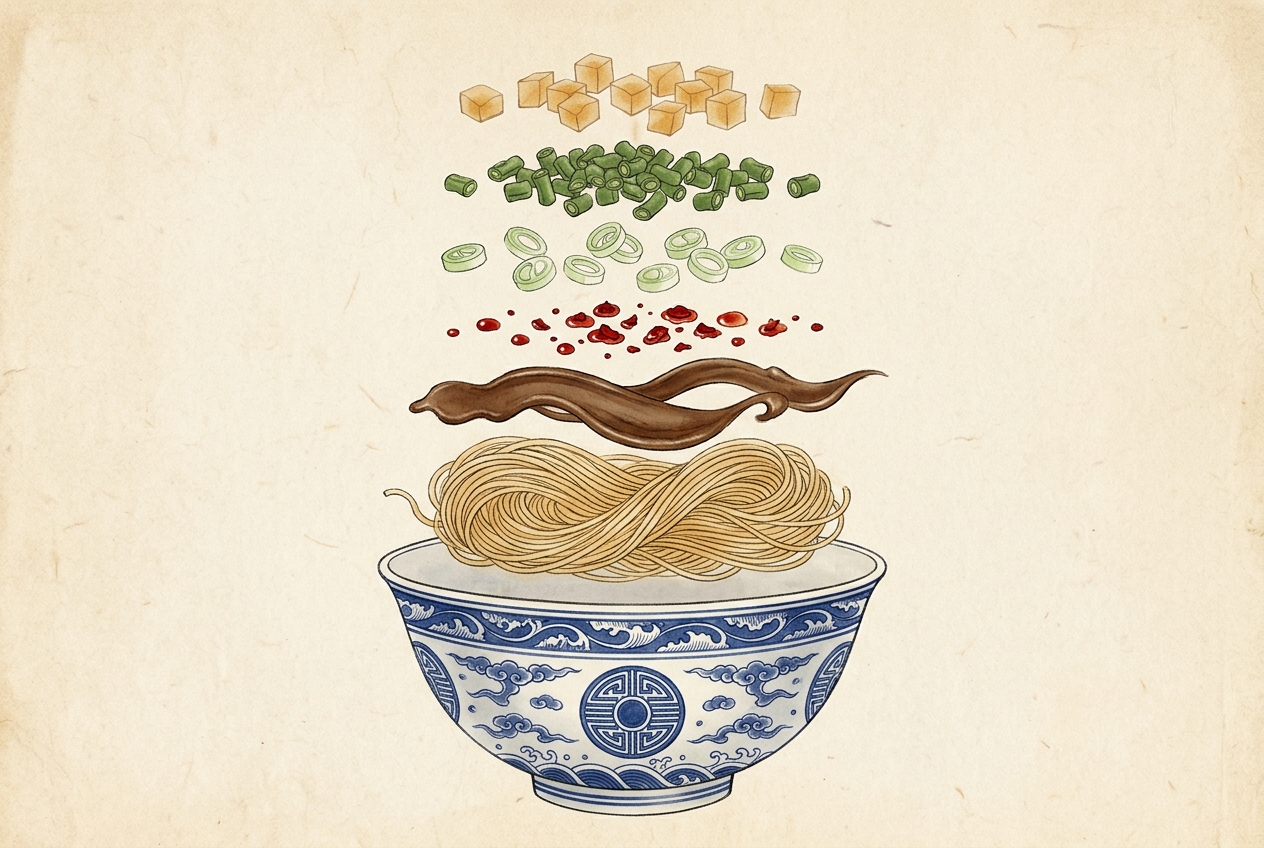
Everyday Marvels: Six Pillars of Reganmian Inquiry
Few dishes on the world stage pack as much historical intrigue and food chemistry into a seventy-five-cent paper bowl as Wuhan Reganmian. First-time visitors wonder how noodles pulled straight from boiling water can emerge completely brothless yet never clump; home cooks puzzle over sesame paste seizing in a mixing bowl; nutritionists marvel at sesame’s extraordinary calcium density.
Serving as the editorial companion to our interactive Q&A database (faq-100.json), this reference chapter opens with a rapid-fire Ten-Myth Scientific Debunking Matrix, followed by curated deep-dives across our six foundational themes.
‘Never underestimate ten seconds in the bamboo basket: wheat turns gold without dye when alkali wakes the grain, and stone-milled sesame hides calcium bone-deep.’ — Rhyme of Reganmian Inquiry
Ten Persistent Myths vs. Culinary & Scientific Reality
| # | Common Misconception | Verified Historical & Food-Science Reality | Governing Discipline |
|---|---|---|---|
| 01 | Yellow strands come from egg yolks or Tartrazine dye | Zero egg, zero dye: natural wheat apigenin flavonoids ionize yellow at alkaline pH ~8.2 | Cereal Pigment Chemistry |
| 02 | Authentic Wuhan sesame sauce is thinned with cold water | Wuhan masters use Youxiejiang: thinning pure paste with 35%–45% toasted sesame oil | Colloidal Rheology |
| 03 | Street stalls still use toxic borax for chewy bounce | Strictly banned decades ago: bounce comes safely from ≥30% wet-gluten flour + $\text{Na}_2\text{CO}_3$ | GB 2760 Food Safety Law |
| 04 | You can boil raw noodles once to 100% and toss with paste | Requires two-stage Danmian parboiling + 8s blanching, or surface starch turns to glue | Starch Gelatinization Kinetics |
| 05 | Reganmian is ‘empty carbs’ with negligible micronutrients | Pure sesame paste packs ~1,170mg calcium/100g, plus sesamin lignans & unsaturated fats | Micronutrient Analysis |
| 06 | Locals routinely eat Reganmian inside Wuhan subway cars | Banned under Wuhan Metro bylaws: sidewalk plastic stools are the proper arena | Urban Transit Sociology |
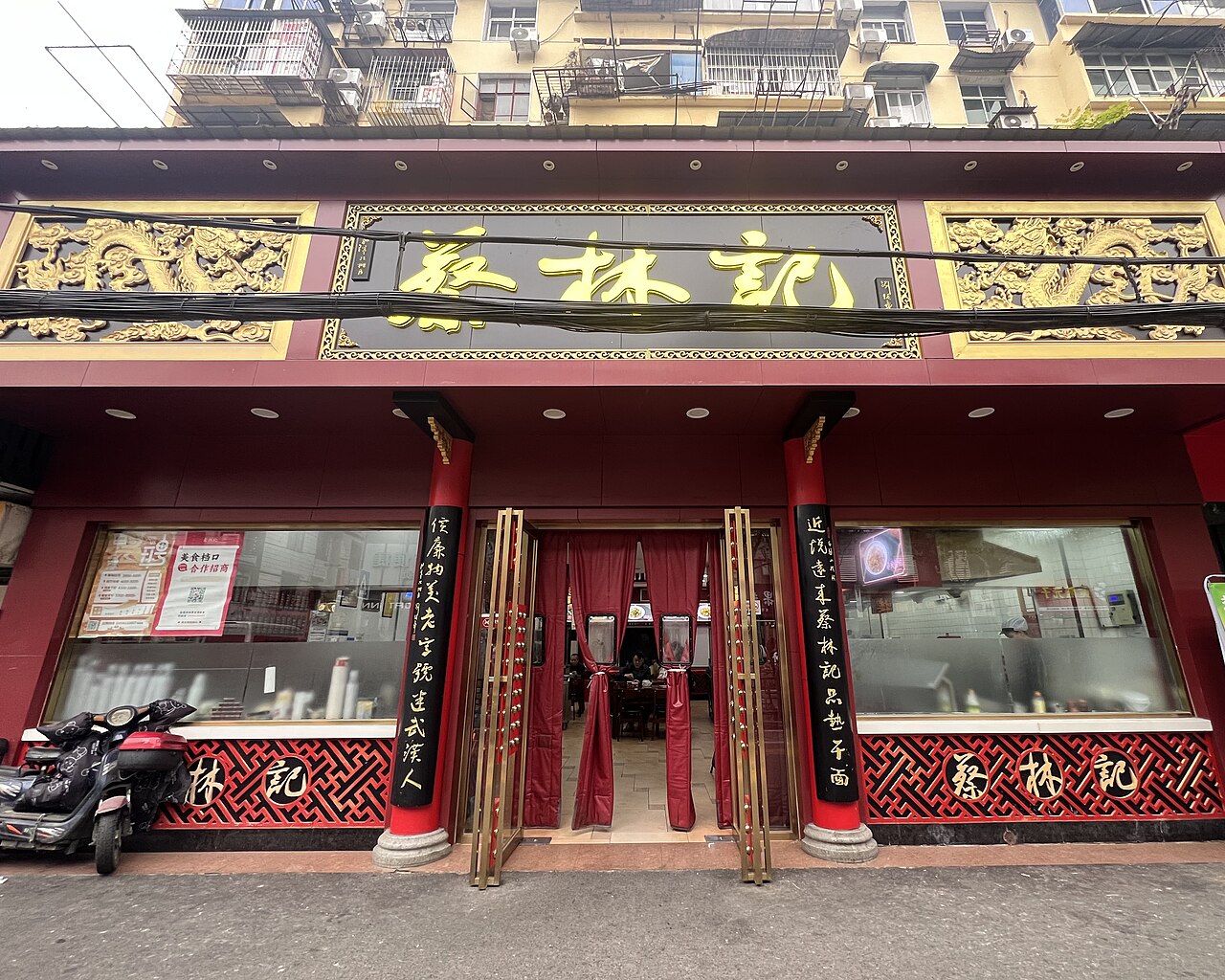
| 07 | ‘Cai Lin Ji’ was founded by partners surnamed Cai and Lin | Solely Cai Mingwei: named Lin (‘grove’) after two chinaberry trees outside his 1928 shop | Commercial Historiography |
| 08 | Shelf-stable wet pouches rely on heavy chemical preservatives | Powered by hurdle technology: mild lactic acid pH tuning, pasteurization & $\text{N}_2$ barrier film | Food Preservation Engineering |
| 09 | Sesame paste is the main culprit behind high sodium | Pure sesame paste is virtually sodium-free: 90% of sodium sits in soy broth & cured pickles | Clinical Dietetics |
| 10 | Reganmian disappears completely after 10:00 AM | Available 24/7: midnight icons like Changzi on Cheshan Rd serve night-shift Wuhan | Nighttime Culinary Geography |
Curated Deep-Dives Across Six Thematic Domains
I. Origins & Heritage: Two Founders and a 1850 Word
- Q: Who deserves credit for inventing Reganmian—peddler Li Bao or Cai Lin Ji founder Cai Mingwei? A: Municipal chronicles recognize a two-step genesis in 1930s Hankou. Along bustling Changdi Street, noodle peddler Li Bao accidentally splashed sesame oil onto parboiled leftover noodles to keep them from souring overnight, discovering an aromatic hit when re-blanched the next morning. Nearby at Manchun Road, Cai Mingwei systematically engineered the alkaline Danmian parboiling workflow, ten-spice lushui reduction, and stone-milled sesame formula—elevating a fortunate street accident into a codified Provincial Intangible Cultural Heritage craft (inscribed June 2011).
- Q: Why do Wuhanites say Guozao (‘celebrating the morning’) instead of ‘eating breakfast’? A: First attested in Ye Diaoyuan’s 1850 Hankou Bamboo-Branch Lyrics (‘Hold off combing your hair—first celebrate Guozao, swallowing glutinous cakes and fried dumplings together’), the verb guo places morning street dining on the same festive linguistic plane as celebrating Lunar New Year (guonian).
II. Ingredients & Home Kitchen Rescue: Mastering Alkali & Emulsion
- Q: How do I recreate alkaline chew in London, New York, or Sydney without a Wuhan wet-noodle factory nearby?
A: Reach into your pantry for baking soda ($\text{NaHCO}_3$). Dissolve
5g(1 tsp) baking soda per liter of boiling water—heat drives off $\text{CO}_2$ and converts bicarbonate into genuine alkaline sodium carbonate ($\text{Na}_2\text{CO}_3$). Boil high-protein round dried wheat or ramen noodles to 80% doneness (a tiny white dot left in the center), drain under a cool fan while tossing with1 tbsptoasted sesame oil, then flash-blanch for 10 seconds right before serving. - Q: Why must a hot bowl be tossed within 30 seconds, and how can I fix a bowl that cooled and clumped?
A: At
85°Cout of the cauldron, heat drops sesame-paste viscosity by over 40%, allowing rapid upward-and-downward emulsification with the20mlof bottom soy broth and garlic water. Wait two minutes for photos and cooling starch sets like mortar. Never add cold tap water to rescue a stiff bowl—splash in a teaspoon of hot noodle-boiling water, warm broth, or aged rice vinegar and lift briskly with chopsticks.
III. Culture, Nutrition & Street Savvy
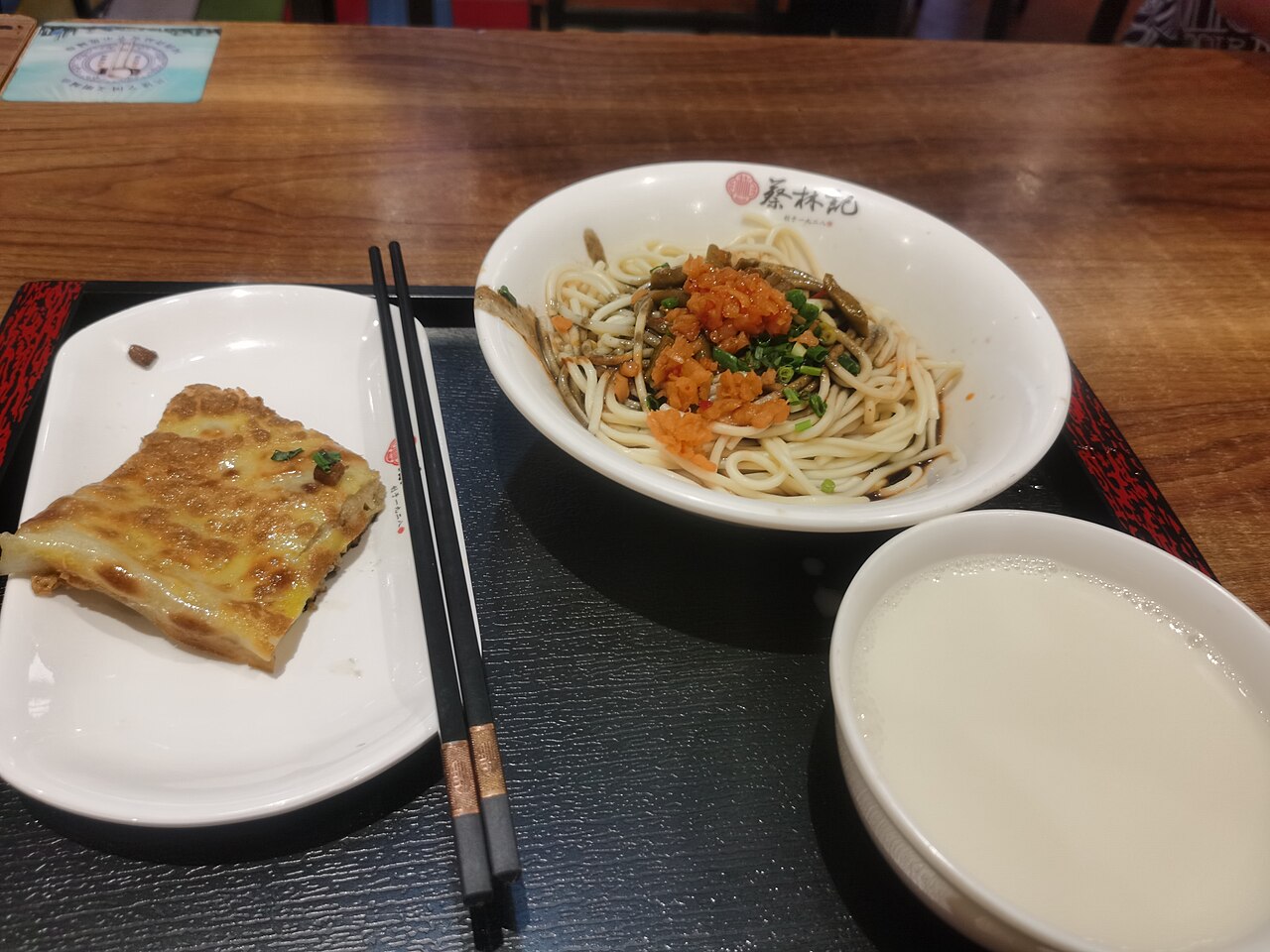
- Q: Why is Danjiu (Egg Rice Wine) considered mandatory beside a bowl of Reganmian? A: Sensory counterpoint. After rich, roasted sesame lipids coat the tongue, a warm bowl of boiling-water-poached egg ribbons swirled with sweet Xiaogan fermented glutinous rice wine gently washes the palate clean—while tearing pieces of a crispy fried Mianwo donut to mop up the last streaks of sauce in your paper bowl ensures zero flavor stays behind.
- Hubei Provincial Food Safety Standard DBS42/005: Wuhan Reganmian (Convenient Type)
- China Food Composition Tables (6th Standard Edition), Peking University Medical Press
- Ye Diaoyuan, Hankou Bamboo-Branch Lyrics (1850) & Wuhan Municipal Commercial Chronicles
❓ Frequently Asked Questions
Why is it called 'Hot Dry Noodles' if it is plunged into boiling water and dressed with liquid sauces?
'Hot' refers to the 6-to-10-second flash-blanch in rolling 98°C water right before serving, while 'Dry' distinguishes it from Chinese broth noodles: vigorous wrist-shaking expels free water, and zero soup is ladled into the bowl so oil-thinned sesame paste and spiced soy essence cling tightly to every strand.
Are Reganmian noodles yellow because of egg yolks or yellow food coloring?
Neither! Authentic Wuhan alkaline noodles contain no egg and zero synthetic dye. Wheat flour naturally contains colorless flavonoid compounds (apigenin glycosides) that ionize in the mildly alkaline environment created by food-grade sodium carbonate, turning a luminous golden yellow.
Why does pure sesame paste suddenly turn into a stiff, chalky lump when I add a splash of water?
You are witnessing colloidal phase inversion: stone-ground sesame paste is a suspension of roasted solids in continuous sesame oil. A small splash of water hydrates proteins into rigid bridges that seize the paste; Wuhan masters bypass this entirely by thinning exclusively with 35%–45% toasted sesame oil.
How many calories are in a standard bowl of Reganmian, and can weight-conscious diners enjoy it?
A standard 2-liang plain bowl (~225g) contains roughly 520–620 kcal. Because 80%-parboiled high-gluten strands and sesame lipids slow gastric emptying, its glycemic curve is gentler than white soup noodles. For a ~395 kcal bowl, order a 1.5-liang portion with half paste, extra rice vinegar, and blanched greens.
Can visitors eat a bowl of Reganmian aboard the Wuhan Metro?
Strictly no! While 1990s urban folklore celebrated commuters balancing bowls on lurching city buses, Wuhan Metro regulations ban eating and drinking inside train cars—and pungent garlic-sesame steam lingers in air-conditioned cabins. Enjoy your bowl on a sidewalk plastic stool before entering the station.
What is the best way to bring authentic neighborhood-stall Reganmian home to another city?
Never pack blanched, sauced noodles for long trips. Instead, ask your favorite stall for unblanched oil-tossed fresh Danmian noodles with house sesame paste, ten-spice soy broth, and pickled radish sealed in separate containers—then blanch for 10 seconds in boiling water at home.
✦ Cross-Referenced Chapters
Origin Legends: Li Bao & Cai Mingwei Textual Inquiry
Investigating the two foundational 1930s Hankou accounts—street peddler Li Bao on Changdi Street and Cai Mingwei’s Cai Lin Ji.
Secrets of Alkaline Noodles (Jianshuimian)
High-gluten flour specifications, sodium carbonate ratios, 1.8mm round strand geometry, and signature springy chew.
The Core Art of "Danmian": Parboiling & Oil-Tossing
Step-by-step mastery of 80%-cooked boiling, fan-cooling, and sesame-oil tossing that keeps alkaline noodles springy for hours.
Troubleshooting 20 Common Mistakes & Master Proverbs
Fixing clumpy strands, bitter alkali aftertaste, broken oil-separated sesame paste, and overly dry bowls.
Caloric & Macronutrient Breakdown by Component
Exact kilocalorie, carbohydrate, protein, lipid, and sodium tables for standard 2-liang plain and beef-topped bowls.
Official Technical Standards: Hubei DB42 Specifications Decoded
Key physicochemical, moisture, alkalinity, and sesame purity benchmarks codified in Hubei’s official regional standards.