Crispy Companions: Mianwo Savory Donuts, Jiguanjiao & Sesame Balls
From an 1880s Blacksmith's Concave Iron Ladle to the Sacred Ritual of Mopping Up Sesame Sauce
Uncovering the late-Qing invention of Wuhan's wheat-free rice-and-soybean donut (Mianwo) by Hanzheng Street peddler Chang Zhiren, the insider street ritual of tearing hot Mianwo to sweep leftover sesame paste from a Reganmian bowl, and Wuhan's wider deep-fried breakfast pantheon.
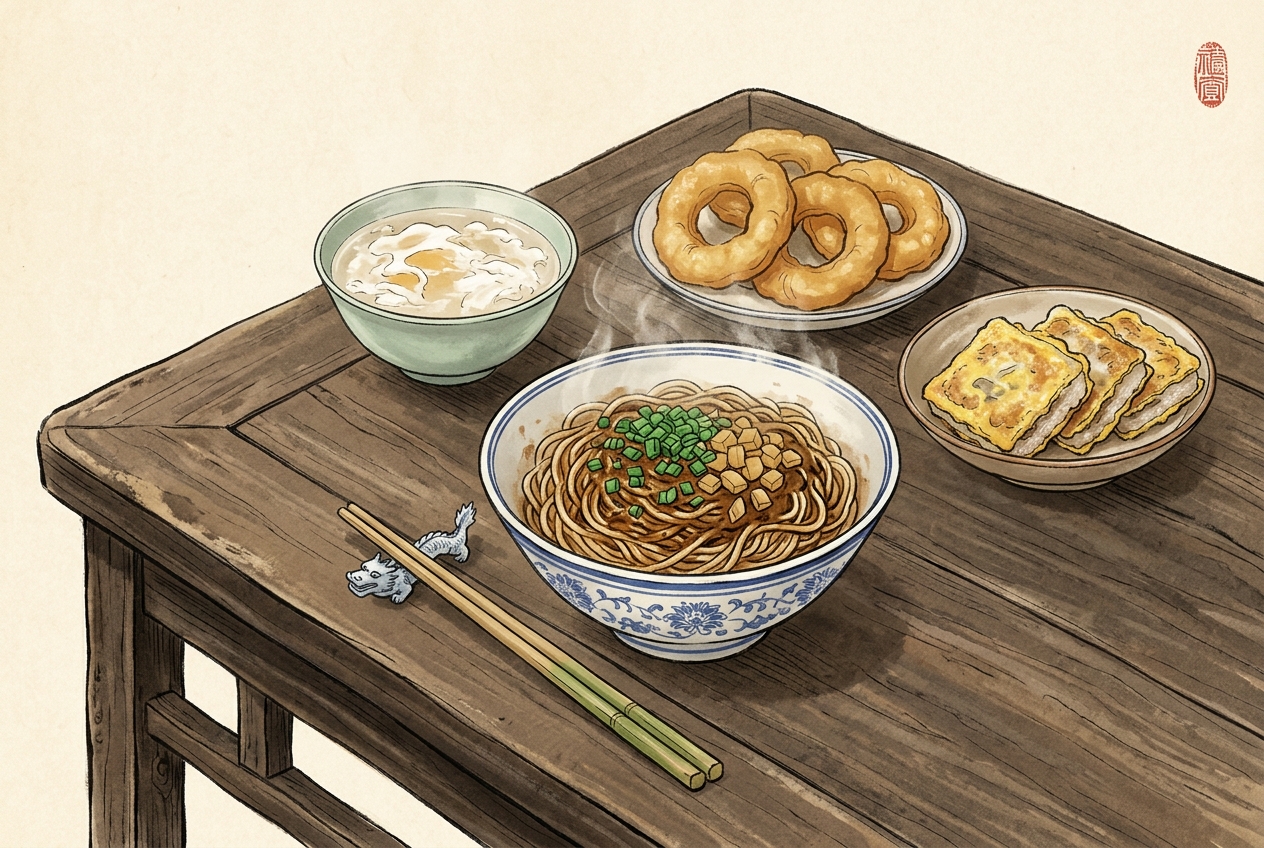
An Iron Ladle on Hanzheng Street: Chang Zhiren and the Wheatless Donut
Walk past any bustling Reganmian storefront in Wuhan at 6:30 AM, and right beside the roaring noodle cauldron you will hear its acoustic partner: the rhythmic, fragrant sizzle of golden rapeseed oil. Behind the wok stands an artisan wielding a long-handled, soot-seasoned iron ladle. With a flick of the wrist, milky-white batter fills the ladle, a quick scrape clears a breathing hole in the center, and the iron plunges into 180°C oil. Forty seconds later, out slides a halo of burnished gold—thick and pillowy around its outer tire, paper-thin and lacy around its inner hole. This is Mianwo (面窝), Wuhan’s beloved savory breakfast ring and Hot Dry Noodles’ oldest fried companion.
Predating Reganmian by roughly half a century, Mianwo was born during the Qing Guangxu era (1875–1908) near the Jijiazui river wharves of Hankou’s Hanzheng Street. Dozens of busy rice-polishing mills lined the汉水 riverbank, generating heaps of inexpensive broken rice (suimi). A struggling sesame-flatbread vendor named Chang Zhiren (昌智仁) set out to turn those humble broken grains into an affordable dockworker snack. Pure rice batter fried up dense and flinty, so Chang experimented until he unlocked a golden ratio: soaking late-harvest indica rice with whole yellow soybeans at roughly 7:3, stone-grinding them into a velvety slurry, and folding in minced ginger, green scallions, salt, and roasted black sesame seeds. Soybean lecithin and proteins trapped microscopic steam pockets during frying, yielding an airy crumb and rich umami depth.
Equally ingenious was Chang’s hardware. Collaborating with a Hanzheng Street blacksmith, he commissioned a 13-centimeter round iron ladle engineered with a sunken outer trough and a raised central dome. When batter filled the ladle, gravity pooled a thick ring around the rim while leaving only a gossamer film across the center hump. Lowered into hot oil, a single fritter delivered two diametrically opposed textures: an outer collar (kuangkuang) that chewed spongy and savory, framing an inner lacy web (woxin cui) that shattered like salted glass. Though Chang originally christened his creation Miwo (“rice nest”), Hankou dialect slurred its puffy silhouette into Mianwo (“flour nest”)—immortalizing a wheat-free masterpiece under a wheat-lover’s name.
Over the decades, Wuhan street cooks riffed brilliantly on Chang’s ladle: autumn and winter bring Shao Mianwo (苕面窝), studded with sweet red-fleshed sweet potato cubes that caramelize at the edges; summer and fall bring Ou Mianwo (藕面窝), packed with crunchy Hubei lotus-root dices; and riverside stalls fry bite-sized Coin Mianwo and umami-packed Shrimp Mianwo.
Carb-on-Carb Nirvana: Tearing Mianwo to Sweep the Bowl
To a modern macro-counter, pairing deep-fried rice-and-soybean rings with sesame-dressed alkaline wheat noodles looks like audacious carbohydrate doubling. To a Wuhan native, however, eating Reganmian without Mianwo leaves an unfinished symphony at the bottom of the bowl.
Every properly dressed bowl of Reganmian relies on generous sauce ratios so that not a single strand goes dry. Once the last noodle has been slurped up, the bottom of the grease-proof paper bowl inevitably holds fifteen to twenty grams of concentrated culinary gold: stone-ground sesame paste emulsified with small-mill sesame oil, ten-spice star-anise soy broth, garlic water, chili oil, and stray jewels of crunchy pickled Huangpi radish and sour cowpeas.
“Never toss the bowl when the noodles are gone— / Tear up a hot Mianwo and scrub the bottom clean; / Once the crispy ring drinks up the sesame sauce, / Even immortals in heaven lean over the clouds.” — Wuhan street-stall proverb
Here unfolds Wuhan’s most satisfying insider ritual. Diners first nibble away the fragile, salty inner lace of a piping-hot Mianwo, then tear its airy, honeycomb-pored outer ring into thumb-sized chunks and drop them straight into the leftover sauce pool. Pressed and swirled with chopsticks, the torn rice-soybean sponge drinks up every drop of nutty sesame emulsion and spicy卤水 braising juice. Each bite detonates in layers: toasted rapeseed crust, roasted black sesame, creamy tahini-like depth, and a final bright crunch of pickled radish. When the diner stands up, the inside of the paper bowl gleams nearly spotless.
The Extended Golden Fryers: Jiguanjiao, Huanxituo & “Chickenless” Nuomiji
Sharing the morning oil cauldron with Mianwo are three fellow golden heavyweights that frequently join Reganmian on family breakfast tables across Hankou, Wuchang, and Hanyang:
1. Jiguanjiao (鸡冠饺 — Savory Cockscomb Fried Dumplings)
Crafted from traditional sourdough-starter wheat dough (laomian), Jiguanjiao is rolled into palm-wide rounds, stuffed with juicy minced pork, scallions, and sometimes glass vermicelli, and crimped along its curved edge into dramatic pleats resembling a rooster’s comb (jiguan). Dropped into wide woks of hot oil, yeast gases inflate the pocket into a golden half-moon the size of an outstretched hand—blistered and crisp outside, cloud-chewy and pork-perfumed within.
2. Huanxituo (欢喜坨 — Hollow Sesame Balls of Joy)
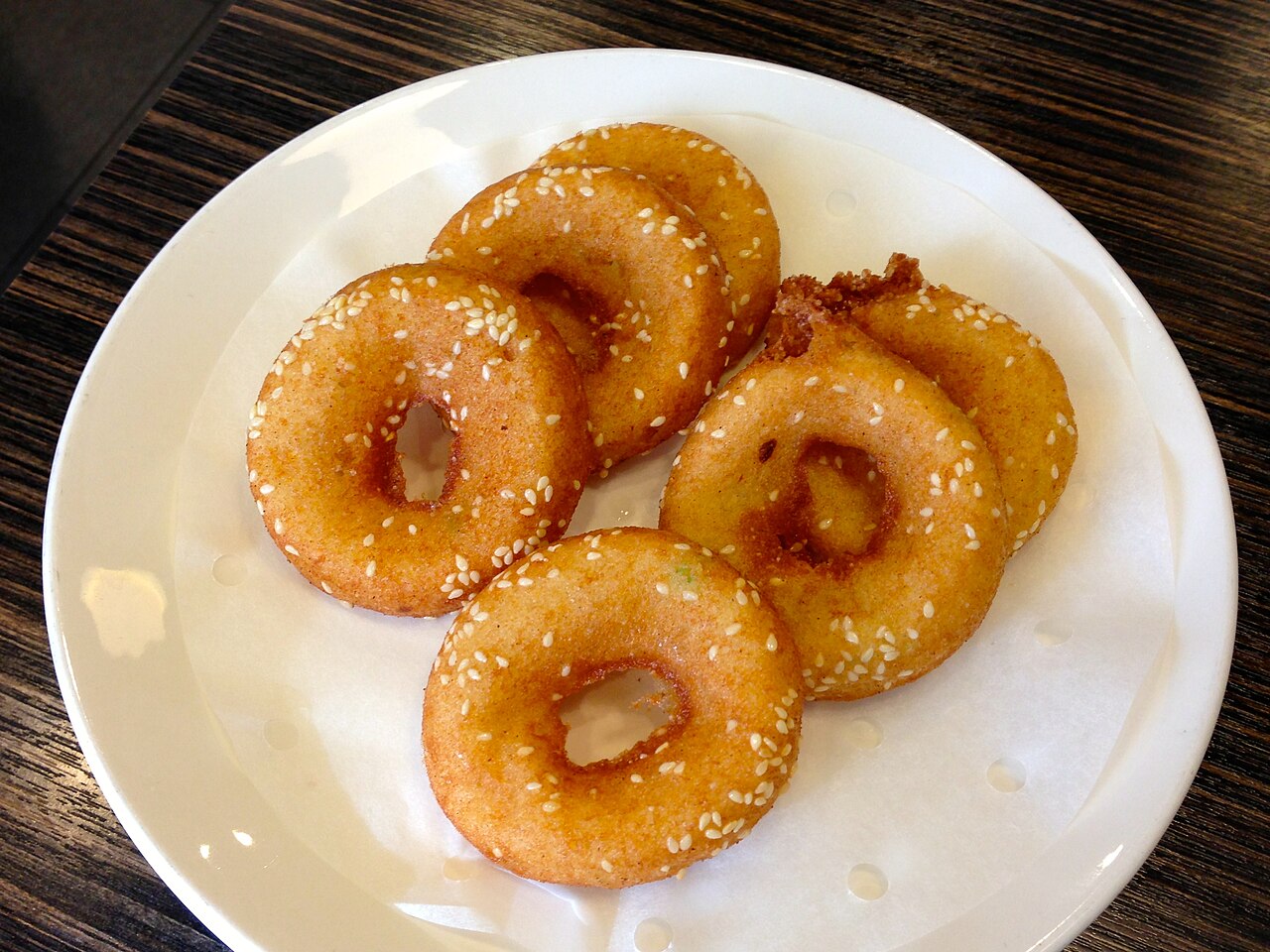
Known elsewhere in China as ma球 or matuan, Wuhan’s version carries the jubilant dialect name Huanxituo (“Balls of Delight”). Water-milled glutinous rice dough is wrapped around sweet red-bean or black-sesame paste, rolled in snow-white hulled sesame seeds, and lowered into moderate oil. Using the back of a slotted ladle, the cook rhythmically presses and rotates each sphere (manhuo qin’an) as internal steam expands it into a hollow, fist-sized golden orb—a festive sweet finale after extra-spicy Reganmian.
3. Wuhan Nuomiji (糯米鸡 — Peppery Fried Sticky-Rice Rounds)
Unwary travelers expecting Cantonese lotus-leaf chicken parcels are in for a delightful surprise: Wuhan’s Nuomiji contains zero chicken. Steamed glutinous rice is wok-tossed with savory soy sauce, diced fatty pork, shiitake mushrooms, spiced firm tofu, bamboo shoots, and an assertive punch of coarse black pepper, then compacted into fist-sized balls, dipped in a whisper-thin wheat batter, and deep-fried. As moisture flashes off, the golden batter puckers into tiny crispy bumps that bear an uncanny resemblance to fried chicken skin—hence its affectionate street nickname.
Field Guide to Wuhan’s Deep-Fried Guozao Companions
| Fried Specialty | Base Batter / Dough & Filling | Signature Geometry | Texture & Flavor Profile | Best Pairing Strategy with Reganmian |
|---|---|---|---|---|
| Classic Mianwo | Stone-ground indica rice + yellow soybeans + ginger, scallion, black sesame | Golden ring: thick airy rim, ultra-thin lacy center hole | Savory, nutty, crisp-meets-spongy | Tear the thick outer ring to mop up leftover sesame paste at the bottom of the bowl |
| Shao Mianwo | Diced red sweet potato bound in lightly salted rice-flour batter | Craggy golden ring of caramelized sweet potato cubes | Crispy salted edges around molten, honey-sweet tubers | Alternate bites with extra-spicy chili Reganmian to cool capsaicin heat |
| Jiguanjiao | Yeast-leavened wheat dough stuffed with minced pork & scallions | Giant pleated half-moon shaped like a rooster’s comb | Blistered crisp crust, chewy sourdough crumb, savory pork juice | Ultimate high-energy pairing alongside plain Reganmian for long walking days |
| Huanxituo | Glutinous rice dough + sweet bean/sesame paste + white sesame crust | Large, hollow, spherical golden orb | Shattering toasted-sesame shell, stretchy mochi-like interior | Enjoyed last as a sweet dessert chaser with hot soy milk or Danjiu |
| Wuhan Nuomiji | Steamed sticky rice + diced pork, mushroom, tofu & black pepper | Bumpy, golden-battered savory sphere (contains no poultry) | Thin “chicken-skin” crunch yielding to peppery, unctuous rice | Beloved winter companion alongside beef Reganmian or radish beef soup |
- Wuhan CPPCC Historical Accounts Committee, 'Wuhan Wenshi Ziliao: Old Hankou Folkways' (Origins of Mianwo)
- Hubei Provincial Department of Commerce, 'Illustrated Compendium of Traditional Chucai Snacks'
- Wuhan Local Chronicles Committee, 'Annals of Wuhan: Traditional Breakfast Specialties'
❓ Frequently Asked Questions
Why is Wuhan's iconic savory ring called 'Mianwo' ('flour nest') if it contains no wheat flour?
Invented in the late Qing Dynasty near the rice mills of Hanzheng Street, peddler Chang Zhiren ground broken indica rice with yellow soybeans into a savory batter. He originally named his ring-shaped fritter 'Miwo' ('rice nest'), but because its puffy golden rim resembled leavened wheat bread—and 'mi' and 'mian' blurred in rapid Hankou street cries—locals canonized it as 'Mianwo'.
How does a single Mianwo achieve both soft-chewy and shatteringly crisp textures at once?
The secret lies in the specialized iron ladle's topography: a deep circular moat around the perimeter and a convex dome in the center. Thick batter pooling in the outer moat puffs into a pillowy, soybean-aerated ring ('kuangkuang'), while the thin film draped over the central dome fries into a lacy, blistered wafer ('kibian') that shatters on contact.
Why do Wuhan locals order deep-fried Mianwo alongside already calorie-rich Reganmian?
Beyond textural contrast—blistered crunch against springy noodles—a finished bowl of Reganmian always leaves behind a prized pool of emulsified sesame paste, spiced soy broth, chili oil, and diced pickled radish. Tearing porous Mianwo into chunks to wipe that bowl spotless is Wuhan's ultimate 'carb-on-carb' morning ritual.
✦ Cross-Referenced Chapters
Soul of the Bowl: Stone-Ground Sesame Paste Craft
Low-temperature roasting, stone-mill grinding, and the great culinary debate between 100% pure sesame vs. 80/20 sesame-peanut blends.
Scallions, Garlic Water & Secret Spiced Braising Broth
Uncovering the hidden umami backbone: raw crushed garlic infusion and ten-spice star-anise soy broth at the bottom of the bowl.
Wuhan "Guozao" Panorama: A Month Without Repeating Breakfast
Origins of the term "Guozao" and how Wuhan’s exuberant morning street-food universe revolves around Hot Dry Noodles.
The Guozao Triad: Reganmian, Three-Delicacy Doupi & Peppery Shaomai
How glutinous-rice Doupi pan-squares and black-pepper pork Shaomai join Reganmian as Wuhan’s morning trinity.
Six Old-Alley Guozao Citywalk Trails
Turn-by-turn morning walking itineraries through Shanhaiguan Road, Liangdao Street, Dacheng Road, Meigui Street, and Lanling Road.
Caloric & Macronutrient Breakdown by Component
Exact kilocalorie, carbohydrate, protein, lipid, and sodium tables for standard 2-liang plain and beef-topped bowls.