The Guozao Triad: Reganmian, Three-Delicacy Doupi & Peppery Shaomai
Alkaline Wheat, Mung-Bean Golden Crusts, and Lard-Rich Black-Pepper Sticky Rice—Wuhan's Morning Trinity
Examining Wuhan's celebrated 'Three Heavenly Kings of Guozao'—Hot Dry Noodles, Lao Tongcheng's pan-seared Three-Delicacy Doupi (1929), and Shunxiangju's heavy-oil black-pepper Shaomai (1932)—alongside the modern street sensation of stuffing hot Shaomai inside crispy fried dough pies.
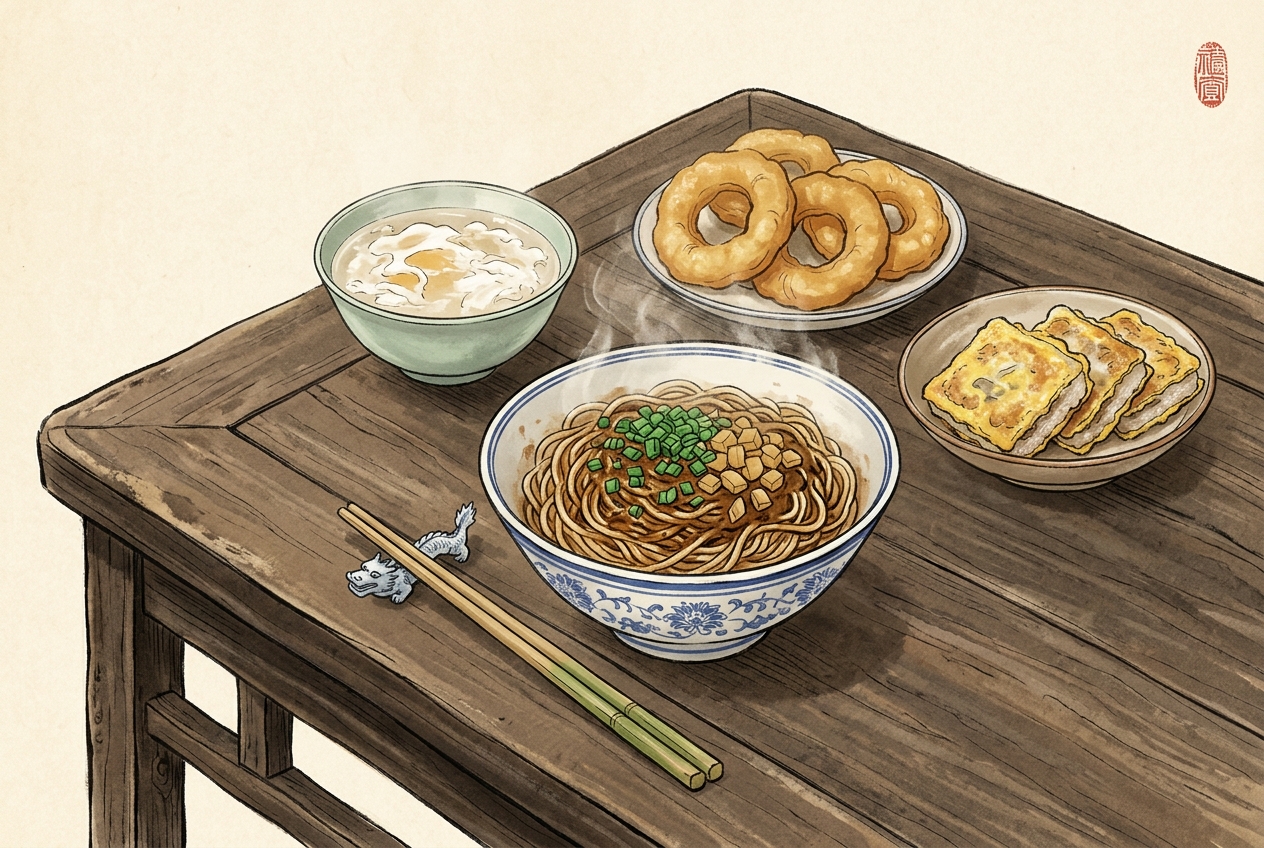
Three Stars Over 1930s Hankou: Birth of the Morning Trinity
Few cities on earth witnessed a culinary burst quite like Hankou between 1929 and 1932. Within a two-mile radius of the customs house clock tower—where foreign river steamers, rail termini, and native guildhalls converged—three street-food masterpieces achieved their definitive modern forms almost simultaneously: Lao Tongcheng’s Three-Delicacy Doupi on Dazhi Road (1929), Cai Lin Ji’s Reganmian near Changdi Street and Manchun Road (c. 1930), and Shunxiangju’s Heavy-Oil Shaomai on Hualou Street (1932).
Nearly a century later, locals revere this triumvirate as the Three Heavenly Kings of Guozao (Guozao Sanda Tianwang). While a solo commuter rushing to catch the metro will happily grab a quick paper bowl of Reganmian, weekend family outings and homecomings call for the full Three-King Morning Banquet: a shared bowl of Reganmian for nutty chew, a golden platter of Sanxian Doupi tiles for savory crispness, and a bamboo basket of glistening Zhongyou Shaomai accompanied by sweet Danjiu or Humijiu. Together, wheat, mung bean, and glutinous rice form an interlocking portrait of Hubei’s agricultural abundance.
“Cai Lin Ji’s alkaline strands, Lao Tongcheng’s golden crust, Shunxiangju’s peppered lard purses— / Set all three upon the morning table, and no banquet hall in the nine provinces can rival it.” — Republican-era Hankou Zhongshan Avenue diner’s saying
Armor of Mung Bean and Gold: Lao Tongcheng & Three-Delicacy Doupi
Despite its English literal translation (“bean skin”), Sanxian Doupi (三鲜豆皮) is neither tofu skin nor a simple crepe—it is an architectural pan-seared gratin of mung-bean batter, fresh egg, glutinous rice, and savory ragout. Rural Hubei families had long celebrated winter festivals by spreading rice-and-bean batters on iron griddles, but in 1929, Hanyang entrepreneur Zeng Houcheng opened a modest eatery outside Hankou’s Dazhi Gate that became Lao Tongcheng (老通城). Following World War II in 1946, Zeng recruited master chef Gao Jin’an (高金安), whose meticulous refinements earned him the lifelong title “King of Doupi” (Doupi Dawang). After Mao Zedong dined twice at Lao Tongcheng in 1958 to praise its golden squares, a saying swept China: “Until you have tasted Lao Tongcheng, you have not truly arrived in Wuhan.”
Watching a master execute a full pan of Sanxian Doupi in an eighty-centimeter, forty-kilogram flat cast-iron skillet is breathtaking street choreography:
- The Golden Shell: Husked green mung beans and early-harvest indica rice are soaked and stone-ground into a pale jade batter. Ladled onto the smoking-hot skillet and swept razor-thin with a bamboo scraper, the crepe is immediately brushed with half a dozen beaten farm eggs, baking into a fragrant, marigold-yellow skin.
- The Sticky-Rice & Three-Delicacy Core: Steamed, glistening white glutinous rice isblanketed evenly across the egg crepe, crowned with a generous ladle of braised Sanxian Saozi (“Three Fresh Delicacies”): finely diced pork shoulder, winter shiitake mushrooms, and crisp bamboo shoots (often joined by spiced firm tofu dices, sweet green peas, or freshwater shrimp).
- The Mid-Air Flip: Melted pork lard is drizzled around the skillet’s rim (liuyou) so the underlying egg-and-bean crust fries shatteringly crisp while savory meat juices baste the sticky rice. Then comes the showstopper: gripping both scorching iron handles, the chef crouches and launches the entire meter-wide disc spinning into mid-air, landing it upside down without losing a single grain. Sliced with a crescent spatula into neat two-inch square tiles and showered with green scallions, Doupi delivers an unforgettable contrast alongside springy Reganmian.
Paper Skins & Black-Pepper Thunder: Wuhan’s “Shaomei”
If Sanxian Doupi is poised and golden, the third monarch—Zhongyou Shaomai (重油烧麦, affectionately written in Wuhan signage as 烧梅, Shaomei or “plum-blossom steamed purses”)—is pure, unapologetic intensity. Created in 1932 by master pastry chef Hu Youchen at Shunxiangju on bustling Hualou Street, and carried forward today by legendary queues outside Yan Laoyao (严老幺) on Qianjin Fourth Road, Wuhan Shaomai bears almost no resemblance to dainty Cantonese shrimp siu mai or northern mutton shaomai.
Three unmistakable signatures define the Wuhan school:
- Gossamer Plum-Blossom Wrappers: Scalded wheat dough is rolled at the edges with a tapered wooden spindle (zouchui) until translucent and ruffled like lotus leaves. Gathered loosely at the waist without sealing the crown, each dumpling emerges from eight minutes of roaring steam looking like a blooming white winter plum (mei).
- Molten Pork-Lard Glutinous Rice: Plump steamed sticky rice is folded with finely diced fatty-lean pork, fragrant shiitake mushrooms, dark soy, and unabashed ladles of snow-white rendered pork lard (hua zhuyou). Every grain glistens like oiled jade and melts effortlessly on the tongue.
- Electrifying Coarse Black Pepper: The true calling card of Wuhan Shaomei is a fearless dose of freshly cracked black pepper. Biting through the whisper-thin wrapper unleashes an aromatic shockwave of piperine heat and rich pork jus that clears winter dampness from the sinuses in a single breath.
Carb Inception: The Viral Rise of “Youbing Bao Shaomai”
Never content to leave carbohydrate pairings tame, Wuhan’s street vendors birthed a twenty-first-century phenomenon along Wuchang’s historic Liangdao Street (spearheaded by cult stalls such as Zhao Shifu Everyday Red Oil-Pie & Reganmian): Youbing Bao Shaomai (油饼包烧麦, “Fried Dough Pie Stuffed with Shaomai”).
The technique is glorious culinary audacity. A sourdough wheat round (youbing) is deep-fried until its exterior blisters golden-crisp and its interior puffs completely hollow. Snipping a pocket along the scorching crust with kitchen shears, the vendor plucks three to four molten, lard-glistening black-pepper Shaomai straight from the bamboo steamer, tucks them snug inside the fried pie, and gives a gentle press with tongs so the peppery rice bursts and bastes the airy bread crumb within. Across Wuhan today, ordering a bowl of sesame-rich Reganmian alongside a shared Youbing Bao Shaomai stands as the ultimate rite of passage for every devoted carb pilgrim.
Comparative Matrix of Wuhan’s “Three Heavenly Kings”
| Dimension | Wuhan Reganmian | Three-Delicacy Doupi (Lao Tongcheng Style) | Heavy-Oil Shaomai (Shunxiangju / Yan Laoyao Style) |
|---|---|---|---|
| Primary Grain Base | High-gluten winter wheat + sodium carbonate (jianshui) | Husked mung bean + indica rice crepe + glutinous rice | Scalded wheat wrapper + pearl glutinous rice |
| Signature Fat Carrier | Stone-ground white sesame paste + small-mill sesame oil | Pan-seared pork lard (liuyou) + fresh farm egg wash | Generous rendered white pork lard folded into rice |
| Defining Aromatic Note | Toasted sesame, crushed garlic water, ten-spice soy, chili oil | Braised pork, winter bamboo shoots, shiitake umami | Bold, sinus-tingling cracked black pepper |
| Cooking Vessel & Craft | Boiling cauldron + bamboo strainer (10-sec blanch) | 80 cm flat cast-iron skillet (spread, layer, sear, mid-air flip) | Tapered spindle rolling + roaring bamboo steamer |
| Benchmark Institutions | Cai Lin Ji, Cai Mingwei, Changqing, Luo Shi | Lao Tongcheng, Wang Shifu Doupi, Zhou Ji | Shunxiangju, Yan Laoyao, Zhao Shifu (Youbing mashup) |
| Classic Table Role | Everyday solo staple or shared savory base | Sliced into 4–6 golden squares for table sharing | Ordered by the pair (or tucked inside hot Youbing) with Humijiu |
- Wuhan Local Chronicles Committee, 'Annals of Wuhan: Time-Honored Brands Lao Tongcheng and Shunxiangju'
- Hubei Provincial Intangible Cultural Heritage Dossier: 'Lao Tongcheng Sanxian Doupi Culinary Craft'
- Zeng Qingwei & Xiang Yang, 'Legends of Centennial Wuhan Time-Honored Brands', Wuhan Publishing House
❓ Frequently Asked Questions
Why are Reganmian, Sanxian Doupi, and Heavy-Oil Shaomai hailed as Wuhan's 'Three Heavenly Kings'?
Crystallizing within three kilometers of one another in late-1920s and early-1930s Hankou, the trio represents masterworks across three distinct grains and heat mediums: boiled-and-tossed alkaline wheat noodles (Reganmian), cast-iron pan-seared mung-bean and glutinous-rice squares (Doupi), and roaring-steam lard-and-pepper sticky rice purses (Shaomai).
How does Wuhan's 'Zhongyou Shaomai' (Shaomei) differ from Cantonese dim sum siu mai?
Whereas Cantonese siu mai is a bite-sized yellow-wrapper parcel of bouncy pork and shrimp, Wuhan's 'Shaomei' (literally 'plum-blossom bun' for its ruffled white rim) is twice as large and filled with steamed glutinous rice, diced fatty pork, shiitake mushrooms, generous rendered pork lard, and an electrifying dose of coarse black pepper.
What is 'Youbing Bao Shaomai', and how do locals eat it with Reganmian?
Born along Wuchang's Liangdao Street (famously at Zhao Shifu's shop), 'Youbing Bao Shaomai' slits open a blistered, hollow deep-fried sourdough pie and stuffs three or four molten black-pepper Shaomai inside. Two friends typically split one stuffed oil-pie for crunch and peppery heat while each cradling a bowl of sesame-rich Reganmian.
✦ Cross-Referenced Chapters
Genealogy of Time-Honored Brands & Schools
Mapping the historical splits, apprenticeships, and brand evolutions from Cai Lin Ji to Cai Mingwei, Changqing, and Zeng Mazi.
Wuhan "Guozao" Panorama: A Month Without Repeating Breakfast
Origins of the term "Guozao" and how Wuhan’s exuberant morning street-food universe revolves around Hot Dry Noodles.
Crispy Companions: Mianwo Savory Donuts, Jiguanjiao & Sesame Balls
Dipping crispy rice-milk Mianwo rings into leftover sesame sauce at the bottom of the bowl—classic Wuhan carb-on-carb bliss.
Flagship Heritage Brands: Cai Lin Ji, Cai Mingwei & Changqing
Detailed profiles of Wuhan’s historic benchmark chains, flagship locations on Jiqing Street, and signature flavor profiles.
Cult Neighborhood Stalls Across Hankou, Wuchang & Hanyang
An insider’s dossier on beloved alley shops—Luo Shi Raw-Blanched Beef, Zhao Shifu Oil-Pie & Reganmian, Changzi, and Xiaoqiu.
Six Old-Alley Guozao Citywalk Trails
Turn-by-turn morning walking itineraries through Shanhaiguan Road, Liangdao Street, Dacheng Road, Meigui Street, and Lanling Road.